Introduction
EV adoption is accelerating fast — global EV sales reached record levels in 2024, with growth showing no signs of slowing. But behind every traction motor and battery pack sits a set of power converter systems — DC-DC converters, traction inverters, onboard chargers — whose plastic components are carrying engineering burdens far beyond anything demanded by conventional ICE vehicle applications.
The challenge is specific: these parts must handle 400V–800V electrical environments, sustained temperatures above 125°C, and mechanical stresses from vibration and thermal cycling. On top of that, they must contribute to vehicle lightweighting targets that help offset the mass penalty of large battery packs.
Get the material or design wrong, and the consequences aren't just performance losses. In a high-voltage environment, a misjudged resin choice can mean electrical breakdown, fire risk, or premature field failure — failures that are expensive to trace and nearly impossible to fix after vehicle integration. This article breaks down the material selection criteria, critical design requirements, and manufacturing considerations that determine whether a converter component performs or fails in service.
Key Takeaways
- EV converter systems operate at 400V–800V and sustained temperatures above 125°C — well outside what standard ICE electrical components are rated for.
- Minimum acceptable flame retardancy is UL 94 V-0; dielectric strength and CTI ratings directly affect design safety margins.
- PA66-GF, PBT, PC/ABS, and PPS each fill distinct roles across converter sub-components.
- Current design specs require EMI grooves, IP67/IP6K9K sealing geometry, and compliance with IEC 60664 and AIS-038.
- Converter housings and connector parts are best produced via precision injection molding with dedicated in-house tooling.
Why EV Power Converters Place Unique Demands on Plastic Components
The Voltage Gap Is Significant
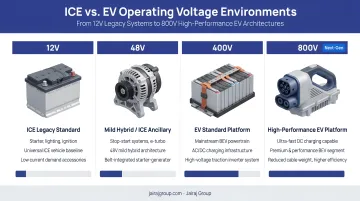
ICE vehicles operate predominantly on 12V systems, with mild hybrids pushing into 48V territory. EV power converter systems run at 400V to 800V, with next-generation architectures moving higher still. This voltage step-up fundamentally changes what's acceptable from an insulating material.
Plastics used in converter enclosures, connector housings, bus bar mounts, and insulating barriers must meet far stricter arc-resistance and dielectric breakdown thresholds. A resin that performs acceptably in a 48V relay housing may fail catastrophically at 400V if it wasn't designed for that duty.
Thermal Loads at the Component Level
Power electronics dissipate significant heat under load. Converter housings sit directly adjacent to components that push continuous junction temperatures to 150°C and above. The plastic surrounding those components must:
- Maintain dimensional stability without warping or creeping
- Resist off-gassing that could contaminate sensitive electronics
- Retain mechanical strength at continuous operating temperatures of 125°C or higher
Short-term peak tolerance isn't enough. Materials must sustain their properties across thousands of thermal cycles over the vehicle's service life.
Compensatory Lightweighting
EV battery packs add 400–600 kg to vehicle mass compared to an equivalent ICE drivetrain. To recover some of that weight penalty, manufacturers are replacing metal enclosures and brackets throughout the powertrain — including converter assemblies — with high-performance engineering plastics. According to the US Department of Energy, lightweight material substitution in vehicles can reduce component weight by 30–50%, with direct benefits to energy efficiency and range.
That means every material decision carries two requirements: deliver real mass savings, and survive high-voltage, high-temperature duty without compromise.
EMI/RFI Integration
Converter switching circuits generate electromagnetic interference that can disrupt CAN bus communications, sensor signals, and infotainment systems. Housing designs increasingly need to incorporate:
- Conductive coatings or metallic inserts for shielding
- EMI gasket grooves for compression seals
- Carefully managed apertures and seams
Geometry, material choice, and shielding treatment all affect the final result, which is why electrical and mechanical engineering teams typically need to work through housing design together.
Critical Material Properties for EV Converter Plastic Parts
Not every engineering plastic qualifies for converter duty. Four properties determine whether a resin can handle a high-voltage power electronics environment.
Flame Retardancy: UL 94 V-0 Is the Floor
UL 94 V-0 is the minimum acceptable flame retardancy classification for converter enclosures and connector housings. In practice, this means the material self-extinguishes within 10 seconds after a flame is removed and produces no flaming drips. In a 400–800V environment, a material that sustains combustion or drips molten plastic is a thermal runaway accelerant — not an option.
Flame-retardant grades of PA66, PBT, and PC/ABS are widely available and routinely specified for these applications.
Dielectric Strength and CTI
Two electrical parameters govern insulation performance:
- Dielectric strength — the voltage per unit thickness a material withstands before electrical breakdown
- Comparative Tracking Index (CTI) — resistance to surface conduction and arc tracking under contaminated conditions
Higher CTI values allow engineers to reduce creepage distances in compact converter layouts, a direct advantage as powertrain packaging targets tighter footprints. IEC 60664 provides the framework for calculating required insulation coordination based on operating voltage and pollution degree.
Heat Deflection Temperature (HDT) and Thermal Stability
HDT is the primary screening criterion for thermal suitability. The distinction that matters in converter applications:
- Short-term peak temperature — what the material survives briefly
- Continuous-use temperature — what it sustains without creep, dimensional drift, or mechanical degradation
Converter housing materials must perform reliably at the upper end of their rated range, not just tolerate brief thermal spikes.
Chemical Resistance and Dimensional Stability
Converter plastics routinely encounter glycol-based coolants, thermal interface fluids, cleaning agents, and road salt. Resistance varies significantly across polymer families — PPS and PBT typically outperform commodity resins in coolant and solvent exposure.
For multi-pin connector housings and insert-bearing parts, glass-fiber reinforcement is standard practice. It improves stiffness, reduces the coefficient of thermal expansion (CTE), and maintains the tight tolerances needed for reliable connector mating across wide temperature swings.
Polymer Types Best Suited for EV Converter Applications
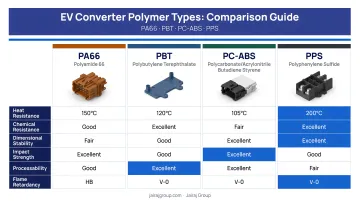
| Polymer | Primary Use Cases | Key Advantage | Watch Out For |
|---|---|---|---|
| PA66-GF | Connector housings, sensor mounts, structural brackets | Thermal performance, moldability | Moisture absorption during processing |
| PBT / PBT-GF | Connector bodies, relay housings, bus bar insulators | Dimensional stability, tracking resistance | Lower impact strength vs. PC |
| PC/ABS (FR grades) | Converter covers, junction box lids, display bezels | Impact strength, design flexibility | Limited solvent/chemical resistance |
| PPS | High-heat zones adjacent to power components | 220°C continuous use, inherent flame retardancy | Higher cost, demanding processing |
PA66-GF: The Workhorse
Glass-filled PA66 is the default choice for connector housings and structural elements in converter assemblies. It molds well into complex geometries, handles engine bay temperatures, and resists the automotive fluids these components encounter routinely. FR grades rated UL 94 V-0 are widely available — BASF's Ultramid A3X2G5 is one common example.
One practical constraint: PA66 absorbs moisture, which affects dimensional stability and processing quality. Parts require controlled drying before molding — skipping this step leads to inconsistent results.
PBT and PBT Blends
PBT offers a strong combination of dimensional stability, tracking resistance, and chemical inertness that makes it particularly well suited for connector bodies, bus bar insulators, and relay housings within converter assemblies. Glass-filled grades improve stiffness with minimal warpage, which matters when tight flatness tolerances are critical for sealing surfaces.
PC/ABS for Covers and Enclosures
Where impact strength and design flexibility take priority over extreme chemical resistance, flame-rated PC/ABS blends serve well. Common applications include converter covers, junction box lids, and indicator windows. Chemical and solvent exposure is a genuine limitation — this isn't the right choice for parts directly wetted by coolant.
PPS for High-Heat Zones
PPS is reserved for sub-components sitting directly adjacent to heat-generating power electronics. Its continuous-use temperature reaches 220°C, moisture absorption is near zero, and flame retardancy is inherent rather than additive. Processing demands are real: higher melt temperatures and wear-resistant tooling are required. That cost and complexity keeps PPS in targeted applications where no other polymer meets the thermal requirement.
Design Requirements: From Geometry to Compliance
Integrated Functional Features
Modern converter housing design goes well beyond a simple enclosure. Injection-molded parts now routinely incorporate:
- EMI gasket grooves for conductive compression seals
- Snap-fit assembly features that eliminate fasteners entirely
- Wire routing clips molded in-place during the shot
- Cooling channel geometry integrated directly into housing walls
- Boss and rib structures that add stiffness without increasing wall thickness
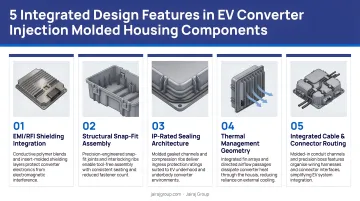
This design philosophy reduces part count, simplifies assembly, and cuts secondary operations, which lowers overall system cost.
Jairaj Group applies DFM principles — including flow analysis and cooling optimization — to converter housing components from the design stage. Insert molding capability enables direct integration of metal contacts, threaded inserts, and compression limiters into plastic housings, which is critical for bus bar and connector assembly applications.
Sealing, Tolerance, and Assembly Interfaces
EV power electronics enclosures commonly target IP67 or IP6K9K ingress protection ratings. Achieving these ratings consistently in production requires:
- Precise O-ring groove dimensions and surface finish
- Consistent compression limiter placement
- Wall thickness and gate placement decisions made with sealing geometry in mind
GD&T requirements for multi-part converter assemblies directly influence mold design. Parting line location, draft angles, and sink mark management all affect whether a housing seals reliably across thousands of thermal cycles.
These dimensional and sealing requirements don't exist in isolation — they feed directly into regulatory compliance obligations across markets.
Compliance Standards
EV converter plastic components must satisfy a combination of standards depending on market:
- UL 94 — flammability classification (V-0 minimum)
- IEC 60664 — insulation coordination for low-voltage equipment
- AIS-038/CMVR — Indian EV safety regulations, relevant for OEMs supplying the domestic market
Documentation traceability — from resin lot certification to finished part inspection records — is increasingly a contractual requirement in OEM quality agreements. Suppliers who cannot produce full material and process records at audit risk disqualification, regardless of part performance.
What to Look for in a Manufacturing Partner for EV Converter Components
Precision Molding and In-House Tooling
Converter housings combine tight dimensional tolerances, complex geometry, and functional integrated features. That combination demands:
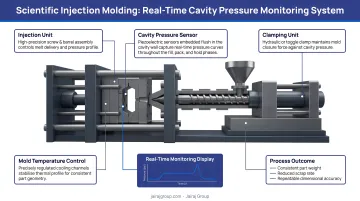
- Scientific injection molding with real-time cavity pressure monitoring and process documentation
- In-house tool room capability for iterative design modifications during validation
- Multi-cavity and insert molding experience for production efficiency and metal-plastic integration
In-house tooling is particularly valuable during development. When design changes are needed — a gate move, wall thickness adjustment, or sealing groove modification — an in-house tool room turns that around in days rather than the weeks an external toolmaker requires.
Jairaj Group's EV Polymer Capabilities
Jairaj Group brings over 40 years of precision polymer engineering to EV converter applications, with ISO 9001:2015-certified manufacturing facilities across six locations in India — spanning the automotive clusters in Aurangabad, Sanand, Rudrapur, and the NCR region (Manesar/Gurugram and Faridabad).
Their capabilities relevant to converter component manufacturing include:
- PLC-controlled injection molding with real-time monitoring and cavity balancing
- In-house tool rooms supporting mold development and iterative validation
- Insert molding for hybrid metal-plastic assemblies
- Processing of PA66-GF, PBT, PC, and other engineering polymer families with flame-retardant and electrical-grade properties
- EV-specific component manufacturing, including EV charger components, sensor housings, and precision electrical enclosures
The group entered EV-focused polymer components in 2023 and has since added tooling and process capability specifically oriented toward automotive OEM and Tier 1 supplier qualification requirements.
Quality Documentation for EV-Grade Parts
Capability alone isn't enough — automotive OEM quality systems require specific documentation deliverables for safety-critical plastic parts:
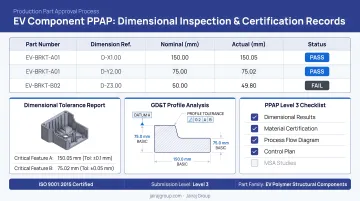
- PPAP (Production Part Approval Process) documentation packages
- Cpk data demonstrating process capability on critical dimensions
- DFMEA/PFMEA support during design validation
- Material certification traceability from resin lot to finished part
- Dimensional inspection reports tied to GD&T callouts
Jairaj Group supports these requirements with electrical insulation testing, flame retardant testing, temperature cycling validation, and dimensional verification — with certification documentation aligned to IEC standards and export program requirements.
Frequently Asked Questions
What are the major components of an electric power vehicle?
The core systems are the battery pack, traction motor, power electronics (traction inverter, DC-DC converter, onboard charger), thermal management system, and regenerative braking system. Plastic components appear across nearly all of these, from battery enclosures and connector housings to sensor mounts and thermal interface supports.
What polymers are used in electric cars?
The main engineering polymer families used are:
- PA66, PBT, PPS — for converter and power electronics housings requiring flame retardancy and high dielectric ratings
- PC/ABS — for structural enclosures needing impact resistance
- PP, POM (acetal) — for lower-demand sub-systems such as interior trim and body panels
Selection depends on the sub-system's thermal, electrical, and mechanical requirements.
What design requirements must plastic components in EV converters meet?
Primary requirements include UL 94 V-0 flame rating, adequate dielectric strength and Comparative Tracking Index (CTI) for the operating voltage, dimensional stability across thermal cycling, IP-rated sealing geometry (typically IP67 or IP6K9K), and integration of functional features such as EMI barriers, gasket grooves, and cooling pathways.
Why are plastics replacing metals in EV power converter housings?
Engineering-grade plastics offer 30–50% weight savings vs. equivalent metal parts, inherent electrical insulation, corrosion immunity, and the ability to mold complex multi-functional geometries in a single part. For converter enclosures where both electrical safety and weight reduction are priorities, no metal alternative delivers all three properties in one solution.
What manufacturing process is best suited for EV converter plastic parts?
Precision injection molding is the primary process — it produces complex, net-shape geometries with tight tolerances. Where metal contacts, compression limiters, or threaded inserts must be embedded directly in the housing, insert molding is used to create integrated metal-plastic assemblies in a single operation.