Plastics have always had a presence in electronics. But in high-voltage, high-performance power electronics, their role is still underestimated by engineers who default to metal out of habit rather than engineering logic.
That's changing. The global power electronics market is projected to grow from USD 51.73 billion in 2025 to USD 67.42 billion by 2030, with automotive and EV platforms driving the largest share of demand. OEMs competing in that market cannot afford to carry the weight, corrosion risk, and design rigidity that metal imposes — not when precision plastic components offer measurable alternatives.
This article covers the practical, engineering-grounded reasons why the switch is happening, and what separates successful transitions from costly ones.
Key Takeaways
- Engineering-grade plastics deliver electrical insulation metals physically cannot — essential in 400V–800V EV systems and industrial drives
- PA66-GF, PPS, and PEEK handle continuous operating temperatures from 140°C to 260°C — confirmed against material datasheets
- Plastic housings, brackets, and insulators reduce assembly weight without compromising structural or thermal performance
- A 10% drop in vehicle mass improves fuel economy by 6–8% — material choice directly affects EV range
- Choosing the wrong grade risks field failures, delayed certifications, and costly redesigns — the stakes are real
What Are Plastic Components for Power Electronics?
Plastic components in power electronics are precision-molded polymer parts that serve functional — not cosmetic — roles in power conversion, distribution, and protection systems. This includes housings, insulators, terminal blocks, transformer bobbins, connector bodies, relay bases, and structural brackets.
These components appear in:
- EV battery management systems and on-board chargers
- Solar inverters and DC-DC converters
- Motor drive controllers and industrial switchgear
- Power supply enclosures and relay assemblies
The stakes are higher than standard injection molding. Every component must meet dimensional precision requirements, flame-retardancy ratings (UL94 V-0 is the baseline for most power electronics housings), and IEC thermal class specifications.
A relay base that passes visual inspection but uses an under-specified PA grade will fail thermally in service — and that failure shows up in the field, not the factory.
Jairaj Group manufactures components across these categories, including terminal blocks, relay mounting assemblies, EV charger handles, and sensor housings. Material grades — PA66-GF, PBT, PC, PEEK, and ABS — are selected for the specific thermal and electrical demands of each application.
Key Advantages of Plastic Components for Power Electronics
Electrical Insulation and Intrinsic Safety
Electrical insulation is not a feature in power electronics — it is a system-level requirement. Components must isolate live circuits, prevent inter-phase arcing, and protect operators in systems operating from 48V DC up to 800V DC in modern EV traction inverter platforms.
Metals conduct electricity. They cannot serve this function without coatings or secondary treatments that add cost, compliance complexity, and failure modes of their own.
Engineering plastics eliminate that problem at the material level. Verified dielectric strength values from manufacturer datasheets:
| Material | Grade | Dielectric Strength | Flame Rating |
|---|---|---|---|
| PA6-GF30 | BASF Ultramid B3U30G6 | 35/30 kV/mm (IEC 60243-1) | UL94 V-2 |
| PPS | Ryton R-4 | 20 kV/mm (ASTM D149) | UL94 V-0 / 5VA |
| PEEK | Victrex 450G | 23.0 kV/mm at 2mm (IEC 60243-1) | RTI Elec 260°C |
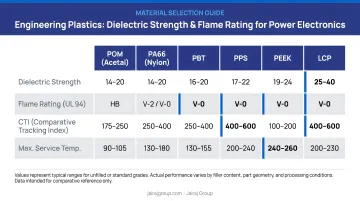
For power electronics housings and insulators, UL94 V-0 is the standard certification requirement — specimens must self-extinguish within 10 seconds of each flame application, with no dripping of flaming particles.
Key compliance point: Purpose-formulated engineering plastics with built-in flame-retardant systems reduce certification burden compared to treating or coating metals for the same outcome. RoHS compliance — restricting hazardous substances in electrical and electronic equipment — is also more straightforward to document for pre-certified polymer formulations than for metal assemblies with surface treatments.
This is most relevant for high-voltage EV powertrains (400V–800V), industrial motor drives, solar inverters, and aerospace power electronics — anywhere voltage spikes, phase-to-ground faults, and arc flash exposure are design-critical risks.
Key metrics to track:
- Dielectric strength (kV/mm)
- Insulation resistance (MΩ)
- UL94 certification status
- Field failure rate and safety incident rate
Weight Reduction and Design Consolidation
Weight is a direct engineering variable in EV programs. According to NREL's 2024 lightweighting analysis, a 10% reduction in vehicle mass produces a 6–8% improvement in fuel economy — and that relationship holds for battery-electric vehicles in terms of range and battery sizing efficiency.
Power electronics housings, structural insulators, and bracket assemblies are consistent contributors to system weight. Replacing them with precision-molded plastic components removes mass at multiple points across the assembly without sacrificing structural or thermal performance.
The weight advantage compounds when design consolidation is applied. Injection molding enables complex geometries that fabricated metal simply cannot achieve in a single part:
- Integrated cable routing channels
- Snap-fit assembly features eliminating fasteners
- Multi-wall geometries combining structural and insulating functions
- Part consolidation replacing three or four metal stampings with one molded assembly
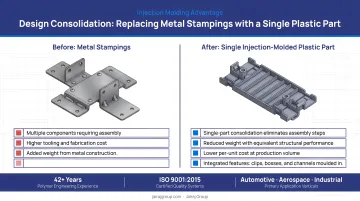
Each consolidation reduces component count, assembly cycle time, and direct labor cost per unit. At production scale — thousands of units per month across an automotive program — those savings are substantial.
Where this applies directly: EV battery management systems, on-board charger enclosures, and powertrain housings where every gram counts. For high-volume automotive power modules, assembly efficiency affects per-unit profitability at scale.
| KPI | What It Measures |
|---|---|
| System assembly weight (kg) | Mass removed per design iteration |
| Parts-per-assembly count | Consolidation effectiveness |
| Assembly cycle time | Labor and throughput impact |
| Material cost per unit | Direct BOM savings |
| EV driving range (km) | End-customer performance outcome |
Corrosion Resistance, Thermal Stability, and Total Cost of Ownership
Metals in power electronics environments face a sustained degradation process. Moisture, thermal cycling, vibration, coolants, and lubricants cause corrosion, oxidation, and fatigue over time. These failures are typically latent — invisible during incoming inspection, only appearing as field failures months or years after deployment.
Engineering plastics are immune to these mechanisms without surface treatments. Verified continuous-use temperature ratings:
- PA6-GF30 (BASF Ultramid B3U30G6): RTI Elec 140°C
- PPS (Ryton R-4): 200°C to 220°C continuous use
- PEEK (Victrex 450G): RTI Elec 260°C, melting point 343°C
BASF's documentation for Ultramid B3U30G6 specifically notes that halide-free stabilisation minimises corrosion impact and protects sensitive electronic components — a direct manufacturing-level consideration for power electronics applications.
For lifecycle cost, the difference between plastic and metal is not just purchase price. Metal assemblies in sealed enclosures require periodic corrosion inspection, recoating, and fastener replacement over their service life. Plastic assemblies in the same environments do not — and that maintenance elimination compounds across large installed bases.
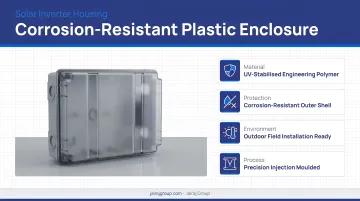
Outdoor solar inverters, EV charging stations, underhood automotive applications, and marine or railway power systems all sit squarely in this category — as does any product with IP54 or higher enclosure requirements.
Lifecycle metrics that reflect these gains:
- Mean time between failures (MTBF)
- Warranty claim rate
- Annual maintenance cost per unit
- Component replacement frequency
- IP-rating retention over product lifecycle
What Happens When OEMs Get Material Selection Wrong
Power electronics programs that treat plastic component selection as a procurement afterthought tend to encounter the same failures — repeatedly, and at the worst possible stage:
Under-specified grades causing thermal failure. Standard-grade plastics in power electronics lead to thermal creep, dielectric breakdown at elevated temperatures, and dimensional distortion. Incoming inspection rarely catches these — they surface in the field, where reversal costs the most.
Compliance gaps that stall certification. Plastic formulations that do not meet UL94 V-0, relevant IEC thermal class ratings, or RoHS substance limits can halt product certification entirely. A single non-compliant component can delay market launch by months and trigger redesign cycles that consume tooling investment and engineering capacity.
Supplier reliability failure. Inconsistent material batches, unverified dimensional tolerances, and absent testing documentation are the root cause of most power electronics quality escapes at the component level. What starts as a cost-saving choice at the component level frequently turns into the most expensive line item once field failures begin.
Getting Maximum Value from Plastic Components in Power Electronics
The transition from metal to plastic stacks cost and performance benefits only when OEMs engage material decisions at the design stage — before tooling is committed, not after. Specifying the correct engineering plastic grade for the assembly's thermal class, voltage level, and mechanical environment at the outset prevents the costly retroactive changes that define failed transitions.
Those material decisions only hold up in production when the supplier can execute on them. Development speed and first-time-right outcomes depend on in-house tool room facilities, polymer engineering expertise, and comprehensive testing — capabilities that reduce iterative qualification cycles significantly.
Jairaj Group brings 40+ years of precision plastic component manufacturing experience to these programs, with in-house tooling and ISO 9001:2015-certified processes. Their Research, Development & Value Engineering Centers support the upstream decisions that determine whether a power electronics program reaches production on schedule:
- Material selection aligned to thermal class and voltage requirements
- Design for Manufacturability (DFM) analysis
- Mold flow simulation before tool commitment
- Rapid prototyping for early-stage validation
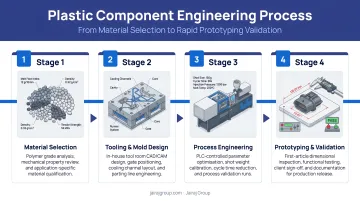
That track record earned Jairaj the "Best Supplier Award for Fastest & First Time Right Developments" from Endurance Technologies.
Long-term value compounds when OEMs standardize on validated material-supplier combinations across product families. This approach reduces qualification overhead, supports traceability requirements, and builds supply chain resilience that scales with volume growth.
Conclusion
Engineering-grade plastics earn their place in power electronics on measurable terms: electrical insulation, weight reduction, corrosion resistance, and lifecycle durability — delivered at the material level, without the surface treatments, maintenance cycles, or conductivity risks that metal assemblies carry.
Those advantages compound across the product lifecycle:
- Fewer warranty claims from corrosion or insulation failure
- Lighter, simpler assemblies that reduce integration time
- Faster production cycles with consistent dimensional accuracy
- Lower maintenance burden over the component's service life
Capturing these gains depends on material selection and manufacturing precision — both applied together, not separately. Jairaj Group has supplied first-time-right plastic components to OEMs across automotive, electrical, and industrial sectors since 1985, with the toolroom capabilities and process controls to back volume commitments consistently.
Frequently Asked Questions
What type of plastic is used in electronics?
The most widely used engineering plastics in electronics include PA (polyamide/nylon), PBT, PPS, PC, ABS, PEEK, and PTFE. The right choice depends on the operating temperature, voltage rating, flame-retardancy requirement, and mechanical loads of the specific application — no single grade suits all power electronics environments.
What are the main components of power electronics?
Power electronics systems are built around inverters, motor controllers, on-board chargers, DC-DC converters, switchgear, and power supply units. Within each, plastic sub-components — housings, insulators, transformer bobbins, terminal blocks, and connector bodies — provide the electrical isolation and structural support the system depends on.
Why are OEMs switching from metal to plastic in power electronics?
Three factors drive the shift. First, plastics provide intrinsic electrical insulation that metals cannot match without secondary treatments. Second, they cut system weight — directly supporting EV range and efficiency targets. Third, corrosion immunity and design consolidation reduce part count, assembly time, and total cost of ownership.
Can plastic components handle high temperatures inside power electronics?
Engineering-grade plastics — particularly glass-fibre-reinforced PA, PPS, and PEEK — are rated for continuous use temperatures of 140°C to 260°C. They are suitable for demanding power electronics thermal environments when the correct material grade is specified at the design stage. Standard-grade plastics are not appropriate for these applications.
What flame-retardancy standards apply to plastic components in power electronics?
UL94 V-0 is the primary standard for housings and insulators; IEC 60085 covers thermal class ratings for insulation systems; and RoHS restricts hazardous substances in electrical equipment. Confirm compliance with all three during material selection — not after design lock.
How should OEMs evaluate a plastic component supplier for power electronics applications?
Evaluate suppliers on five criteria:
- Proven expertise across relevant engineering plastic grades
- In-house tooling and mould-making capability
- Documented first-time-right development track record
- Full testing and material documentation, including PPAP and IEC/UL compliance
- ISO 9001 certification as the baseline quality assurance requirement