The scale of what's coming makes this urgent. MarketsandMarkets projects the global hybrid OEM product portfolio will reach 26.3 million units by 2030, up from 14.8 million in 2024 — nearly doubling in six years. That growth trajectory is forcing OEMs to rethink polymer strategies from scratch, not incrementally.
This article covers the specific design challenges hybrids create for plastics, the next-generation materials gaining traction, where they matter most in vehicle architecture, and what sustainability regulations are reshaping material sourcing decisions.
Key Takeaways
- Hybrid vehicles combine combustion and electric systems, creating dual-environment demands that standard automotive plastics weren't designed to meet
- High-performance thermoplastics (PA6, PA66, PPS, PEEK) and fiber-reinforced composites are replacing commodity polymers in structural, thermal, and electrical applications
- Battery enclosures, thermal management systems, and lightweight structural components represent the highest-growth areas for advanced plastics in hybrids
- The EU's ELV regulation mandates at least 25% recycled plastic content after 2036, meaning OEMs need to design for compliance today
- Supplier polymer engineering depth, not just molding capacity, will determine which OEMs gain the fastest advantage
Why Hybrid Vehicles Present a Unique Design Challenge for Plastics
A pure BEV optimises primarily for battery protection and weight reduction. A traditional ICE vehicle needs under-hood thermal resistance and fluid compatibility. A hybrid must do both simultaneously, and that dual requirement pushes plastic material selection into genuinely new territory.
Plastic components in a hybrid must tolerate:
- Combustion engine heat cycles (continuous exposure above 150°C in under-hood zones)
- High-voltage electrical insulation requirements (up to 800V in some PHEV systems)
- Aggressive cooling fluids and lubricants
- Structural loads from a heavier overall vehicle
The battery pack placement compounds this. In PHEVs and full hybrids, packs are typically floor-mounted, which means surrounding structural and thermal components face load-bearing and thermal exposure requirements that didn't exist in earlier ICE platforms.
Mild, Full, and Plug-In Hybrids: How Material Demands Differ
Material requirements aren't uniform across hybrid segments:
- Mild hybrids (mHEVs): Plastics primarily serve lightweighting and under-hood thermal resistance. The 48V electrical systems are relatively low-risk, so dielectric demands are moderate
- Full hybrids (HEVs): Add requirements for high-voltage cable insulation and battery housing; engineering thermoplastics become essential at this tier
- PHEVs: Carry the most demanding specifications. Larger battery packs, higher voltages, and significantly heavier curb weights make aggressive lightweighting of every non-powertrain component a functional necessity
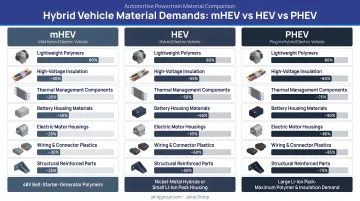
The weight penalty is measurable. Comparing equivalent 2026 Toyota Prius trims, PHEV variants weigh 110–115 kg more than their HEV counterparts — driven by the 13.6 kWh lithium-ion pack.
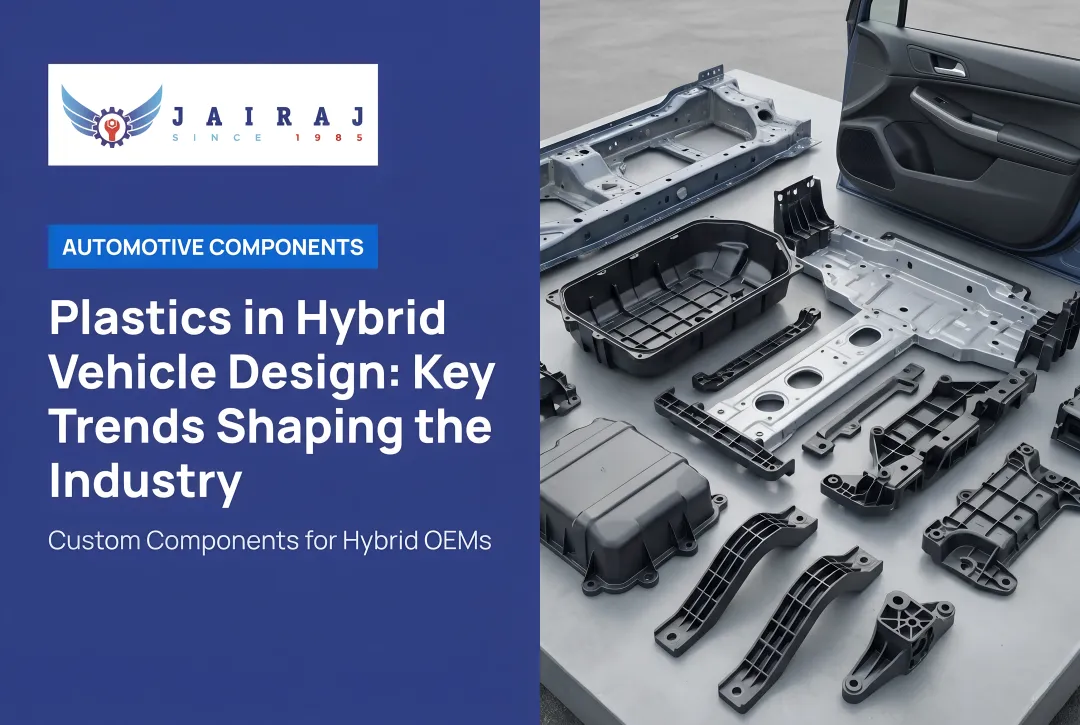
That added mass creates a compounding problem: more weight demands more structural reinforcement, which adds further weight and directly cuts into the electric range the battery pack was sized to deliver. Replacing metal brackets, housings, and structural inserts with high-performance engineering plastics is how OEMs interrupt that cycle without sacrificing load capacity or crash performance.
Key Advanced Polymers Driving the Next Generation of Hybrid Vehicles
The shift away from commodity PP and ABS is already underway. The materials taking their place in hybrid-critical applications each bring specific property advantages.
Engineering Thermoplastics: PA, PPS, and PEEK
These three families dominate powertrain-adjacent and electrical applications:
| Polymer | Key Properties | Primary Hybrid Applications |
|---|---|---|
| PA6 / PA66-GF | HDT up to 250°C, CTI 600V, UL 94 V-0 (select grades) | Sensor housings, cooling circuit components, connector housings |
| PPS | RTI >175°C, CTI 600V, excellent chemical resistance | High-voltage power electronics housings, thin-wall insulators, stator bobbins |
| PEEK | Continuous use at 260°C, dielectric strength 23 kV/mm, volume resistivity 10¹⁶ ohm-cm | E-motor insulation, high-temp powertrain-adjacent components |
PA66-GF (glass-fiber reinforced nylon) represents the highest-volume engineering thermoplastic in hybrid applications — balancing thermal performance, dielectric properties, and processability at automotive scale.
Fiber-Reinforced Composites and Thermally Conductive Polymers
Three material categories are reshaping hybrid component design at different cost and performance tiers:
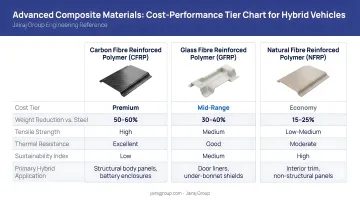
- Carbon fiber composites (CFRP): Can reduce component weight by more than 60% compared to steel, per the U.S. Department of Energy. Cost and repairability constraints limit CFRP to high-value structural elements where mass reduction justifies the premium.
- Glass-fiber composites (GFRP): Fill the cost-effective middle ground, appearing in battery enclosures, body panels, and underbody shields where moderate weight reduction and good dimensional stability are the priority.
- Thermally conductive polymers: An emerging class engineered to actively manage heat around battery packs and power electronics. New compounds achieving 1–10 W/mK reduce dependence on heavier metallic heat sinks — a meaningful advantage as thermal management becomes a key differentiator in hybrid powertrain design.
Multi-Material Systems and Advanced Moulding
Aluminium-plastic laminates and overmoulded metal inserts allow OEMs to optimise strength, weight, and thermal performance at the component level rather than selecting a single material for an entire part. A structural bracket, for instance, can carry a metal core for stiffness while the overmoulded polymer provides insulation, vibration damping, and reduced mass.
Achieving this at scale requires precision multi-shot moulding and in-mould assembly techniques — capabilities that are increasingly decisive in supplier selection as component complexity rises.
Where Plastics Are Making the Biggest Difference in Hybrid Architecture
Battery Housing and High-Voltage Component Protection
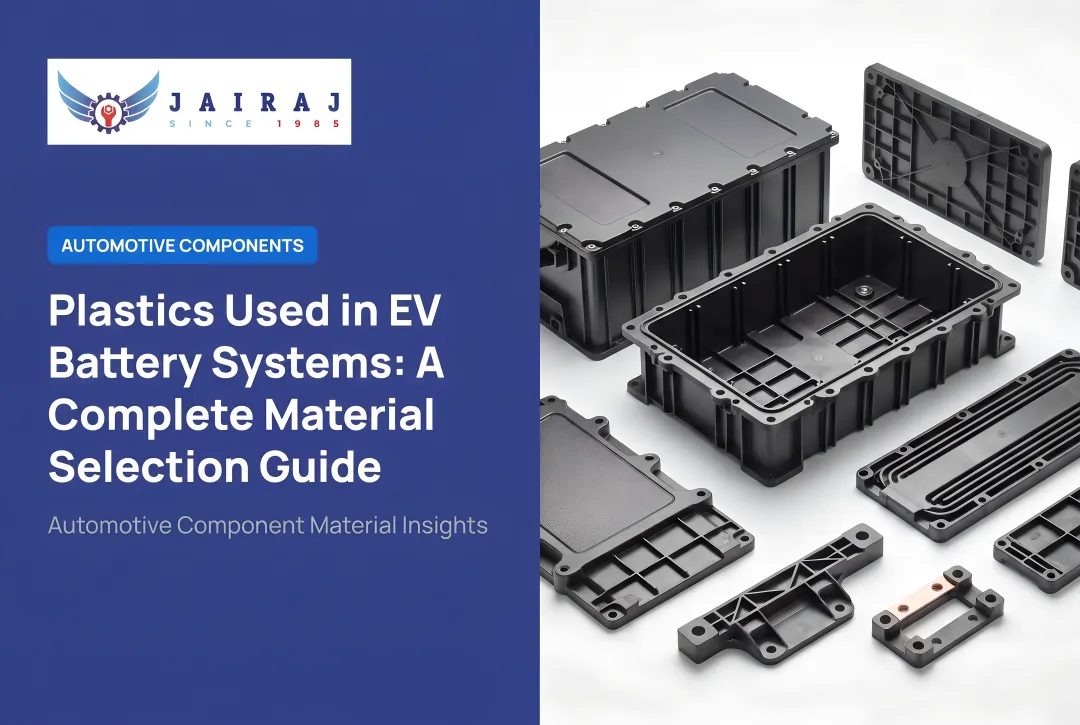
Battery enclosures in PHEVs and full hybrids represent one of the most demanding plastic applications in any vehicle. The material specification must simultaneously deliver:
- Structural rigidity under mechanical load
- Flame retardancy (UL 94 V-0 at relevant wall thicknesses is a common OEM target)
- Dielectric insulation meeting IEC 60664-1 requirements for systems up to 1,000V AC / 1,500V DC
- Precise dimensional tolerances to maintain sealing and fit across thermal cycles
GFRP composites and flame-retardant polyamide grades are the materials of choice here. Solvay's Ryton PPS Supreme HV, for example, targets high-voltage power electronics housings with CTI 600V and UL 94 V-0 — enabling thin-wall insulators down to 0.3mm.
Components surrounding high-voltage cables and connectors face their own specification layer: electromagnetic shielding compatibility and insulation integrity under vibration. Specialty polymer formulations that weren't part of the standard ICE supply chain are now required at volume.
Lightweighting Structural and Interior Components
The fuel economy case for lightweighting is clear: a 10% reduction in vehicle weight yields a 6–8% improvement in fuel economy, per U.S. DOE data. In a PHEV carrying an extra 250 lb of battery pack, recovering that mass through polymer substitution in non-powertrain components directly protects electric range.
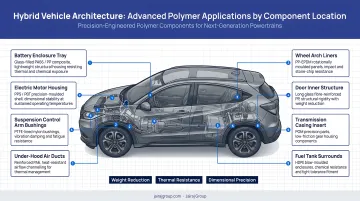
Current hybrid platforms are specifying advanced polymers across multiple component categories:
- Instrument panels: PC/ABS and PP blends for impact resistance with reduced mass vs. metal substrates
- Door modules: PA66-GF for structural door carrier components requiring stiffness and temperature resistance
- Interior trim (dashboard panels, pillar trims, glove box housings): ABS, PP, and PC/ABS with UV stability
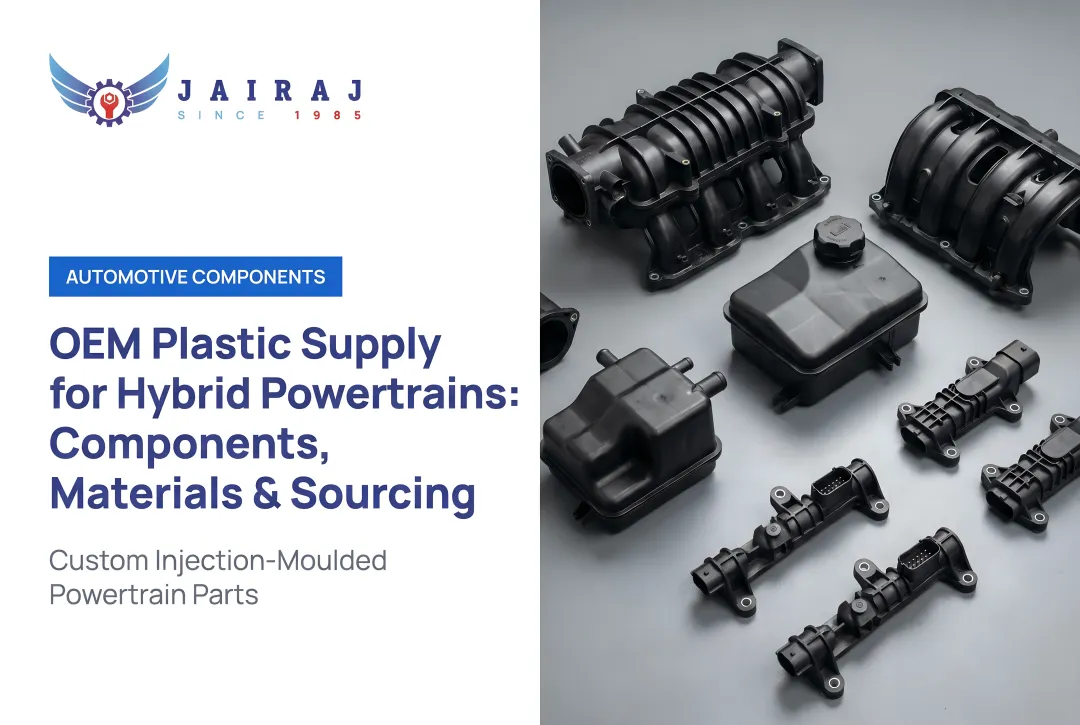
- Sensor housings: PA66-GF for engine-bay thermal resistance and chemical compatibility with automotive fluids
- Underbody shields: GFRP for aerodynamic coverage with thermal and impact protection
Thermal Management Systems
Hybrids generate heat from two distinct sources: the combustion engine and the battery/power electronics stack. Each operates at different temperature ranges and duty cycles, so thermal components must manage both without allowing thermal crosstalk between systems — a challenge that doesn't exist in pure ICE or pure EV platforms.
Plastics with engineered thermal performance are appearing in:
- Fluid-handling and cooling channel housings — PA66 grades with hydrolysis resistance for long-service durability
- Under-hood heat shields using thermally stable polyamides rated for sustained elevated temperatures
- Thermal interface gap fillers between battery modules and cooling plates, with conductivity values reaching up to 3 W/mK
The Sustainability Mandate: Recycled Content and Circular Design
Sustainability requirements are no longer aspirational — they have a regulatory timeline.
The European Commission's 2025 agreement on circular automotive rules mandates that at least 25% of plastics used in new vehicles must come from recycled material after 2036, with 20% of that recycled share sourced specifically from end-of-life vehicles. Safety-critical components are exempt, but a substantial share of hybrid plastic content falls outside that exemption.
For OEMs with European market exposure — including Indian manufacturers with export programmes — recycled-content compliance must be designed in at platform launch. Retrofitting for compliance after production begins carries significant re-engineering cost and timeline risk.
Practical Challenges of Recycled Feedstocks
Integrating recycled plastics into hybrid-grade applications isn't straightforward:
- Recycled feedstocks show greater variability in mechanical properties and thermal performance than virgin polymers
- Post-consumer PP and PC/ABS compounds require rigorous lot-level testing before use in structural or thermal applications
- Qualification must cover dimensional verification, temperature cycling, and chemical resistance assessment — each validated across multiple material batches to account for lot-to-lot variability
Adoption is growing in non-safety-critical applications — interior trim, underbody covers, packaging clips — but high-voltage and structural components remain predominantly virgin polymer, where performance consistency requirements leave little tolerance for feedstock variability.
Recycled content targets are only one side of the compliance picture. Design for disassembly addresses the other: OEMs and Tier-1 suppliers are increasingly specifying single-polymer construction where possible, alongside recyclable fastener systems that enable material recovery from scrapped vehicles. Multi-material assemblies that can't be separated at end of life will face growing scrutiny under this regulation.
What OEMs Should Look for in a Polymer Component Supplier for Hybrid Platforms
Hybrid vehicle plastic components demand more than moulding capacity. The right supplier needs:
- Polymer engineering depth: Recommends the correct material grade for dual thermal-electrical environments — not just processes whatever spec is handed over
- Material validation capability: In-house testing for dimensional performance, temperature cycling, flame retardancy, and dielectric properties against automotive standards
- In-house tooling: Rapid tooling iteration is essential — hybrid platforms evolve quickly, and waiting on external toolmakers extends development cycles unacceptably
- DFM integration: Early design-for-manufacturability analysis prevents costly tooling revisions and maintains quality from first sample through series production
- Multi-facility capacity: Consistent quality across production sites — not just prototype capability at a single location
Suppliers that check these boxes are rare — but they exist. Jairaj Group brings 40+ years of precision polymer engineering across PA66-GF, PEEK, PPS, PC, and flame-retardant grades, with an in-house tool room, six manufacturing facilities across India's automotive corridors, and validated testing infrastructure covering dimensional, thermal cycling, flame retardancy, and electrical insulation.
Their ISO 9001:2015-certified quality system and active expansion into EV and hybrid polymer components make them a practical fit for OEMs moving from prototype into high-volume production on hybrid platforms.
Frequently Asked Questions
What is the future of plastics in automotive design?
Engineering polymers and composites are steadily displacing metals and commodity plastics across structural, thermal, and electrical applications. Electrification mandates, lightweighting targets, and incoming recycled-content regulations are all pushing this forward — hybrid and EV platforms are leading the most aggressive material transitions.
What types of plastics are used in hybrid vehicles?
The primary material families are engineering thermoplastics (PA6, PA66, PPS, PEEK) and glass or carbon fibre reinforced composites. Flame-retardant polyamide grades are used for battery housings, while thermally conductive polymer compounds manage heat around battery packs and power electronics.
How do hybrid vehicles differ from EVs in their plastic requirements?
Hybrids must serve two environments simultaneously — combustion engine heat and high-voltage electrical systems — whereas pure EVs primarily optimise for battery protection and overall weight reduction. This dual-environment requirement makes material selection in hybrids technically more complex and typically demands higher-grade polymer formulations.
What role does lightweighting play in hybrid vehicle efficiency?
Every kilogram saved through polymer substitution of metal directly extends electric range and reduces fuel consumption in ICE mode. With PHEVs carrying 100+ kg of additional battery mass, plastics are the primary tool OEMs have to recover that weight penalty in surrounding structural and interior components.
Are recycled plastics being used in hybrid vehicle manufacturing?
Use is expanding, though most applications are currently limited to non-safety-critical components where recycled feedstock variability poses lower risk. The EU's ELV regulation — mandating 25% recycled plastic content after 2036 — is driving investment in qualified recycled-content polymer solutions across the industry.
What challenges do OEMs face when sourcing plastic components for hybrid platforms?
OEMs most often struggle to find suppliers with both deep polymer engineering expertise and hybrid-grade manufacturing capability. Beyond sourcing, qualifying novel material formulations against stringent automotive safety standards while managing compressed development timelines adds significant complexity to each platform launch.