The stakes are real. An undersized housing or a misspecified polymer grade doesn't just fail the component — it can compromise electrical insulation, trigger thermal runaway risk, or introduce NVH into an actuator geartrain. OEM procurement teams specifying plastic parts for hybrid systems need suppliers who understand these trade-offs at the material and process level, not just at the price-per-part level.
This article covers three things: which components rely on plastics in hybrid powertrains, which engineering materials are specified for those applications, and what supplier qualification criteria actually matter when sourcing these parts.
Key Takeaways
- Hybrid powertrains use plastic components across five systems — HV battery enclosures, thermal management, actuator geartrains, fluid management, and structural brackets
- PA66, PA46, PBT, PPS, and PPA are the primary engineering plastics specified — grade-level specification is required, not just polymer family
- Supplier qualification requires ISO 9001:2015 at minimum, IATF 16949 for automotive production, with documented PPAP and FMEA
- Injection molding dominates hybrid plastic part production; blow molding handles hollow fluid components; in-house tooling is a meaningful differentiator
- India's auto component exports reached USD 22.90B in FY25, growing 8% year-on-year — making it a strategically relevant supply base for global OEM programs
Why Hybrid Powertrains Create Unique Plastic Component Demand
Hybrid powertrains don't inherit the thermal environment of a combustion engine or an EV — they inherit both simultaneously, and plastic components must be specified for that combined reality.
Under-hood temperatures near the combustion engine can exceed 200°C in short-cycle conditions. At the same time, the battery cooling circuit operates in a tightly controlled thermal band. Plastic components in these systems must contend with:
- High sustained heat from combustion-side proximity
- Electrical isolation requirements near high-voltage (HV) battery circuits
- Fluid compatibility in coolant storage and routing components
- Mechanical stability across wide temperature cycling ranges
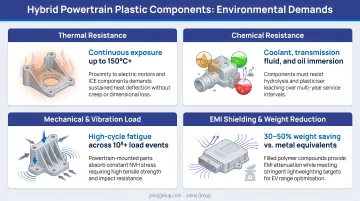
Parts that fail either environment create cascading risk — there's no redundancy for a misspecified bracket or a degraded coolant reservoir.
The market scale reflects this complexity. The electric vehicle plastics market is projected to grow from USD 3.7B in 2022 to USD 12.6B by 2027 at a 27.9% CAGR, with hybrid vehicles cited as a key demand driver and powertrain components identified as a leading application category.
On the content-per-vehicle side, an average mid-size EV already contains 450 lb of plastics and polymer composites — 140 lb more than a comparable ICE vehicle. Hybrids carry comparable complexity, with the added requirement of isolating HV systems from ICE thermal and fluid environments.
For OEM plastic suppliers, this translates directly into stricter material qualification, tighter dimensional tolerances, and documentation requirements that span both powertrain domains — not just one.
Key Plastic Components in Hybrid Powertrain Systems
Battery Pack and High-Voltage System Enclosures
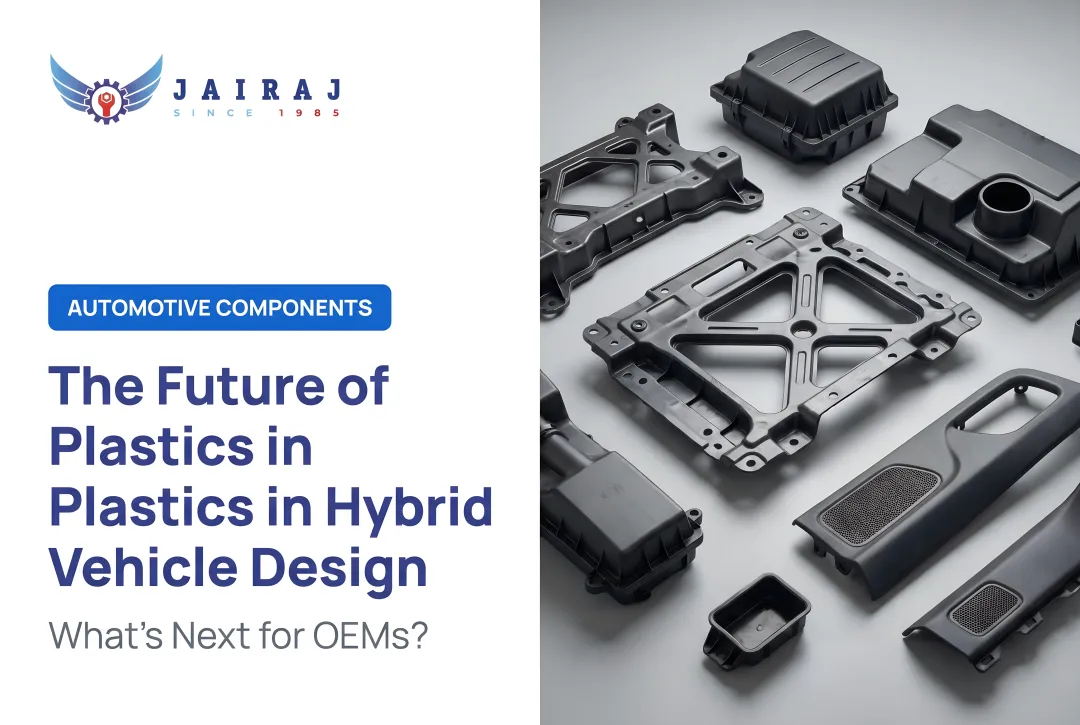
The HV battery housing is the most demanding plastic application in any electrified vehicle. It must provide:
- Dimensional stability under thermal cycling and mechanical load
- Dielectric insulation — glass-fiber-reinforced PA6 grades have demonstrated insulation capacity up to 800V in series-production housings
- Crush and impact resistance to protect cells in collision scenarios
- Flame retardancy — halogen-free grades are increasingly specified
LANXESS and INFAC's joint development of a GF-reinforced PA6 battery module housing, adopted for series production by a Korean OEM, is a reference case for the structural and electrical performance thermoplastic composites can deliver in production-grade housings. Plastic battery enclosures weigh 35% less on average than metal versions, according to the American Chemistry Council — a figure that directly affects range and efficiency on every hybrid platform.
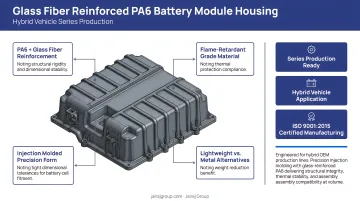
Jairaj Group's insulated battery covers use PA66-GF, PEEK, PC, and TPU with vibration-resistant geometries and built-in reinforcements — engineered to meet the electrical protection requirements of high-voltage hybrid systems.
Thermal Management Components
Hybrid vehicles typically run two separate cooling loops — one for the ICE, one for the battery pack. Both require plastic components that can handle pressurized coolant, thermal expansion, and chemical exposure from coolant additives.
Key components include:
- Coolant reservoir tanks (hollow blow-molded, single-piece construction)
- Pump housings and manifolds
- Insulated fluid storage for battery cooling circuits
Coolant reservoirs from Jairaj Group are designed for pressure fluctuation resistance and leak prevention, tested across the full thermal range of automotive operating conditions.
Actuator Geartrain Components
Electric power steering, electric parking brakes, and electric brake boosters all rely on precision polymer gears. These are not commodity parts — the requirements are tight:
- Fatigue resistance across millions of load cycles
- Low NVH — gear noise transfers directly to the cabin
- Tight dimensional tolerances that maintain mesh geometry across operating temperature ranges
PA46 is the benchmark material here. Envalior's Stanyl PA46 is documented in EPS gears, EPB actuators, and brake booster geartrains, delivering 17% lower weight than metal alternatives with comparable torque capacity. Glass-reinforced Stanyl grades provide up to 50% more wear resistance than other high-temperature polyamides.
For actuator geartrain applications, Jairaj Group machines precision gears in Nylon and PA66-GF with self-lubricating properties and custom tooth profile capability — built to the tolerances that EPS and EPB systems demand.
Air and Fluid Management Parts
Where ICE management meets hybrid control electronics, plastic must handle both elevated temperatures and chemical exposure from fuels, EGR gases, and intake air. This covers:
- Throttle body and EGR valve housings
- Turbo actuator covers
- Intake manifold components
Jairaj Group produces air intake manifolds via blow molding and fluid management components in PP and PA66-GF — materials selected for chemical compatibility with automotive fluids and sustained performance under thermal load.
Structural and Mounting Brackets
Lightweight plastic brackets, cable management clips, and sensor housings are where volume matters. These parts replace metal on the drivetrain frame and contribute directly to the mass reduction that improves hybrid fuel economy and electric range.
Supporting that mass reduction, Jairaj Group supplies:
- Wire harness clips in PP, PA6, PA66, ABS, and POM — corrosion-proof, lightweight replacements for metal fasteners
- Sensor housings in PA66-GF and PC — rated for engine bay temperatures and chemical exposure
- Cable management components designed for high-density drivetrain packaging
Engineering Plastics Specified for Hybrid Powertrain Applications
Polyamide Variants: PA6, PA66, PA46
Polyamides dominate hybrid powertrain specifications because they combine mechanical strength, thermal resistance, and (in glass-reinforced grades) structural performance approaching aluminum at a fraction of the weight.
Key distinctions by grade:
| Grade | Typical Application | Key Advantage |
|---|---|---|
| PA6 | Battery module housings, fluid components | Cost-effective, good impact resistance |
| PA66 | Structural brackets, sensor housings, gears | Higher heat resistance than PA6, widely processed |
| PA46 | Actuator gears, EPS components, EPB | Superior fatigue resistance, up to 50% more wear resistance vs. other high-temp polyamides |
PA66's long-term temperature index sits at 118°C at 5,000 hours under IEC 60216 conditions — adequate for many applications, but not for the highest-heat zones near the combustion system.
PPA and PPS for High-Temperature Zones
When continuous operating temperatures exceed polyamide limits, OEM specifications shift to:
- Polyphthalamide (PPA): Continuous service up to 185°C, with low water absorption and chemical resistance — used in EGR valve housings and thermal management valve bodies
- Polyphenylene Sulfide (PPS): Service temperatures up to 240°C (Fortron, Celanese), with short-term resistance to 260°C — the go-to material for the highest-heat proximity applications
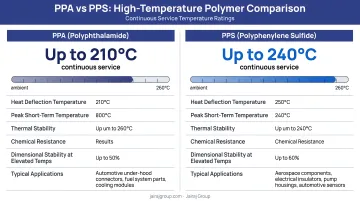
Both outperform standard polyamides in dimensional stability under sustained thermal load, which matters in valve bodies where seal geometry must hold across the full duty cycle.
PBT for Electrical Connectors and Sensor Bodies
Polybutylene terephthalate (PBT) is the standard specification for electrical connector housings, sensor covers, and mechatronic control unit housings. Its low moisture absorption — approximately 0.2% at equilibrium for GF30 grades — means dimensional stability in humid under-hood environments where PA66 (which absorbs 8–9% at water saturation) would shift.
BASF's Ultradur PBT is documented across ABS/ESP systems, electric steering systems, and plug-in connectors — a list that maps directly onto hybrid powertrain electronics.
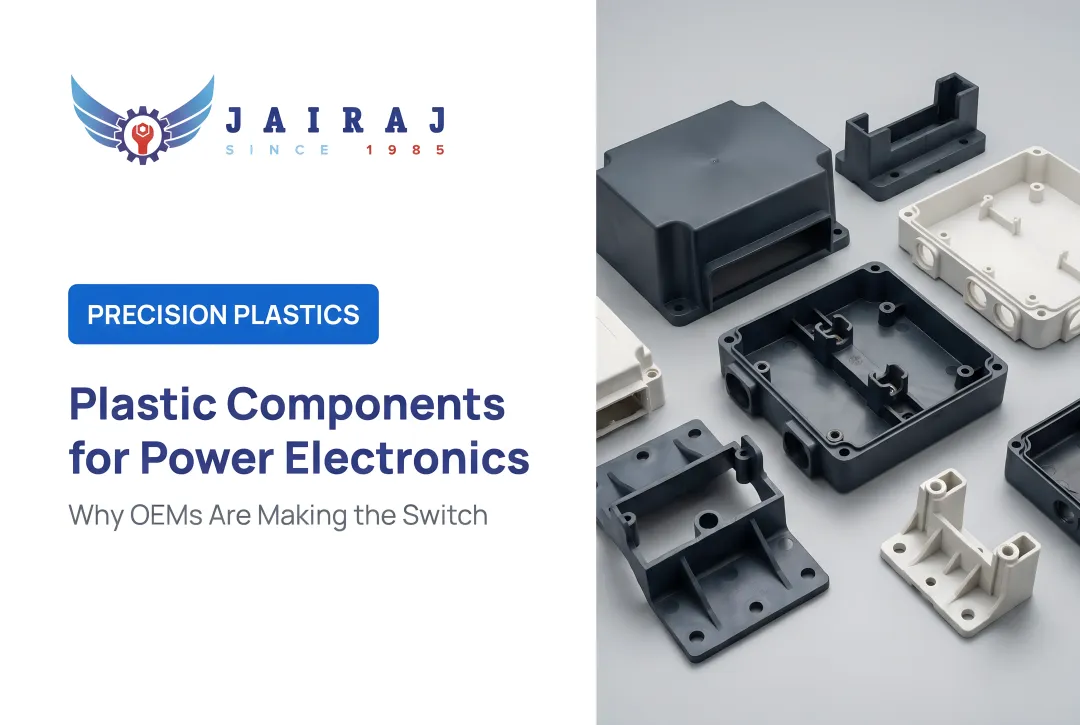
Jairaj Group supplies PBT components for relay socket housings and terminal blocks with documented flame retardancy, electrical insulation, and dimensional stability under IEC and UL-compliant testing.
Reinforced Grades: The Structural Case
For structural applications, OEMs increasingly specify 30–50% glass-fiber reinforced PA66. The weight case is documented: plastic battery enclosures deliver around 10% weight savings versus aluminum designs, and the ACC puts the average at 35% lighter than metal versions. That weight differential compounds across a full BEV or PHEV platform, where dozens of reinforced polymer components replace cast metal equivalents.
Material Selection: Grade-Level Matters
The dual thermal environment of a hybrid powertrain — combustion heat on one side, battery thermal management on the other — means selecting a polymer family is not enough. Suppliers must advise at the grade level and back that guidance with testing data across the full operating temperature range.
Key advisory inputs at the design phase include:
- Thermal resistance mapping against specific zone temperatures
- Chemical compatibility with coolants, lubricants, and battery electrolytes
- Mechanical performance under cyclic fatigue loads
- Dimensional stability data under sustained humidity and heat
Jairaj Group's R&D team engages at the design phase — before tooling is committed — providing material selection support that covers all four of these inputs. Early engagement is where procurement teams avoid the most expensive rework cycles.
Manufacturing Processes That Deliver Hybrid-Grade Plastic Parts
Precision Injection Molding
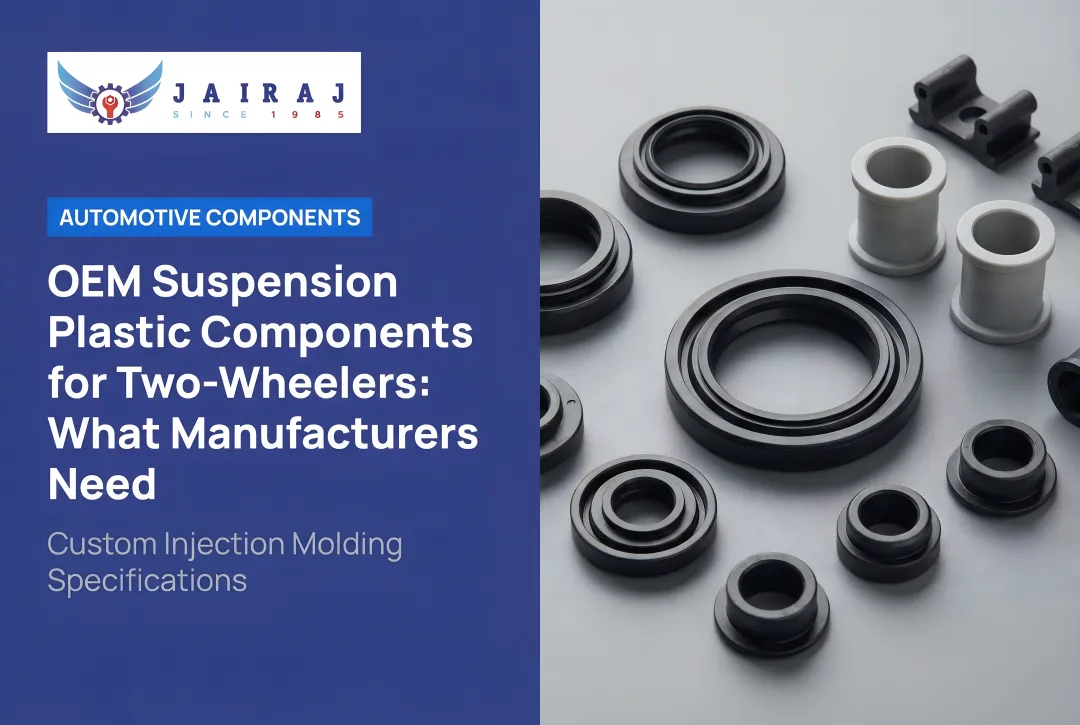
Injection molding is the primary manufacturing process for hybrid powertrain plastic parts. Actuator gears, sensor housings, connector bodies, and structural brackets all require the dimensional repeatability that only validated injection tooling delivers.
Jairaj Group operates PLC-controlled injection molding machines with in-house tool room capability — covering DFM review, flow analysis, cooling optimization, and warpage prediction before production tooling is committed. For OEM customers, this means fewer prototype iterations and tighter process control from first-article through production volumes.
Blow Molding for Hollow Fluid Components
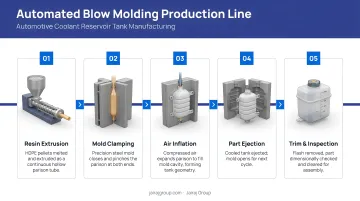
Coolant reservoirs, fluid ducts, and washer bottles require hollow geometries that injection molding cannot produce. Blow molding achieves this in one cycle, eliminating weld lines that introduce leak paths in pressurized fluid systems.
Jairaj's automated blow molding lines produce coolant reservoir tanks, ducts, and ventilation components with real-time wall thickness monitoring and post-mold inspection. The single-piece construction is relevant for hybrid battery cooling circuits, where any leak path near HV components is unacceptable.
Value-Added Assembly
Insert molding, overmolding, and in-house sub-assembly reduce the number of assembly steps that land on the OEM's production line. Jairaj Group offers:
- Two-shot and insert molding for multi-material integration
- Dedicated assembly cells with guided automation and calibrated fixtures
- Modular assembly of sensor modules, battery covers, and electronics enclosures
Delivering completed sub-assemblies directly to the OEM line reduces handling steps, simplifies supplier coordination, and cuts overall program cost on hybrid powertrain builds.
How to Qualify an OEM Plastic Supplier for Hybrid Powertrain Programs
Certifications and Quality Systems
- ISO 9001:2015 — baseline requirement for any serious supplier
- IATF 16949:2016 — the automotive-specific QMS standard; 101,407 IATF 16949 certified sites worldwide as of July 2025
- PPAP documentation — required before production approval
- FMEA and control plans — hybrid-specific risk analysis, not generic documentation
Jairaj Group holds ISO 9001:2015 certification across multiple facilities, with PPAP documentation, FMEA reports, and control plans available for OEM qualification processes.
Testing and Validation Capability
A qualified hybrid plastic supplier should be able to perform — and document — the following on-site:
- Dimensional inspection and CMM verification
- Thermal cycling across the operating temperature range
- Chemical resistance to automotive fluids and coolants
- Mechanical and wear performance testing
- Electrical insulation testing for HV-proximity components
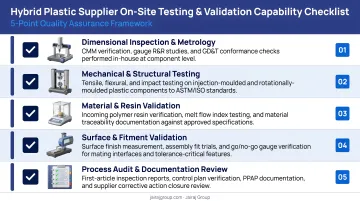
On-site testing capability shortens qualification timelines — sending parts to external labs adds weeks to PPAP completion.
Multi-Facility Supply Resilience
Hybrid program schedules are unforgiving. A supplier with geographically distributed facilities can absorb regional disruptions — logistics, labor, power — without halting OEM production.
Jairaj Group operates manufacturing facilities across Faridabad, Rudrapur, Aurangabad (two plants), IMT Manesar, and Sanand, with dedicated inventory management and contingency planning for OEM supply continuity.
India's auto component export base reached USD 22.90B in FY25, with ACMA projecting USD 70–100B by FY2030 — a scale that gives OEMs sourcing from India access to a mature, competitive supply chain with built-in redundancy.
Early Engineering Engagement
The suppliers who deliver the fewest downstream problems are the ones involved before tooling is committed. Engaging a supplier at the design phase — before tooling is committed — reduces downstream rework, avoids late-stage material substitutions, and compresses time-to-production. Jairaj Group's engineering team provides:
- DFM analysis to catch manufacturability issues early
- Material grade advisory matched to thermal and chemical exposure requirements
- Process simulation that converts OEM specifications into cost-optimized, production-ready designs
Quality, Compliance, and Traceability for OEM Hybrid Plastic Parts
Hybrid powertrain components — particularly those in HV proximity or structural roles — require documentation that stands up to OEM audits. The minimum expectation:
- Material certificates for every batch
- Dimensional inspection records tied to part serial numbers
- Process records covering injection parameters, cycle data, and tooling revision history
- PPAP package current at production approval
Jairaj Group maintains full batch traceability, material certification, and process records under ISO 9001:2015 systems, with technical documentation available for OEM supplier qualification.
The EU is introducing mandatory recycled plastic content targets for vehicles under new end-of-life vehicle regulations, and Volkswagen Group has committed to 40% circular materials in vehicles by 2040. OEM procurement teams are now routinely asking suppliers to document recyclability and post-consumer resin (PCR) content availability.
This is moving from a preference to a hard sourcing requirement. Suppliers entering hybrid OEM programs should be prepared to answer it at qualification.
Frequently Asked Questions
What is OEM in EV?
OEM (Original Equipment Manufacturer) in the EV and hybrid context refers to the vehicle brand or platform owner — such as a major automaker — that designs the vehicle and sources components from Tier 1 and Tier 2 suppliers. The finished vehicle is sold under the OEM's brand, with most parts sourced externally.
What plastic material is used in the automotive industry?
The most common families are PA6, PA66, PBT, PPS, PPA, PP, and ABS. In under-hood and structural applications, glass-fiber-reinforced engineering plastics are preferred — the reinforcement delivers the heat resistance, mechanical strength, and dimensional stability that base polymers alone cannot achieve in demanding environments.
What are the most common plastic components in a hybrid powertrain?
The primary categories are battery pack enclosures, thermal management housings, actuator geartrain gears, EGR and throttle valve bodies, and electrical connector housings. Each has distinct material and process requirements.
Why are plastics preferred over metals in hybrid vehicle powertrain components?
Plastics offer weight reduction (up to 35% lighter than metal equivalents in battery enclosures), corrosion resistance, thermal and electrical insulation, design flexibility, and part consolidation. In hybrid systems, every kilogram saved directly improves fuel efficiency and extends electric range — a direct commercial benefit, not just an engineering preference.
What certifications should an OEM plastic supplier have for hybrid powertrain parts?
ISO 9001:2015 is the baseline; IATF 16949:2016 is the automotive-specific standard typically required for production supply. OEM procurement teams should also confirm the supplier has documented PPAP capability, FMEA processes, and control plans before granting production approval.
How does injection molding support hybrid powertrain plastic part production?
Precision injection molding with validated tooling and PLC-controlled machinery achieves the dimensional tolerances that actuator gears and sensor housings require. In-house tool room capability — covering DFM, flow simulation, and cooling design — reduces iteration time and maintains process control from prototype through full production volume.