For OEMs, Tier-1 suppliers, and component manufacturers, understanding where plastic use is heading in hybrid platforms is not optional — it is a procurement and investment decision. The hybrid segment is growing fast, particularly in India, where strong-hybrid car and SUV sales jumped 128% year-over-year in April 2025 according to Autocar Professional. The material trends driving that growth are already locked into platform decisions being made today.
This article covers the four main trends reshaping how plastics are specified, sourced, and manufactured for hybrid vehicles — and the forces accelerating each one.
Key Takeaways
- Hybrid powertrains create a dual thermal challenge: polymers must handle combustion heat and battery electrical demands simultaneously
- Every kilogram saved through metal-to-plastic conversion directly improves electric range and fuel economy in hybrids
- Recycled and bio-based plastics are entering active production at Tier 1 suppliers — no longer just sustainability targets on paper
- Advanced polymers are enabling quieter interiors, compact under-hood packaging, and integrated electronics housings
- Tighter emissions regulations, rising hybrid sales, and OEM cost pressure are forcing suppliers to move faster than ever
Trend 1: Lightweighting Through Metal-to-Plastic Conversion
Why Weight Matters More in Hybrids
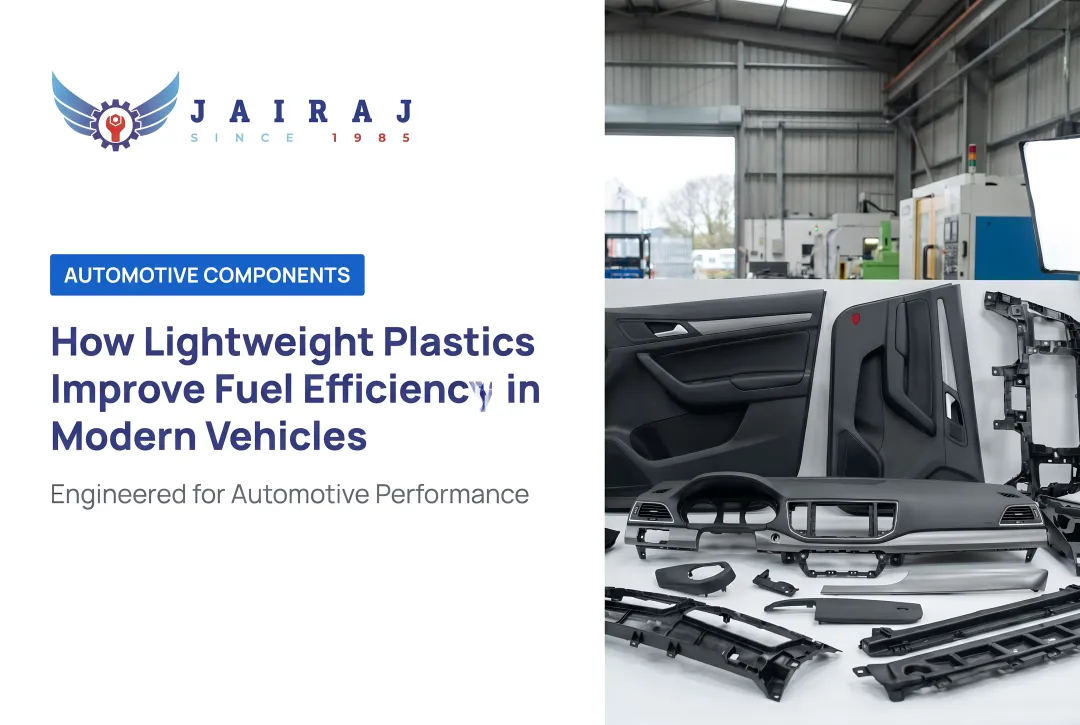
A hybrid powertrain is, by definition, heavier than a comparable ICE vehicle. Combining a combustion engine, electric motor, battery pack, and associated power electronics adds significant mass, and every extra kilogram works against the electric range and fuel economy the vehicle is sold on. Metal-to-plastic conversion is the most direct engineering lever available to recover that weight penalty.
According to the American Chemistry Council, plastics account for roughly 50% of a vehicle's volume while contributing less than 10% of its weight — a ratio that makes them uniquely efficient for hybrid architectures where mass reduction has compounding benefits across both drive modes.
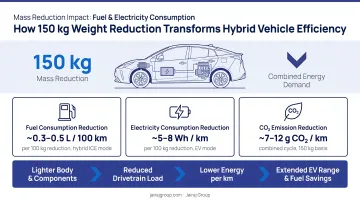
The performance impact is measurable. DOE/NREL modelling showed that a 150 kg reduction in glider mass lowered HEV fuel consumption from 5.35 to 5.00 L/100 km, and reduced PHEV electricity consumption from 167 to 157 Wh/mile — with the required battery capacity to maintain range dropping from 13.4 to 12.4 kWh. Those are not marginal gains.
Where Conversion Is Happening
Components actively moving from metal to engineering-grade plastics in hybrid platforms include:
- Structural body panels and bumper systems — glass-fiber-filled polypropylene replacing sheet metal
- Chassis brackets and mounting components — PA66-GF taking over from stamped steel
- Interior seat frames — reinforced polyamide reducing seat mass without compromising load ratings
- Under-hood covers and airflow components — polypropylene compounds replacing aluminium covers
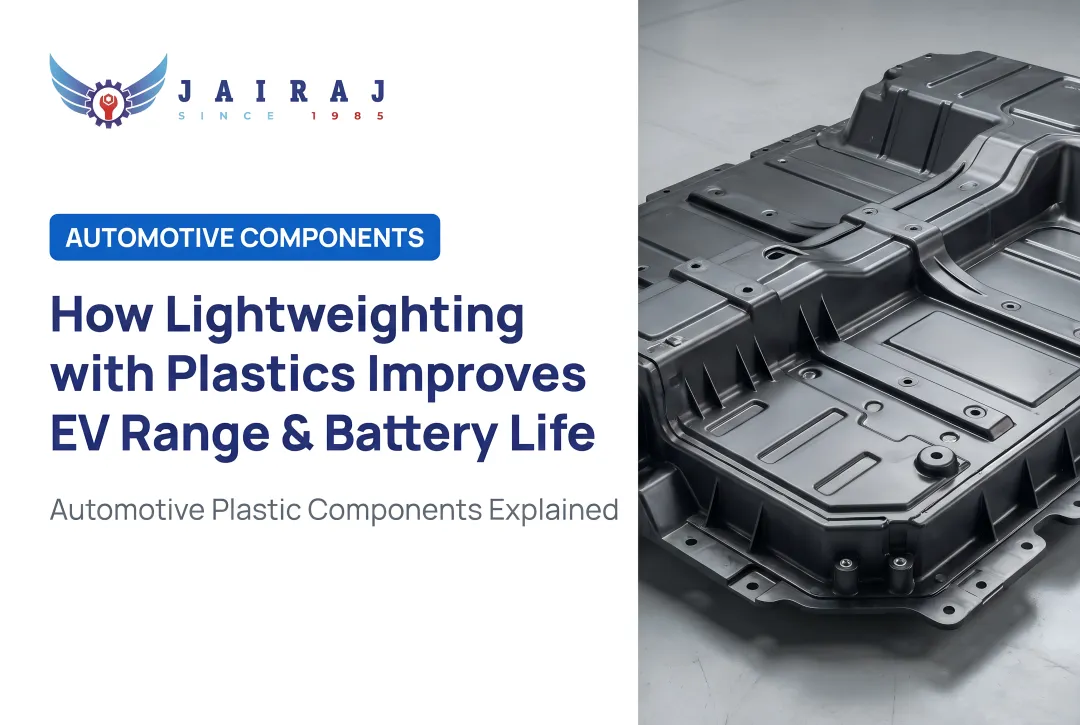
- Battery enclosure lids and module trays — where polymer weight savings are additive to the battery system's already significant mass
Jairaj Group works with PA66-GF and glass-fiber-reinforced polypropylene across their automotive component range — materials central to structural lightweighting in under-hood and chassis applications.
Their PLC-controlled injection moulding lines and in-house tool rooms deliver the dimensional consistency that OEM structural conversions demand, helping customers translate weight reduction targets directly into production-ready parts.
Trend 2: High-Performance Polymers for Thermal and Battery Management
The Dual Thermal Problem
A hybrid vehicle's polymer components face conditions that neither a pure ICE nor a pure EV creates. Under the hood, combustion-side temperatures stress materials continuously. Simultaneously, battery-adjacent components must provide dielectric insulation, resist thermal runaway conditions, and meet flame-retardancy thresholds — all within a tightly packaged architecture.
This has driven real demand for specialty polymers with verified performance thresholds:
| Polymer | Key Rating | Application |
|---|---|---|
| Solvay Ryton PPS Supreme | RTI >175°C, UL 94 V-0 | HV connectors, thermal management |
| Celanese Fortron PPS | RTI 200–240°C, HDT 260°C+ | Connectors, E/E housings |
| Envalior ForTii / Durethan | CTI 600 V, RTI 140°C, UL 94 V-0 at 0.75 mm | High-voltage connectors |
| BASF Ultramid Advanced N | Halide-free, electro-corrosion resistant | HV connectors, power electronics |
| Solvay Xydar LCP | High-heat, thermal runaway resistance | Battery module insulation |
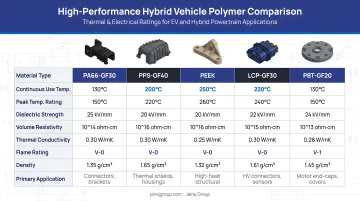
Material selection for battery-adjacent parts cannot rely on a single metric. CTI (Comparative Tracking Index), RTI (Relative Temperature Index), dielectric strength, and UL 94 flame classification all need to be evaluated together for the specific application geometry and voltage environment.
Applications Requiring These Materials
These performance thresholds translate directly into the components that carry the most risk in a hybrid system. Battery and high-voltage applications where thermally stable, flame-retardant, and electrically insulating plastics are now standard include:
- Battery casings, module housings, and cell dividers
- Coolant system housings and channel components
- High-voltage cable conduits and connector bodies
- Hybrid control unit enclosures
- Charging-side connectors and busbar insulators
Jairaj Group manufactures plastic insulated battery covers and precision components using PEEK, PA66-GF, and PC — materials that offer dimensional stability in high-temperature and chemically aggressive environments. Their quality system includes PPAP documentation, FMEA reports, material certificates, and dimensional verification as standard deliverables for automotive OEM supply, documentation that OEMs increasingly require before approving any supplier for a hybrid platform program.
Jairaj holds ISO 9001:2015 certification across its facilities and maintains comprehensive testing protocols covering temperature cycling, chemical resistance, and performance validation — capabilities that align with what automotive OEMs require from suppliers entering hybrid platform programs.
Trend 3: Sustainable and Circular Plastics
Hybrid vehicles carry a green positioning in the market. That positioning creates commercial pressure for OEMs to reduce lifecycle emissions beyond the tailpipe — which means extending sustainability requirements into their supply chains and material choices.
Grand View Research projects the high-performance bioplastics market for automotive and aerospace to reach USD 4.23 billion by 2030, growing at a 15.2% CAGR from 2025 to 2030. That growth is being driven by active procurement decisions, not just exploratory R&D.
Toyota offers the clearest hybrid-linked example. Their North America Environmental Sustainability Report documents bio-based plastics in seat cushions across the Prius, Corolla, and RAV4. Toyota's Sustainability Data Book sets a target to triple recycled-plastics use by 2030 and achieve 30% or higher recycled-material content by weight in vehicles produced in Japan and Europe by the same year.
Where Sustainable Plastics Are Being Applied
- Interior trim and floor systems — post-industrial recycled resins replacing virgin PP and ABS
- Non-structural body panels — recycled-content compounds where surface finish requirements allow
- Seat cushion components — bio-based polyols and bio-derived foams (as demonstrated in Prius production)
- Under-hood non-critical covers — post-consumer recycled PP grades gaining acceptance
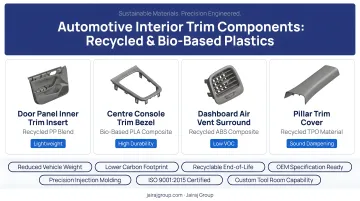
The sustainability case goes beyond marketing. Carbon lifecycle reporting is moving from voluntary disclosure toward a compliance requirement in multiple jurisdictions — the embodied carbon in a component is becoming a metric OEMs must account for, not just report.
Suppliers that invest in material lifecycle documentation now will be better positioned as OEM sustainability targets harden into supply chain requirements. The ask is already appearing in procurement criteria across Tier 1 contracts.
Trend 4: Design Flexibility, NVH Reduction, and Smart Plastics
NVH in Hybrid-Specific Conditions
When a hybrid vehicle shifts into electric-only drive mode, combustion engine noise disappears — and so does the masking effect that previously covered road noise, wind noise, and drivetrain hum. As SAE has noted, the definition of a quiet vehicle is fundamentally changing as electric motors replace combustion engines in more driving conditions. For hybrid vehicles, this creates a specific NVH engineering challenge: the cabin noise profile changes dynamically depending on which drive mode is active.
Modern NVH-engineered polymers and acoustic damping materials are replacing traditional felt inserts in door panels, floor systems, and pillar covers. This reduces part count and assembly time while improving acoustic performance across both drive modes.
Design Freedom and Component Integration
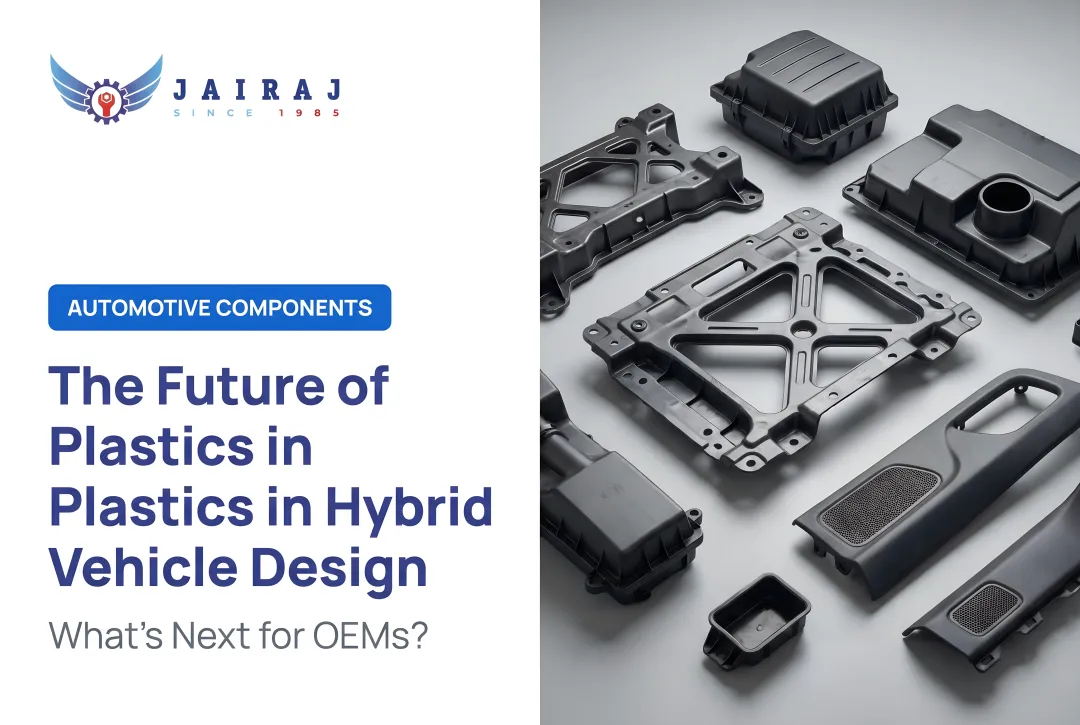
Hybrid underbody packaging is genuinely more constrained than either ICE or EV layouts. Fitting combustion components, electric drive hardware, battery modules, and thermal management systems into a shared platform requires compact, geometrically complex parts that only injection-moulded polymers can deliver economically.
Key applications where design flexibility is driving polymer adoption:
- Sensor and electronics housings molded directly into structural components — reducing part count and assembly steps
- Polycarbonate for HMI surfaces — supporting 3D displays, touchscreens, and black-panel effects in hybrid cockpits (Covestro's automotive-grade PC is purpose-developed for this)
- Multi-cavity and insert-molded assemblies — combining metal inserts with engineering polymers for hybrid-strength, low-weight results
Smart and Functional Plastics
Functional plastics are now engineered into hybrid platforms alongside structural and acoustic components:
- Electrically conductive thermoplastic compounds for EMI shielding around inverters, converters, and battery management electronics
- High-gloss engineering polymers for premium interior surfaces on hybrid models positioned as premium alternatives to ICE equivalents
- In-mold electronics integrating circuits and sensors directly into molded components
Jairaj Group's insert moulding and overmoulding capabilities support hybrid metal-plastic configurations where structural and functional requirements overlap. Their sensor housings in PA66-GF demonstrate precision fitment for automotive sensing systems, supporting the tighter tolerances and material pairings that more integrated hybrid component designs demand.
What's Driving These Trends in Hybrid Vehicle Design
These trends reflect converging pressures across regulation, technology, market growth, and supply chain economics.
Regulatory and Emissions Compliance Pressure
India's CAFE Phase 2 sets an industry-average target of 113 gCO₂/km for FY 2022–23, creating direct weight-reduction pressure on Indian OEMs. In the US, EPA finalized multi-pollutant standards for MY 2027 and beyond, with ICCT summarising the MY 2032 target at 85 g/mi CO₂. In Europe, new-car CO₂ standards are on a trajectory toward a 100% reduction target from 2035.
Lightweighting through metal-to-plastic conversion supports compliance across all three regulatory environments — not as a standalone strategy, but as one of the most cost-effective tools available to OEMs managing fleet-average targets.
Technology Advances in Polymer Science
High-temperature engineering thermoplastics available today make designs possible that were impractical five years ago. Key material advances include:
- PPS grades with RTI above 200°C for high-heat underhood applications
- LCP grades engineered for battery thermal runaway conditions
- Halide-free polyamides for electro-corrosion resistance in EV/hybrid powertrains
Fiber-reinforced hybrid polymers are also expanding into applications previously reserved for metals.
Market Growth and OEM Platform Investment
IEA data shows global electric car sales — including BEVs and PHEVs — exceeded 17 million in 2024, up more than 25% year-on-year. In India specifically, strong-hybrid vehicles are growing faster than the headline EV number: Toyota Kirloskar's 128% year-on-year growth in April 2025 reflects a market actively choosing hybrid technology.
That demand is driving platform-level investment. Toyota's fifth-generation hybrid system on the TNGA platform and Hyundai's TMED-II system under the Hyundai Way strategy are both ground-up architectures designed from the outset with advanced polymer specifications built in.
Cost Efficiency and Supply Chain Considerations
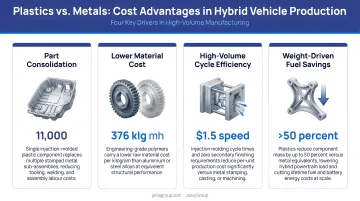
Plastics offer structural cost advantages in high-volume hybrid production:
- Part consolidation — a single molded component replacing three or four metal stampings
- Reduced secondary operations — no welding, painting, or corrosion treatment needed for many polymer parts
- Lower logistics cost — lighter components reduce freight cost at scale
- Faster tooling amortisation — injection mold tooling amortises efficiently across high production volumes
Supplier Ecosystem Maturity in India
India's Tier-1 and Tier-2 plastic component manufacturing base has matured to a point where domestic OEMs can source hybrid-specific polymer components locally with confidence. Suppliers with in-house tool rooms, multi-facility manufacturing, and certified quality systems are now the preferred choice — they reduce lead times, eliminate import dependencies, and engage in DfM collaboration early in the platform development cycle.
Jairaj Group operates six manufacturing facilities across Faridabad, Rudrapur, Aurangabad, Manesar, Sanand, and Sector 59 Faridabad, with in-house tool rooms, rapid prototyping capability, and ISO 9001:2015 certification. Recognition as a capable supplier and strategic business partner by Endurance Technologies and Tenneco Automotive reflects the OEM-validated credibility that hybrid platform sourcing decisions require.
Industry Impact and Future Signals
Operational and Supply Chain Impact
OEM design workflows for hybrid platforms are incorporating supplier involvement earlier than traditional ICE programs. Design for Manufacturability reviews (where component suppliers engage before design freeze) reduce costly tooling iterations and compress time-to-market.
Jairaj Group's R&D and Value Engineering centres participate in these DfM reviews — covering flow analysis, cooling optimisation, and warpage prediction — directly cutting the iteration cycles that add cost and delay to new platform launches.
Tier-1 and Tier-2 suppliers are also being asked to take on broader responsibilities: sub-assembly, full testing documentation, PPAP, and component-level traceability. Jairaj's value-added services — including plastic welding, comprehensive dimensional and thermal testing, PPAP documentation, and FMEA reporting — align with what hybrid platform OEMs are increasingly requiring from their direct suppliers.
Business and Investment Impact
The commercial scale of this shift is significant. MarketsandMarkets projects the electric vehicle plastics market to grow from USD 3.7 billion in 2022 to USD 12.6 billion by 2027 at a 27.9% CAGR. That growth trajectory is driving supplier investment priorities toward advanced polymer processing capability, high-temperature material qualification, and EV/hybrid-specific quality documentation.
Jairaj Group's 2023 expansion into EV-focused polymer components and its recognition in Forbes India's DGEMS 2024 list mark concrete steps toward capturing that demand as hybrid volumes accelerate.
Future Signals: What to Watch in the Next 1–3 Years
- Bio-based and recycled plastics shifting from targets to mandates — as OEM 2030 sustainability commitments approach, supplier qualification for recycled-content resins will move from optional to required
- Multi-material assemblies — structural plastics combined with metals for crash-critical hybrid components, requiring suppliers with both material expertise and DfM capability
- Higher thermal thresholds — as battery energy density increases, battery-adjacent polymer specifications will tighten further, favouring suppliers already qualified on PPS, LCP, and high-performance PA grades
In hybrid vehicle design, plastics carry direct consequences for range, safety, compliance, and cost — handled together, not in sequence. Suppliers that invest in material expertise, upstream collaboration capability, and hybrid-specific quality systems now will hold a measurable advantage as hybrid volumes scale through this decade.
Frequently Asked Questions
Why are plastics preferred over metals in hybrid vehicle design?
Plastics reduce vehicle weight without sacrificing structural performance, directly improving both electric range and fuel economy in hybrid drivetrains. They also enable complex geometries that compact hybrid powertrains require, and offer better corrosion resistance and design flexibility than metal alternatives at comparable or lower cost.
Which plastics are most commonly used in hybrid vehicle components?
Polypropylene (PP) and polyamide (PA/nylon) dominate interior and structural applications. Polycarbonate (PC) and ABS are standard for HMI surfaces and housings. For thermally demanding battery-adjacent and high-voltage applications, PPS, LCP, and high-performance PA grades (such as PPA and PA66-GF) are the primary choices.
How do plastics help improve the range of hybrid vehicles?
Lighter vehicles require less energy to accelerate and maintain speed. Replacing metal components with engineering-grade plastics reduces curb weight directly. DOE/NREL modelling found a 150 kg mass reduction lowered HEV fuel consumption from 5.35 to 5.00 L/100 km, with comparable gains in PHEV electricity consumption.
What role do plastics play in hybrid vehicle battery systems?
Battery casings, module housings, cell dividers, and thermal management components rely on flame-retardant, electrically insulating polymers. These materials must meet CTI, RTI, and UL 94 ratings to ensure safety and longevity in high-voltage environments.
Are recycled and sustainable plastics being used in hybrid vehicle manufacturing?
Yes — Toyota's Prius uses bio-based plastics in seat cushions, and Toyota has committed to 30% or higher recycled-material content by weight in Japan and European production by 2030. Post-consumer and post-industrial recycled resins are entering interior trim and non-structural panel applications across multiple OEM programmes.
How are plastic requirements for hybrid vehicles different from those for fully electric vehicles?
Hybrid polymers must simultaneously handle combustion engine thermal loads and battery/electrical system requirements — a dual-demand environment that pure EVs don't face. Pure EVs manage only electric powertrain thermal conditions, making material selection simpler than in hybrids, where both environments coexist in a single, tightly packaged architecture.