Introduction
Battery packs are getting heavier. The average EV battery weighs between 200–600 kg, and as range expectations climb, the instinct is to simply add more cells. The problem: more cells mean more weight, which demands yet more energy, which erodes the very range gains you were chasing.
Engineers know this. What's less discussed is how precision-engineered plastics offer a practical, scalable exit from this loop — one that doesn't require exotic materials or complete platform redesigns.
Carbon fibre and aluminium attract the attention. Engineering-grade polymers do the work. Across battery housings, motor brackets, thermal management assemblies, and cable management systems, high-performance polymers deliver consistent weight reductions — at production-viable costs and without the tooling complexity of metal alternatives.
This article breaks down exactly how plastic lightweighting affects the two metrics that matter most: range per charge and long-term battery health.
Key Takeaways
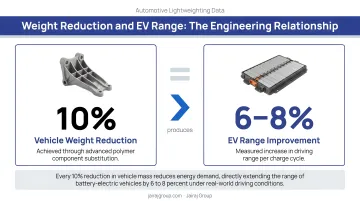
- Every 10% reduction in vehicle weight delivers roughly 6–8% improvement in energy efficiency; plastics typically cut component weight by 40–60% compared to metal equivalents
- Lighter EVs draw less current per kilometre, reducing internal battery heat and slowing capacity degradation over time
- Engineering plastics allow structural, thermal, and mounting functions to be consolidated into a single moulded part
- Without lightweighting, engineers must offset extra mass with larger, heavier, and costlier battery packs — a compounding trade-off with no clean exit
- The payoff compounds: preserved battery capacity and lower energy draw add up across a vehicle's full service life
What Is Plastic Lightweighting in EVs?
Plastic lightweighting, in practical terms, means replacing metal, rubber, or other heavy materials in EV components with engineering-grade polymers and fibre-reinforced composites, while maintaining structural integrity and functional performance.
The materials involved — nylon (PA66-GF), PEEK, polyphenylene sulphide (PPS), polycarbonate, and glass or carbon-fibre reinforced grades — are selected for their mechanical properties, thermal stability, and chemical resistance. These polymers are specified precisely because they can match or exceed the performance of the metal parts they replace, at a fraction of the weight.
That weight-to-performance advantage translates to measurable gains across the vehicle — from the battery pack outward.
Where Plastics Are Applied in EVs Today
Common application areas include:
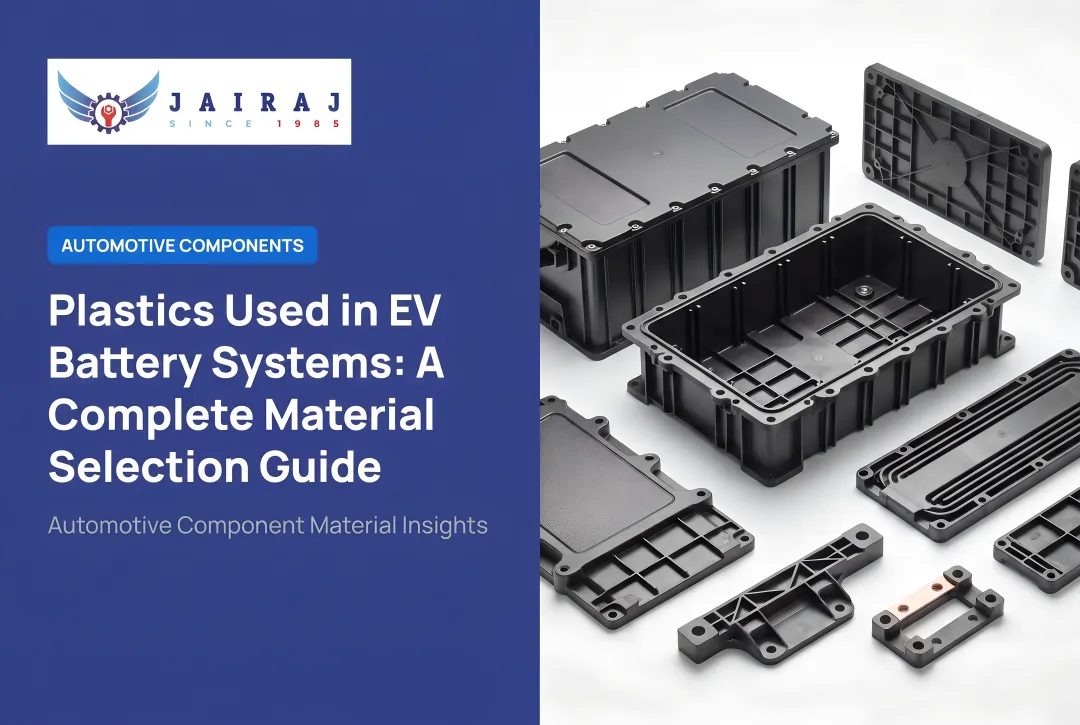
- Battery enclosures and insulated battery covers — thermal protection and structural containment
- Motor housings and brackets — structural support with lower mass
- Thermal management housings — temperature regulation around the battery pack
- Cable management systems — routing and protection of high-voltage wiring
- Interior structural panels — load-bearing elements with weight advantages
- HVAC ducting and under-hood components — heat and airflow management
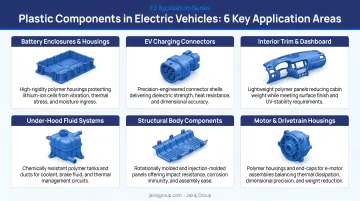
In each of these applications, weight reduction is the outcome of an engineering decision — one that directly affects how far an EV travels and how long its battery lasts.
Key Advantages of Plastic Lightweighting for EV Range and Battery Life
The three advantages below focus on operational, measurable outcomes tied to metrics EV engineers and OEMs actively track: range, energy consumption, battery cycle life, and total cost of ownership. They're also interconnected — weight savings reduce energy draw, which reduces heat, which reduces battery degradation. Each benefit compounds the next.
Extended Driving Range Per Charge
Replacing metal brackets, panels, housings, and structural parts with engineering plastics directly reduces curb weight. In EVs, every kilogram removed translates to measurable additional range.
A lighter vehicle requires less motor torque to accelerate and maintain speed. Less torque means the battery delivers fewer watt-hours per kilometre, stretching the same battery capacity over a greater distance.
According to the U.S. Department of Energy, a 10% reduction in vehicle weight produces approximately 6–8% improvement in fuel/energy efficiency. Applied to EVs, that's a direct range extension on a fixed battery capacity.
This advantage matters more in EVs than in ICE vehicles. EVs already carry a significant weight penalty from their battery packs — so every gram saved in a bracket, housing, or panel has proportionally higher impact on the efficiency equation.
KPIs directly affected:
- Kilometres per charge (range)
- Energy consumption rate (kWh/100 km)
- Battery discharge depth per trip
- Regenerative braking capture efficiency
When it matters most: Long-range passenger EVs and commercial fleet vehicles where daily distance requirements aren't negotiable. Also critical when engineers need to downsize a battery pack to reduce cost without compromising range targets — plastic lightweighting makes that trade-off viable.
Range anxiety remains the primary consumer barrier to EV adoption. A 2024 AAA survey found it consistently ranks as the top concern among non-EV owners. Extending real-world range through weight reduction addresses this at the engineering level, not through marketing.
Reduced Thermal Stress on Battery Cells = Longer Battery Life
A lighter EV draws less current from the battery per unit of distance. This matters because heat generation inside lithium-ion cells is directly proportional to current draw: I²R losses mean heat scales with the square of current. Lower current draw means less internal heat generated per trip, per cycle, per year.
Engineering plastics contribute a second layer of thermal protection. High-performance polymers used in battery enclosures, thermal management housings, and insulated battery covers provide thermal insulation and vibration damping that protects cells from heat spikes and mechanical stress between cycles.
Research published in ScienceDirect confirms that elevated operating temperatures are among the primary drivers of lithium-ion capacity degradation — accelerating both calendar aging and cycle life reduction. Keeping cells cooler, consistently, directly extends how long a battery retains its usable capacity.
The financial dimension matters here. Battery packs remain the single most expensive component in an EV, historically representing 30–40% of total vehicle cost. Extending battery health through lighter, thermally protective polymer components has direct value for both OEMs (warranty exposure) and vehicle owners (replacement costs).
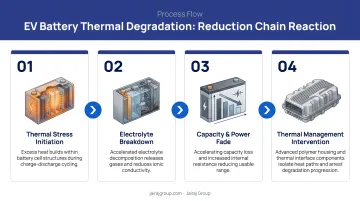
The compounding effect:
- Lighter vehicle draws less current per kilometre
- Lower current generates less internal heat per cycle
- Reduced heat slows capacity degradation
- Slower degradation means more usable capacity retained over the vehicle's life
KPIs directly affected:
- Battery cycle life (number of full charge-discharge cycles)
- Capacity retention (% of original capacity after X cycles or years)
- Battery replacement interval
- Total cost of ownership over vehicle lifetime
High-frequency use cases benefit most: ride-sharing fleets, delivery vehicles, and daily commuter EVs where batteries cycle multiple times per day. Thermal stress savings compound rapidly under heavy use, making polymer thermal management components the highest-value investment in these applications.
Design Freedom and Component Consolidation
Engineering plastics processed through precision injection moulding enable something metal fabrication rarely can: combining multiple components into a single moulded part.
A plastic battery enclosure, for example, can integrate impact-absorbing ribs, mounting bosses, and thermal insulation features in a single moulded part, replacing what would otherwise require a multi-piece metal assembly with separate fasteners, gaskets, and brackets.
Manufacturers with in-house tool room capabilities and multi-cavity, insert, and two-shot moulding expertise — Jairaj Group's polymer manufacturing operations include all of these — can produce these complex geometries at production volumes, making consolidation viable well beyond the prototyping stage.
This creates system-level weight savings that go beyond simple material substitution:
- Fewer parts mean fewer fasteners, fewer seals, fewer joints
- Assembly labour decreases alongside part count
- Dimensional consistency improves when one moulded part replaces three or four metal pieces
- Total system weight drops through elimination of connectors and intermediate components
When applied across 10–20 component locations in an EV programme, the cumulative effect can meaningfully shift the vehicle's energy consumption curve.
KPIs directly affected:
- Total part count per assembly
- System weight per functional assembly
- Assembly time per unit
- Manufacturing cost per vehicle
- Dimensional consistency across production runs
When it matters most: New EV platform development, where component architecture is still being defined. Retroactive substitution offers some benefit, but the greatest gains come when plastic consolidation is designed in from the start.
What Happens When Lightweighting Is Overlooked
When heavy metal components remain where plastics could perform equivalently, engineers face a compounding weight penalty that becomes progressively harder to recover from.
The loop runs like this: heavier components → larger battery pack needed to meet range targets → added battery weight → further range shortfall → even larger pack required. Each design cycle makes the problem worse, not better.
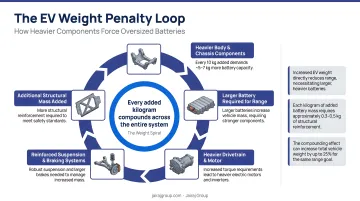
Oversized battery packs also carry greater thermal loads during charging and discharging. More heat accelerates cell degradation — meaning the vehicle's effective range shrinks faster over its operating life than it would in a lighter, better-thermally-managed design. The battery you specified to deliver 500 km at launch might be delivering 430 km within three years.
That degradation carries a direct commercial cost:
- Larger batteries cost more to manufacture and source
- Heavier vehicles consume more energy per kilometre and take longer to charge
- Shrinking real-world range over time erodes customer satisfaction and resale value
These outcomes compound each other — and all of them trace back to weight decisions made early in the design process.
How to Get the Most Value from Plastic Lightweighting
Getting meaningful results from plastic lightweighting requires a systematic approach, not a one-off substitution.
Prioritise the highest-impact components first. Focus on parts with the greatest mass, highest exposure to thermal cycling, or the most complex multi-part assemblies. In EV programmes, these typically include:
- Battery enclosures and insulated covers
- Motor housings and structural brackets
- HVAC ducting and under-hood assemblies
- Cable management and connector housings
Treat lightweighting as a systems programme, not a single swap. One lightweight part has marginal impact on range or battery life. A coordinated effort across 15–20 components shifts key performance metrics measurably. The compounding benefits only materialise when savings accumulate: less weight means less heat generated, which means slower battery degradation across the vehicle.
Choose suppliers who combine material expertise with production-grade tooling. Whether a polymer component holds tolerances across 10+ years of thermal cycling comes down to material selection, process control, and validation rigour — not just the initial design.
Jairaj Group brings over four decades of polymer engineering experience, ISO 9001:2015 certification, and the manufacturing infrastructure to back it up: in-house tool rooms, PLC-controlled injection moulding, and dedicated R&D and value engineering centres. That combination translates lightweighting decisions into durable, consistent production outcomes.
Conclusion
Plastic lightweighting improves the two metrics that matter most to EV buyers and fleet operators: how far the vehicle travels per charge, and how long the battery retains its capacity. The gains are concrete and cumulative.
The advantages compound: weight reduction reduces energy draw, which reduces heat, which reduces battery degradation — making each gram saved more valuable over the vehicle's lifetime than it appears at the point of design.
Plastic lightweighting works best as an ongoing engineering discipline, revisited at each design iteration. As high-performance polymers — glass-filled nylons, carbon-fiber composites, structural foams — continue to expand their application envelope, OEMs and suppliers who systematically re-evaluate component designs will compound their efficiency gains with each vehicle generation.
Frequently Asked Questions
Does weight affect EV range?
Yes, directly. A heavier vehicle requires more energy per kilometre to accelerate and maintain speed. Research consistently shows that a 10% reduction in vehicle weight yields approximately 6–8% improvement in energy efficiency, translating to extended range on a fixed battery capacity.
Do lighter wheels increase EV range?
Lighter wheels reduce unsprung mass, which lowers rolling resistance and the energy needed for acceleration. The effect per wheel is modest, but it adds up across a full drive cycle. That cumulative gain is why composite and polymer-reinforced wheel designs are increasingly specified in production EVs.
What types of plastics are used for lightweighting in electric vehicles?
Common engineering plastics include nylon (PA66, PA66-GF), polypropylene (PP), polyphenylene sulphide (PPS), PEEK, and glass or carbon-fibre reinforced polymer composites. Material selection depends on the thermal, structural, and chemical demands of each application.
How does plastic lightweighting affect EV battery life?
Lighter vehicles draw less current per kilometre, generating less internal heat in battery cells. Additionally, thermally protective polymer materials in battery enclosures and covers reduce cell temperature variation. Both effects slow capacity degradation, extending the battery's usable life.
Is plastic lightweighting safe for structural EV components?
Engineering-grade plastics and fibre-reinforced composites are used in structurally demanding — including crash-relevant — roles in production vehicles today. Safety depends on correct material specification, design validation, and manufacturing process control, not the material category itself.