Key Takeaways
- A 10% reduction in vehicle weight can deliver 6–8% fuel economy gains, making polymer-for-metal substitution a direct engineering lever
- PEEK, PPS, and PEI form the core high-performance polymer triad for automotive — each suited to distinct thermal, chemical, or electrical demands
- Under-hood ICE applications drove early polymer adoption; EV platforms now demand higher dielectric strength and flame retardancy that legacy material specs weren't designed for
- Material selection alone doesn't guarantee performance — high-performance resins require tightly controlled processing conditions to deliver rated properties
- Jairaj Group is ISO 9001:2015 certified, supplying precision polymer components to Tier-1 automotive clients including Gabriel India and Tenneco Automotive
Why Automotive Engineers Are Turning to High-Performance Polymers
The pressure is real. Every kilogram removed from a vehicle has downstream consequences — fuel savings, extended EV range, reduced brake wear, smaller battery packs. According to the U.S. Department of Energy's lightweighting program, a 10% reduction in vehicle weight can result in a 6–8% improvement in fuel economy. In EVs, the effect compounds: an NREL study modelled that a 150 kg mass reduction improved energy consumption from 347 Wh/mile to 329 Wh/mile and reduced required battery energy from 24 kWh to 23 kWh for the same target range — meaning lighter vehicles need smaller, cheaper battery packs.
Weight is only part of the story. Under-hood environments combine sustained heat, aggressive chemistry, and vibration loads that would quickly degrade commodity plastics. High-performance polymers maintain dimensional stability and mechanical strength across these conditions, reducing replacement frequency and supporting longer component service life.
The durability numbers are concrete. Victrex documents PEEK-based automotive parts retaining stiffness and strength after 5,000 hours at 150°C — a performance profile that directly supports extended warranty programmes.
The Polymer Performance Pyramid
Not all plastics are created equal. The industry recognises a clear performance hierarchy:
- Commodity plastics (PP, PE, PVC) — low cost, limited thermal and mechanical performance
- Engineering plastics (ABS, standard nylon, polycarbonate) — improved properties, suitable for moderate-duty applications
- High-performance polymers (PEEK, PPS, PEI, PPA) — designed for continuous service above 150–200°C, aggressive chemical exposure, and precision-critical applications
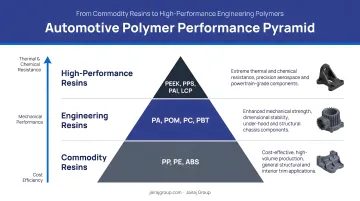
The cost premium at the top tier is real — and justified in components where failure means warranty claims, safety risk, or vehicle downtime.
Key High-Performance Polymers Used in Automotive Applications
Material selection depends on the specific combination of thermal, chemical, mechanical, and electrical requirements for each component. The four families below cover the majority of under-hood and EV polymer engineering decisions.
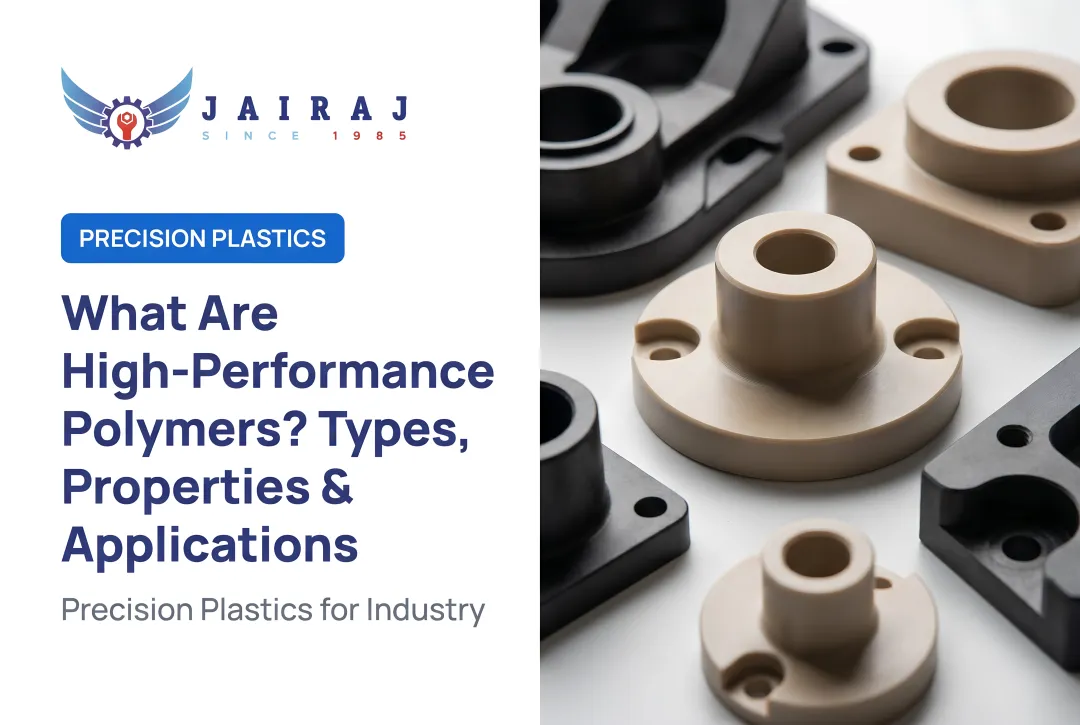
Polyetheretherketone (PEEK)
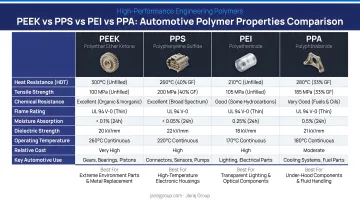
PEEK is the reference material when no other polymer will do. Victrex confirms a continuous service temperature of 260°C, with documented resistance to transmission oils, brake fluids, biodiesel blends, E15/E85, and exhaust condensate. Its high strength-to-weight ratio translates directly: Victrex cites PEEK bushings delivering 70% weight savings compared to metal equivalents, with more than 500 million PEEK-based parts now in automotive service globally.
Primary applications include:
- Transmission seals and thrust washers
- Bearing cages and hydraulic valves
- Airbag sensor housings
- Pressure sensor diaphragms
Polyphenylene Sulfide (PPS)
PPS delivers dimensional stability and flame retardancy in chemically aggressive environments. Toray's TORELINA PPS carries a UL temperature index of 200–240°C with a UL94 V-0 flame rating and very low water absorption. Solvay's Ryton Supreme HV grade is rated at CTI 600V, making it a strong candidate for EV high-voltage components alongside traditional fluid-handling parts.
Long-term durability is well-documented: Solvay demonstrated Ryton PPS grades compatible with Ford's ULV 25 ATF specification after testing at 150°C for up to 3,000 hours with minimal mechanical property change.
Polyetherimide (PEI)
PEI — best known under SABIC's ULTEM trade name — offers a glass transition temperature of 217°C, inherent UL94 V-0 flame retardancy achievable at just 0.41 mm wall thickness, and dielectric strength up to 33 kV/mm (at 0.8 mm in oil). This combination makes it particularly relevant for EV electrical components where thin-wall insulation must survive both heat and high-voltage stress. SABIC lists auto electrical, inverter, and busbar applications explicitly.
Polyamide Variants (PA66, PA46, PPA)
Glass-fibre-reinforced polyamides bridge engineering and high-performance territory at high production volumes. Standard PA66 faces thermal limits above 120–130°C, but polyphthalamide (PPA) closes that gap. Envalior's ForTii PPA reports a 325°C melting temperature and mechanical performance retention at 150°C that PA66 cannot match, while enabling metal replacement at roughly 50% of original component weight.
For the most demanding under-hood applications, BASF's Ultramid Endure extends this further still — with continuous loading capability up to 220°C.
Under-Hood Applications: Where Heat and Chemistry Demand More
The engine compartment remains the most demanding polymer test environment in any vehicle. Components here must survive sustained thermal loads, constant fluid exposure, and vibration — often simultaneously.
Thermal and Fluid Management Components
The shift from metal to polymer in cooling and fluid systems is well-established. BASF's Ultramid A 218 V30 polyamide is used in production for thermostat housings, coolant pipes, expansion tanks, and radiator end tanks. Denso has produced radiator tanks from plant-derived PA610. The weight savings are material: a glass-filled polyamide radiator end tank replaces a metal casting at a fraction of the weight, with no compromise on pressure or thermal performance when the right grade is selected.
Jairaj Group manufactures plastic coolant reservoir tanks using blow moulding technology — PLC-controlled, fully automated systems designed for lightweight, high-strength fluid containment at automotive production volumes.
Air Intake and Engine Surrounds
The intake manifold business case for polymers is proven. A nylon 6/6 Zytel intake manifold uses approximately 8 lb of resin while saving 5 lb versus the aluminium version it replaced — a weight delta that compounds across a vehicle programme. Beyond mass, injection moulding enables complex internal geometries and integrated features that are prohibitively expensive to machine in aluminium.
Glass-fibre-reinforced PA and PPS are the primary materials here, chosen for their combination of thermal resistance, dimensional stability, and compatibility with air-side fuel vapour exposure.
Powertrain and Transmission Components
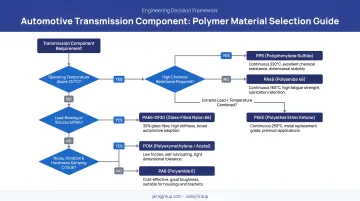
Where air-side exposure is manageable, transmission environments are not. Automatic transmission fluid is chemically aggressive enough to eliminate most standard engineering plastics outright — which is why material selection for these components is non-negotiable.
Transmission sensor housings, solenoid bodies, valve plates, and gear shift components all require dimensional stability through repeated thermal cycling alongside continuous ATF exposure. The primary material choices are:
- PEEK — for the highest-temperature zones and prolonged fluid immersion
- PPS — where thermal resistance and chemical inertness are required at lower cost
- Grade-specific fluid compatibility testing (such as Solvay's Ford ATF validation programme) provides the documented evidence OEM engineers need for sign-off
Jairaj Group's injection moulding operations — supported by in-house tooling, PLC-controlled machinery, and ISO 9001:2015-certified quality processes — produce tight-tolerance sensor and powertrain components for Tier-1 clients including Gabriel India and Tenneco Automotive.
EV-Specific Polymer Applications: The New Frontier
EV-Specific Polymer Applications
EVs don't just swap a combustion engine for an electric motor. They fundamentally change the polymer design brief. Combustion heat is replaced by electrochemical and electrical thermal loads. The priorities shift to dielectric strength, UL94 V-0 flame ratings, dimensional stability through charge/discharge cycles, and chemical compatibility with battery electrolytes and glycol coolants.
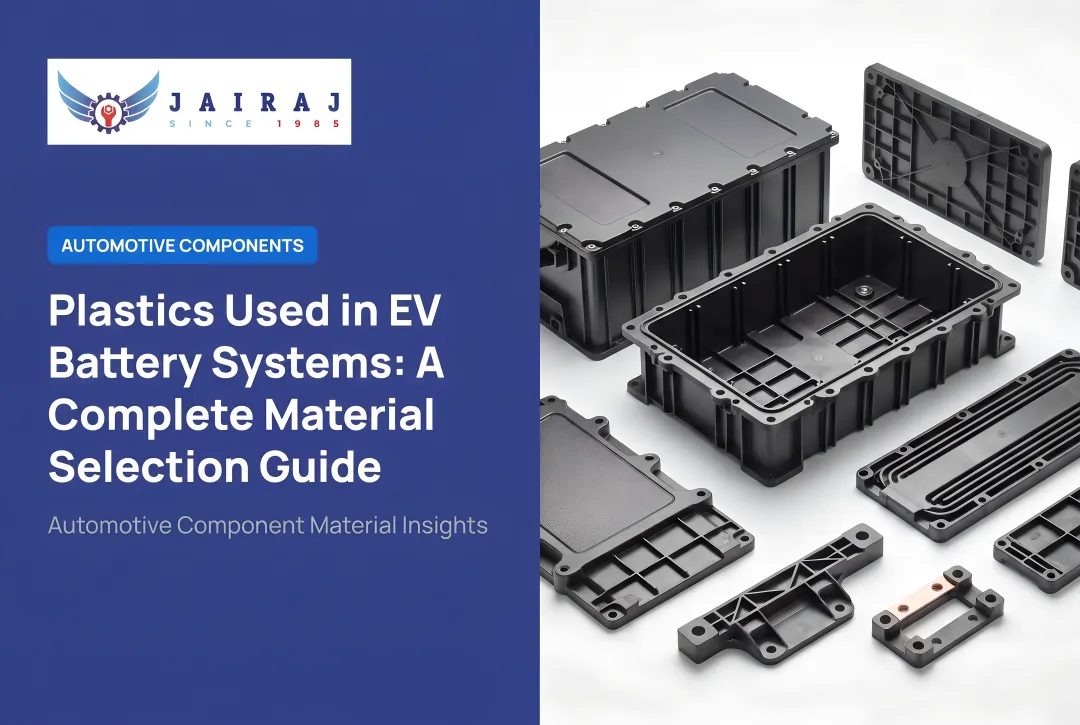
Battery Module Housings and Cell Holders
Battery module housings, cell spacers, and busbar covers require polymers that will not propagate flame in a thermal runaway scenario. UL94 V-0 at thin wall sections is non-negotiable. PPS and PEI are strong candidates: both carry V-0 ratings, offer low thermal conductivity to slow heat transfer between cells, and maintain dimensional stability through repeated thermal cycling. Injection moulding is the preferred process — it delivers the precision fit and scalable production volumes battery pack assembly requires.
Solvay introduced Xydar LCP G-330 HH in 2023 specifically for high-heat EV battery module insulation, citing improved passenger safety during thermal runaway events.
High-Voltage Connector and Insulator Components
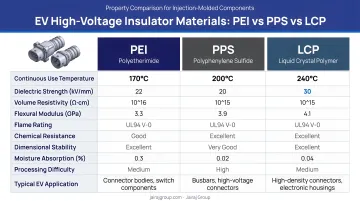
Modern EV architectures operate at 400V to 800V DC, with DC bus voltages reaching up to 950V in some configurations. Connectors, cable conduits, and terminal insulators at these voltage levels demand materials that combine high dielectric strength with flame retardancy and mechanical integrity.
Key material options for HV insulator applications include:
- PEI (ULTEM) — dielectric strength up to 33 kV/mm (thickness-dependent), inherent V-0 rating; SABIC identifies it for EV connectors and busbars
- PPS — CTI 600V rating addresses tracking resistance in humid environments
- LCP — combines thin-wall mouldability with high electrical performance for miniaturised connector geometries
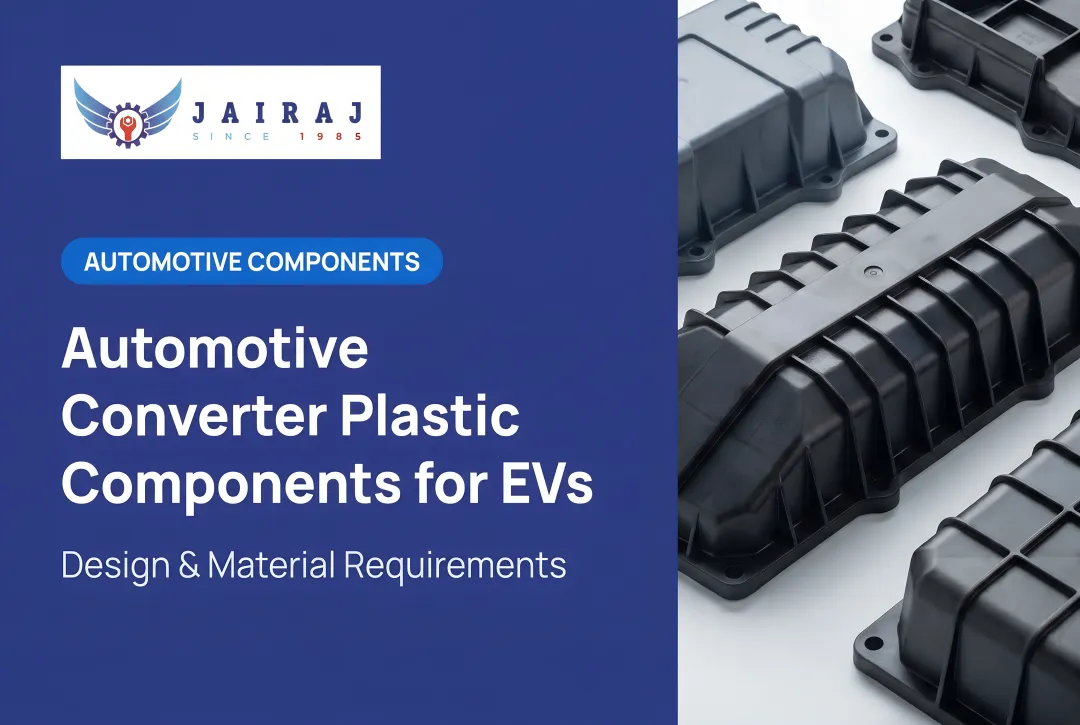
Thermal Management and Cooling System Parts
EV battery thermal management systems rely on glycol-based coolant circuits — pumps, manifolds, and heat exchanger end plates that must resist coolant chemistry across a 10–15 year vehicle service life. PPS is the preferred polymer here: low water absorption prevents dimensional creep, inherent chemical resistance handles glycol formulations, and its UL94 V-0 rating satisfies safety requirements for battery-adjacent components.
BASF's Ultramid Advanced grades have also passed extensive coolant application testing at 105°C continuous use, providing an alternative polyamide pathway for less demanding cooling circuit components.
Since 2023, Jairaj Group has expanded into EV-focused polymer components, with injection moulding capabilities — including multi-cavity, insert, and two-shot moulding — directly applicable to EV thermal and electrical component development for Indian automotive OEMs.
How to Select the Right Polymer Component Manufacturing Partner
Material selection is necessary but not sufficient. High-performance polymers are processing-sensitive: PEEK, PPS, and PEI each have specific melt temperature windows, drying requirements, and mould temperature demands that directly affect final part properties. A component moulded from the correct resin on poorly calibrated equipment will underperform relative to specification.
Selecting the wrong partner compounds the risk. When evaluating a polymer component supplier for automotive applications, the baseline requirements are:
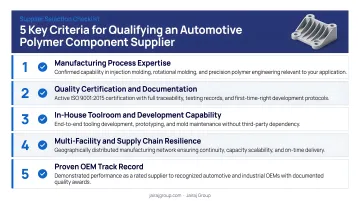
Key Qualifying Criteria
- IATF 16949 certification — the automotive-specific QMS standard, aligned with ISO 9001 but adding supply-chain requirements specific to the sector
- In-house tool room — enables faster mould development, modification, and first-article turnaround without third-party tooling delays
- Resin-specific processing controls — documented melt temperature, mould temperature, drying time, and cycle parameters for each high-performance resin grade
- Dimensional and functional testing — CMM capability, material properties validation, thermal cycling, and chemical resistance testing with full documentation
- PPAP and FMEA documentation — required for OEM supplier qualification; absence is a disqualifier in most Tier-1 programmes
Development Speed as a Competitive Differentiator
OEM launch timelines leave little room for development iterations. A supplier's ability to produce first-time-right tooling and validate it quickly compresses the window from design freeze to production start.
Jairaj Group received the "Best Supplier Award For Fastest & First Time Right Developments" from Endurance Technologies, reflecting a development process that integrates DFM analysis, flow simulation, and prototype iteration before tool steel is cut.
Their ISO 9001:2015-certified quality system, combined with in-house tool room capabilities across six manufacturing facilities, supports the full documentation trail (PPAP, FMEA, control plans, material certifications) that Tier-1 and OEM programmes require.
Frequently Asked Questions
What are examples of high-performance polymers for automotive applications?
The most common are PEEK for high-temperature engine and transmission parts, PPS for fuel system and fluid handling components, PEI for EV electrical connectors and insulators, and glass-filled polyamide (PA66, PPA) for intake manifolds and structural brackets.
What polymers are used in automotive applications?
Automotive polymers span the full material hierarchy — from commodity grades like PP and ABS used in interior trim, to high-performance resins required for under-hood and EV powertrain environments. The further a component sits from ambient conditions (higher heat, harsher chemicals, greater load), the further up the performance ladder the material selection moves.
How do high-performance polymers contribute to EV range and efficiency?
Replacing metal components with polymer equivalents reduces vehicle mass, which directly reduces energy consumption per kilometre. NREL modelling showed a 150 kg mass reduction cut required battery energy from 24 kWh to 23 kWh for the same range target. Polymers with high dielectric strength also improve safety and efficiency in high-voltage electrical systems.
What is the difference between engineering plastics and high-performance polymers in automotive use?
Engineering plastics like standard nylon or polycarbonate offer improved properties over commodity grades but lose structural integrity above 130–150°C or in aggressive chemical environments. High-performance polymers like PEEK and PPS maintain their mechanical and chemical resistance properties at temperatures above 200°C — the threshold that under-hood and EV powertrain applications frequently demand.
Can high-performance polymers replace metal in automotive components?
Yes, in many non-structural applications. PPA grades can replace metal at roughly 50% of original component weight while maintaining stiffness and strength. However, metal replacement decisions must be validated against load-bearing requirements, crash-safety standards, and the specific operating environment — polymer substitution is not a blanket decision.
What certifications should automotive polymer component manufacturers hold?
ISO 9001:2015 is the baseline quality management requirement. IATF 16949 is the automotive-specific standard covering supply chain requirements, PPAP, and FMEA processes. Manufacturers supplying EV components should also provide material certifications, resin batch traceability, dimensional documentation, and RoHS compliance data conforming to OEM-specific material specifications.