The challenge is two-layered: India-side export formalities (IEC, DGFT, GST) and EU/Finland destination requirements (CE marking, REACH, customs documentation). Getting both layers right is what separates shipments that clear smoothly from those that sit in customs.
This guide walks through both layers step by step.
Key Takeaways
- HS classification: Plastic parts for industrial use fall under Chapter 39 (typically heading 3926); Finnish customs requires a 10-digit TARIC code
- EU compliance: CE marking applies when parts enter regulated finished products; REACH covers all articles with SVHCs above 0.1% by weight
- Key documents: Commercial invoice, Certificate of Origin, Packing List, Bill of Lading/AWB, and Shipping Bill
- Sea freight route: JNPT or Mundra → Hamburg/Rotterdam → Helsinki Vuosaari (25–45 days transit)
- Air freight: Recommended for samples and urgent batches only
- Incoterms guidance: FOB or CIF recommended for first-time Finland shipments to limit liability exposure
Why Finland Is a Strategic Entry Point for Indian Plastic Exporters
Finland punches above its weight as an EU entry point. Its industrial base spans automotive supply chains, electronics manufacturing, and heavy machinery, and creates consistent demand for precisely the kind of B2B plastic components that Indian manufacturers like Jairaj Group produce.
The strategic logic is straightforward: goods released into EU customs territory for free circulation can move freely across all 27 member states. According to the European Commission, once your shipment clears Finnish customs and enters free circulation, it can be distributed to German, Swedish, or Dutch buyers without further import formalities. For Indian manufacturers targeting Northern Europe broadly, that single customs clearance covers the entire region.
What Finnish Industrial Buyers Actually Look For
Finnish OEMs and Tier 1 suppliers prioritise suppliers who arrive with paperwork in order. Quality documentation, material traceability, and on-time delivery matter as much as unit price. Manufacturers holding ISO 9001:2015 certification (and ideally IATF 16949 for automotive applications) move through supplier qualification audits faster than those without.
This is where experienced Indian manufacturers hold a real advantage. Jairaj Group, for instance, operates under ISO 9001:2015 quality systems across its six manufacturing facilities, with full material traceability documentation, PPAP reports, and in-house dimensional and durability testing. That's exactly the documentation package Finnish procurement teams request during onboarding.
The sectors with the strongest plastic parts demand in Finland:
- Automotive and heavy vehicles: housings, brackets, pedal systems, suspension components
- Industrial machinery: precision gears, bushings, custom enclosures
- Electronics and electrical equipment: relay holders, connector housings, instrument panels
- Medical and aerospace: device casings, avionics enclosures
India-Side Export Requirements: IEC, HS Codes, and DGFT Compliance
Registrations Every Indian Plastic Exporter Needs
The Importer Exporter Code (IEC) is mandatory for any Indian export — no physical goods can legally leave India without one. Issued by DGFT and linked to your firm's PAN, the IEC requires:
- A valid PAN for the firm
- A bank account in the firm's name
- A verified business address
Applications are filed through the DGFT portal.
GST compliance gives exporters two routes:
- File a Letter of Undertaking (LUT) in Form GST RFD-11 before shipment — this allows zero-rated exports without paying IGST upfront, with input tax credit (ITC) refundable afterward
- Pay IGST on the export and claim a refund afterward, using the Shipping Bill as the refund application when returns and export manifests are filed correctly
Most regular exporters prefer the LUT route to preserve working capital. Note that LUT filing is not available to exporters prosecuted for tax evasion of ₹2.5 crore or more.
With IEC and GST compliance in place, the next step is classifying your goods correctly — which determines duties on both the Indian and Finnish side.
HS Code Classification for Plastic Parts Under Chapter 39
All plastic parts fall under HS Chapter 39 of the Harmonized System. Getting the sub-heading right is critical — the code must match exactly across all export documents and the Shipping Bill filed through ICEGATE.
| HS Code | Description | Typical Application |
|---|---|---|
| 3916 | Monofilament, rods, sticks, profile shapes | Extruded structural profiles |
| 3917 | Tubes, pipes, hoses and fittings | Industrial fluid system parts |
| 3926 | Other articles of plastics | Injection-molded housings, brackets, precision components |
| 3923 | Articles for conveyance or packing | Packaging components |
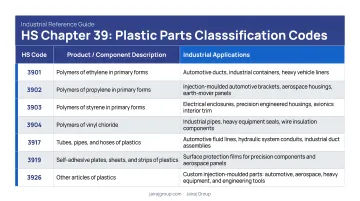
For injection-molded and blow-molded industrial components, heading 3926 is the standard classification.
On the EU side, Finnish customs requires a 10-digit TARIC code — extending beyond the 6-digit HS and 8-digit CN level. According to Finnish Customs, the TARIC code determines applicable duty rates, licensing requirements, and any restrictions. Verify your product's TARIC classification using the EU TARIC database.
The Shipping Bill, filed through ICEGATE (India's customs e-filing portal), is the primary Indian export document. It captures the IEC, HS code, declared value, buyer/seller details, and port of export.
Errors in ICEGATE filing can delay cargo release at the Indian end. The most common mistakes to avoid:
- Mismatched invoice numbers
- Incorrect GSTIN
- Wrong port codes
Supporting documents can be attached digitally via e-Sanchit.
EU and Finland Compliance Requirements for Plastic Parts
CE Marking: When Is It Required?
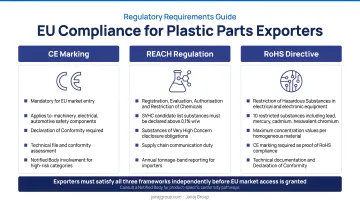
CE marking does not apply to plastic parts as standalone components. It becomes mandatory when those parts are incorporated into a finished product covered by an EU directive.
Practical examples relevant to Indian exporters:
- **Plastic housing for industrial electrical equipment** → Low Voltage Directive (2014/35/EU) applies to the finished product
- Injection-molded machine guard or bracket → Machinery Regulation (EU) 2023/1230, mandatory from January 2027
- **Plastic casing for a medical diagnostic device** → Medical Devices Regulation (EU) 2017/745
If you're supplying plastic components as B2B inputs, confirm the end-use with your Finnish buyer. They may need to include your component in their own CE conformity assessment documentation.
REACH Regulation: Chemical Compliance
EU REACH Regulation (EC No 1907/2006) sets binding obligations for plastic part exporters. If any article you supply contains a Substance of Very High Concern (SVHC) from ECHA's Candidate List at more than 0.1% by weight, you must provide the recipient with safe-use information. Consumers can request this information free of charge within 45 days.
Finnish importers will ask for REACH compliance declarations or test reports from an accredited lab before placing orders. Prepare material declarations and, where applicable, third-party test evidence for your polymer compounds and any additives.
Suppliers exceeding the 0.1% SVHC threshold also carry SCIP (Substances of Concern In Products) database obligations under the EU Waste Framework Directive — a separate submission requirement your Finnish buyer will likely flag during onboarding.
Additional Standards Finnish Buyers Expect
RoHS compliance applies when plastic parts go into electrical or electronic equipment (EEE). The RoHS Directive restricts 10 substances, including:
- Lead, mercury, cadmium, and hexavalent chromium
- Phthalates: DEHP, BBP, DBP, and DIBP
Plastic relay holders, connector housings, and instrument panels fall squarely in this category. RoHS declarations of conformity are required for these product lines.
Carbon footprint documentation: Finnish industrial buyers increasingly request lifecycle and carbon footprint data as part of their supply chain sustainability reporting. Collecting this data now positions Indian suppliers better for tenders over the next 2–3 years. Note that plastics are currently outside CBAM scope — which covers cement, aluminium, fertilisers, steel, hydrogen, and electricity — but sustainability expectations are tightening across B2B procurement regardless.
Essential Export Documentation Checklist for India-to-Finland Shipments
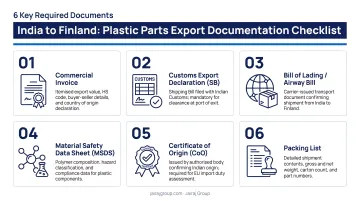
A single error on the commercial invoice can trigger customs holds in Finland. Every document below must be accurate and complete before the shipment moves.
Document-by-Document Breakdown
Commercial Invoice — Must include:
- 10-digit TARIC/HS code
- Precise product description (not generic terms like "plastic parts")
- Declared value in EUR or USD
- Buyer and seller details with addresses
- Country of origin: India
- Incoterms used (e.g., FOB Mumbai)
Certificate of Origin — India and the EU concluded FTA negotiations in January 2026, but preferential tariff treatment is not confirmed as in force at the time of publication. Until confirmed, standard MFN duties apply. Obtain a general Certificate of Origin through FIEO or your local Chamber of Commerce.
- GSP/REX note: Form A certificates are no longer accepted for GSP preferential treatment after June 2020. If claiming GSP, you must be registered under the REX (Registered Exporter) system.
Packing List — Itemised list of contents, weights, and dimensions per package.
Bill of Lading (sea) or Air Waybill (air freight) — Issued by the carrier; the Finnish importer needs this to take possession of goods.
Single Administrative Document (SAD) — Filed by the Finnish importer or their customs broker with Finnish Customs upon arrival. This is the standard EU import declaration for goods from non-EU countries.
EORI Number — The Finnish importer must hold an EORI (Economic Operator Registration and Identification) number to clear goods through EU customs. Confirm your buyer's EORI status before shipment.
- DDP Incoterms: If shipping on DDP terms, the Indian exporting entity will also need an EU EORI number.
Additional documents Finnish customs or buyers may request:
- REACH compliance declaration
- Material Safety Data Sheets (MSDS/SDS)
- RoHS declaration of conformity
- Test certificates for applicable EU directives
- Packing conformity declarations for any hazardous materials
Shipping Routes and Logistics from India to Finland
Sea Freight: The Standard Route
The primary routing for India-to-Finland shipments runs from JNPT (Nhava Sheva) or Mundra to major European hub ports — Hamburg, Rotterdam, or Antwerp — then onward via feeder service or road transport to Helsinki's Port of Vuosaari, which handles containerised cargo and RoRo traffic.
Transit time: Freightos estimates sea shipping at 20–45 days for general India-Europe routes; 25–35 days is a reliable working estimate for this lane — confirm with your carrier before quoting lead times to Finnish buyers.
FCL vs. LCL decision:
- FCL (Full Container Load) for high-volume or repeat orders — better per-unit cost, faster clearance
- LCL (Less than Container Load) for smaller initial orders or mixed-product shipments
Air Freight: For Samples and Urgent Shipments
Air freight routing runs from Delhi IGI or Mumbai Chhatrapati Shivaji through European hubs (Frankfurt, Amsterdam) to Helsinki-Vantaa Airport. Finnair Cargo operates direct Asia-Europe services through its Helsinki hub.
Use air freight when:
- Sending first samples or prototype batches for approval
- Fulfilling urgent replacement orders
- Shipping high-value, low-weight precision components where air freight cost is marginal relative to part value
Finland-Specific Logistics Considerations
- Baltic ice season: According to the Finnish Meteorological Institute, ice cover peaks January–March with freezing possible from October — plan shipment windows and buffer stock around this schedule
- Packaging protection: Cold and moisture-resistant packaging for plastic components shipped November through March
- Freight forwarder selection: Use a forwarder with proven India-EU lane experience who can handle customs brokerage at both ends — ICEGATE filing in India and SAD filing in Finland
Packaging, Labeling, and Incoterms for Finland-Bound Plastic Parts
Labeling Requirements
For B2B industrial plastic parts, labeling requirements are less extensive than for consumer goods. At minimum:
- Country of origin marking: "Made in India" on packaging (used by Finnish customs alongside commodity code and declared value to determine duty)
- Material identification codes where applicable to the product
- Relevant compliance markings (CE, RoHS symbol) on packaging or accompanying documentation when required by the applicable directive
ISPM 15 Compliance for Wood Packaging
All wooden packaging materials (pallets, crates, dunnage) used in shipments to Finland must comply with ISPM 15 standards. Requirements include:
- Wood must be debarked and heat-treated to approved standards
- The ISPM 15 mark must be stamped visibly on each piece
- Non-compliant packaging can trigger delays, rejection, or forced treatment at the exporter's cost
Confirm ISPM 15 compliance with your packaging supplier before every shipment — Finnish Customs enforces this consistently.
Once packaging and compliance are sorted, the next decision is who controls freight, insurance, and risk in transit. That's where Incoterms come in.
Incoterms Guidance
| Incoterm | Exporter Responsibility | Best Used When |
|---|---|---|
| FOB | Ends at Indian port when goods are on board | Buyer has established freight relationships |
| CIF | Arranges freight and insurance to Finnish port | Exporter wants to control freight selection |
| DAP | Delivers to Finnish buyer's premises; buyer handles import | Established relationships; exporter comfortable with EU logistics |
Recommendation for first-time exporters: Start with FOB or CIF. These terms limit your liability exposure while the trade relationship matures. DAP can be offered as a value-add once you have a reliable freight forwarder and understand the Finnish buyer's clearance process.
Frequently Asked Questions
How do you export products from India to Europe?
Exporting from India to Europe requires an IEC from DGFT, correct HS/TARIC code classification, a Certificate of Origin, and compliance with EU product regulations (CE marking, REACH, or RoHS where applicable). File a Shipping Bill through ICEGATE, and coordinate with a freight forwarder for sea or air routing to your destination EU country.
Which plastic products are exported from India?
India's major plastic export categories include injection-molded and blow-molded components, plastic packaging, pipes and fittings, household articles, and engineering polymer parts — with B2B precision components for automotive, electronics, and medical sectors among the fastest-growing segments.
What is the export promotion scheme for plastics in India?
PLEXCONCIL (Plastics Export Promotion Council) and DGFT run government-backed schemes to support plastic product exports, covering incentives and market development assistance. Scheme details change periodically — check the PLEXCONCIL or DGFT website directly for current program specifics.
Do Indian plastic exporters need CE marking to sell in Finland?
CE marking is required only when plastic parts are incorporated into a finished product covered by an EU directive — machinery, electrical equipment, or medical devices, for example. Raw or semi-finished plastic components supplied as B2B inputs typically don't need CE marking themselves, but confirm the end-use application with your Finnish buyer.
What import duty applies to plastic parts from India imported into Finland?
Finland applies the EU Common External Tariff (CET), and rates vary at the 10-digit TARIC level — there is no single duty for all plastic parts. Indian exporters currently pay standard MFN rates; use the EU TARIC database to confirm your specific code before quoting prices.
What is the best shipping route from India to Finland for plastic parts?
For regular volume, sea freight via JNPT (Nhava Sheva) or Mundra to Hamburg or Rotterdam — then onward to Helsinki Vuosaari — is the standard cost-effective route. Air freight from Delhi or Mumbai suits urgent samples or high-value, low-weight consignments where speed justifies the premium.