Introduction
Naval vessels operate in conditions that expose every component to simultaneous, compounding stress. Saltwater corrodes metal and degrades seals across a salinity range that averages 35 parts per thousand. Hydrostatic pressure at operational depths stresses every joint. Continuous engine and propeller vibration fatigues components over thousands of operating hours, while temperature swings between Arctic patrols and tropical deployments cycle materials through extremes that exceed 60°C differential.
Metal components have served naval engineering for centuries, but they carry serious liabilities in this environment. Corrosion drives maintenance costs into the billions globally. Dead weight reduces range and payload. Protective coatings require constant renewal — and still fail.
For naval engineers and procurement teams, engineering plastics are no longer an alternative under consideration. The decisions now are which polymers, in which applications, and against which compliance standards.
This guide covers the high-performance polymers specified for naval applications, where precision plastic parts are deployed across vessel systems, what engineering tolerances and compliance standards apply, and what separates a qualified manufacturing partner from a commodity supplier.
Key Takeaways
- Engineering plastics — PEEK, PTFE, UHMWPE, glass-filled Nylon — outperform metals in corrosive, high-pressure naval environments without sacrificing structural integrity
- Precision plastic parts are critical across propulsion, navigation, fluid handling, electronics, and weapons systems
- Naval components must satisfy MIL-SPEC, DEF STAN, and India-specific DAP requirements with full material traceability
- Sourcing demands an ISO-certified manufacturer with in-house tooling, polymer-specific expertise, and documented quality systems
Why Naval Defence Vessels Demand Precision Plastic Components
The Operational Environment Makes Material Selection Critical
No other operating environment combines saltwater immersion, hydrostatic pressure, constant mechanical vibration, and thermal cycling the way naval service does. A submarine diving repeatedly through thermoclines subjects every component to pressure changes and temperature differentials that would crack a brittle metal fitting or delaminate a poorly bonded assembly within months.
Material selection is therefore a core engineering decision for every system on a naval vessel — not a procurement afterthought.
Weight, Corrosion, and Acoustic Performance
Three arguments drive plastic adoption in naval applications:
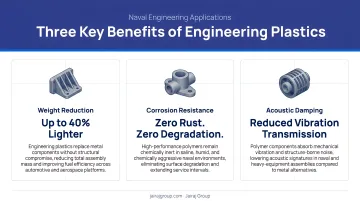
PEEK components weigh up to 70% less than equivalent steel parts, and carbon-fibre-reinforced PEEK brackets have achieved 40% lower weight versus aluminium. On naval vessels, every kilogram eliminated from non-structural components contributes directly to fuel efficiency, extended operational range, and increased mission payload.
Engineering plastics such as PEEK, PTFE, and Nylon do not oxidise, pit, or require protective coatings to survive saltwater immersion — unlike stainless steel or aluminium. This inertness reduces maintenance cycles and cuts vessel downtime. Corrosion costs Navy surface fleets an estimated $2.43 billion per year; plastics simply sidestep that problem.
For submarines, stealth corvettes, and patrol vessels, acoustic signature is a tactical asset. Research from Defence Research and Development Canada confirms that most modern submarine hulls use anechoic rubber tiles to support stealth. Elastomers, UHMWPE composites, and filled PTFE absorb vibration energy and reduce transmitted noise — properties no metal can replicate.
Lifecycle Cost Reality
Beyond initial material cost, the total ownership comparison favours engineering plastics in high-wear naval applications. Victrex reports PEEK bearings achieving approximately 10,000 service hours compared to roughly 1,000 hours for polyamide bearings under the same test conditions, and up to 4× longer lifecycle for PEEK seals versus standard PTFE. Fewer replacement cycles means fewer vessel downtime events — a direct operational cost saving.
Military-Grade Plastics: Materials Selection for Naval Defence
"Military-grade plastic" is not a single trademarked product. It describes polymer materials that have been formulated, tested, and specified to meet defined mechanical, thermal, chemical, and environmental thresholds established by military standards bodies. Engineers encountering this term in procurement documents should read it as a performance classification, not a material name.
Structural and Load-Bearing Applications
PEEK (Polyether Ether Ketone)
PEEK operates continuously at temperatures up to 200°C+, resists hydrolysis and hydraulic fluids, and maintains exceptional dimensional stability under sustained mechanical load. MIL-P-46183 is the US military specification covering PEEK moulding and extrusion material.
Primary naval applications include bearing housings, pump components, sonar transducer mounts, and structural brackets where metal-equivalent strength is required at substantially reduced weight. Jairaj Group processes PEEK across precision components for defence applications, including sensor housings and tight-tolerance structural parts.
UHMWPE (Ultra-High Molecular Weight Polyethylene)
With a density of 0.92–0.95 g/cm³, UHMWPE floats on water, an inherent advantage in marine applications. Standard notched impact tests cannot break the material under ISO 179 conditions, and it operates across a temperature range from -269°C to +80°C.
Its self-lubricating property eliminates grease requirements in wet-environment bushings. Defence applications include ballistic fabrics and vehicle armour; its abrasion resistance and low friction make it equally relevant for hull wear components and impact liners.
Sealing, Fluid Handling, and Electrical Systems
PTFE and Filled Grades
PTFE delivers a continuous service temperature of 260°C, chemical inertness to virtually all corrosive reagents, and a static coefficient of friction as low as 0.05–0.08 against polished steel. Glass-filled and carbon-filled grades improve dimensional stability under load. Naval applications include:
- Shaft seals and gaskets in fuel and hydraulic systems
- Valve seats in high-temperature coolant circuits
- Liner bearings where chemical exposure rules out lubricated metal
Glass-Filled Nylon (PA66-GF)
Glass-fibre reinforcement reduces moisture-driven dimensional change to less than 0.1% per 1% water absorption longitudinally, per BASF Ultramid data — a critical property in marine environments where unreinforced nylon would swell unpredictably. Applications include cable guides, pipe clamps, structural brackets, and connector housings. Jairaj Group's PA66-GF processing experience across high-volume automotive programmes translates directly to the dimensional consistency naval connector and bracket assemblies demand.
Polycarbonate (PC) and ABS
PC's impact resistance and optical clarity suit it for instrument covers, sight windows, and lens housings. SABIC LEXAN transparent sheets achieve 80% light transmission at 2mm for aerospace and military interior applications.
ABS offers dimensional stability and machinability for electronics enclosures, duct fittings, and interior structural housings. Both materials are qualified in aerospace supply chains and carry equivalent performance relevance for naval applications sharing those environmental demands.
Key Applications of Precision Plastic Parts on Naval Vessels
Propulsion and Drivetrain Systems
Precision-moulded PEEK and UHMWPE bushings, bearing retainers, seal housings, and impeller components appear throughout propulsion shafts, water-jet systems, and auxiliary pumps. Tight dimensional tolerances are critical at this tolerance level. Misalignment from a poorly toleranced bushing translates directly into vibration, fluid leaks, and potential catastrophic mechanical failure at sea.
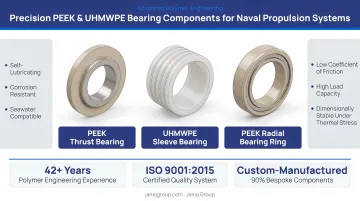
Jairaj Group supplies self-lubricating plastic bearings in PEEK and POM construction with maintenance-free operation and validated load capacity. Their UHMWPE bushings are designed specifically for wet-environment, corrosion-free operation — properties directly applicable to naval propulsion systems.
Navigation, Sonar, and Communications
Radar arrays, sonar domes, GPS antenna mounts, and radio communication housings require plastics that are EMI-transparent or selectively shielded, dimensionally stable across wide temperature ranges, and UV-resistant for topside exposure. Rubber sonar domes have become the standard over steel predecessors on Navy vessels, owing to their superior transducer protection and acoustic transparency.
Jairaj Group produces avionics enclosure panels with EMI/RFI shielding in materials including PC, ABS, PEEK, and ULTEM, manufactured under AS9100 aerospace standards. This capability applies directly to naval sensor housing production.
Fluid Systems — Fuel, Hydraulic, and Coolant
PTFE-lined fittings, Nylon pipe clamps, and engineered plastic valve components appear throughout naval fluid distribution systems. Chemical compatibility with naval distillate fuels and Mil-Spec hydraulic fluids is a primary material selection criterion.
Jairaj Group manufactures PTFE seals with custom profiles for industrial and defence fluid applications, covering:
- Temperature resistance across naval operating ranges
- Low friction for reduced pump load and wear
- Chemical inertness against fuels and hydraulic fluids
Weapons Systems and Electronics Protection
Precision plastic housings for guidance electronics, decoy launcher mechanism components, and munitions storage fittings require repeatable, first-time-right production. Insert moulding and overmoulding allow metal fasteners and electrical conductors to be encapsulated within plastic housings, achieving the required strength at reduced weight while maintaining electrical isolation.
For defence applications where dimensional repeatability directly affects mission readiness, Jairaj Group's PLC-controlled injection moulding process with real-time monitoring delivers the consistency required. The company has documented insert moulding and overmoulding production for hybrid metal-plastic configurations, including electrical insulation components for defence and aerospace customers.
Engineering Requirements: Tolerances, Testing, and Performance Standards
Tolerance Expectations
Tight tolerances in precision plastic moulding are maintained through PLC-controlled injection moulding machines with real-time cavity pressure monitoring, calibrated cooling systems, and closed-loop process adjustments. General tolerance guidance for machined and moulded components follows frameworks such as ISO 2768, though actual requirements for naval components are contract-specific and must be drawn from the component qualification plan.
Jairaj Group's precision moulding lines incorporate cavity balancing and calibrated cooling with dimensional verification and full traceability documentation built into every defence production run.
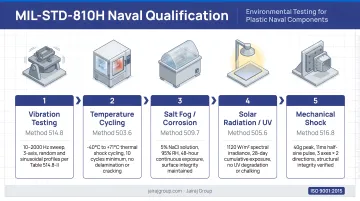
Naval Environment Testing Protocols
Tolerances alone don't determine acceptance — environmental qualification testing does. Pass/fail criteria and duration requirements are defined by the contract qualification plan, not by the test standard in isolation. Naval plastic components typically undergo:
- Salt spray/fog testing per ISO 9227 (equivalent to ASTM B117), evaluating corrosion resistance under continuous saline exposure
- Shock and vibration qualification under MIL-STD-810H (31 January 2019) — Method 514 for vibration, Method 516 for shock, and Method 528.1 for shipboard mechanical vibration, tailored to each component's lifecycle profile
- Hydrostatic pressure immersion, verifying sealing integrity and structural stability at operating depth
- Thermal cycling to confirm dimensional stability and material integrity across the full service temperature range
- UV/weathering exposure for topside and externally mounted components
Material Documentation and Batch Traceability
Naval procurement requires a complete documentation package for every production lot:
- Material certificates confirming polymer grade, batch number, and supplier chain
- Dimensional inspection reports against the approved drawing
- Process control records demonstrating parameter stability during the production run
- Test data for any environmental or mechanical qualification tests
Jairaj Group delivers this full documentation package as standard, with ISO 9001:2015-certified quality systems supporting batch traceability from raw material receipt through finished component delivery.
Compliance Standards and Certification Requirements for Naval Defence Plastic Parts
International Military Standards
Naval procurement teams are typically bound by a layered compliance framework — international military specifications set the material baseline, while programme-specific and national requirements govern qualification. Key MIL-SPEC references for naval plastic components include:
| Specification | Material | Status |
|---|---|---|
| MIL-P-46183 (Amendment 2, 1999) | PEEK moulding and extrusion material | Active; verify current status via DLA ASSIST |
| MIL-P-22241B | PTFE sheet and film | Superseded by ASTM D3293, D3308, D3369 |
UK DEF STAN standards are managed under MOD standardisation policy via JSP 920. Specific DEF STAN numbers applicable to naval plastic components are programme-specific and should be confirmed from the RFP. NATO STANAG applicability to precision plastic components is similarly programme-defined — no universal polymer-specific STANAG was identified in available public sources.
Indian naval defence programmes frequently reference international MIL-SPEC and DEF STAN benchmarks as performance baselines for critical systems components.
India-Specific Defence Compliance
For Indian suppliers, the compliance pathway involves:
- Defence Acquisition Procedure (DAP) 2020 — governs acquisition categories, indigenous content requirements, and planning; confirms the Atmanirbhar Bharat indigenisation framework for domestic supplier qualification
- DDP QAD-R03 — covers quality assurance for engineering and hull equipment for Indian Naval warships
- JSG 015-2018 — governs registration of manufacturers for defence, including self-certification status requirements for approved suppliers with comprehensive quality systems
Specific indigenous content percentages and programme qualification targets are RFP-defined and should be sourced directly from current MoD or programme documentation.
ISO 9001 and Higher Certification Benchmarks
ISO 9001:2015 is the minimum expected quality management certification for any supplier entering the naval defence supply chain. Procurement teams evaluating suppliers for critical applications should also look for:
- AS9100 — for suppliers serving aerospace-adjacent or dual-use defence programmes
- IATF 16949 — relevant for automotive-adjacent defence programmes
- PPAP-equivalent First Article documentation — material certificates, dimensional reports, process control plans, and FMEA as part of first-article approval packages
- First Article Testing (FAT) — full performance validation against specification before series production release, covering dimensional conformance, material properties, and functional performance under simulated operating conditions
Choosing the Right Precision Plastic Parts Manufacturing Partner for Naval Defence
Core Manufacturing Capabilities to Evaluate
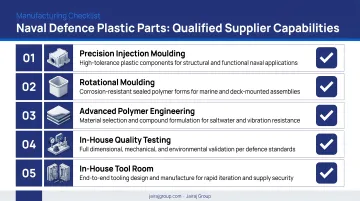
A qualified naval defence plastic parts manufacturer must demonstrate:
- In-house tool room covering mould design, CNC machining, and rapid design iteration without third-party dependency
- Multi-cavity precision injection moulding with PLC process control and real-time monitoring
- Validated polymer processing experience across PEEK, PTFE, UHMWPE, glass-filled Nylon, and Polycarbonate
- Insert moulding and overmoulding capability for hybrid metal-plastic configurations
- Dedicated quality infrastructure including dimensional verification, material testing, and traceability documentation
Quality Documentation and Supply Chain Reliability
Certifications establish the baseline — but procurement teams should verify operational execution:
- Can the supplier deliver complete documentation packages (material certs, inspection reports, process records) on time and at production scale?
- Does the supplier maintain production capability across multiple facilities to protect against single-site disruption?
- Is there an established process for first-article approval and ongoing process control?
Supply chain interruptions for critical naval components have direct programme-milestone consequences. A supplier operating across multiple facilities with documented process controls at each site presents lower delivery risk than a single-site operation.
Jairaj Group as a Domestic Precision Plastic Parts Partner
Jairaj Group has been engineering precision polymer components since 1985, operating six manufacturing facilities across India — in Haryana, Uttarakhand, Maharashtra, and Gujarat. That multi-site footprint directly addresses the delivery continuity criteria naval procurement teams require.
Key qualifications relevant to naval defence procurement:
- ISO 9001:2015 certified, with PLC-controlled injection moulding and real-time process monitoring across all facilities
- In-house tool room covering mould development, CNC machining, and prototype tooling for rapid design iteration
- Validated polymer portfolio: PEEK, PTFE, UHMWPE, PA66-GF, Polycarbonate, and ABS
- Complete documentation packages — material traceability certificates, dimensional inspection reports, and process control records as standard deliverables
- Defence component experience spanning sensor housings, EOD suit components, avionics enclosures with EMI/RFI shielding, and armoured vehicle panels
As a domestic Indian manufacturer, Jairaj Group supplies naval defence OEMs and shipyards seeking qualified suppliers aligned with Atmanirbhar Bharat indigenisation objectives under DAP 2020.
Naval component enquiries can be directed to the Jairaj engineering team at japl@jairajgroup.com or +91-9711-114-300 for discussion of application requirements, material selection, and compliance documentation.
Frequently Asked Questions
What is military-grade plastic and how is it specified for naval defence components?
"Military-grade plastic" refers to polymer materials meeting defined mechanical, chemical, and environmental performance thresholds set by standards bodies such as MIL-SPEC or DEF STAN. Specification involves selecting materials against criteria covering temperature range, chemical resistance, pressure tolerance, and service life. It describes a performance classification, not a single proprietary material.
What types of plastics are used to manufacture precision parts for naval defence vessels?
The most common high-performance engineering plastics for naval applications are PEEK, PTFE, UHMWPE, glass-filled Nylon, Polycarbonate, and ABS. Selection depends on the specific application, operating environment (fluid contact, pressure, temperature), and the mechanical performance requirements defined in the component specification.
Which plastics used in aerospace are suitable for naval defence precision parts?
Aerospace-grade polymers — particularly PEEK, PTFE, and Polycarbonate — are well-suited for naval defence because both sectors share demanding requirements for chemical resistance, dimensional stability under pressure and thermal cycling, and low weight-to-strength ratios. Jairaj Group's AS9100-qualified aerospace component capabilities apply directly to naval applications.
What types of plastic are used in marine vessels and naval defence ships?
Commercial marine applications commonly use GRP/FRP composites, PVC, and Nylon for deck and hull fittings. Naval defence applications require a higher tier — PEEK, PTFE, UHMWPE, and glass-filled engineering plastics for precision structural, propulsion, and systems components, held to far stricter specifications than commercial marine standards.
What compliance certifications are required for plastic parts used in Indian naval defence?
Indian naval defence suppliers typically must meet several overlapping compliance requirements:
- ISO 9001:2015 as the baseline quality management standard
- DAP 2020 indigenous content requirements under the Defence Acquisition Procedure
- DDP QAD-R03 quality assurance standards for naval equipment
- Full material traceability documentation throughout the supply chain
- MIL-SPEC or DEF STAN performance benchmarks as referenced in the programme RFP