Introduction
Modern defence platforms face a relentless engineering challenge: reduce weight without sacrificing survivability, strength, or reliability. For ground vehicles, this tension is stark — a DTIC study found that MRAP vehicles weigh approximately four times that of a HMMWV and consume twice the fuel. For airborne systems, every gram affects lift, range, and endurance. For soldiers in the field, U.S. Army doctrine sets the fighting load threshold at 22 kg — beyond that, performance and survivability both degrade.
Material selection sits at the centre of this problem. Lightweight engineering plastics — not commodity polymers, but precision-specified materials like PEEK, polycarbonate, UHMWPE, and ABS — have shifted from secondary options to first-choice solutions across defence manufacturing.
This article covers where these materials are applied, what the verified weight and density figures show, and what operational advantages they deliver across the platform lifecycle.
Key Takeaways
- PEEK, polycarbonate, HDPE, UHMWPE, and ABS now replace metal in military aircraft, UAVs, armoured vehicles, and personal protection equipment
- Most engineering plastics weigh between 0.96–1.40 g/cm³ vs. aluminium at 2.70 g/cm³ and steel at 7.85–8.06 g/cm³
- Lighter platforms lower fuel consumption, extend UAV endurance, reduce soldier load, and cut logistics costs
- Corrosion is among the costliest maintenance failures in defence fleets globally; plastics eliminate the oxidation and rust that drive those recurring costs
- The correct material-process pairing is non-negotiable; wrong selections fail in field conditions
What Are Lightweight Plastic Materials for Defence?
In defence manufacturing, "lightweight plastics" means high-performance engineering thermoplastics — materials formally specified in military and aerospace standards, not off-the-shelf commodity polymers.
Several polymers carry explicit military or aerospace designations:
- PEEK — covered under MIL-P-46183 ("Plastic Molding and Extrusion Material, Polyetheretherketone")
- Polycarbonate — originally specified in MIL-P-83310, now superseded by SAE AMSP83310 for transparent aerospace applications
- PTFE — covered by SAE AMS3678A for mouldings and extrusions
- PAI (Polyamide-imide) — specified in SAE AMS3670/1B (unfilled) and AMS3670/5D (30% carbon-fibre filled)
UHMWPE, HDPE, ABS, and Nylon are selected at the programme level based on performance requirements rather than a single overarching specification. What they share is the need to clear a consistent performance threshold — which is what the "defence-grade" classification actually measures.
What Makes These "Defence-Grade"
The classification reflects a performance threshold: FST (flame, smoke, toxicity) compliance, thermal stability, impact absorption, chemical inertness, and dimensional repeatability under load. Under 14 CFR 25.853 and Appendix F — the FAA's aircraft interior fire-test framework — applicable materials must meet burn limits of no more than 15 seconds average flame time, heat release ceilings of 65 kW/m², and smoke density limits of Ds ≤ 200.
Meeting these thresholds is what makes metal replacement viable — reducing platform weight without trading away the structural or fire-safety properties that field applications demand.
Key Defence Applications for Lightweight Plastics
Military Aircraft and UAVs
In fixed-wing and rotary aircraft, performance plastics appear in cockpit instrument enclosures, interior panels, bulkheads, cargo containers, window shades, and electrical connectors. Amphenol Pcd replaced several metal retention clips in an aircraft electrical connector with a single VICTREX PEEK component — reducing part count while meeting the thermal and chemical demands of the application.
For high-temperature structural applications, PEEK, PTFE, and PAI are formally specified for their thermal stability, low outgassing, and FST compliance. Daher's LMPAEK thermoplastic composite panels matched the strength and stiffness of legacy materials while delivering FST compliance and improved fatigue performance.
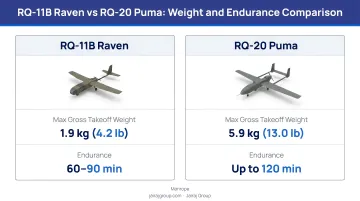
In UAV applications, weight is directly tied to mission capability. The RQ-11B Raven weighs 4.4 lb with 60–90 minutes of endurance; the RQ-20 Puma, at 13.5 lb, achieves 3.5 hours. Every gram added to airframe structure displaces payload or shortens flight time. ABS and polycarbonate are widely used for UAV housing components, drone arms, motor mounts, propeller guards, and body shells — selected for strength-to-weight ratio, impact resistance, and UV stability.
Armoured Vehicles and Ground Transport
Polycarbonate is the material of choice for ballistic-resistant window glazing. Defence vehicle armour kits for tactical applications reference STANAG 4569 AEP55, NIJ 0108.01, and ATPD-2352 as applicable ballistic standards, while SAE AMSP83310 covers transparent polycarbonate sheet for aerospace transparent enclosures.
Plastics also appear throughout armoured vehicle interiors:
- Dashboard assemblies and instrument panels
- Fuel and hydraulic line components
- Seals and protective covers
Metal components in vehicles exposed to moisture, fuel, salt, and field chemicals degrade and require frequent replacement. Plastic alternatives hold their geometry and chemical properties without protective coatings or treatment schedules.
Personal Protection and Tactical Equipment
UHMWPE is the defining material for soft ballistic protection. ArmorSource's selection of Honeywell Spectra Shield (UHMWPE) for helmets used by U.S. and international militaries specifically cited reduced helmet weight and improved mobility without sacrificing ballistic performance.
Polycarbonate is used for face shields and protective eyewear, while impact-absorbing polymer structures appear in helmet liners and padding. Quick-release buckles, handguards, and rail system components are injection-moulded in high-impact polymers, cutting the carried load for dismounted soldiers. Defence doctrine caps fighting loads at 22 kg — beyond that threshold, mobility and endurance deteriorate.
Field Infrastructure and Support Equipment
Modular shelter panels, ammunition storage cases, military-grade containers, and field hospital supply units benefit from plastic's combination of light weight, moisture resistance, and replaceability. Roto-moulded tanks and canopies are common in this category, offering large-format structural integrity at a fraction of steel weight. In logistics terms, that weight reduction translates directly to more payload per sortie or a lower transport cost per mission.
Key Advantages of Lightweight Plastics in Defence
The advantages below are tied to measurable operational outcomes. They compound across a platform's lifecycle — the density figures establish the baseline.
Advantage 1: Weight Reduction That Directly Improves Operational Performance
The density comparisons are unambiguous:
| Material | Density (g/cm³) |
|---|---|
| HDPE / PE | 0.96 |
| ABS | 1.04 |
| Nylon / PA | 1.14–1.15 |
| Polycarbonate | 1.19 |
| PEEK | 1.31 |
| PAI | 1.40 |
| Aluminium 6061-T6 | 2.70 |
| Stainless Steel 304 | 7.85–8.06 |
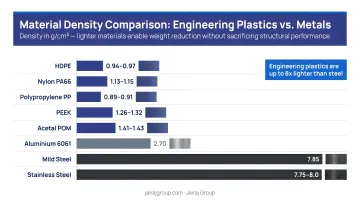
A component made in ABS instead of aluminium carries roughly 60% less mass for the same volume. Against steel, that gap reaches 85–87%. Across an entire platform, those figures translate directly into range, payload, and fuel budgets.
RAND's analysis of Mobility Air Forces found that reducing average basic aircraft weight by 655 lb could save 1.7 million gallons of fuel per year — worth $6.2 million annually at 2013 US fuel prices (per RAND's US DoD-focused analysis). The operational implications extend across platform types:
- Airborne platforms — lighter airframes directly extend range, endurance, and payload capacity
- Ground vehicles — reduced mass lowers fuel consumption per mission and eases transport logistics
- Infantry equipment — every kilogram removed from a soldier's load improves mobility and reduces fatigue under the Army's 22 kg fighting-load threshold
- Procurement — weight reduction can unlock secondary benefits including reduced engine sizing and smaller fuel budgets over a platform's service life
Advantage 2: Corrosion Resistance That Reduces Maintenance Burden
Metal corrodes. Engineering plastics, in nearly all field-relevant environments, do not.
GAO reported that DoD estimated its corrosion costs at over $22.9 billion annually, and AMPP's data from a DoD-contracted FY2016 study puts the figure at $20.6 billion. These numbers reflect the real cost of metal components operating in coastal, tropical, desert, and maritime environments.
Engineering plastics break the corrosion cycle entirely:
- PEEK — documented resistance to aviation hydraulic fluid and brake fluid; stable across a wide chemical range
- PE/HDPE — rated for very good chemical resistance, including 10% sodium chloride (salt water proxy)
- PA/Nylon — high resistance to fuels and alkalis (acid resistance requires material-specific verification)
- Polycarbonate — good impact resistance but sensitive to solvents; application context determines suitability
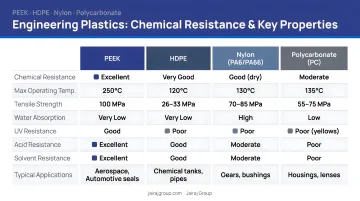
A plastic seal, housing, or panel does not require protective coatings, scheduled treatment, or corrosion-driven replacement. In practice, this means fewer maintenance events, higher platform availability, and lower total lifecycle cost. Maintenance downtime in defence is a readiness issue — every platform undergoing corrosion repair is a platform that cannot be deployed.
The measurable outcomes — mean time between maintenance events, platform availability rate, and lifecycle cost — all improve when corrosion-prone metal components are replaced with engineering plastics.
Advantage 3: Manufacturing Precision and Design Flexibility
Precision injection moulding and thermoforming produce complex, tight-tolerance geometries consistently and repeatably from a single tool. Features that would require secondary machining in metal — integrated clips, mounting rails, quick-release mechanisms, ribbed internal structures — can be moulded directly into plastic parts.
The Amphenol Pcd case illustrates this concisely: one PEEK retention clip replaced several separately installed metal clips in an aircraft electrical connector. Fewer parts mean fewer assembly steps, fewer potential failure points, and a simpler supply chain.
For defence programmes, the manufacturing advantages include:
- Part consolidation — complex integrated features eliminate secondary operations
- Weight-optimised geometry — internal ribs and reinforcement structures impractical in metal can be designed directly into plastic
- Dimensional consistency — real-time monitoring, cavity balancing, and calibrated cooling maintain repeatable quality across production runs
- Traceability — laser marking and full documentation support defence supply chain requirements
Jairaj Group's injection moulding capabilities cover multi-cavity, insert, and two-shot moulding with in-house tooling and DFM support. Rapid prototype tooling is available for defence OEMs working to compressed development schedules or updating legacy equipment variants.
What Happens When Heavy Materials Are Still Used
Defence programmes that default to metal without evaluating high-performance plastic alternatives carry penalties that compound across the platform lifecycle:
- Higher fuel consumption per mission due to excess platform weight
- Increased soldier fatigue from heavier carried loads, with direct impact on field endurance
- More frequent maintenance driven by corrosion, coating degradation, and chemical exposure
- Longer production lead times from complex metal fabrication and secondary machining
- Higher lifecycle costs from accelerated replacement cycles and corrosion management
These penalties rarely reflect deliberate choices. More often, they stem from outdated material specifications or limited familiarity with what modern polymers can actually do. The gap closes when procurement teams work with manufacturers who combine polymer expertise with defence-grade quality systems.
What to Look for in a Defence-Grade Plastic Component Manufacturer
Not all plastic manufacturers are equipped for defence work. Material expertise, process precision, quality documentation, and delivery reliability are non-negotiable for mission-critical components — and most suppliers fall short on at least one.
Key criteria for evaluating a manufacturing partner:
- Polymer range — demonstrated processing of PEEK, HDPE, polycarbonate, ABS, Nylon, and UHMWPE for defence or aerospace applications
- Process capabilities — precision injection moulding and thermoforming with real-time process controls, not just volume production
- In-house tooling — mould design, prototype tooling, and DFM support reduce dependence on external suppliers and accelerate development cycles
- Quality systems — ISO 9001:2015 as a minimum; comprehensive testing including dimensional verification, material properties, chemical resistance, impact, and environmental durability
- Traceability and documentation — full chain of custody, laser marking, and certification documentation for defence supply chain compliance
- Delivery track record — consistent on-time delivery to industrial OEMs; defence readiness cannot absorb supply chain failures
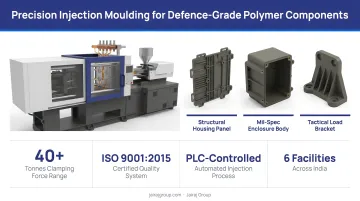
Jairaj Group has manufactured precision plastic and polymer components since 1985, with ISO 9001:2015 certification and in-house tool room capabilities across six facilities in Gurugram, Faridabad, Rudrapur, Aurangabad, Sanand, and Sector 59 Faridabad. The company produces injection-moulded and thermoformed components for defence vehicle manufacturers and drone producers.
Their defence material portfolio spans PEEK, polycarbonate, ABS, Nylon (PA66-GF), UHMWPE, and TPU. Manufactured components include sensor housings, avionics enclosure panels, drone arms, motor mounts, propeller guards, helmet components, and EOD suit parts.
Conclusion
Lightweight plastics earn their place in defence manufacturing through measurable gains in mobility, durability, and cost efficiency — provided the right polymer is selected and processed correctly.
The advantages compound over a platform's service life. Lower fuel costs, reduced maintenance burden, faster production cycles, and better field outcomes all trace back to material and manufacturing decisions made early in the design process. Switching from steel to an appropriate engineering plastic is an engineering decision with a documented operational return.
As India's defence sector accelerates modernisation and indigenisation — with FY2024-25 defence exports reaching ₹23,622 crore, representing 12.04% growth over the prior year — access to precision polymer manufacturers with deep material expertise becomes a competitive factor for OEMs and system integrators building for domestic and global programmes.
Frequently Asked Questions
What plastics are lightweight?
The most common lightweight engineering plastics include HDPE (0.96 g/cm³), ABS (1.04 g/cm³), Nylon (1.14–1.15 g/cm³), polycarbonate (1.19 g/cm³), and PEEK (1.31 g/cm³). In defence, "lightweight" is assessed by strength-to-weight ratio, not density alone — a material must deliver adequate mechanical performance at the lower weight, not simply weigh less.
What is military-grade plastic?
Military-grade plastic is a performance classification applied to engineering polymers that meet strict standards for impact resistance, thermal stability, chemical resistance, and FST (flame, smoke, toxicity) compliance. Polycarbonate, UHMWPE, PEEK, and select ABS and Nylon grades qualify when they meet programme-specific performance thresholds.
What types of plastics are commonly used in defence applications?
Common defence-grade plastics by application:
- HDPE — structural and containment components
- Polycarbonate — ballistic glazing and protective shields
- PEEK / PTFE — high-temperature aircraft components
- UHMWPE — soft ballistic protection in vests and helmets
- ABS / Nylon — housings, tactical gear hardware, and vehicle interiors
Can plastic components replace metal in armoured vehicles?
High-performance plastics already replace metal in armoured vehicle window glazing, interior panels, seals, fuel line components, and instrument housings. Full structural replacement depends on load path and threat requirements. The most effective approach is targeted metal-to-plastic substitution in appropriate applications rather than wholesale replacement.
How are lightweight plastic components for defence manufactured?
The two primary processes are precision injection moulding (for complex, tight-tolerance components in repeatable volumes) and thermoforming (for large-format panels and enclosures). Process selection depends on part geometry, wall thickness, volume, and material specification — both require comprehensive quality documentation for defence supply chain compliance.