Introduction
India's defence sector allocated over ₹6.2 lakh crore in the Union Budget 2024–25 — and a growing share of that spend is flowing into advanced material solutions. Engineered polymers, once treated as secondary inputs, are now embedded in the platforms and subsystems that define modern military capability. From injection-moulded sensor housings on ground vehicles to glass-filled nylon pipe fittings aboard naval vessels, precision plastic components are displacing metal across defence and naval applications.
For manufacturers, procurement officers, and supply chain partners, tracking where this shift is heading has become a competitive necessity. Defence programmes are tightening qualification requirements, mandating domestic sourcing under initiatives like Atmanirbhar Bharat, and specifying materials that deliver measurable operational and lifecycle cost advantages.
This article maps four key trends reshaping plastic manufacturing in the defence and naval sector, examines the forces driving them, and identifies what these changes mean for manufacturers positioned to serve defence and naval OEMs.
Key Takeaways
- High-performance polymers — PEEK, PEI, PPS, glass-filled nylon — are replacing metals in defence vehicles, UAVs, and naval platforms
- Additive manufacturing is transforming spare part supply and prototype validation across global defence programmes
- Corrosion-resistant engineered plastics dominate naval specifications for saltwater-exposed and high-stress applications
- India's Atmanirbhar Bharat push has earmarked 75% of the FY 2025-26 defence modernisation budget for domestic procurement
- Manufacturers with certified quality systems and multi-plant capacity stand to win a growing share of India's domestic defence supply chain
Key Trend 1: High-Performance Polymers Are Replacing Metals in Defence Systems
The Material Substitution Shift
Defence engineers are increasingly specifying high-performance thermoplastics — PEEK, PEI, PPS, glass-filled nylon (PA66 GF), and carbon-fibre-reinforced plastics — for components that previously defaulted to aluminium or steel. The shift spans defence vehicles, UAV frames, aircraft interiors, and military ground platforms.
The numbers reflect the trajectory. According to Grand View Research, the aerospace plastics market is projected to grow from USD 8.15 billion in 2024 to USD 13.88 billion by 2030, with military aircraft applications representing a growing share of that demand.
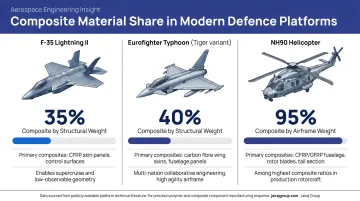
Platform-level data makes the substitution trend concrete:
- F-35 Lightning II: Composite airframe accounts for 35% of the aircraft's structure
- Airbus Tiger helicopter: 80% composites by material share
- NH90 military helicopter: 90% composites by material share
Where PEEK and PAEK Are Being Deployed
The most active substitution is not in primary structures — it is in brackets, clamps, tubing, conduit, housings, and interior components. Victrex documents PEEK clamps achieving up to 20% weight reduction versus metal with 30% faster installation, deployed on Boeing 737 and 787 platforms. PEEK fluid tubing delivers up to 33% weight reduction, and Safran bracket platforms have achieved up to 50% weight reduction versus aluminium using PAEK composites.
For defence procurement teams, these figures matter at programme level: lighter components translate directly to improved fuel efficiency, extended platform range, and greater payload capacity.
The Opportunity for Indian Manufacturers
These weight and performance gains are driving Indian manufacturers to build defence-grade polymer capabilities — and some are already there. Jairaj Group processes PEEK, PEI, PA66-GF, CFRP, and carbon fibre composites across its aerospace and defence component lines, producing sensor housings, avionics enclosures, UAV frames, fairing panels, and structural brackets.
With over four decades of precision injection moulding experience and ISO 9001:2015 certification, Jairaj Group supplies defence OEMs requiring proven, process-controlled polymer components across vehicle, drone, and aerospace platforms.
Key Trend 2: Additive Manufacturing Is Transforming On-Demand Defence Component Production
AM in the Defence Supply Chain
Additive manufacturing — FDM, SLS, and DMLS — has moved from prototyping tool to supply chain strategy in global defence programmes. According to MarkNtel Advisors, the aerospace and defence AM market is projected to grow from USD 7.10 billion in 2026 to USD 16.33 billion by 2032, at a CAGR of 14.89%.
That market growth is backed by formal policy commitments. The US DoD published its official Additive Manufacturing Strategy in January 2021, targeting supply chain agility, readiness, and in-theatre problem-solving. The UK MoD followed with its Defence Advanced Manufacturing Strategy in 2025, committing to expanded AM integration across defence programmes.
AM vs. Injection Moulding: Where Each Wins
The two approaches are complementary, not competitive. The distinction matters for defence procurement:
| Application | Preferred Method |
|---|---|
| Rapid prototype validation | 3D printing (FDM, SLS) |
| Low-volume spare parts, complex geometry | AM (SLS nylon, PEEK filament) |
| Medium-to-high volume enclosures, housings | Precision injection moulding |
| Tight-tolerance connectors, structural brackets | Injection moulding |
| Field repair parts, one-offs | AM |
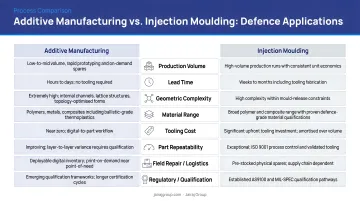
For volume production runs — where dimensional consistency, per-part cost, and repeatable material properties are non-negotiable — precision injection moulding holds the advantage.
Jairaj Group applies this hybrid approach directly: 3D printing within its R&D and Value Engineering Centres handles rapid prototype validation and tooling confirmation, with qualified designs then moving to precision injection moulding for full production.
Key Trend 3: Corrosion-Resistant Engineered Plastics Are Gaining Ground in Naval Applications
Why Naval Environments Demand a Different Material Approach
Naval and marine defence platforms impose conditions that accelerate metal degradation faster than almost any other operating environment: continuous saltwater exposure, mechanical vibration, humidity cycling, and chemical contact. Traditional metal components require anti-corrosion treatment, periodic inspection, and eventual replacement — all of which add to maintenance burden and operational downtime. Engineered plastics address each of these failure modes directly, which is why their adoption across naval surface ships and submarines has moved from experimental to standardised in recent decades.
Documented Naval Applications
The US Navy's own composite applications research confirms this shift with concrete examples:
- GRP pipe and fittings — permitted under MIL-STD-777F(SH) for freshwater, chilled water, seawater ballast, drains, vents, and CHT systems aboard naval surface ships
- Composite deck gratings — delivering 60% weight reduction over steel, governed by NAVSEA Drawing 803-6983499
- Composite electrical enclosures — eliminating galvanic corrosion entirely, standardised under NAVSEA Drawing 803-6983506
- PEEK ribbed conduit — used in well deck areas to withstand salt spray and heated exhaust from landing craft
- Polymer submarine bearings — elastomeric polymer bearings (such as Thordon SXL) used for propeller shafts, diving planes, and periscope bearings, operating without oil or grease
The Strategic Advantage for Naval Programme Managers
These documented applications share a common logic: engineered plastics reduce lifecycle cost while improving operational reliability. For programme managers specifying components on naval platforms, the value proposition is straightforward:
- No anti-corrosion treatment required — unlike steel, saving both cost and maintenance time
- Longer service life in saltwater environments compared to unprotected or treated metals
- Weight reduction that improves vessel fuel efficiency and range
- Galvanic isolation for electrical enclosures and fittings, eliminating a common failure mode
Jairaj Group processes marine-relevant materials including HDPE, PA66-GF, PEEK, POM, and glass-filled polypropylene. In-house testing covers chemical resistance, environmental exposure, and dimensional stability — the same performance parameters that naval platform qualification demands, whether for Indian Navy programmes or export-facing defence contracts.
Key Trend 4: India's Defence Indigenisation Is Creating a New Frontier for Domestic Plastic Manufacturers
The Policy Shift Driving Domestic Demand
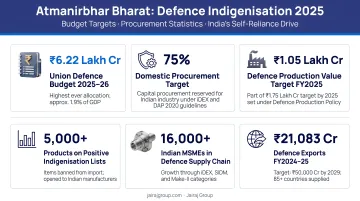
India's Atmanirbhar Bharat initiative has moved from policy statement to procurement mandate. Consider what that shift looks like in practice:
- Rs 1.54 lakh crore in domestic defence production achieved in FY 2024-25
- Target of Rs 1.75 lakh crore for the current fiscal year, scaling to Rs 3 lakh crore by 2029
- 75% of the FY 2025-26 modernisation budget — worth Rs 1,11,544.83 crore — earmarked exclusively for domestic procurement
- 92% of defence contracts (177 of 193) in FY 2024-25 awarded to domestic industry
- 51 large naval vessels currently under construction in India, valued at approximately Rs 90,000 crore
The drone sector adds another dimension. India's UAV market is projected to grow from USD 0.47 billion in 2025 to USD 1.39 billion by 2030, with the defence and security segment growing at 26.4% CAGR — the fastest in the market.
What This Means for Polymer Component Manufacturers
Defence OEMs across military vehicles, drones, naval vessels, radar systems, and communication platforms are now required to localise their supply chains. That creates direct demand for domestic polymer component partners who can deliver:
- Certified quality systems with full traceability documentation
- Multi-component capability across enclosures, housings, structural brackets, and connectors
- In-house tooling for fast programme response
- Consistent dimensional performance at production volumes
Jairaj Group meets these requirements with six manufacturing facilities across India, ISO 9001:2015 certification, in-house tool room capabilities, and active supply to drone and defence vehicle manufacturers. Facilities in Faridabad, Sanand, and Gurugram sit within established and emerging defence manufacturing clusters — shortening lead times and simplifying logistics for OEM partners.
What's Driving These Trends in Defence Plastic Manufacturing
Several convergent forces are accelerating advanced plastic adoption across defence and naval programmes. Global context sets the scale: SIPRI reports world military expenditure reached USD 2.718 trillion in 2024, up 9.4% — the steepest year-on-year rise since at least 1988. Several convergent forces are accelerating advanced plastic adoption across defence and naval programmes. Global context sets the scale: SIPRI reports world military expenditure reached USD 2.718 trillion in 2024, up 9.4% — the steepest year-on-year rise since at least 1988. That spending growth reflects three structural shifts reshaping how programme managers specify components.
Technological Advances
Breakthroughs in PAEK-family materials, flame-retardant composites, and electrically conductive polymer grades are enabling plastics to meet specifications that would have disqualified them a decade ago.
PLC-controlled precision injection moulding and automated tool rooms now give manufacturers the tolerance control and process consistency that defence qualification standards require.
Cost and Operational Efficiency Pressures
Military programmes face persistent lifecycle cost pressure. Plastics address this at multiple points:
- Reduce platform weight, generating measurable fuel savings across a service life
- Eliminate anti-corrosion treatment cycles and associated maintenance spend
- Deliver faster moulding cycles at scale, cutting per-part procurement cost versus metal fabrication
Regulatory and Procurement Policy Shifts
Government-level policy is creating mandatory procurement channels. India's indigenisation lists, NATO allies' AM integration strategies, and European REACH regulations phasing out certain materials in military equipment are all pushing programme managers toward domestic, certified plastic component suppliers — not as a preference, but as a compliance requirement.
How These Trends Are Reshaping the Defence Plastics Value Chain
Operational Impact
Manufacturers are upgrading from standard to high-performance polymer processing. Tight-tolerance injection moulding for complex geometries and multi-material assemblies now comes with enhanced testing requirements — dimensional, thermal, and chemical resistance verification. These are baseline expectations for defence supplier qualification, not optional add-ons.
Business Impact
Defence plastic component suppliers are shifting from transactional part supply to longer-term programme partnerships. Defence OEMs are selecting suppliers who can offer:
- Full design-to-delivery support with DFM capability
- In-house tooling for programme speed
- Documented quality systems with first-article inspection and material traceability
Jairaj Group operates in precisely this way: working alongside customers from material selection through tooling validation to production qualification, rather than entering at the part-supply stage.
Workforce and Capability Impact
These partnership demands are also reshaping workforce requirements. Defence plastic manufacturers increasingly need polymer engineers with skills that span design, tooling, and QA — not specialists siloed in a single function.
Manufacturers investing in these teams are also building digital documentation practices aligned to defence qualification gates. That combination is what moves a supplier from commodity tier to programme partner.
Future Signals for Plastics in Defence & Naval Manufacturing
Four converging forces are set to reshape plastics demand in defence and naval manufacturing over the next one to three years:
- Continuous carbon-fibre-reinforced thermoplastics are advancing toward lightweight armour and vehicle panel applications, with Solvay and GKN Aerospace having renewed their thermoplastic composite collaboration in 2023
- India's naval shipbuilding pipeline — 51 large ships under construction — will generate sustained domestic demand for precision polymer components including piping, electrical enclosures, conduit, and structural fittings
- India's drone sector is growing at 24.4% CAGR through 2030, with military as the largest segment, driving demand for lightweight frames, housings, motor mounts, and propeller guards
- Global defence budget growth is sustaining programme awards, with India's MoD FY 2025-26 allocation up 9.53% year-on-year — the largest single-year increase in recent memory
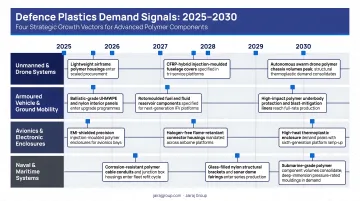
For manufacturers with existing defence qualifications, multi-plant capacity, and ISO 9001 certification — such as Jairaj Group — these signals translate into a practical window: procurement contracts are being awarded now, and supply chains need qualified partners before volumes ramp up.
Conclusion
High-performance polymers are already specified in UAV frames, naval electrical enclosures, aircraft brackets, and ground vehicle sensor housings across active programmes. The question for manufacturers is no longer whether defence plastics matter — it is whether they are ready to supply them at the quality and scale procurement requires.
The four trends covered here — material substitution, additive manufacturing integration, naval corrosion resistance, and Indian indigenisation — are pulling in the same direction. Together, they are reshaping how defence supply chains are organised, qualified, and sourced domestically.
Manufacturers who align their capabilities now stand to benefit as procurement tightens around local, certified suppliers. The key capabilities are specific: material expertise, precision processing, quality documentation, and multi-plant domestic presence. Groups like Jairaj — operating six facilities across India with four decades of polymer engineering experience — illustrate the kind of supply chain depth that defence OEMs are actively looking for as indigenisation mandates expand.
Frequently Asked Questions
What are the trends in the plastic industry?
The plastic industry is moving toward high-performance polymers, lightweight composites, and materials with superior thermal and chemical resistance. Sustainability pressure is bringing recyclable and bio-based options into development pipelines, while defence and aerospace sectors are accelerating demand for precision-engineered polymers that displace metal in critical applications.
What is the future of the defence industry in India?
India's defence sector is expanding rapidly under the Atmanirbhar Bharat initiative, with production targets reaching Rs 3 lakh crore by 2029 and 75% of the modernisation budget mandated for domestic procurement. Growth spans military vehicles, drone platforms, naval shipbuilding, and electronics — all creating sustained demand for certified domestic component manufacturers.
What types of plastics are commonly used in defence manufacturing?
Key materials include PEEK, PEI, PPS, glass-filled nylon (PA66 GF), polycarbonate, and ABS composites. PEEK is preferred for heat-resistant and chemically demanding applications; PA66 GF provides structural rigidity at lower weight; polycarbonate and PC/ABS blends are used for impact-resistant enclosures and protective components.
Why are plastics replacing metals in defence and naval applications?
Lower weight improves platform fuel efficiency, range, and payload, which matters across both air and naval platforms. Plastics are inherently corrosion-resistant without additional treatment, reducing maintenance cost and extending service life. Precision injection moulding also delivers complex geometries and consistent part quality at lower per-unit cost than metal fabrication at volume.
What role does injection moulding play in defence plastic component manufacturing?
Injection moulding enables high-precision, repeatable production of complex defence components — enclosures, housings, structural brackets, and sensor covers — with tight tolerances and consistent material properties. For medium-to-high volume runs, it is more cost-effective than additive manufacturing while meeting the qualification and traceability standards defence programmes require.
What certifications should a defence plastic component supplier have?
ISO 9001:2015 is the baseline quality management requirement; AS9100 (IAQG 9100) is required for aerospace and defence supply chain participation. Suppliers should also provide first-article inspection reports, material traceability documentation, and process control records aligned to OEM and DQA qualification requirements.