Pick the wrong type and you might face long cure cycles limiting throughput, a part that softens in service, materials that can't be recycled under new OEM mandates, or a design that's impossible to repair in the field. For Indian automotive, EV, and aerospace manufacturers scaling production rapidly, these aren't hypothetical risks.
This article breaks down both composite types, compares them side-by-side, and gives engineers and procurement teams a practical framework for making the right call.
Key Takeaways
- Thermoplastics soften and re-form when heated; thermosets cure permanently through chemical cross-linking and cannot be remelted
- Thermoplastics offer faster processing, superior impact resistance, and genuine recyclability — making them a strong fit for automotive and EV applications
- Thermosets deliver higher dimensional stability, compressive strength, and heat resistance; they remain the default choice for certified aerospace structures
- Neither is universally better — match the material to your operating temperature, production volume, and end-of-life requirements
- Getting this decision right early prevents costly redesigns and manufacturing rework downstream
Thermoplastic vs. Thermoset Composites: Quick Comparison
| Factor | Thermoplastic Composites | Thermoset Composites |
|---|---|---|
| Processing | Injection moulding, thermoforming, compression moulding — no chemical cure required | RTM, autoclave, compression moulding — requires controlled cure cycles |
| Cycle Time | Seconds to minutes | 2 minutes (fast-cure systems) to 120–180 minutes (aerospace epoxy) |
| Impact Resistance | High — tough under shock and dynamic loading | Lower — more brittle under sudden impact |
| Compressive Strength | Good | High — superior stiffness and dimensional stability |
| Heat Resistance | 152°C (PP-GF) to 336°C (PEEK-CF) depending on resin grade | Consistently high post-cure; does not soften on reheating |
| Recyclability | Can be remelted and reprocessed | Cannot be remelted; only fibre recovery is possible |
| Repairability | Weldable — induction, ultrasonic, resistance welding | Requires adhesive bonding or mechanical fastening |
| Raw Material Cost | Higher for engineering/high-performance grades | Lower for standard epoxy systems |
What Are Thermoplastic Composites?
Molecular Structure and What Makes Them Different
Thermoplastic composites consist of reinforcing fibres — glass, carbon, or aramid — embedded in a thermoplastic polymer matrix. The defining characteristic is physical, not chemical: when heated above the glass transition or melting temperature, the long, linear polymer chains slip past one another. On cooling, they re-lock. No chemical reaction occurs, which means the material can be re-formed repeatedly.
This is what separates thermoplastics from thermosets. Where thermosets form a permanent three-dimensional cross-linked network during cure, thermoplastics retain a reformable molecular architecture throughout their service life.
Resin Grades and Fibre Selection
Manufacturers have three broad tiers to choose from:
- Commodity grades (PP, PA/Nylon, PET) — high-volume automotive parts, cost-sensitive applications
- Engineering grades (PPS, PETG) — structural applications requiring better thermal or chemical resistance
- High-performance grades (PEEK, PAEK) — aerospace, medical, and extreme-environment components
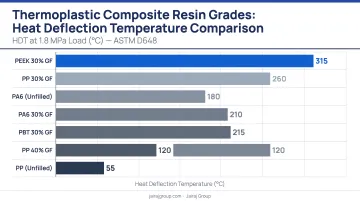
Heat deflection data illustrates the range clearly. Glass-fibre reinforced PP carries an HDT of 152°C, while PA66-GF grades reach 210–220°C. Move to PPS-GF and you're at 260°C; PEEK-CF reaches 336°C under load. Fibre reinforcement — glass, carbon, or aramid — is selected separately based on the stiffness, weight, and strength requirements of each part.
Operational Advantages That Matter at Scale
Thermoplastics offer several production advantages over thermoset alternatives:
- No cure stage — parts solidify on cooling, enabling cycle times measured in seconds or minutes rather than hours
- Room-temperature storage — no refrigeration required, unlike thermoset prepregs that must be kept cold to prevent premature cure
- Weld-joinable — induction, ultrasonic, and resistance welding replace adhesive bonding, simplifying assembly and enabling field repair
- Strong impact tolerance — linear polymer chains absorb energy more effectively than brittle cross-linked networks
Jairaj Group works across this full material range — processing PEEK, PA66-GF, PPS, carbon fibre, and glass fibre composites via injection moulding and thermoforming for automotive, EV, and aerospace customers. Each of these production characteristics has a direct bearing on cycle time, assembly cost, and part performance at scale.
Where Thermoplastic Composites Are Used
The automotive composites market is projected to grow from USD 11.1 billion in 2025 to USD 43.0 billion by 2035 at a 14.5% CAGR. Thermoplastics are driving much of that expansion, particularly in EV battery and structural applications.
Strongest application fits:
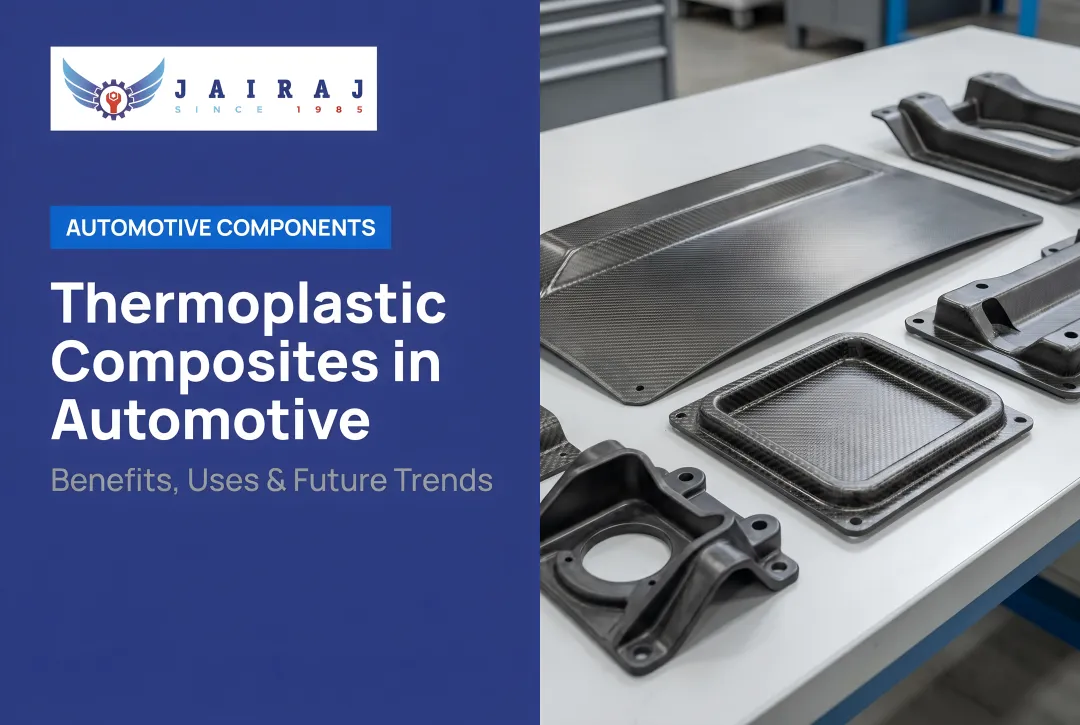
- Automotive: body panels, bumpers, instrument panels, structural liners (PP-GF), under-hood components (PA66-GF)
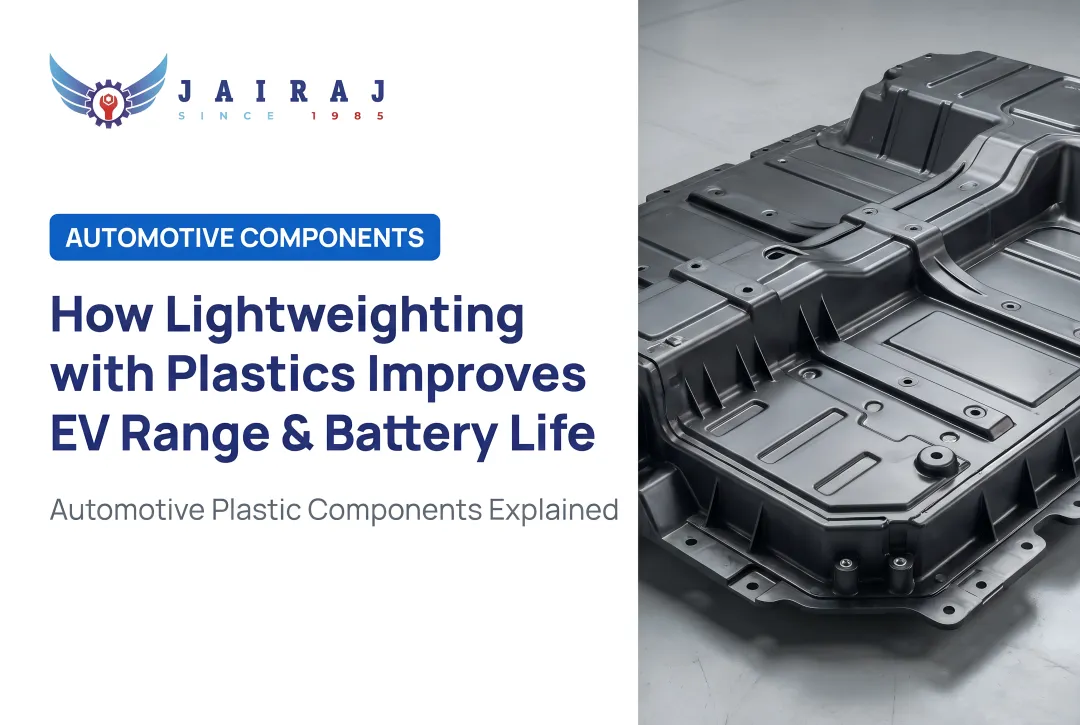
- EV: battery housings and enclosures, structural brackets, thermal management components
- Aerospace: drone frames, avionics enclosures, fuselage panels requiring strength-to-weight performance
- Consumer electronics: PC and ABS composite housings
A concrete example: Kautex Textron won an OEM contract for a full-BEV thermoplastic composite lower battery housing using glass-fibre reinforced PP and PA via compression moulding and injection overmoulding. The housing met crush, bottom impact, and external fire test requirements — standards unreinforced plastics cannot meet.
Beyond performance, Kautex reported reduced component count, lower bill-of-materials cost versus metal, and a smaller part carbon footprint. It's a repeatable outcome, not an outlier.
What Are Thermoset Composites?
How Curing Creates a Permanent Structure
Thermoset composites embed reinforcing fibres in a liquid resin — epoxy, phenolic, polyurethane, or vinyl ester — that undergoes irreversible chemical cross-linking during cure. Heat, UV, or a chemical catalyst triggers the reaction, forming a three-dimensional molecular network that is permanent. It will not soften on reheating.
That permanence delivers exceptional stiffness, dimensional stability, and heat resistance — and also makes the material impossible to remelt, reshape, or recycle through conventional means.
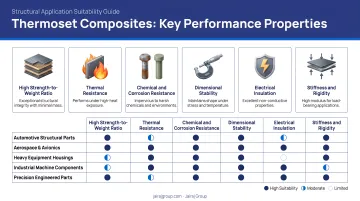
Performance Strengths Relevant to Structural Applications
Thermoset composites dominate applications where these properties are non-negotiable:
- Dimensional stability under load — minimal creep over time, predictable behaviour in sustained stress environments
- High compressive and flexural strength — Hexcel HexPly 8552/IM7 delivers 0° compressive strength of ~1,690 MPa (245 ksi) at room temperature dry
- Consistent heat resistance — epoxy systems maintain structural performance at operating temperatures without the softening risk present in some thermoplastic grades
- Chemical resistance — well-suited for aggressive fluid environments in aerospace, marine, and industrial applications
Constraints to Plan Around
- Brittle under sudden impact loads compared to thermoplastics
- Prepregs require cold storage to prevent premature cure — adding logistics complexity
- Standard aerospace epoxy cure cycles run 120–180 minutes at elevated temperatures, though fast-cure thermoset systems can achieve 2 minutes for specific thin-section parts
- End-of-life recycling is limited to fibre recovery; the matrix cannot be reprocessed
Where Thermoset Composites Are Used
Airbus states that thermoset CFRPs are currently more widespread in aeronautics, and the Boeing 787 airframe is 50% carbon fibre reinforced plastic and other composites — both validated on thermoset epoxy-carbon systems. Primary application fits:
- Aerospace: wing panels, fuselage frames, structural brackets requiring certified allowables
- Defence: phenolic composites for thermal shielding and armour panels
- Electrical/electronics: epoxy-glass laminates for PCBs and insulating housings
- Marine: hulls and structural components exposed to continuous water and chemical contact
- Wind energy: turbine blades where stiffness-to-weight and fatigue resistance are critical
Which Should You Choose?
Decision Framework
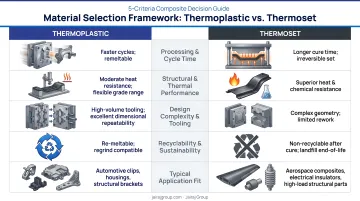
No single factor determines the right composite type. Evaluate these five criteria for each application:
- Operating temperature — Does the part face sustained heat above your thermoplastic grade's HDT? If so, either step up to PEEK/PPS or move to thermosets.
- Production volume — High volumes favour thermoplastics' faster cycle times and lower per-part processing costs at scale.
- Structural requirements — Parts under high compressive loads or requiring tight dimensional tolerances under sustained stress lean toward thermosets.
- Sustainability and end-of-life — India's push toward EV adoption and OEM sustainability mandates is making thermoplastics' recyclability an increasingly relevant qualification criterion for domestic and export supply chains.
- Repairability — Thermoplastics can be re-welded in service; thermosets require adhesive or mechanical repair patches.
Situational Recommendations
Choose thermoplastic composites when:
- Production volumes are high and cycle time is a throughput constraint
- The part requires impact resistance, damage tolerance, or in-service repairability
- Recyclability is a purchasing criterion or OEM compliance requirement
- Assembly uses welding rather than adhesive bonding
Choose thermoset composites when:
- The part operates continuously at high temperatures with no thermal cycling advantage
- High compressive/flexural stiffness and minimal creep are design requirements
- The component is a primary structural aerospace or defence part requiring established certification
- Precise dimensional tolerances under sustained load are non-negotiable
The Hybrid Reality
Neither material wins every zone in a complex assembly. Aerospace fuselage assemblies and automotive chassis designs increasingly combine both: thermoset primary structures where stiffness and temperature resistance are paramount, with thermoplastic secondary brackets, clips, and closeout panels where impact tolerance and fast production matter. The selection is deliberate — driven by load paths, temperature exposure, and production economics specific to each zone.
Total Cost vs. Raw Material Cost
Thermoset resins typically have lower raw material costs than high-performance thermoplastic grades. But raw material cost is not total part cost. When you account for cure cycle time, tooling utilisation, refrigerated storage, scrap recovery, and end-of-life disposal, thermoplastics' total cost of ownership can be lower at scale. A documented thermoplastic conversion delivered 75% cycle-time savings versus thermoset hand layup for one Boeing component. For high-volume programmes, that cycle-time gap compounds quickly — making full lifecycle cost the more reliable basis for material selection than resin price alone.
Real-World Application: EV Battery Enclosures
The shift from metal to thermoplastic composite in EV battery enclosures illustrates how the selection framework plays out in practice.
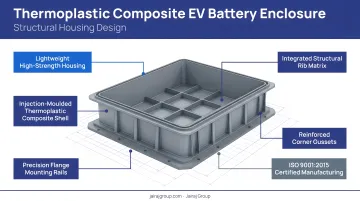
Kautex's Pentatonic programme addressed a clear set of challenges: conventional metal battery housings are heavy, corrosion-prone, and difficult to integrate with adjacent systems. The decision criteria applied mapped directly to thermoplastics' strengths:
- Production volume — automotive-scale BEV programmes require fast, repeatable cycle times
- Impact and fire requirements — glass-fibre reinforced PP and PA met crush, bottom impact, and external fire tests that unreinforced plastics fail
- Functional integration — thermoplastic processing enabled component count reduction and leaner BOM versus metal
- Recyclability — thermoplastic matrix supports end-of-life recovery in line with emerging automotive circularity requirements
The Kautex example reflects a pattern now appearing in Indian supply chains. For automotive OEM suppliers here, this type of material decision is becoming a qualification requirement, not just an engineering preference. As EV production volumes in India grow — with approximately 1.4 million EVs sold in 2024 — OEM requirements around material performance, recyclability, and production efficiency are converging.
Jairaj Group's engineering and R&D teams work with customers through material specification, design for manufacturability, and prototype-to-production transitions for exactly these applications. This spans PEEK and CFRP components for aerospace, as well as PA66-GF and PP-GF parts for automotive and EV programmes across six manufacturing facilities.
If your team is evaluating composite material selection for automotive, EV, or aerospace components, Jairaj Group's four decades of polymer engineering experience can support the process from material specification through to precision-moulded production parts. Contact the technical team at japl@jairajgroup.com or +91-9711-114-300.
Conclusion
Thermoplastics are the right fit when speed, repairability, recyclability, and impact tolerance are priorities. Thermosets hold their ground where dimensional stability, heat resistance, and structural rigidity are non-negotiable — and no amount of processing convenience changes that.
For Indian manufacturers in automotive, aerospace, EV, and industrial sectors facing competing performance and sustainability demands, the material decision belongs at the design stage — not after tooling is cut and prototypes have failed. Getting it right early means fewer redesigns, lower scrap rates, and components that perform across their full service life.
Frequently Asked Questions
What is the difference between thermoplastic and thermoset composites?
Thermoplastics soften and re-form when heated — it's a reversible physical change with no chemical reaction involved. Thermosets cure through irreversible chemical cross-linking and cannot be remelted after processing. That distinction directly determines how each material behaves in repair, recycling, and production.
Which is stronger, thermoplastic composites or thermoset composites?
It depends on the type of load. Thermosets generally offer higher compressive strength and stiffness; thermoplastics have superior impact resistance and fracture toughness. A part designed for sustained compressive loads favours thermosets; one subject to shock or dynamic loading favours thermoplastics.
Which is better for carbon fibre: thermoplastic composites or thermoset composites?
Both are used with carbon fibre reinforcement. Thermoset epoxy-carbon systems dominate aerospace structural applications because of their stiffness and established certification. Thermoplastic-carbon composites are growing in automotive and EV applications where faster processing, weldability, and recyclability change the economics.
Is PVC a thermoplastic or thermoset?
PVC (polyvinyl chloride) is a thermoplastic — it can be melted and reformed repeatedly. Common applications include automotive cables, construction profiles, and electrical insulation.
Can thermoplastic composites be recycled?
Yes. Because the matrix can be remelted, thermoplastic composites can be reprocessed — the material retains value at end of life. Thermoset composites cannot be remelted; only the fibre (not the matrix) can typically be recovered through mechanical, thermal, or chemical recycling routes.
What are common thermoplastic composites used in automotive applications?
The most common materials are:
- PP-GF (glass-fibre reinforced polypropylene) — structural body components and interior trim
- PA6-GF / PA66-GF (polyamide/Nylon composites) — under-hood parts and EV battery housings
- PEEK composites — high-temperature or structurally demanding applications