Thermoplastic composites have moved from niche aerospace material to mainstream automotive solution over the past decade. They're lightweight, structurally capable, recyclable, and — critically — compatible with the kind of high-volume, short-cycle production that automotive OEMs actually need.
This article covers what thermoplastic composites are, how they compare to thermosets, where they're used in vehicles today, how they're manufactured, and where the market is heading — particularly for electric vehicles.
Key Takeaways
- Unlike thermosets that cure permanently, thermoplastic composites can be reheated, reshaped, and recycled
- Seat shells have demonstrated 45% weight savings vs. steel; door modules up to 35%
- Processing cycle times of 1–3 minutes make these materials compatible with high-volume automotive production
- The broader EV composites market is projected to reach USD 5.1B by 2029, making EVs a central growth driver for thermoplastic adoption
- EU regulations now require vehicles to be 85% recyclable/reusable, creating structural demand for thermoplastic solutions
What Are Thermoplastic Composites?
Thermoplastic composites combine a thermoplastic resin matrix — typically polypropylene (PP) or polyamide (PA/nylon) — with reinforcing fibers such as glass, carbon, or aramid. The fibers provide structural performance; the matrix binds them and determines processing behavior.
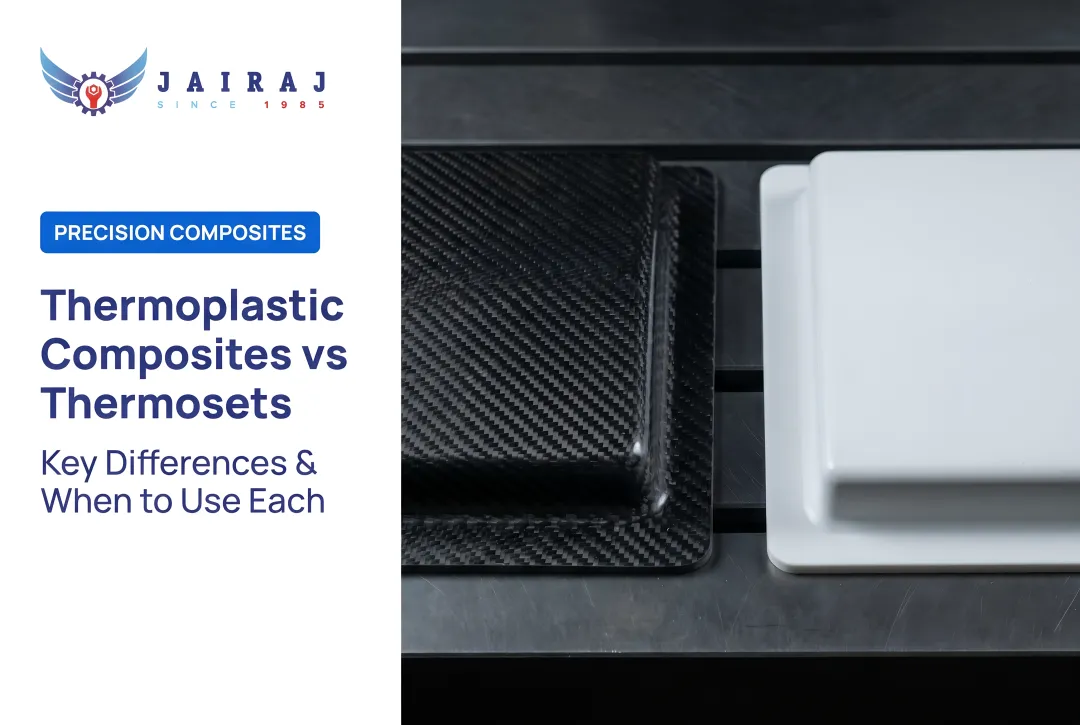
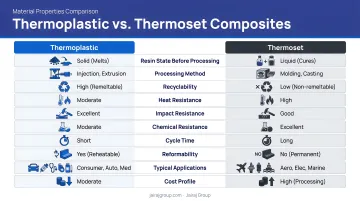
The critical distinction from thermoset composites comes down to chemistry. Thermosets cure through an irreversible chemical reaction; once set, they cannot be remelted or reformed. Thermoplastics, by contrast, solidify through cooling and can be reheated and reshaped repeatedly without material degradation.
As AZoM notes, this gives thermoplastic composites an almost indefinite shelf life, a practical advantage for manufacturing logistics.
Two Main Categories for Automotive
Glass Mat Thermoplastics (GMTs) are PP-based materials reinforced with random or chopped glass fiber. They're widely used for semi-structural components where moderate strength and low cost are the priorities: bumper beams, underbody shields, and load floors. GM's 1984 Chevrolet Corvette front bumper, made with Azdel PM 400 (a GMT with 40% continuous-strand glass in a PP matrix), achieved 30% lower weight than steel.
Advanced Thermoplastic Composites (ATCs) use continuous-fiber reinforced laminates and tapes, often PA6-based, for applications with higher structural demands, elevated temperature exposure, or crash performance requirements. The Audi A8 rear seat shell is a current production example: it uses Tepex dynalite, a PA6 continuous-glass laminate overmolded with short-glass PA6.
Thermoplastic vs. Thermoset: Quick Comparison
| Property | Thermoplastic Composite | Thermoset Composite |
|---|---|---|
| Recyclability | ✅ Can be remelted | ❌ Not recyclable |
| Shelf life | Indefinite | Limited (refrigerated storage) |
| Cycle time | 1–3 minutes | 20–60+ minutes (cure dependent) |
| Repairability | Weldable/reformable | Limited |
| High-volume suitability | High | Moderate |
Key Benefits of Thermoplastic Composites in Automotive
Lightweight Advantage — With Real Numbers
The weight savings from thermoplastic composites vary by component design and fiber type, but the documented figures are compelling:
- Seat shells: Audi A8 rear seat shell — 45% lighter than sheet steel (Lanxess, Tepex PA6 continuous-glass)
- Seat backs: GAC ENO.146 EV concept — up to 50% lighter than metal (Covestro Maezio CFRTP)
- Door module carriers: Ford Focus — 35% lower weight than injection-molded carrier; over 5 kg saved vs. metal door concepts
- Bumper beams: GMT baseline — 30% lower weight than steel
Each figure comes from production deployments or cited concept data — not projected targets.
Strength-to-Weight Ratio
Thermoplastic composites don't just reduce mass — they maintain meaningful structural performance. Comparing specific strength (tensile strength divided by density) across materials makes this clear:
| Material | Density (g/cm³) | Tensile Strength (MPa) | Specific Strength |
|---|---|---|---|
| Tepex PA6/glass (continuous) | 1.80 | 390 | 216.7 |
| BASF Ultramid PA6 GF50 | 1.567 | 235 | 150.0 |
| Aluminum 6061-T6 | 2.70 | 310 | 114.8 |
| ASTM A36 Steel | 7.80 | 400–550 | 51–70 |
Continuous-fiber thermoplastic composites like Tepex significantly outperform steel on specific strength. One honest caveat: specific stiffness (stiffness per unit weight) remains higher for steel and aluminum — a factor engineers must account for in deflection-sensitive applications.
Recyclability and Sustainability
Unlike thermosets, thermoplastic matrices can be remelted and reprocessed at end of vehicle life. This directly addresses regulatory pressure: EU End-of-Life Vehicle rules require vehicles to be 85% recyclable/reusable and 95% reusable/recoverable, with the 2023 EU ELV Regulation proposal adding recycled-plastic content requirements for new vehicles.
Lanxess has also reported new Tepex variants under development using recycled and bio-based raw materials — indicating the trajectory of material development beyond current commercial grades.
Design Flexibility and Part Consolidation
Overmolding and hybrid forming enable complex, multi-functional parts to be produced in a single molding cycle. A seat back shell, for example, can integrate ribs, clips, and load-path features in one shot — replacing an assembly of stamped steel brackets and fasteners.
The downstream benefits compound quickly:
- Shorter assembly lines with fewer handling steps
- Lower tooling investment across the component set
- Reduced joint failure risk from eliminated fastener interfaces
Short Cycle Times That Scale
Cycle time is the clearest production advantage thermoplastics hold over thermosets. According to JEC, CAPROCAST T-RTM processes achieve injection times of approximately 5 seconds and total cycle times of 2–3 minutes. Automated tape-laying processes run at roughly 1–2 minutes per cycle. These numbers are compatible with automotive body shop throughput — thermoset cure cycles, which can run 20–60+ minutes, are not.
Where Thermoplastic Composites Are Used in Vehicles
Thermoplastic composites now appear across nearly every zone of the vehicle. Fiber type and resin grade are selected based on load requirements, temperature exposure, and production volume.
Body and Structural Components
Seat shells, door carriers, and pillar reinforcements represent the most validated structural applications. Production examples include:
- Seat structures: The Audi A8 rear seat shell (Tepex PA6 + overmolded short-glass PA6) and GAC ENO.146 EV concept seatbacks (Covestro Maezio CFRTP) both meet crash and fatigue requirements at significantly lower mass than steel equivalents.
- Door module carriers: The Ford Focus door module uses PP-matrix continuous-glass UD tapes and organo sheets, saving over 1 kg per car versus long-glass-fiber PP and over 5 kg versus metal door concepts.
- A-pillar reinforcements: Porsche has explored a Tepex thermoplastic composite insert as a structural reinforcement for convertible A-pillars, where torsional stiffness with low added mass is critical.
For body-in-white integration, the hybrid metal-thermoplastic approach offers a practical path. A thermoplastic composite insert reinforces a metal structural member — reducing steel mass while retaining conventional joining methods (welding, adhesives) that existing assembly lines already support.
Chassis and Underbody Parts
Chassis applications are moving from concept to production faster than most expect:
- Suspension components: The 2019 Ram 1500 and Jeep Grand Wagoneer use hybrid upper control arms combining BASF Ultramid B3WG10 GF50 PA6 with metal — meeting fatigue and safety requirements that pure polymer solutions couldn't achieve alone.
- Underbody shields: Beyond weight savings, thermoplastic composites resist corrosion, dampen vibration, and allow complex geometries that direct airflow or channel debris. BMW M3 underbody shields use SymaLITE PP with oriented glass fibers.
- Brake pedals: Lanxess has reported the first all-plastic brake pedal for a battery-electric sports car, using a Tepex thermoplastic composite insert.
Interior and Exterior Components
Interior components — dashboard substrates, load floors, battery trays, and valve covers — prioritize dimensional stability, surface quality, and NVH (noise, vibration, harshness) performance alongside weight reduction.
Exterior applications center on energy absorption. Bumper beams and side anti-collision beams built from thermoplastic composites absorb more impact energy per unit weight than short-fiber polymer or steel alternatives, meeting crash safety requirements without the mass penalty.
Manufacturing and Processing Methods
Three primary processing routes dominate automotive thermoplastic composite production:
Compression/press forming — Thermoplastic sheets or blanks are heated and formed under pressure. Fast cycle times and good fiber orientation control make this well-suited for structural panels and seat shells.
Injection molding — Ideal for complex geometries, thin walls, and high volumes. Long-fiber and short-fiber reinforced thermoplastics are injection-molded for front-end carriers, suspension brackets, and interior structures.
Hybrid overmolding — A pre-formed composite blank (organosheet or UD tape layup) is placed in the mold, then overmolded with injection material to add ribs, clips, and functional features in a single cycle. The Audi A8 seat shell uses exactly this approach. The result: minimal material waste and high part complexity achieved within a single production cycle.
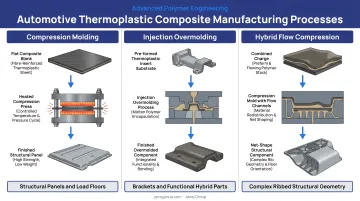
UD (unidirectional) tapes and CFRT (continuous fiber-reinforced thermoplastic) sheets are the semi-finished inputs that make hybrid and press-forming processes work. Fiber orientation is engineered to direct strength where load paths demand it — something conventional molded plastics cannot replicate.
Critical Processing Challenges
Engineers working with these methods must manage several interdependent variables:
- Fiber orientation control during forming — misalignment undermines the structural advantage of the composite
- Void-free consolidation — porosity defects compromise mechanical properties and part certification
- Metal-composite joint adhesion — interface quality determines load transfer in hybrid assemblies
Tooling design and process control govern all three. Get these right, and the part meets spec. Miss them, and no amount of material selection recovers the loss. Jairaj Group's overmolding and insert molding experience with glass-fiber reinforced polymers — including PA66-GF — puts them on familiar ground with this process logic, particularly for automotive OEM structural components.
Thermoplastic Composites and the EV Revolution
Electric vehicles intensify every lightweighting challenge. Heavy battery packs increase curb weight, which compresses range — so every kilogram saved elsewhere in the structure has a measurable impact on how far the vehicle travels on a charge.
Thermoplastic composites address this directly, and EV-specific applications are already in production or advanced development:
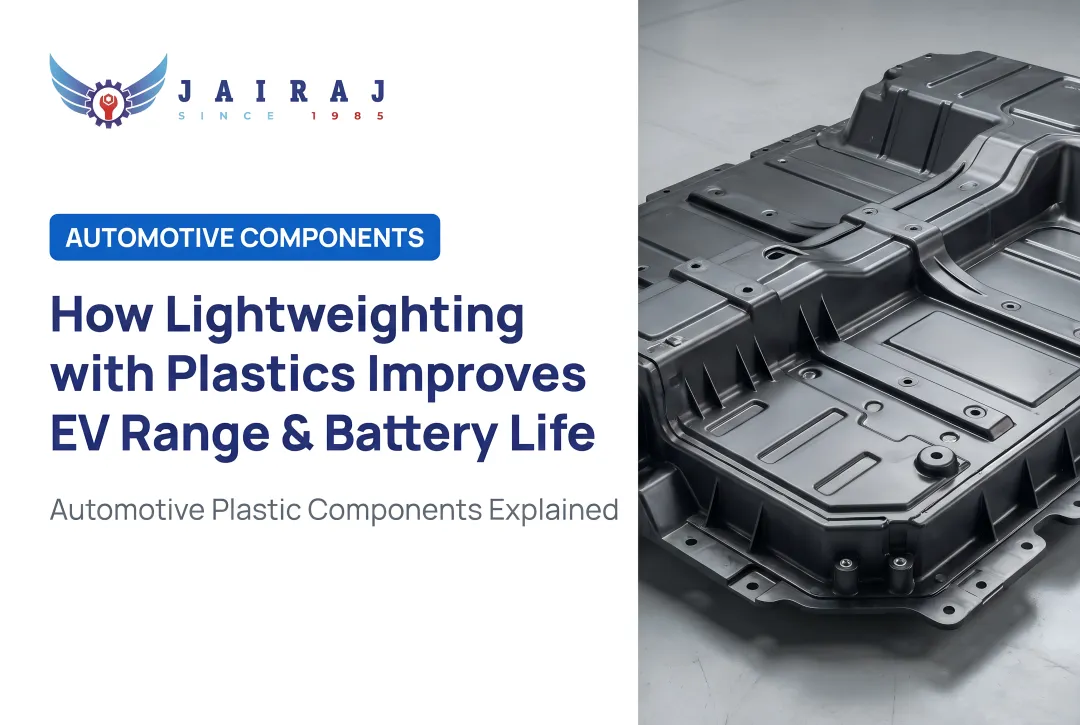
- Battery enclosures: Kautex Pentatonic uses glass fiber-reinforced PP and PA composites for cell-to-pack and cell-to-module EV architectures, meeting simultaneous requirements for flame retardancy, impact resistance, and dimensional stability
- Underbody shields: Envalior's Tepex composite underbody panels (approximately 1.5 m × 1 m, 3–4 mm thick) protect battery packs from road debris and thermal events
- Seat structures: As noted above, the GAC ENO.146 EV concept demonstrated up to 50% weight savings in seatbacks using CFRTP
- Brake pedals: First all-plastic thermoplastic composite brake pedal deployed in a battery-electric sports car
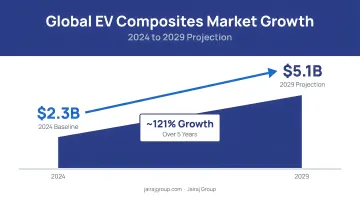
According to MarketsandMarkets, the global EV composites market is projected to grow from USD 2.3 billion in 2024 to USD 5.1 billion by 2029 at a 17.1% CAGR — a rate that reflects how fundamentally EVs are reshaping vehicle architecture and material choices.
Jairaj Group's 2023 expansion into EV-focused polymer components — with facilities across Manesar, Sanand, Aurangabad, Rudrapur, and Faridabad — directly targets this shift. Capabilities including PLC-controlled injection molding, overmolding, and PA66-GF processing allow the company to support automotive and EV OEMs moving to thermoplastic composite components at production scale.
Future Trends and Market Outlook
Market Scale
Market data shows accelerating adoption across sectors:
- Automotive composites overall: USD 11.1B in 2025, projected USD 43.0B by 2035 at 14.5% CAGR (MarketsandMarkets, 2025)
- Global thermoplastic composites (all sectors): USD 32.2B in 2021, projected USD 62.6B by 2030 (Grand View Research)
Primary growth drivers: lightweighting regulations, EV adoption, and recycled-content mandates from regulators and OEM sustainability commitments.
Material and Process Innovation
Three developments are shaping the near term:
- Bio-based and recycled matrices: Lanxess is already developing Tepex variants from recycled and bio-based feedstocks — reducing the carbon footprint of the composite itself, not just the vehicle it goes into
- T-RTM / in-situ polymerization: CAPROCAST's PA6 T-RTM process achieves 5-second injection times and 2–3 minute total cycles, with raw material costs reported below €2/kg — making continuous-fiber thermoplastic composites economically viable for high-volume programs
- Automated fiber placement and tape laying: 10-second-per-layer cycle times for automated tape laying are closing the gap between composite performance and mass-production throughput
Regulatory Tailwinds
Regulation is pulling in the same direction as the technology. The EU has set fleet-wide CO₂ reduction targets of 55% for new passenger cars by 2030 and 100% by 2035 versus 2021 levels. The US EPA has introduced new greenhouse gas standards beginning with model year 2027. In India, CAFE Phase 2 norms are tightening fleet-average CO₂ limits for domestic OEMs, creating parallel pressure on the supply chain. Combined with ELV recyclability requirements, these rules make thermoplastic composites not just technically attractive but strategically necessary for OEMs and their suppliers.
These regulatory timelines are fixed. Suppliers who build thermoplastic composite processing capability ahead of peak OEM demand will have a meaningful lead when sourcing decisions are made — and the market data suggests that demand is already building.
Frequently Asked Questions
What is the difference between thermoplastic and thermoset composites in automotive?
Thermosets cure permanently through a chemical reaction — they can't be remelted, recycled, or reformed, and they require long cure cycles. Thermoplastics solidify by cooling, can be reheated and reshaped, and support 1–3 minute cycle times. For high-volume automotive production, thermoplastics win on both processing speed and end-of-life recyclability.
Which thermoplastic materials are most commonly used in automotive composites?
Polypropylene (PP) and polyamide 6 (PA6/nylon) are the most widely used matrices — PP dominates GMT applications like underbody shields and bumper beams, while PA6 covers continuous-fiber laminates (Tepex) for structural parts like seat shells and A-pillar reinforcements.
How much weight can thermoplastic composites save compared to steel in automotive parts?
It depends on the component and design. Seat shells have demonstrated 45% savings versus steel (Audi A8); seatbacks up to 50% in EV concept applications. Door module carriers have shown 35% savings versus injection-molded alternatives and over 5 kg versus metal door concepts.
Are thermoplastic composites suitable for electric vehicles?
Yes — EVs are one of the primary drivers of thermoplastic composite adoption. Thermoplastic composites are used for battery enclosures, underbody protection shields, lightweight seat structures, and brake pedals in current EV programs. Reducing structural weight helps offset the mass of battery packs and directly extends vehicle range.
What manufacturing processes are used for thermoplastic composites in automotive?
The three primary methods are compression/press forming, injection molding, and hybrid overmolding. All three support cycle times of 1–3 minutes, which aligns with automotive assembly throughput requirements. Hybrid overmolding (a pre-formed composite insert combined with injection-molded ribs and features) is increasingly the preferred method for complex structural parts.
Can thermoplastic composites be recycled at end of vehicle life?
Yes. Thermoplastic matrices can be remelted and reprocessed, unlike thermosets. This makes them compatible with EU End-of-Life Vehicle requirements (85% recyclable/reusable targets) and with OEM circular economy commitments. New variants using recycled and bio-based raw materials are already in development at the material supplier level.