Lightweight plastics are frequently cited as part of the answer. But the real question isn't whether they reduce weight on paper — it's whether that weight reduction translates into measurable outcomes: fuel consumption per kilometre, CO2 emissions per gram per kilometre, and total cost of ownership across a fleet operating in Indian conditions.
This article addresses exactly that. Not material science theory, but operational impact.
Key Takeaways
- Plastics account for roughly 50% of a modern vehicle's volume but less than 10% of its weight — no metal achieves that ratio at production scale
- A 10% vehicle weight reduction can yield a 6–8% improvement in fuel economy, according to the US Department of Energy
- Reducing a vehicle's weight by 100 kg cuts fuel consumption by approximately 0.2 L/100 km and CO2 by about 10 g/km
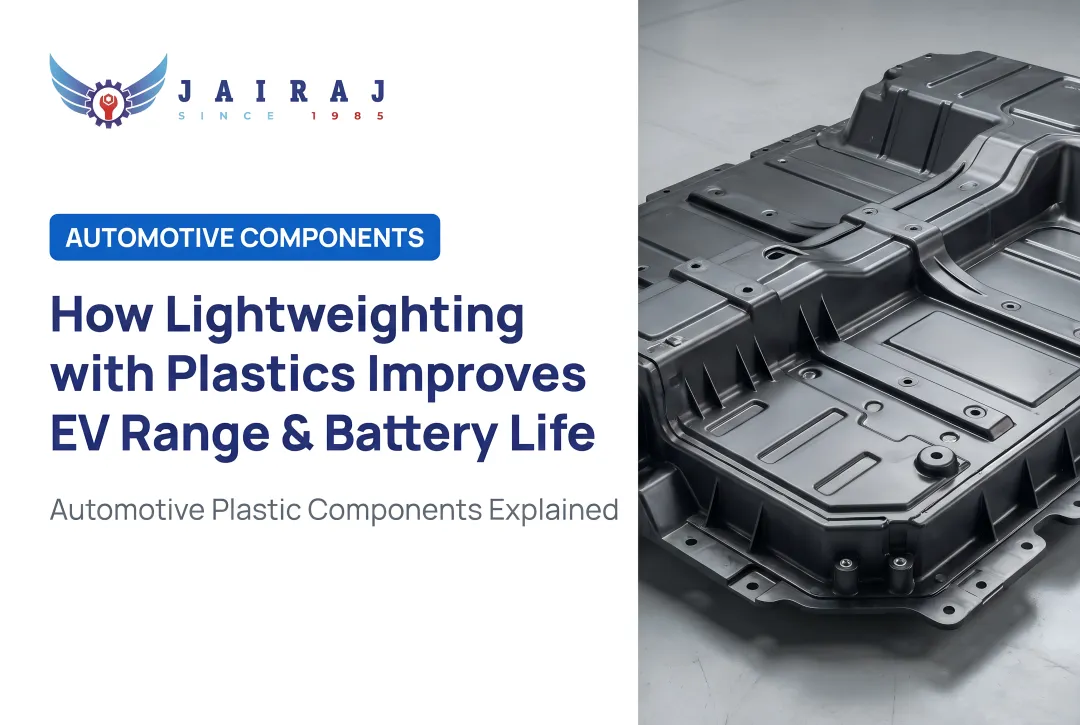
- For EVs, lightweight plastic body and interior components help offset heavy battery packs — extending range without upsizing the battery
- Achieving those savings depends on precision moulding to tight tolerances — components off-spec by even fractions of a millimetre can negate the intended weight and performance gains
What Are Lightweight Plastics in Modern Vehicles?
Lightweight plastics are polymer-based materials engineered to replace heavier metal parts while maintaining or improving structural performance — reducing vehicle mass without compromising function.
The main polymer families used in automotive applications include:
- Polypropylene (PP) — bumpers, battery boxes, door modules, and interior trim; its strength-to-weight ratio and chemical resistance make it one of the most widely used automotive polymers
- Polyamide (PA6, PA66, PA66-GF) — glass-fibre reinforced grades handle high temperatures and mechanical loads, making them suitable for sensor housings, gear components, and structural brackets
- Polycarbonate and PC/ABS blends — chosen for optical clarity and impact resistance in headlamp housings, instrument clusters, and instrument panels
- Polyurethane (PU/TPU) — rebound bumpers, suspension bushings, and cushioning applications; absorbs energy and resists fatigue cycling
- HDPE and POM — fuel system components, low-friction bushings, and guide rails that must resist chemical degradation over time
- Fibre-reinforced composites — structural panels, door beams, and ladder frames where the highest strength-to-weight ratios are required
The real advantage is cumulative. Across a single vehicle, lightweight plastics may replace metal in hundreds of individual components. That aggregate mass reduction — not the material cost per kilogram — is what drives measurable improvements in fuel efficiency and emissions performance.
Three Advantages That Actually Show Up in Fleet Data
The following advantages are grounded in engineering outcomes that are measurable at vehicle and fleet level.
Advantage 1: Direct Weight Reduction Lowers Fuel Consumption Per Kilometre
Every kilogram of vehicle mass requires energy to accelerate, decelerate, and maintain speed. Reduce the mass and the energy demand per kilometre falls with it.
According to the US Department of Energy, a 10% reduction in vehicle weight can improve fuel economy by 6–8%. A 2024 NREL analysis corroborated this, noting the same ratio applies alongside corresponding GHG reductions. The ICCT refines it slightly: if the engine is downsized to maintain constant performance, a 10% weight reduction reduces fuel consumption by 6–7%.
What does this look like in component terms?
| Component | Steel Weight | Polymer Weight | Saving |
|---|---|---|---|
| Front bumper system | 16.31 kg | 8.70 kg | 7.61 kg (47%) |
| Rear bumper system | 16.07 kg | 9.75 kg | 6.32 kg (39%) |
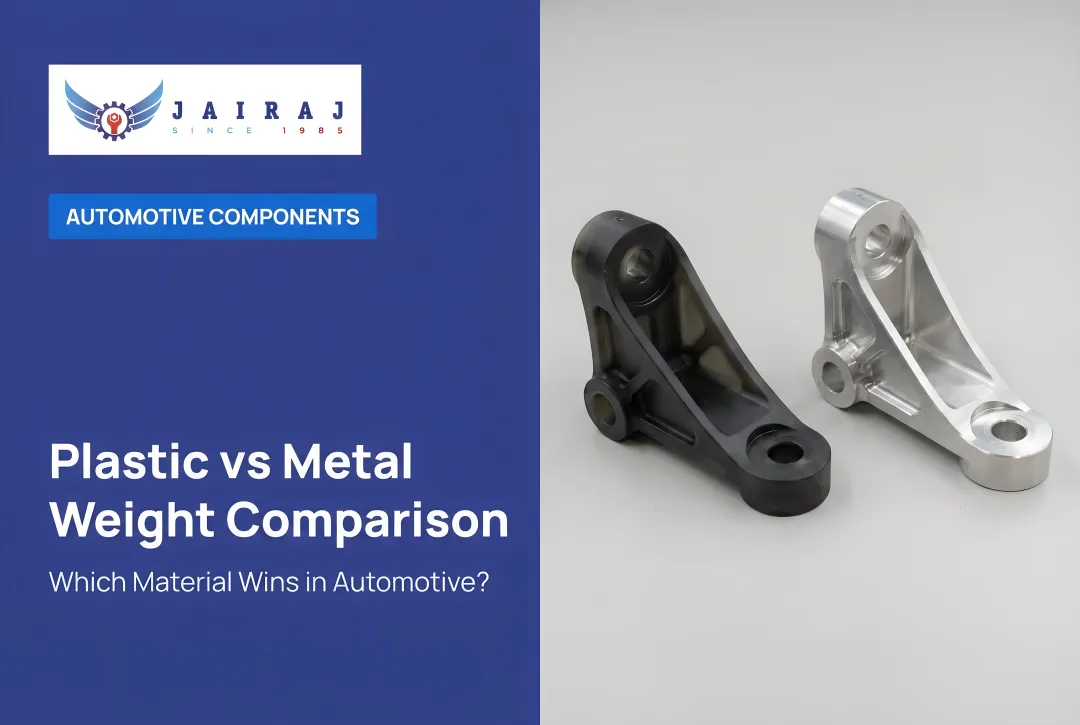
| Door beam (35% GF-PA6) | 8.97 kg | 4.04 kg | 4.92 kg (55%) |
| Tailgate (GF-PP) | 19.62 kg | 10.96 kg | 8.66 kg (44%) |
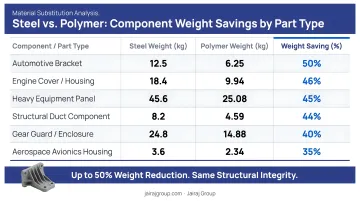
Source: NHTSA Advanced Plastics and Composites Study (2012)
Across a vehicle, PlasticsEurope's automotive data confirms that reducing vehicle weight by 100 kg cuts fuel consumption by approximately 0.2 L/100 km and CO2 by about 10 g/km.
At fleet scale, this compounds. An Indian logistics operator running 500 vehicles — each covering roughly 60,000 km annually — would see measurable diesel savings from a 0.2 L/100 km improvement alone, without changing routes, drivers, or load configurations.
KPIs this moves: Fuel consumption per 100 km, CO2 g/km, operational cost per km, EV driving range
When it matters most: High-mileage commercial fleets, passenger cars under CAFE compliance pressure, and EVs where reducing body mass directly extends range on the same battery capacity.
Advantage 2: Design Consolidation Adds Safety Features Without Adding Weight
Modern vehicles carry more equipment than ever — ADAS sensors, cameras, radar units, larger airbag systems, infotainment modules. Each addition carries mass. Injection-moulded plastic allows engineers to absorb these additions through part consolidation: a single moulded bumper or dashboard module replaces multiple stamped and welded sub-components, cutting fasteners, assembly steps, and the hidden weight that comes with them.
The safety dimension is often misunderstood. Heavier does not mean better protected — test data shows the opposite:
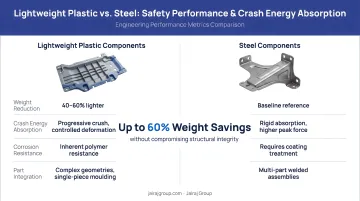
- NHTSA's 2012 advanced plastics study found that a polymer/plastic front bumper system delivered comparable crash performance in both rigid-wall and pole impact tests versus the steel baseline
- PlasticsEurope reports that energy-absorbing plastic bumpers can absorb 4–5 times more energy than bumpers made from alternative materials
- A carbon-fibre thermoset composite ladder frame reduced weight from 231.6 kg to 156.8 kg (32% saving) while achieving equivalent stiffness and impact performance
The same NHTSA study documented a 4.10 kg saving on an instrument panel and a 2.0 kg saving from a long-glass-fibre-reinforced PP door module — components that also simplified assembly.
This matters most in premium, EV, and SUV segments, where safety feature density is highest and excess weight most directly erodes performance and range. Key metrics affected: total curb weight, part count per assembly, crash energy absorption, and assembly cycle time.
Advantage 3: Corrosion Resistance Preserves the Fuel Efficiency Gain Over Time
Fuel efficiency is not only a day-one specification. Metal components corrode, develop surface oxidation, and accumulate damage over operating years — in vehicles exposed to monsoon conditions, coastal salt air, or road chemicals common in northern Indian winters.
Polymer components do not rust. A plastic bumper or mudguard moulded to specification on day one remains dimensionally stable under normal operating conditions years later. The weight and aerodynamic profile stay consistent.
This has direct operational relevance for:
- Commercial vehicle operators where unplanned maintenance creates revenue-affecting downtime
- Agricultural machinery operating in wet, chemically active soil environments
- Defense vehicles exposed to dust, moisture, and corrosive chemicals
- Coastal and high-humidity markets across India where steel components degrade faster than manufacturers' design assumptions
Jairaj Group's components for these applications — including HDPE mudguards, PA66-GF sensor housings, and roto-moulded canopies for heavy equipment — are specified precisely because these polymer grades maintain their structural and dimensional properties under the conditions where metal alternatives would require early replacement.
KPIs this moves: Component replacement frequency, maintenance cost per vehicle per year, vehicle downtime, total cost of ownership over a 5–10 year operating life
When it matters most: Commercial vehicles, agricultural machinery, defense vehicles, and any application where the operating environment is chemically aggressive or where unplanned downtime is operationally expensive.
Where Lightweight Plastics Replace Metal in Production Vehicles
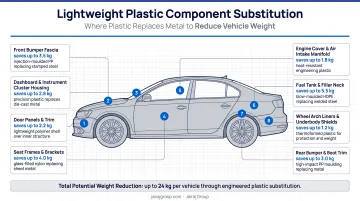
The substitutions are already well established in production vehicles. Key application areas include:
- Bumper systems — front and rear, including energy-absorbing structures; plastic bumpers typically weigh 50% less than metal equivalents
- Instrument panels and dashboard structures — replacing fabricated metal assemblies with single moulded modules
- Door modules and door beams — glass-fibre reinforced PA6 door beams save up to 55% versus steel
- Air intake systems and charge-air ducts — plastic charge-air ducts weigh approximately half their metal counterparts
- Fuel system components — air intake pipes and fuel tanks are now almost entirely produced in plastics, with a 50% weight saving versus metal alternatives
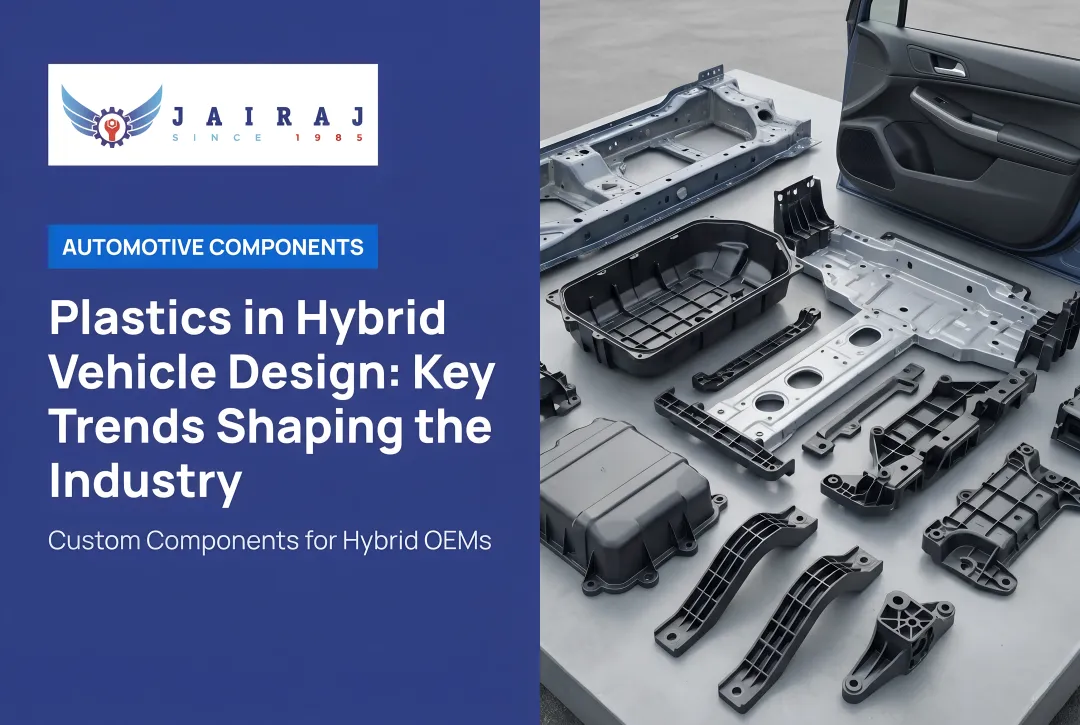
- Underbody and structural panels — roof (43% saving), tailgate (44% saving), truck bed (31% saving) per US NHTSA lightweighting data
- Throttle housings — 40% lighter per part than traditional metal housings
- Wheels — plastic wheels can weigh 6 kg, saving 3 kg per wheel versus metal equivalents
Precision injection moulding is the process that makes these substitutions viable at production volume. It allows complex geometries, consistent wall thickness, and tight dimensional tolerances across large batch runs. For OEMs managing CAFE compliance across thousands of vehicles, component-to-component consistency is non-negotiable — weight savings only accumulate as designed when every part meets specification.
That consistency demand is precisely where supplier capability matters. Jairaj Group supplies precision injection-moulded plastic components to major automotive OEMs including Endurance Technologies, Gabriel India Limited, and Tenneco Automotive, with recognition from all three for development speed, first-time-right quality, and supplier performance. Manufacturing facilities across Gurugram, Faridabad, Rudrapur, Aurangabad, and Sanand place Jairaj Group within India's primary automotive manufacturing corridors.
How to Get the Most Value from Lightweight Plastic Components
Switching to plastics is not a single decision — it's an ongoing engineering practice. Three things determine whether the fuel efficiency gain is fully realised.
1. Match material to application requirements
Not every polymer performs the same. Each grade has a defined role:
- PP — exterior structural applications where weight and weather resistance matter
- PA66-GF — high-temperature underhood environments requiring stiffness and thermal stability
- TPU — suspension and cushioning roles that demand energy absorption
- Fibre-reinforced composites — structural load-bearing applications with demanding strength requirements
Specifying the wrong grade undermines both the weight savings and the durability. Start from mechanical, thermal, and chemical exposure requirements — not unit cost per kilogram.
2. Prioritise manufacturing precision
The weight target is theoretical until a component is consistently moulded to exact dimensions. Dimensional variation means designed-in weight savings are never reliably achieved across a production run.
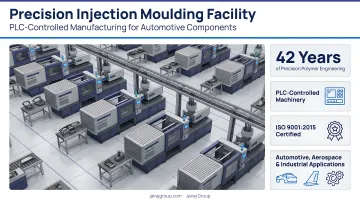
Work with suppliers who operate in-house toolrooms, use PLC-controlled injection moulding machinery, and maintain documented quality systems (ISO 9001:2015 or IATF 16949). Jairaj Group's "Best Supplier Award For Fastest & First Time Right Developments" from Endurance Technologies is a concrete measure of what dimensional consistency looks like from an OEM's perspective.
3. Review material specifications periodically
Polymer science advances. Glass-fibre reinforced PA66 grades available today offer better strength-to-weight ratios than materials specified five years ago. Manufacturers who build a periodic material review process into their engineering practice stack efficiency gains over time. Jairaj Group's R&D and Value Engineering centres are structured for exactly this — ongoing material selection, validation, and optimisation rather than one-time specification decisions.
Conclusion
The fuel efficiency case for lightweight plastics is grounded in physics, supported by decades of automotive engineering data, and validated across production vehicles worldwide. Weight reduction delivers measurable fuel savings. Corrosion resistance extends those gains across the full vehicle operating life.
A single plastic bumper is a marginal improvement. A vehicle engineered with lightweight polymers throughout its body, interior, and underhood systems achieves material fuel economy gains — the kind that show up in CAFE compliance figures and in fleet operators' annual fuel budgets.
The manufacturers who sustain that advantage treat material selection as an ongoing engineering discipline — revisited at every platform cycle, not settled at initial specification.
Frequently Asked Questions
Does using lightweight plastic improve fuel efficiency?
Yes. Less vehicle mass requires less engine energy per kilometre. The US Department of Energy benchmarks a 10% vehicle weight reduction at a 6–8% fuel economy improvement — a ratio that applies to both internal combustion and electric vehicles. Across large fleets, even modest per-vehicle gains translate into significant fuel and emissions savings.
What plastics are fuel-resistant and safe for fuel system components?
High-density polyethylene (HDPE) is widely used for fuel tanks due to its resistance to swelling, permeation, and chemical degradation from petrol, diesel, and ethanol blends. Fuel lines typically use fluoropolymers for their permeation resistance. Both materials must meet permeation and chemical compatibility standards defined by automotive OEM specifications and regional regulatory frameworks.
What is the lightest but strongest plastic for automotive use?
Carbon fibre-reinforced polymer (CFRP) composites offer the highest strength-to-weight ratio — industry testing has documented CFRP ladder frames saving over 74 kg versus steel equivalents with no loss in stiffness or crash performance. For less demanding applications, glass-fibre reinforced polypropylene or PA66-GF delivers a practical balance of strength, lightness, and cost.
How much weight can replacing metal with plastic save in a car?
Research from the US Department of Energy indicates that replacing cast iron and traditional steel with lightweight polymer composites can reduce vehicle body and chassis weight by up to 50%. At the component level, savings range from 10–60% depending on material and application — with documented examples including 47% for front bumpers, 55% for door beams, and 44% for tailgates.
Which vehicle components benefit most from lightweight plastic substitution?
The highest-impact substitution points are bumpers, instrument panels, door modules, door beams, charge-air ducts, fuel tanks, throttle housings, underbody shields, and tailgates. These are high-mass components where polymer alternatives are structurally validated and already in widespread production use.
How do lightweight plastics support electric vehicle performance?
EV batteries are significantly heavier than ICE powertrains, adding considerable base weight before any other component is considered. Lightweight plastic body and interior components help offset this penalty — reducing total vehicle mass either extends driving range on the same battery or allows a smaller, less expensive battery pack while maintaining the same range target.