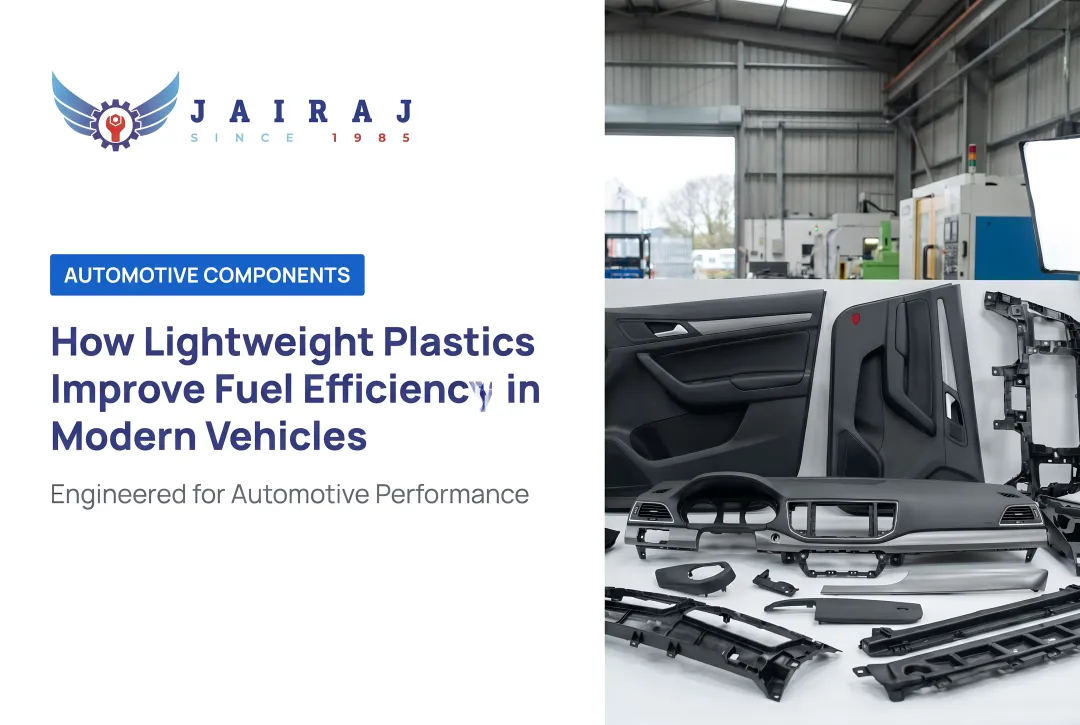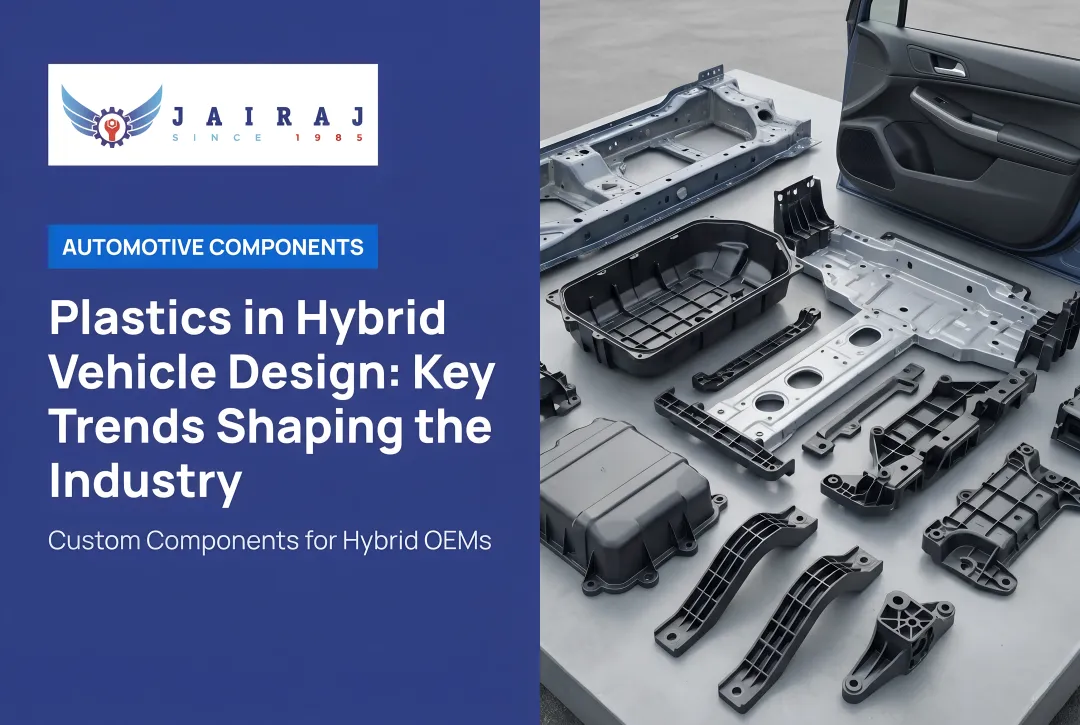
At the centre of this challenge sits one recurring question: plastic or metal?
The answer isn't straightforward. Steel still dominates body structures. Aluminum holds ground in engines and suspension. But high-performance engineering plastics are taking over intake manifolds, sensor housings, battery enclosures, and dozens of other components where weight, corrosion resistance, and design complexity once favoured metal.
This article breaks down the actual density data, strength-to-weight numbers, real conversion outcomes, and a clear framework for deciding which material wins — for your specific component.
Key Takeaways
- Steel is roughly 7.5x denser than common automotive plastics; aluminum is still ~2x denser than most engineering polymers
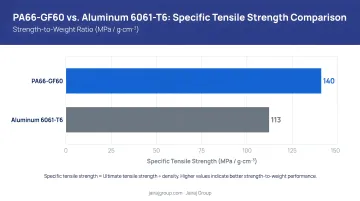
- PA66 with 60% glass fibre hits 155.7 MPa/g/cc specific tensile strength — beating 6061-T6 aluminum's 114.8 MPa/g/cc
- Real-world plastic conversions have cut component weight by 30% and cost by 15% versus equivalent steel designs
- India's CAFE 2 norms and heavy EV battery packs are pushing OEMs to cut weight everywhere else
- No universal winner exists — the right call depends on operating temperature, load type, and production volume
Plastic vs Metal in Automotive: Quick Weight Comparison
Material Density and Performance at a Glance
| Attribute | Engineering Plastics | Aluminum (6061-T6) | Steel (AISI 1020) |
|---|---|---|---|
| Density | 0.9–1.67 g/cc | 2.70 g/cc | 7.87 g/cc |
| Tensile Strength | 35–260 MPa (grade dependent) | 310 MPa | 420 MPa |
| Specific Tensile Strength | Up to 155.7 MPa/g/cc (PA66-GF60) | 114.8 MPa/g/cc | ~53 MPa/g/cc |
| Corrosion Resistance | Excellent (no rust or oxidation) | Moderate (anodising required) | Poor (requires coating) |
| Design Flexibility | High (complex geometry, part consolidation) | Moderate | Lower |
| Typical Use Cases | Manifolds, housings, panels, brackets | Engine blocks, suspension, body panels | Body-in-white, chassis, crash structures |
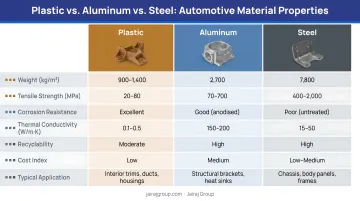
A same-size part made from steel can weigh up to 6x more than an equivalent thermoplastic component, and approximately 2x more than aluminum. On a strength-per-weight basis, high-performance grades like PA66-GF60 outperform both — as the specific tensile strength row above illustrates.
That density gap also highlights why material selection requires more precision than simply choosing "metal" or "plastic." Steel spans carbon, HSLA, and ultra-high-strength variants; aluminum alloys differ significantly by grade; magnesium (AZ31B at 1.77 g/cc) sits closer to plastics on the density scale. Plastics show the same range — commodity PP at 0.905 g/cc versus glass-filled PA66 at 1.67 g/cc. Grade selection matters as much as material family.
What Plastic Brings to Automotive Engineering
The Weight Advantage in Hard Numbers
Modern automotive plastics are precision-engineered polymers, not commodity materials. The grades relevant to structural and semi-structural applications — PA6.6, PPA, PPS, ABS, Polycarbonate — are selected for specific mechanical, thermal, and chemical performance requirements.
The density gap is significant:
- PP (unfilled): 0.905 g/cc
- ABS: ~1.04 g/cc
- Polycarbonate: ~1.19 g/cc
- PA66 (unfilled): ~1.14 g/cc
- PA66-GF60: 1.67 g/cc
Set those figures against aluminium at 2.70 g/cc and steel at 7.87 g/cc, and the weight reduction potential becomes clear. According to PlasticsEurope, plastics are approximately one-sixth the weight of steel in automotive applications.
Beyond Weight: The Operational Advantages
Weight savings alone don't explain why plastic adoption has accelerated. Additional benefits matter:
- Corrosion resistance — no rust, no oxidation coatings, no paint required on structural parts
- Acoustic damping that's particularly valuable in EVs, where combustion noise no longer masks other sounds
- Design freedom — complex geometries requiring multiple metal stampings can be produced as a single moulded part
- Part consolidation replaces multiple metal sub-components with one injection-moulded assembly, cutting both steps and total part count
Where Fibre Reinforcement Changes the Equation
The objection that plastic is weaker than metal no longer holds for reinforced engineering grades. Celanese Celstran PA66-GF60 delivers 260 MPa tensile strength at 1.67 g/cc, yielding a specific tensile strength of 155.7 MPa/g/cc. Aluminium 6061-T6, with 310 MPa tensile strength at 2.70 g/cc, achieves only 114.8 MPa/g/cc on the same metric.
That's a 35% advantage in strength-to-weight for the reinforced plastic.
Jairaj Group works with PA66-GF across its precision injection-moulded automotive portfolio. Sensor housings, suspension components, and under-hood parts are areas where this strength-to-weight ratio translates directly into production performance.
Use Cases: Where Plastic Has Replaced Metal
Plastic has moved well beyond interior trim. Current automotive applications include:
- Intake manifolds (originally cast aluminium, now injection-moulded nylon)
- Engine mounts and support brackets
- Fuel system components and reservoir tanks
- Instrument panels and dashboard structures
- Exterior body panels, bumpers, fenders
- Under-hood enclosures and sensor housings
- EV battery covers and enclosures
- Brake and accelerator pedal systems
Jairaj Group manufactures across most of these zones, from blow-moulded fuel tanks and air intake manifolds to injection-moulded sensor housings, suspension bushings, and EV battery enclosures. Customers include automotive OEMs such as Endurance Technologies, Gabriel India Limited, and Tenneco Automotive.
Where Metal Still Wins
Steel, Aluminum, and Magnesium — Each With a Purpose
The three primary automotive metals serve distinct roles:
- Steel (carbon, HSLA, UHSS): Body-in-white, crash-critical pillars and beams, chassis rails. Steel accounts for roughly 54% of average vehicle weight and dominates safety structures where crash energy absorption behavior is well-validated and regulatory compliance is non-negotiable.
- Aluminum alloys (6061, cast alloys): Engine blocks, cylinder heads, suspension components, hoods, and doors. Ducker Carlisle projects aluminum content reaching 565 lb per vehicle by 2028, driven by lightweighting pressure in body panels.
- Magnesium alloys (AZ31B at 1.77 g/cc): Steering columns, seat frames, instrument panel beams, and gearbox housings — applications that need low density but can't accommodate plastic's stiffness limitations.
Why Plastic Can't Replace Metal Everywhere
Metal's enduring advantages in specific zones:
- Extreme temperature performance — above 150°C (and often much higher for exhaust and powertrain components), most plastics cannot sustain mechanical properties over time
- Absolute rigidity under continuous load — creep under sustained stress remains a limitation even for high-performance polymers
- Crash energy absorption — body-in-white and safety-critical structures rely on validated metal deformation behavior; switching to plastic here is impractical under current regulations
- Mature supply chain — established joining, welding, and assembly infrastructure for metal creates switching costs that aren't justified for every component
ICCT data shows body-in-white at 23–28% of vehicle mass and powertrain at 24–26%. Both segments remain firmly metal-dominated, and that's unlikely to change without significant advances in structural polymer validation.
Plastic vs Metal: How to Make the Right Call
The Three-Axis Decision Framework
Material selection for a specific automotive component comes down to three axes:
- Operating temperature — Below ~150°C for most polymers, above that range (exhaust, high-load powertrain) requires metal
- Structural load type — Static loads and moderate dynamic loads suit reinforced plastics well; continuous high-load or crash-critical applications still require metal
- Production volume — Injection moulding offers cost-efficient mass production for plastic; metal stamping economics vary by geometry and volume
Addressing the Strength Misconception
Raw tensile strength comparisons favour metal: steel at 350–420 MPa versus PA66 at 82 MPa unfilled. For lightweighting decisions, though, tensile strength alone tells the wrong story — strength-to-weight ratio is the relevant metric.
At 155.7 MPa/g/cc, PA66-GF60 outperforms 6061-T6 aluminium (114.8 MPa/g/cc) on this measure. For components where the design objective is to carry a given load at minimum mass, reinforced engineering plastic is the stronger engineering choice.
That strength-per-gram advantage becomes strategically important once you account for the regulatory targets now binding OEMs.
The Emissions Compliance Driver
Regulatory pressure is structural and accelerating:
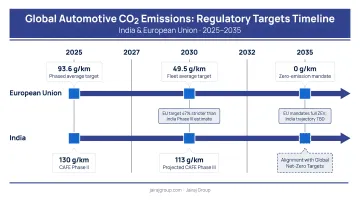
- India CAFE 2: 113 gCO₂/km from FY 2022-23
- EU 2025-2029: 93.6 g/km
- EU 2030-2034: 49.5 g/km
- EU from 2035: 0 g/km
According to the US Department of Energy, an extra 100 lb (roughly 45 kg) can reduce fuel economy by approximately 1%, and a 10% vehicle weight reduction improves fuel economy by 6–8%.
In EVs, the pressure is even sharper. Battery packs in production vehicles weigh between 295 kg (2020 Nissan Leaf) and 681 kg (2019 Audi e-tron). Every kilogram saved through material substitution in non-battery components directly offsets that penalty.
Meeting those targets without blowing the bill of materials budget is where the material decision gets practical.
The Cost Dimension
Cost comparison between plastic and aluminium die-casting is component-specific, not universal. Directional evidence from documented conversions:
- Toyota Sienna third-row seatback: 15% cost reduction versus prior steel design (BASF, 2020)
- Ford Fusion thermoplastic energy absorber: 10% lower cost than comparable steel part (ICCT, 2016)
Plastic tooling (injection moulds) can carry significant upfront cost, but high-performance resin grades add material cost over commodity steel. Part consolidation — fewer components, fewer assembly steps — is often where the economic case closes.
Situational Guidance
Choose plastic when:
- Weight reduction is the primary design objective
- Operating temperature stays below ~150°C
- Corrosion resistance is needed without coatings
- Complex geometry or part consolidation can reduce assembly cost
- Production volumes justify injection mould tooling investment
Choose metal when:
- Component operates above 150°C continuously (exhaust, powertrain)
- Crash energy absorption behaviour must meet safety regulations
- Continuous high structural loads create creep risk for polymers
- Joining to existing metal structures makes substitution impractical
Real-World Impact: Metal-to-Plastic Conversions
What the Evidence Shows
Documented automotive conversion outcomes provide the clearest picture of what's achievable:
| Component | Conversion | Weight Saving | Cost Change |
|---|---|---|---|
| Ford Windstar 3.8L intake manifold | Aluminium → 33% GF nylon 6/6 | 5 lb saved | — |
| Toyota Sienna third-row seatback | 15-part steel → BASF polyamide | 30% | −15% |
| Mercedes-Benz S-Class transmission crossbeam | Aluminium die-cast → polyamide | 25% | — |
| Lincoln Continental seat pan | Metal → plastic | 20% | −15% |
| Jeep Renegade floor rocker reinforcement | Steel stampings → PA/PPE blend | 50% | — |
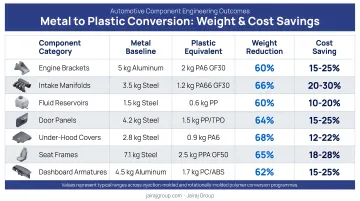
These aren't marginal improvements. A 30% weight reduction on a seatback or 50% on a structural reinforcement accumulates quickly across a vehicle's total mass budget.
What Triggers a Conversion and What Validates It
Conversion decisions are typically triggered by:
- OEM-mandated weight reduction targets on a new platform
- Tightening fuel economy or emissions compliance requirements
- Rising raw material costs for aluminium or steel
- Part consolidation opportunities identified during design reviews
Validation before production release typically involves:
- Selecting materials against temperature, chemical, and mechanical requirements
- Running moldflow analysis to predict fill, weld lines, and warpage
- Prototype testing under combined loads (vibration + pressure, not isolated)
- Thermal testing per ISO 75 (heat deflection under load)
- Mechanical validation per ASTM D638 (tensile) and ISO 179 (impact)
- Heat aging per ASTM D3045 before re-testing mechanical properties
Each of these steps maps directly to where conversion projects succeed or stall. Jairaj Group's engineering team supports this workflow end-to-end: from DFM analysis and process simulation through prototype development, dimensional checks, and production validation. For component-level assessment on a specific conversion, reach the team at +91-9711-114-300 or japl@jairajgroup.com.
Conclusion
No single material wins across every automotive application. High-performance engineering plastics are the clear choice for the majority of non-extreme-temperature, non-crash-critical components — delivering meaningful weight, cost, and design advantages that metal cannot match. Metal remains essential where physics demands it: sustained extreme heat, crash energy absorption, and continuous high structural loads.
In practice, the decision comes down to three factors:
- Weight and range: Every kilogram removed through material substitution improves fuel economy in ICE vehicles and extends range in EVs
- Thermal and structural limits: Metal holds where plastics reach their physical ceiling — exhaust systems, crash structures, suspension links
- Total cost of ownership: Plastics typically reduce part count, tooling complexity, and long-term maintenance costs
Material selection is one of the highest-leverage decisions in vehicle engineering. The manufacturers getting it right aren't choosing plastic or metal wholesale — they're choosing the right material for each specific load case, temperature range, and safety requirement.
Frequently Asked Questions
How much heavier is metal than plastic?
Steel has a density of approximately 7.87 g/cc versus ABS at ~1.04 g/cc — roughly a 7.5x difference. The exact mass gap varies by grade, but the weight advantage of plastic over steel is consistent across nearly all engineering applications.
What is heavier, plastic or aluminium?
Aluminium at 2.70 g/cc is roughly 2x denser than most engineering plastics (0.9–1.5 g/cc). Plastic parts are lighter than aluminium equivalents of the same volume, with glass-filled grades also closing the structural performance gap significantly.
Can plastic components replace metal in load-bearing automotive parts?
Advanced reinforced grades — PA66-GF60, PPS, PPA — can replace metal in many semi-structural applications. Successful examples include intake manifolds, transmission crossbeams, seat structures, and pedal brackets. High-temperature and crash-critical zones still require metal.
How does reducing vehicle weight with plastic affect fuel efficiency?
The US DOE states that a 10% vehicle weight reduction improves fuel economy by 6–8%. In EVs, every kilogram saved reduces energy consumption and can either extend range or allow a smaller battery at constant range.
What types of engineering plastics are used in automotive manufacturing?
Key materials include PA6, PA6.6, PP, ABS, Polycarbonate, PPS, and PPA — with fibre-reinforced grades (glass or carbon) selected based on temperature exposure, chemical environment, and mechanical load demands.
Does switching from metal to plastic affect vehicle safety standards?
Plastic components must meet the same regulatory and OEM safety standards as metal equivalents. Any metal-to-plastic conversion requires validation through thermal, mechanical, and combined-load testing before production sign-off, with full traceability documentation throughout.