The plastic enclosure around a sensor is its primary defence. Get the material wrong and the consequences aren't just a cracked housing — they're connector misalignment, calibration drift, signal noise, and in safety-critical systems like ADAS and ABS, potential failure at precisely the wrong moment.
This guide covers the key weather-related threats sensor housings face, compares the five materials most widely used by automotive OEMs, and gives you a practical framework for narrowing down the right choice for your application.
Key Takeaways
- No single polymer handles every automotive weather stress; match material choice to the sensor's thermal, chemical, and mechanical demands
- The five proven materials are PA66, PBT, PC, PEEK, and PPS — each optimised for different sensor types and environments
- Start with operating temperature, then factor in chemical exposure, moisture sensitivity, UV load, and IP sealing requirements
- PA66-GF and PBT-GF dominate high-volume applications; PEEK and PPS are reserved for extreme heat zones
- Manufacturing partner capability matters as much as resin grade — PEEK and PPS demand specialised processing equipment
Why Automotive Sensors Need Weather-Resistant Plastic Housings
The Operating Environment Is Severe
Automotive sensors don't sit in protected enclosures. They're mounted where the action happens:
- Wheel wells: continuous exposure to road splash, stone strike, and de-icing salts
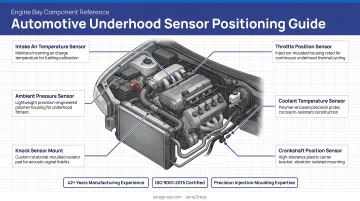
- Engine bays: peak temperatures above 130°C with thermal cycling through cold starts
- Exterior surfaces: direct UV radiation that degrades unprotected polymers within months
ISO 16750-4 (climatic loads) and ISO 16750-5 (chemical loads) define the environmental conditions and test protocols that electrical and electronic equipment on road vehicles must survive. These aren't advisory documents — they're the qualification baseline. Any sensor housing material should be evaluated against these standards from the design outset.
For ingress protection, IEC 60529 sets the framework. IP67 means dust-tight and immersion-protected to 1 m; IP68 extends this to continuous immersion beyond those conditions. Achieving either rating is a function of both material choice and dimensional precision in the moulded part.
What Happens When the Wrong Material Is Chosen
Material selection failures in sensor housings follow predictable patterns:
- Moisture absorption in PA6 or unstabilized PA66 causes dimensional swelling, leading to connector misalignment and intermittent signal faults
- UV degradation in unprotected ABS embrittles the housing, creating micro-cracks that allow moisture ingress and accelerate failure
- Thermal cycling in brittle or mismatched polymers generates micro-stress at weld lines and around metal inserts — over thousands of cycles, this leads to seal distortion or housing fracture
- Chemical attack from concentrated road salt solutions on improperly compounded PA66 causes surface degradation and loss of structural integrity at elevated temperatures
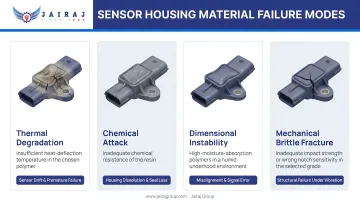
Each failure mode carries a direct performance consequence. A swollen housing misaligns a connector pin; a cracked seal admits moisture to electronics. In ABS or ADAS applications, dimensional instability in the enclosure can cause calibration drift — which translates to false readings, erratic system responses, or unplanned shutdowns.
Top Weather-Resistant Plastics for Automotive Sensors
These five materials were selected based on proven automotive OEM adoption, verified thermal range coverage from -40°C to 260°C, and availability in injection-moldable grades suited to high-volume precision manufacturing.
PA66 (Polyamide 66 / Nylon 66)
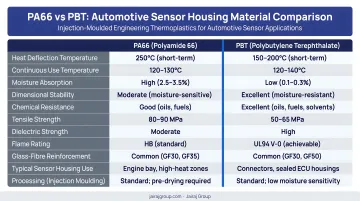
PA66 is the workhorse of automotive sensor housing applications. It combines mechanical strength, good heat resistance, and excellent processability in high-volume injection molding — which is why it appears across a wide range of sensor body applications.
The critical factor for weathering performance is moisture management. BASF's Ultramid A3K datasheet shows standard PA66 absorbs 2.5–3.1% moisture at 23°C/50% RH, rising to 8–9% at water saturation. For precision sensor fits, that's a significant dimensional risk. Glass-fiber-reinforced grades (PA66-GF30) reduce this to 1.5–1.9% at 50% RH, with long-term service temperature validated at 135°C under IEC 60216 testing.
Heat-stabilised and hydrolysis-resistant grades extend resistance to engine coolant and repeated thermal cycling. Standard PA66 shows limited resistance to calcium chloride solutions at elevated temperatures — a real-world concern for wheel-well sensor housings exposed to winter road treatments.
| Property | PA66-GF30 (Verified Data) |
|---|---|
| Continuous Service Temp | Up to 135°C (long-term, IEC 60216) |
| Moisture Absorption (50% RH) | 1.5–1.9% |
| Chemical Resistance | Engine oils, greases, fuels: resistant. Hot calcium chloride solutions: limited — compounding required |
| Typical Applications | Speed sensor housings, crankshaft/camshaft position sensor bodies, temperature probe housings |
Jairaj Group processes PA66-GF for automotive sensor housing applications, with components engineered for engine bay thermal loads and chemical exposure to automotive fluids and oils.
PBT (Polybutylene Terephthalate)
PBT's defining advantage over PA66 is its dramatically lower moisture uptake. BASF Ultradur B 4300 G6 (PBT-GF30) absorbs just 0.2% at 23°C/50% RH and 0.4% at water saturation — roughly one-tenth the moisture uptake of standard PA66. For sealed connector bodies where pin-to-socket alignment must stay precise over years of humidity cycling, this is the differentiating property.
PBT also offers inherently good resistance to automotive fluids and fuels, and glass-filled grades provide the rigidity needed to prevent housing distortion during press-fit assembly. Long-term service temperature for PBT-GF30 reaches 140°C.
| Property | PBT-GF30 (Verified Data) |
|---|---|
| Continuous Service Temp | Up to 140°C (long-term) |
| Moisture Absorption (50% RH) | 0.2% |
| Chemical Resistance | Excellent against automotive fluids, fuels, road salts. UV-stabilised grades required for exterior exposure |
| Typical Applications | Sealed sensor plug bodies, multi-pin connector housings, fuel rail sensor housings |
PA66 handles structural loads; PBT handles dimensional precision. For sensor housings where sealing geometry must hold tolerances over years of humidity exposure, PBT-GF is the standard specification.
PC (Polycarbonate)
Polycarbonate occupies a distinct niche: it's the only material in this group that supports optical functions. Standard Covestro Makrolon grades achieve 87–90% visible light transmittance. For LiDAR applications, the Makrolon AX2675 ST grade delivers ≥89% IR transparency at 905 nm — the wavelength used by most automotive LiDAR systems.
This makes PC the material of choice for sensor covers that must allow electromagnetic or optical signal transmission: LiDAR cover lenses, rain/light sensor domes, forward-facing camera housings.
Covestro and Canatu developed a production-ready heated LiDAR cover lens using Makrofol PC film with integrated carbon nanotube transparent heaters and film insert molding (FIM) — demonstrating how PC can incorporate active de-icing functions directly into the lens structure.
PC sensor covers must operate from -40°C to 120°C for automotive LiDAR applications, and UV-stabilised grades are required for any exterior position with prolonged sun exposure.
| Property | Automotive-Grade PC |
|---|---|
| Continuous Service Temp | -40°C to ~120°C |
| Visible Transmittance | 87–90% (standard grades) |
| NIR Transparency | ≥89% at 905 nm (LiDAR-specific grades) |
| Typical Applications | LiDAR cover lenses, camera housings, rain/light sensor domes, parking sensor bezels |
PEEK (Polyether Ether Ketone)
PEEK sits at the top of the thermoplastic performance hierarchy. Victrex data confirms continuous service temperatures up to 260°C, with a melting point of 343°C. Its chemical resistance covers virtually all automotive fluids — fuels, engine oils, brake fluids, concentrated acids — with minimal swelling even at elevated temperatures.
These properties make PEEK the specified material when sensor positions are genuinely extreme: proximity to exhaust systems, turbocharger housings, or direct-injection fuel rails where other materials simply cannot maintain structural integrity over time.
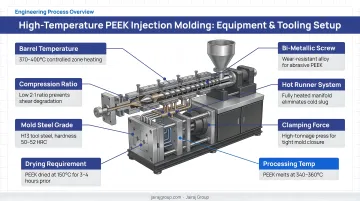
The trade-off is processing complexity and material cost. PEEK requires barrel temperatures well above those used for PA66 or PBT, along with specialised screw designs. This means OEMs need to confirm their component manufacturer has the right equipment before specifying PEEK — it's not a material you can run on a standard general-purpose injection molding line.
| Property | PEEK (Victrex Verified Data) |
|---|---|
| Continuous Service Temp | Up to 260°C |
| Melting Point | 343°C |
| Chemical Resistance | Outstanding — fuels, oils, brake fluids, concentrated acids |
| Typical Applications | Exhaust temperature sensors, high-heat fuel pressure sensors, turbocharger proximity sensors |
Jairaj Group's injection molding infrastructure includes the high-barrel-temperature tooling and specialised screw configurations required for PEEK processing — a capability that rules out most general-purpose molders for these applications.
PPS (Polyphenylene Sulfide)
PPS fills the gap between PBT and PEEK — higher temperature capability than PBT, more cost-accessible than PEEK. Celanese Fortron PPS achieves continuous service temperatures up to 240°C, inherent UL94 V-0 flame resistance, near-zero moisture absorption, and solvent resistance below 200°C that covers all standard automotive chemicals.
Glass or mineral-filled PPS grades add dimensional stability and stiffness, making them well-suited for precision-fit sensor housings in moderate-to-high heat zones — transmission housings, throttle body sensor enclosures, emission sensors. Solvay's Ryton R-4-230BL (40% GF PPS) has been documented for chemical- and heat-resistant sensor housings retaining properties after prolonged exposure up to 200°C.
| Property | PPS (Celanese Fortron Data) |
|---|---|
| Continuous Service Temp | Up to 240°C |
| Flame Rating | UL94 V-0 inherent (some grades 5VA) |
| Chemical Resistance | Excellent — fuels, transmission fluids, coolants, most organic solvents below 200°C |
| Typical Applications | Transmission speed/temperature sensors, throttle position sensor housings, emission sensor bodies |
How to Select the Right Plastic for Your Sensor Application
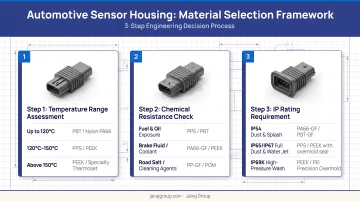
Start With Temperature
Map the sensor's actual operating environment — not just peak temperature, but the continuous thermal load and whether the position experiences repeated heating/cooling cycles. Use this to eliminate materials immediately:
- Above 140°C continuous: eliminate standard PBT and PA66
- Above 220°C: PPS upper boundary — move to PEEK
- Thermal cycling in a location with metal inserts: prioritise glass-filled grades to reduce CTE mismatch
Layer In Chemical Exposure
Cross-reference the fluids the housing will contact against each material's resistance profile:
- Road salt (calcium chloride) at elevated temperatures: requires hydrolysis-stabilised PA66 or switch to PBT/PPS
- Engine coolant (glycol/water): PA66 shows limited resistance above 106°C — PBT or PPS preferred
- Fuels and oils: all five materials handle these well in compounded grades
Match Material to IP Sealing Requirements
Achieving IP67 or IP68 is a joint function of material and geometry. Key considerations:
- Low moisture absorption (PBT and PPS especially) helps O-ring groove dimensions stay consistent over time — a known weak point for PA66 in humid or wet environments
- Overmoulded TPE seals require a substrate that supports good TPE adhesion and maintains dimensional stability through temperature cycling
Account for Manufacturing Constraints
PEEK and PPS require higher processing temperatures and specialised screw designs compared to PA66 or PBT. Confirm that your component manufacturer has the right equipment and polymer expertise before committing to a grade — this is a qualification step, not a reason to avoid high-performance materials.
Jairaj Group's engineering team works through this during early-stage development — reviewing operating environment, temperature requirements, and sealing demands, then running DFM analysis and flow simulation before tooling begins. For sensor housing programmes, this upstream review catches material-processing mismatches before they reach production validation.
Why These Five Materials — And What Didn't Make the List
These materials were selected against three criteria: coverage of the full automotive sensor operating range (-40°C to 260°C), availability in injection-moldable grades from established global compounders, and verified OEM adoption in automotive electrical and sensor applications.
Three commonly discussed materials were excluded:
- ABS: Deflection temperature under load is approximately 87–99°C for standard grades — insufficient for most under-hood or even many exterior sensor positions
- Standard PA6: Higher moisture absorption than PA66 (both can exceed 8% at saturation in hot water conditions), without the mechanical performance upside that justifies the tradeoff
- Standard PVC: Increasingly restricted under automotive end-of-life vehicle directives governing hazardous substance content, and thermally limited for most sensor housing environments
For safety-relevant sensor components, processability alone is not sufficient. Each material on this list has a track record across real-world service conditions — temperature cycling, chemical exposure, and mechanical stress — that the excluded options cannot reliably match.
Conclusion
PA66-GF handles structural, high-volume applications up to 135°C. PBT-GF delivers dimensional precision where moisture stability is the priority. PC is the only viable option for optical and near-IR transparent covers. PPS bridges the gap between standard engineering resins and PEEK's extreme-environment performance. PEEK is reserved for applications where nothing else survives the combined thermal and chemical load.
The selection process should evaluate the full operating envelope: continuous temperature, thermal cycling severity, fluid contact chemistry, UV exposure, and sealing geometry requirements. Then validate against ISO 16750 climatic and chemical load standards before committing to a production material.
That material-to-process path is where manufacturing expertise matters. Jairaj Group has been producing precision injection-molded polymer components for automotive OEMs since 1985. The company operates in-house tooling, testing capabilities covering dimensional verification, thermal cycling, and chemical resistance validation, and holds ISO 9001:2015 certification. Engineering teams across six facilities in India process PA66-GF, PBT, PC, PEEK, and other high-performance resins.
If you're developing a sensor housing and need material consultation or component development support, reach out to the Jairaj Group team at japl@jairajgroup.com or +91-9711-114-300.
Frequently Asked Questions
What type of plastic is used in automotive?
Automotive plastics vary by application. PP dominates bumpers and interior trim. PA66 and PBT are standard for sensor housings and connectors. PC is used for transparent covers and lenses. ABS appears in interior panels. PPS and PEEK handle high-heat under-hood components. Material selection is driven by the thermal load, chemical environment, and structural requirements of each application.
What is the most temperature-resistant plastic for automotive sensors?
PEEK holds the top position, with continuous service capability up to 260°C verified by Victrex. PPS follows at up to 240°C (Celanese Fortron data). Heat-stabilised PA66-GF reaches 135°C for long-term service. For sensors positioned near exhaust systems, turbochargers, or high-heat combustion zones, PEEK is typically the specification despite the cost premium.
Which plastic is best for exterior automotive sensor housings exposed to UV and rain?
UV-stabilised PC or UV-stabilised PBT are the standard recommendations. PC is preferred where optical clarity or near-IR transparency is required — LiDAR covers, camera housings, rain sensors. PBT-GF offers better dimensional stability and dramatically lower moisture absorption for sealed connector bodies and sensor plugs exposed to rain and road splash.
Can injection-molded plastic sensor housings achieve IP67 or IP68 ratings?
Yes, with the right material and geometry combination. Low-moisture-absorption materials like PBT-GF and PPS maintain O-ring groove dimensions over time, and dimensional precision in the molded part — gate location, cavity pressure, and part tolerances — determines whether the sealing geometry holds under real-world conditions.
How does thermal cycling affect plastic automotive sensor housings over time?
Repeated heating and cooling creates micro-stress at weld lines and around metal inserts, leading to cracking or seal distortion over thousands of cycles. Glass-fiber-reinforced grades of PA66, PBT, or PPS reduce the coefficient of thermal expansion significantly, minimizing stress concentration and extending service life.