According to the American Chemistry Council's 2023 Chemistry and Automobiles report, plastics and polymer composites account for 50% or more of a vehicle's volume while contributing less than 10% of its weight. That weight-to-performance ratio isn't just a fuel economy story — it's the foundation of modern vehicle safety engineering.
This article unpacks both sides of that story: the passive systems that protect occupants during a crash, and the active monitoring systems that try to prevent one.
Key Takeaways
- Plastics are structural in passive safety: bumpers, crumple zones, airbag housings, and seatbelt mechanisms all rely on precision-engineered polymers
- ADAS cameras, radar/LiDAR sensors, and ECUs all depend on plastic enclosures for RF transparency, dimensional stability, and heat resistance
- Polymer selection is application-specific — the right material depends on whether the part needs to absorb impact, insulate current, or survive heat
- EVs use 45% more plastic than comparable ICE vehicles, driven by battery weight offset and high-voltage system requirements
- Dimensional precision is non-negotiable: even minor out-of-spec tolerances in sensor housings can cause ADAS calibration drift
Why Plastics Became Central to Vehicle Safety
The shift from all-metal vehicle construction wasn't simply about cutting weight. Metals are excellent at bearing loads — but they're poor at managing energy during a crash. When steel deforms, it does so unpredictably. Engineered polymers can be tuned to deform in controlled, progressive ways that direct crash energy away from occupants.
The numbers make this concrete. The ACC 2023 report notes that fibre-reinforced polymer composites can absorb four times the crush energy of steel by weight — a decisive advantage for any application where controlled energy dissipation determines whether occupants survive a collision.
Plastic content in the average vehicle has also grown substantially. In 2021, the average vehicle contained approximately 186 kg of plastics and polymer composites (~411 lb), up 16% from around 161 kg (~354 lb) in 2012. That growth tracks directly with tightening safety performance requirements.
Two Categories of Safety Role
It helps to separate how plastics contribute:
- Passive safety systems — components that physically protect occupants when a crash occurs: crumple zones, airbag housings, bumpers, seatbelt mechanisms, pillar foam
- Active safety systems — electronic monitoring components that detect hazards and alert or assist drivers before a crash: ADAS sensor housings, radar/LiDAR enclosures, ECU housings, instrument cluster substrates
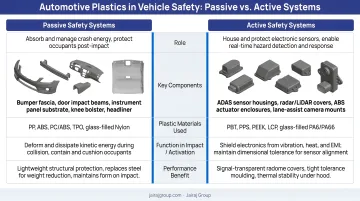
Plastics play a distinct, engineered role in both. Composite and reinforced polymers are qualified to specific deformation and load-bearing standards through automotive safety testing — the same rigorous validation process that governs every structural element in a modern vehicle. Understanding which components carry which loads is where the material selection decisions get specific.
Passive Safety Systems: Polymers That Protect Occupants
Crumple Zones and Bumpers
Front and rear crumple zones use expanded polypropylene (EPP) and reinforced PP components specifically because their deformation behaviour can be tuned by adjusting foam density and geometry. EPP offers high energy absorption, low weight, and the ability to absorb energy across repeated impacts without catastrophic failure — a property that distinguishes it from single-use crush materials.
Front and rear bumpers function within a similar logic. Under India's AIS-023 standard (and equivalent international regulations such as 49 CFR Part 581 for export markets), bumpers must withstand pendulum and barrier impacts at defined speeds without damage to safety systems. Reinforced PP compounds — including long-glass-fibre grades — are the dominant material choice because they combine impact resistance, low-temperature performance, and the ability to meet these requirements at lower weight than metal alternatives.
Airbag Systems
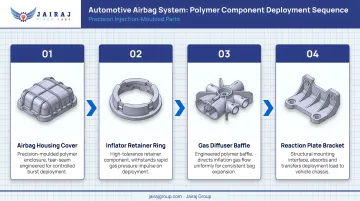
An airbag system contains far more plastic than most people realise:
- Module housing — rigid polymer enclosure protecting the folded bag and inflator
- Deployment door — precision-scored plastic designed to fracture at a defined force level
- Inflator casing — heat-resistant polymer enclosure for the gas generation components
- Bag fabric — high-tenacity nylon or polyester that must deploy within milliseconds without tearing
Every one of these components must meet performance requirements under India's AIS-145 (Automotive Industry Standard for airbag systems) and equivalent international standards such as FMVSS No. 208 for export-market vehicles. Dimensional accuracy and material consistency aren't manufacturing preferences here — they're directly tied to whether the system deploys correctly in a real crash.
Seatbelt and Restraint Systems
Seatbelt webbing performance is governed in India by IS 14225 and CMVR Schedule requirements, with international equivalents including FMVSS No. 209 for export markets. Polyester fibre is the dominant choice because it meets these strict mechanical thresholds while holding dimensional stability across temperature and humidity ranges:
| Requirement | Minimum Threshold |
|---|---|
| Breaking strength (Type 1) | 26,689 N |
| Max elongation at 11,120 N | 20% |
Plastic housings also protect retractor mechanisms from contamination and impact. Buckle assemblies integrate polymer components engineered for consistent quick-release performance under load.
Pillar Foam and Rollover Protection
Polyurethane structural foam injected inside hollow A, B, and C pillars and door sills addresses one of the most underappreciated passive safety challenges. This foam improves roof crush resistance during rollovers — a crash scenario with historically high fatality rates. The components are invisible from inside the vehicle but directly influence whether the occupant cell holds its shape during an inversion event.
Active Safety and Monitoring Systems: Plastics Behind the Electronics
ADAS Sensor Housings
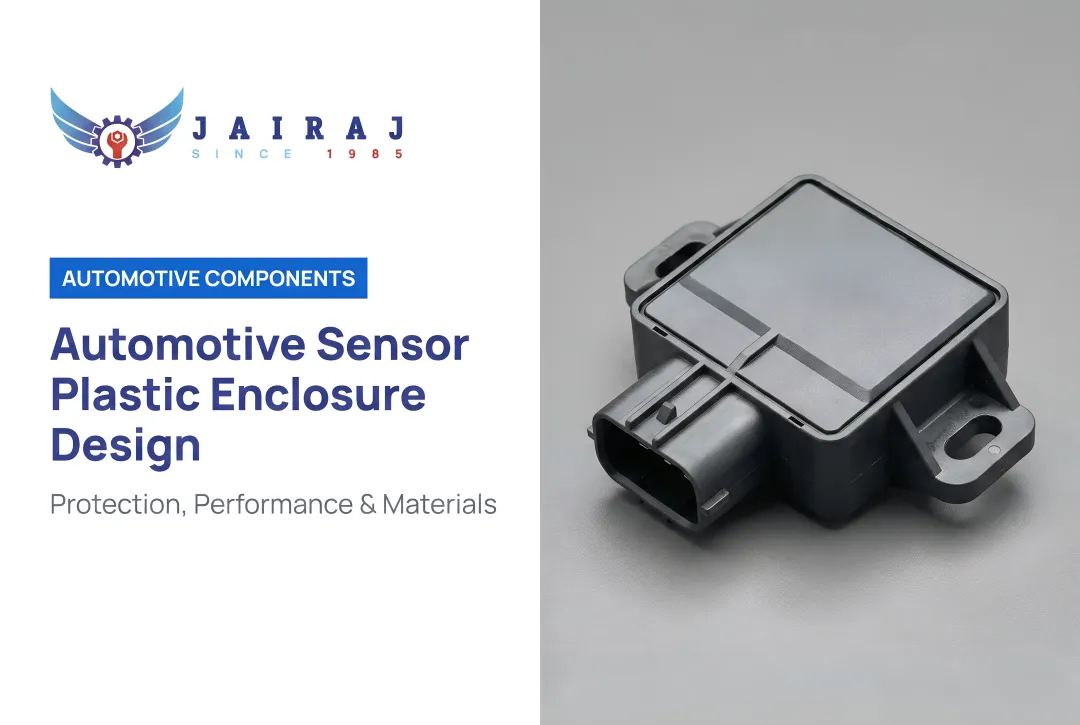
Cameras, radar modules, and ultrasonic parking sensors embedded across modern vehicles depend on precision-moulded plastic enclosures to function as designed. The challenge isn't just protection — it's dimensional stability.
ADAS sensor calibration is inherently geometry-dependent. If a camera housing warps slightly due to thermal cycling or moisture absorption, the sensor's field of view shifts — affecting lane-keep assist, collision warning timing, or automatic emergency braking activation.
Materials like SABIC's NORYL and NORYL GTX resins address this directly. Their low warpage, low moisture absorption, and UV resistance maintain calibration geometry across a vehicle's full service life.
Radar and LiDAR Enclosures
Radar and LiDAR covers carry a requirement that eliminates most standard polymers: RF transparency. The housing material must allow radar signals to pass through without significant absorption, reflection, or distortion. For LiDAR systems, near-infrared transparency at 905 nm is equally critical.
Covestro's materials data confirms that LiDAR enclosures must function across -40°C to 120°C — a range that also eliminates many commodity plastics. Polycarbonate grades and PC+PBT blends have emerged as the dominant materials for this application, combining RF/IR transparency with UV resistance and thermal stability. The refractive index must also remain stable across this temperature range to prevent beam divergence and pointing errors that would compromise sensor accuracy.
ECU Enclosures and Wiring Connectors
Electronic control units and wiring harness connectors use PBT (polybutylene terephthalate) and glass-filled nylon (PA66-GF) for specific reasons:
- Maintains stable mechanical and electrical properties regardless of humidity levels
- Resists fuels, brake fluid, lubricants, and common automotive solvents
- Holds tight tolerances through repeated thermal cycling
BASF's Ultradur PBT is documented for use in safety-relevant ABS/ESP systems, airbag control units, and electric steering ECUs. These aren't interchangeable with standard engineering plastics — the grade, glass loading, and additive package are specified precisely because the application demands consistent performance across a vehicle's full service life.
Instrument Clusters and Driver Monitoring
The plastic substrates behind digital instrument clusters serve two roles simultaneously: structural support for display electronics and optical performance. Anti-glare coatings, controlled surface reflectance, and dimensional flatness directly affect how clearly a driver reads speed, warning indicators, and driver monitoring system (DMS) outputs. When either property fails, both fail.
Key material choices in this application include:
- Polycarbonate — impact resistance and dimensional stability for housing structures
- PMMA — optical clarity for lenses and display covers
- PC/ABS blends — surface finish and structural performance where both are needed
Jairaj Group manufactures speedometer components including gauge covers, instrument cluster housings, and speedometer lenses — processing these materials for automotive applications under ISO 9001:2015 with dimensional verification and material traceability documented throughout. Their sensor housings in PA66-GF follow the same documented process — material selection, dimensional verification, and traceability built in from the start, not added at inspection.
Key Polymers: Selection Logic for Safety Applications
| Polymer | Primary Safety/Monitoring Application | Key Properties |
|---|---|---|
| PP / EPP | Crumple zones, bumper energy absorbers | Progressive deformation, low weight, resilience after impact |
| Polycarbonate (PC) | Radar covers, LiDAR housings, headlamp lenses | RF/IR transparency, UV resistance, thermal stability |
| PA66 / Nylon | Airbag housings, seatbelt mechanisms, sensor connectors | High strength, temperature resistance, low creep |
| Polyurethane (PU) | Pillar foam, door padding, head impact areas | Energy absorption, formability, occupant protection |
| PBT / PC+PBT | ECU housings, ABS/ESP control units, wiring connectors | Low moisture absorption, chemical resistance, electrical insulation |
| PPA (Polyphthalamide) | High-voltage EV connectors, thermal connectors | High heat distortion temperature, chemical resistance |
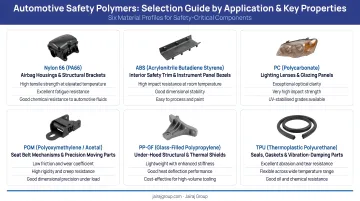
Material selection for safety and monitoring components is never interchangeable. OEMs and Tier-1 suppliers specify exact grades and additive packages because the same base polymer in different grades performs very differently under load, temperature, or chemical exposure. The key additives driving those differences include:
- UV stabilisers — prevent degradation in sensor housings and exterior lenses
- Flame retardants — meet cabin safety and electrical enclosure requirements
- Impact modifiers — tune energy absorption in crumple zones and padding components
Jairaj Group supports OEMs and Tier-1 suppliers from grade selection through production, processing PA66-GF, PC, PBT, POM, TPU, and PC/ABS for automotive safety applications. Material certification and batch-level traceability are maintained at every stage — not as an afterthought, but as part of the standard production workflow.
Plastics in EV Safety and Battery Systems
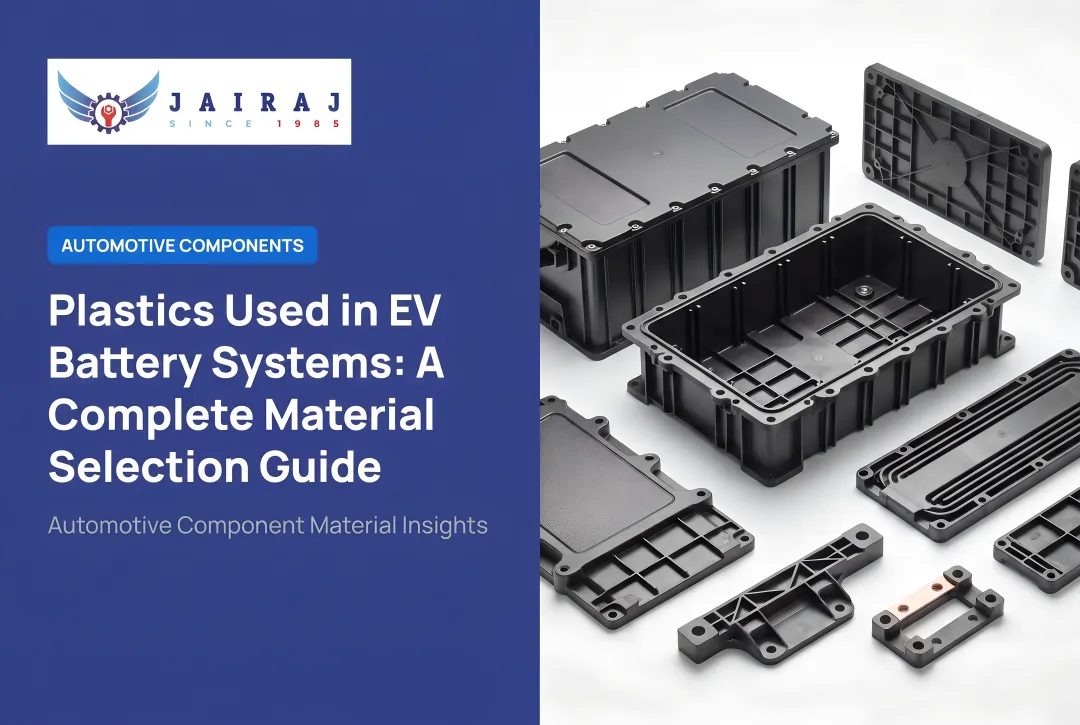
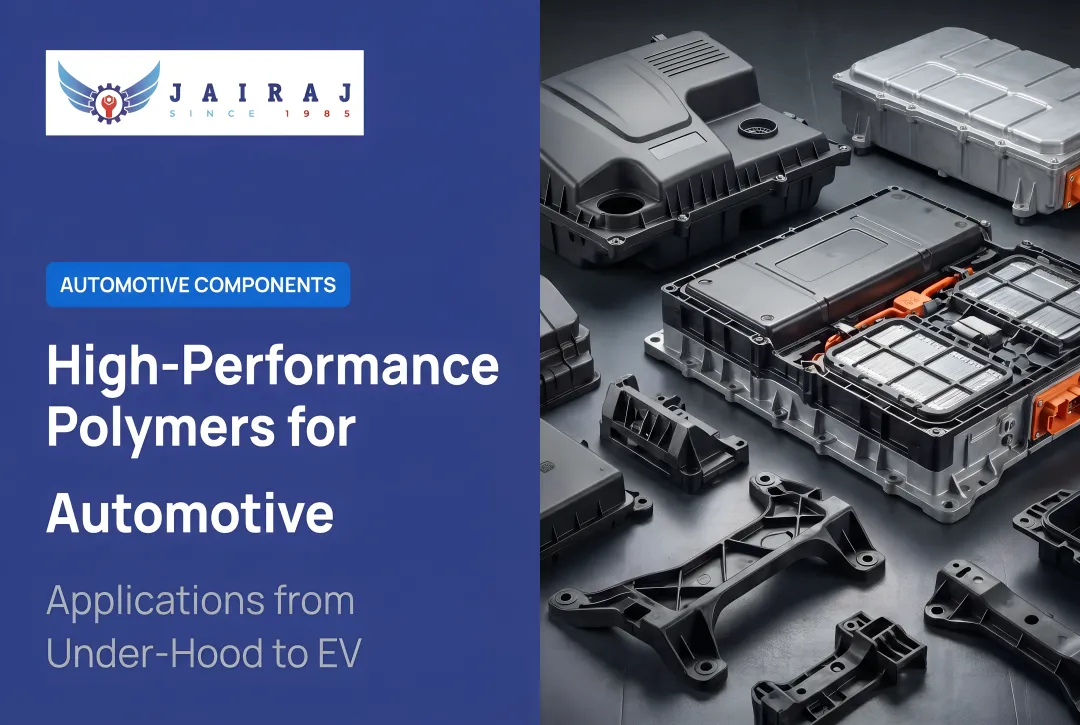
The shift to electric vehicles has sharply increased the role of plastics in automotive design. The ACC's 2024 Chemistry and Automobiles report puts the figure plainly: a mid-size EV contains 45% more plastics and polymer composites than a similarly sized ICE vehicle — approximately 450 lb versus 310 lb. The heavier battery pack forces weight reduction everywhere else, and polymers are the primary lever.
Within EV-specific systems, plastics serve several functions that have no direct ICE equivalent:
- Battery pack enclosures using thermoplastics that isolate modules electrically and resist thermal runaway propagation between cells
- Insulation films such as SABIC's NORYL NHP8000VT3, which achieve UL 94 V-0 at 0.25 mm and CTI-PLC0 ratings for 600V battery applications
- High-voltage connectors like BASF's Ultramid Advanced N3U42G6 PPA — rated UL 94 V-0 at 0.25 mm, with a heat distortion temperature of 265°C and non-halogenated flame retardancy for thin-walled designs
- EV sensor housings demanding flame-retardant, chemically resistant polymers that hold up in electrochemical environments
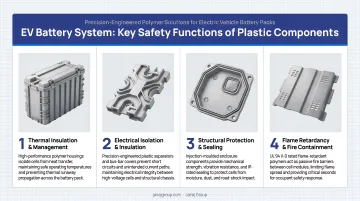
Meeting these requirements demands both material expertise and process precision. Jairaj Group manufactures plastic insulated battery covers in PEEK, PA66-GF, PC, TPU, and HDPE, along with EV charger components — supplying parts engineered to the dimensional tolerances and flame ratings that EV battery systems require.
Why Manufacturing Quality Is Non-Negotiable
A sensor housing that's dimensionally correct to drawing produces a vehicle that functions as designed. One produced even marginally out-of-spec — through inadequate process control, improper material drying, or tool wear — can trigger calibration drift in ADAS systems that won't be caught until field failure.
This is why the qualification requirements for safety-critical plastic component suppliers go well beyond a general ISO certification.
What Supplier Qualification Actually Involves
According to IATF 16949 requirements, product safety requirements focus specifically on manufacturing-process characteristics that affect the safety performance of the final assembly. Personnel developing Control Plans and FMEAs must understand safety-critical characteristics, and traceability extends to lot codes and batch numbers traceable through the value chain.
AIAG's PPAP process exists precisely because engineering design record compliance must be demonstrated through documented production-part approval — not assumed from a quality certificate.
OEMs and Tier-1 suppliers qualifying a safety-critical plastic component manufacturer should look for:
- Certified quality systems: IATF 16949 (automotive-specific) or ISO 9001:2015 at minimum
- Tooling ownership and in-house tool room control, not just process oversight of a third-party tool
- PPAP documentation capability — Control Plans, FMEAs, and dimensional reports generated to OEM specifications
- Batch-level material traceability from polymer input through finished component
- A proven Tier-1 track record with supplier awards or A-rated status as direct evidence of sustained capability
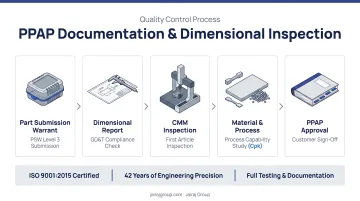
Jairaj Group holds ISO 9001:2015 certification, operates in-house tool rooms, and maintains PPAP documentation processes with comprehensive dimensional and mechanical testing capabilities. Their Tier-1 supply relationships with Endurance Technologies, Gabriel India Limited, and Tenneco Automotive — along with supplier awards received from each — reflect the kind of sustained performance that safety-critical component programs require.
Frequently Asked Questions
What is the role of plastics in vehicle safety monitoring?
Plastics serve two distinct functions: they form the energy-absorbing and structural components of passive safety systems (bumpers, crumple zones, airbag housings, pillar foam), and they provide the precision enclosures and substrates that allow active monitoring systems — ADAS cameras, radar sensors, ECUs — to maintain calibration and perform reliably across a vehicle's service life.
What types of plastics are used in automotive airbag systems?
Airbag systems use high-tenacity nylon or polyester for the bag fabric itself, rigid engineering polymers for the module housing and deployment door, and heat-resistant polymers for the inflator casing. Each component must meet strict dimensional and performance standards across the full deployment sequence.
How do plastic crumple zones improve crash safety compared to metal?
Expanded polypropylene and reinforced PP can be engineered to deform progressively — absorbing energy in a controlled sequence rather than transmitting peak force directly to the occupant cell. Industry testing indicates fibre-reinforced composites can absorb significantly more crush energy per kilogram than steel, while also reducing overall vehicle weight.
Why are plastic housings preferred over metal for ADAS sensors?
Specific polymers like polycarbonate are RF and IR transparent, allowing radar and LiDAR signals to pass through the housing unimpeded. They're also mouldable to tight dimensional tolerances for sensor alignment, lightweight, and resistant to UV, moisture, and temperature extremes from -40°C to 120°C — a combination metal cannot match.
How does plastic use in EVs differ from conventional vehicles?
EVs use approximately 45% more plastic overall to offset battery weight. Beyond volume, EVs require specialised polymers for battery pack enclosures, electrical insulation films, and high-voltage connector housings — all demanding UL 94 V-0 flame ratings, high heat distortion temperatures, and electrochemical resistance not typically required in ICE vehicles.
What should OEMs look for in a safety-critical plastic component supplier?
Look for ISO 9001:2015 or IATF 16949 certification, in-house tooling for design control, PPAP and FMEA documentation capability, and batch-level material traceability. A verifiable track record with Tier-1 automotive customers — backed by supplier awards or audit results — is the strongest indicator of sustained production quality.