Introduction
Modern vehicles carry between 60 and 100 sensors — and that count is expected to double within the next six years as ADAS, EV powertrains, and emission control systems grow more complex. Every one of those sensors depends on a plastic enclosure to keep it functional.
The enclosure is not a passive shell. It is the primary barrier between a precision sensing element and an environment that includes thermal swings from -40°C to +125°C, high-pressure wash cycles, automotive fluids, and sustained mechanical vibration. An incorrect material choice, inadequate wall geometry, or a flawed sealing approach will cause sensor failure in the field.
This article covers what automotive sensor plastic enclosures must deliver, which protection standards apply, how to match materials to operating conditions, and which injection moulding design decisions determine whether a sealed housing holds up over a vehicle's full service life.
Key Takeaways
- IP67 is the baseline for sealed automotive sensors; underbody and exterior locations typically require IP69K
- PA, PC, PC-ABS, PP, and ABS selection depends on thermal range, chemical exposure, and dimensional stability — not cost
- Wall thickness (1.5–3.0 mm), draft angles, and seal groove geometry determine whether protection ratings hold across thousands of thermal cycles
- Static immersion tests don't predict long-term sealing — thermal cycling degrades seal compression progressively
- ISO 16750 (parts 3, 4, 5) and ISO 20653 are the primary validation standards — alongside OEM-specific requirements
What Automotive Sensor Plastic Enclosures Must Actually Deliver
The enclosure's job is more complex than containment. It must satisfy four distinct engineering requirements at once — and each one can independently cause field failure if neglected.
Four Functional Requirements
| Requirement | What It Means in Practice |
|---|---|
| Structural protection | Resists mechanical shock, vibration from road input, and mounting loads without cracking or deforming |
| Environmental sealing | Prevents ingress of moisture, dust, and automotive fluids across the full operating life |
| Thermal management | Maintains dimensional stability and seal compression across -40°C to +125°C cycles |
| Signal non-interference | Does not block or distort the sensor's measurement medium — pressure, ultrasound, optical, or RF |
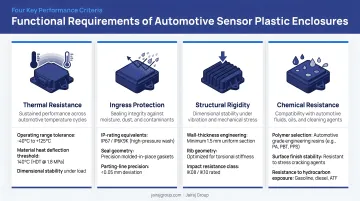
That last requirement is often underestimated. Material and geometry decisions affect all four requirements simultaneously — and signal compatibility adds constraints that purely structural thinking tends to miss:
- Radar housings must be transparent to the transmitted signal frequency
- Pressure sensor housings must expose the diaphragm to the measured medium without contamination
- Optical sensor housings require a window matched to the correct spectral range
These signal-compatibility requirements narrow material choices significantly before structural or thermal criteria are even applied.
Where Designs Fail in the Field
The gap between lab test conditions and real operating environments is where most enclosure failures originate. A housing that passes a single static IP67 immersion test may still allow moisture ingress after hundreds of thermal cycles — because the plastic housing and any metal inserts expand and contract at different rates, relaxing the seal over time.
ISO 16750-4:2023 states that climatic test cycles are not intended as life tests for validating 10-year or 150,000 km durability. Real duty cycles accumulate effects that no single test captures:
- Vibration from road input over years of service
- Thermal expansion and contraction on every drive cycle
- UV degradation on exposed surfaces
- Chemical attack from coolant, brake fluid, fuel, and cleaning agents
Enclosure designs that only optimize for certification pass rates tend to reveal weaknesses in the second or third year of service — precisely when warranty and recall exposure peaks.
Protection Standards and Operating Limits
Ingress Protection: IP Ratings in Automotive Context
The standard most engineers reference first is IEC 60529, but for road vehicles the correct reference is ISO 20653, which applies specifically to enclosures of electrical equipment on road vehicles and includes K-code ratings that cover conditions not addressed by general IEC 60529.
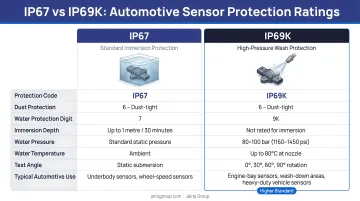
The practical difference between IP67 and IP69K is significant:
| Rating | Test Condition |
|---|---|
| IP67 | 1 metre submersion for 30 minutes (static, ambient temperature) |
| IP69K | High-pressure jet at 80°C ±5°C, 15 ±1 L/min, nozzle distance 175 ±25 mm, sprayed at 0°, 30°, 60°, and 90° angles |
A sensor housing that passes IP67 has not been exposed to high-temperature, high-velocity water. For exterior, underbody, and powertrain sensor enclosures that see vehicle wash cycles — or steam cleaning during service — IP67 alone is insufficient. The thermal and mechanical stress of IP69K testing is entirely different, and the seal design must reflect that.
Thermal Operating Envelope
Automotive sensor enclosures must maintain dimensional stability and seal integrity across a thermal range that varies by mounting location:
- Interior sensors: -40°C to +85°C
- Most exterior and body sensors: -40°C to +105°C
- Under-hood and powertrain applications: -40°C to +125°C or higher
This range is not just about material survival. Warpage and seal face geometry change across the thermal envelope. Differential expansion between the plastic housing, metal inserts, and elastomeric seals accumulates with each cycle.
Rapid temperature transitions in sealed housings also create pressure differentials that drive moisture migration through seals. Pressure-equalising membrane vents — supplied by manufacturers such as GORE and Donaldson — address this directly. They allow pressure equalisation while maintaining liquid exclusion, and select formats are rated to IP69K.
Vibration and Mechanical Shock
Mounting location determines the vibration profile the enclosure must survive. ISO 16750-3:2023 separates mechanical load test profiles by location:
- Engine-mounted equipment
- Body-mounted / sprung mass equipment
- Wheel, suspension, and unsprung mass equipment
Enclosure geometry contributes to vibration resistance as much as material hardness does. How mounting bosses, wall rigidity, and rib geometry are configured determines how vibration energy distributes through the housing. A soft polymer in a well-ribbed geometry can outperform a stiffer material in a poorly supported one.
Material Selection: Matching Polymer Properties to Automotive Sensor Demands
Material selection is the most consequential early-stage decision. The right polymer must satisfy thermal, chemical, mechanical, and dimensional requirements simultaneously — and a compromise in any one area propagates into seal integrity, dimensional tolerance, and production consistency.
ABS: Interior and Low-Stress Applications
ABS offers ease of moulding, good surface finish, moderate impact resistance, and low cost. Its limitations are clear:
- Susceptible to UV degradation with extended sun exposure
- Attacked by fuels, oils, and many automotive cleaning agents
- Not suitable for under-hood or elevated-temperature applications
ABS is appropriate for interior sensor applications — cabin temperature sensors, seat occupancy detection, ambient light sensors — where thermal loads are moderate and chemical exposure is limited.
Polycarbonate (PC) and PC-ABS Blends
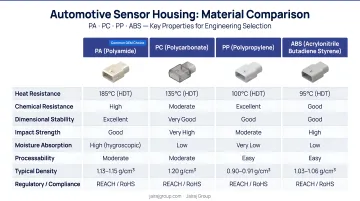
PC delivers high heat resistance, dimensional stability, and impact strength. Covestro's Makrolon 9425 PC achieves a heat deflection temperature of 138°C at 1.80 MPa, UL 94 V-0 rating at 1.5 mm, and a saturation water absorption of 0.24% — specs that qualify it for exterior sensor housings where thermal and moisture stability are non-negotiable.
PC-ABS blends balance PC's thermal performance with improved surface quality and toughness, and are widely used for automotive exterior and semi-structural sensor housings. Both PC and PC-ABS comply with UL 94 V-0 flammability requirements at appropriate wall thicknesses, and PC grades are commonly used for transparent sensor windows where optical clarity is required.
Note that PC grades are not interchangeable. HDT, water absorption, and UL94 rating vary by specific grade — datasheet-level verification is required before specifying.
Polyamide (PA/Nylon): Under-Hood and Chemical-Exposure Applications
PA is the material Jairaj Group most commonly applies to automotive sensor housings, and for good reason. PA66-GF (glass-filled nylon 66) offers:
- High mechanical strength and fatigue resistance
- Resistance to automotive fluids including fuel, oil, coolant, and brake fluid
- Temperature stability for engine bay applications
- Excellent dimensional stability under mechanical load
The engineering caution with PA is moisture absorption. Envalior's ForTii F11 PPA lists 4.1% water absorption compared to PC's 0.24%. Moisture causes dimensional change over time — and that change is concentrated precisely where seal faces must hold tight tolerances. PA-based enclosure designs must account for moisture-induced dimensional variation in sealing surface geometry, verified against the selected grade's datasheet.
Polypropylene (PP): Chemical Resistance and Weight Reduction
Where PA addresses high-temperature and chemical-resistance demands, PP targets a different trade-off. Its semi-crystalline structure delivers dimensional stability and broad chemical resistance. Its limitations at elevated temperatures — reduced rigidity above approximately 100°C — limit its use to lower thermal-load zones. PP is well-suited for fluid-contact sensor enclosures in areas where chemical resistance and weight reduction (relevant for EV applications) outweigh the need for high-temperature rigidity.
Selecting the Right Material: What Experience Brings to the Decision
Material selection for automotive sensor enclosures is not a lookup exercise. It requires cross-functional knowledge of polymer behaviour under combined thermal, chemical, and mechanical loading — alongside awareness of how the material will behave during moulding.
Jairaj Group's engineering teams, working with automotive customers since 1985, bring this cross-functional perspective to every material decision. They know, for instance, how a PA66-GF grade flows through a complex sensor housing tool and how moisture absorption in that grade shifts sealing surface dimensions after six months in service. That production-stage awareness — comparing PA66-GF against a PC-ABS alternative before tooling is cut — is what prevents costly late-stage revisions.
Design and Manufacturing Considerations for Injection-Moulded Sensor Enclosures
Enclosure geometry and the injection moulding process are inseparable. When a design cannot be moulded consistently, it cannot be sealed consistently — and seal failure is the most common failure mode in automotive sensor housings.
Wall Thickness, Ribs, and Draft Angles
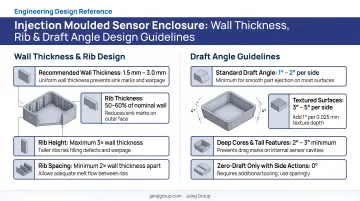
- Wall thickness: 1.5 mm to 3.0 mm depending on material and structural requirements. Uniformity matters more than absolute thickness — uneven walls create differential cooling, warpage, and seal face distortion
- Ribs: Increase housing rigidity without adding wall mass. Rib thickness should be 50–60% of the nominal wall to prevent sink marks on the opposite face
- Draft angles: Minimum 1–2° on vertical faces for consistent ejection and dimensional repeatability at sealing surfaces
Sealing Architecture: O-Rings, Gaskets, and Overmoulding
The main sealing approaches used in automotive sensor enclosures each have specific requirements:
- Compression gaskets — depend on consistent housing flatness across the seal face; surface finish Ra value directly affects sealing performance
- O-ring grooves — groove geometry (depth, width, and corner radii) must be designed for the specific O-ring cross-section and compression ratio
- Face seals — require controlled housing deflection under fastener torque; housing stiffness at the seal face matters
- Overmoulded TPE seals — integrate the seal into the housing during moulding, eliminating assembly-stage seal placement errors; Jairaj Group's two-shot moulding and overmoulding capabilities support this approach for appropriate applications
One closure method that doesn't belong in this list: snap-fits. Snap-fit closures alone are insufficient for IP67 or IP69K-rated sensor housings. Retention force degrades with thermal cycling, and snap geometry cannot maintain consistent seal compression across temperature extremes.
Common Specification and Design Mistakes
Mistake 1: Specifying IP Rating Without Accounting for Thermal Cycling
A housing that passes a static IP67 test may lose seal integrity after 500 thermal cycles between -40°C and +105°C. Differential expansion between the plastic housing, metal inserts, and elastomeric seals progressively reduces seal compression.
Thermal cycle testing — not just static immersion — is required to validate long-term sealing performance. Key variables to assess:
- Compression set of the elastomeric seal after repeated cycling
- Dimensional change at the seal face across the full temperature range
- Insert pull-out force after thermal stress exposure
Mistake 2: Selecting Material on a Single Property
Single-property material selection is a consistent source of field failures. Choosing PA for its tensile strength without evaluating moisture absorption effects on seal face dimensions is one example. Selecting PC without confirming chemical compatibility with the cleaning agents used in the vehicle's service environment is another. Neither failure mode appears in initial qualification testing — both appear in the field.
How Enclosure Performance Is Specified, Tested, and Validated
Automotive sensor enclosures are validated against a combination of international and OEM-specific standards. Rated values on a datasheet represent test-condition outcomes — not field performance guarantees.
Relevant Standards and Testing Methods
| Standard | Scope | Applicability |
|---|---|---|
| ISO 20653:2023 | IP protection for road-vehicle electrical equipment | Primary ingress protection reference for automotive |
| ISO 16750-3:2023 | Mechanical loads by mounting location | Vibration and shock test profiles |
| ISO 16750-4:2023 | Climatic loads including temperature cycling | Thermal validation framework |
| ISO 16750-5:2023 | Chemical loads including fluids and cleaning agents | Fluid compatibility validation |
| USCAR-2 | Automotive electrical connector system sealing | Connector interface sealing |
| ASTM B117 | Salt spray / fog exposure | Relevant to inserts, terminals, and metallised features |
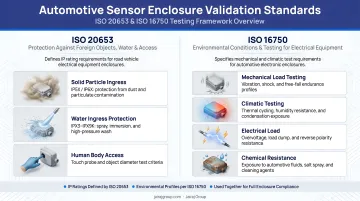
Primary test types for sensor enclosure qualification:
- Thermal shock cycling: validates seal compression retention across the operating temperature range
- High-pressure wash (IP69K): confirms sealing under worst-case washdown conditions
- Salt spray (ASTM B117): evaluates corrosion resistance of metal inserts and exposed hardware — particularly relevant where brass inserts or terminals are exposed
- Fluid immersion per ISO 16750-5: confirms polymer and seal compatibility with application-specific fluids
- Vibration endurance per ISO 16750-3: validates housing structural integrity at the relevant mounting location profile
Design Validation vs. Production Validation
The ZVEI Robustness Validation framework distinguishes two critical validation stages:
- Design Validation Testing (DVT): Performed once per design to confirm the design meets specification. This is where thermal cycling, fluid immersion, and high-pressure wash testing happen
- Production Validation Testing (PVT): Ongoing sampling to confirm manufacturing consistency — verifying that the production process continues to deliver parts that match what the design validation approved
DVT confirms the design is sound; PVT confirms production stays that way. Suppliers operating under ISO 9001:2015 — including Jairaj Group — support this with full traceability documentation, dimensional verification records, and PPAP packages that feed directly into OEM approval workflows.
Frequently Asked Questions
What IP rating is required for automotive sensor plastic enclosures?
IP67 is the baseline for most automotive sensors requiring submersion protection. Exterior, underbody, and powertrain sensor enclosures typically require IP69K to withstand high-pressure, high-temperature wash conditions. The right rating is determined by mounting location and whether the enclosure faces pressure washing or steam cleaning during vehicle service.
What is the best plastic material for under-hood automotive sensor enclosures?
Polyamide (PA/Nylon) — particularly glass-filled grades like PA66-GF — and PC-ABS blends are most commonly used for under-hood applications due to their thermal stability, fluid resistance, and mechanical strength. Material selection must be validated against the actual fluid exposure and temperature range of the mounting location, with moisture absorption effects on seal surface dimensions confirmed from the grade's datasheet.
How does thermal cycling affect plastic sensor enclosures over a vehicle's lifetime?
Repeated thermal cycling causes differential expansion between the plastic housing, metal inserts, and sealing elements, progressively reducing seal compression until moisture ingress occurs. Enclosures that pass static IP immersion tests can still fail under cyclic thermal load, so thermal cycle validation is required — not optional.
What wall thickness is recommended for injection-moulded automotive sensor enclosures?
Wall thickness typically ranges from 1.5 mm to 3.0 mm depending on material and structural requirements. Uniformity matters more than absolute thickness. Uneven walls cause differential cooling, warpage, and seal face distortion that undermine dimensional accuracy and ingress protection over the component's service life.
What is the difference between IP67 and IP69K for automotive sensor applications?
IP67 tests submersion at 1 metre for 30 minutes under static, ambient-temperature conditions. IP69K tests resistance to high-pressure, high-temperature jets (80°C, close range, multiple spray angles). Automotive applications exposed to vehicle wash-down or steam cleaning during service require IP69K — passing IP67 does not confirm resistance to these conditions.
How is chemical resistance factored into automotive sensor enclosure design?
Chemical compatibility must be assessed for every fluid the enclosure may contact — not assumed from general polymer family descriptions. ISO 16750-5 defines the automotive chemical load framework, and material selection must be confirmed against the actual fluid environment of the mounting location. Each polymer family carries distinct vulnerabilities that vary by grade and exposure duration.