Introduction
A failed wire insulation in a high-voltage switchgear panel doesn't just trip a breaker. It can trigger equipment damage, production shutdowns, or serious safety incidents. Yet material selection for electrical insulation is still treated as a cost-centre decision at too many organisations, with engineers defaulting to whatever was used last time or whatever is cheapest per kilogram.
Plastics have become the dominant insulation material across automotive wiring, EV battery systems, industrial switchgear, and aerospace electronics. They offer high dielectric strength alongside lightweight form, corrosion resistance, and compatibility with high-volume manufacturing processes like injection moulding.
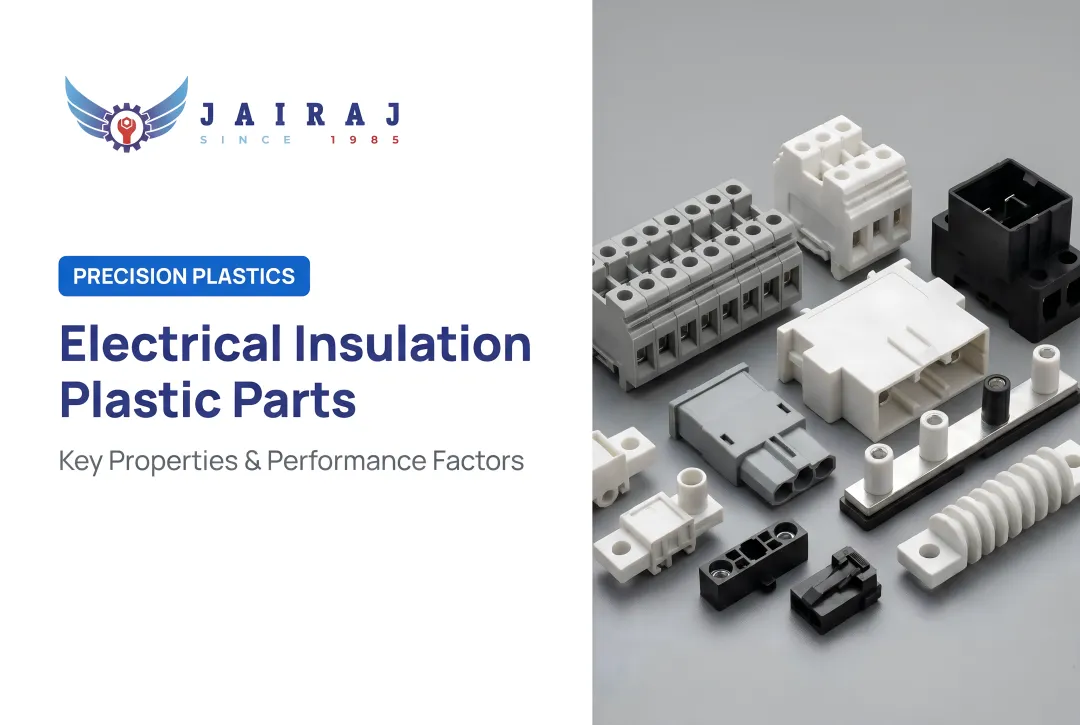
The phrase "insulating plastic" covers materials with vastly different capabilities — PTFE, Polycarbonate, Nylon, PVC, and ABS each carry distinct performance profiles that determine where they work and where they fail. This guide compares all five head-to-head on the properties that drive real-world reliability: dielectric strength, thermal rating, flame retardance, moisture resistance, and cost.
Key Takeaways
- No single material wins every spec — the right choice depends on your voltage, thermal, and mechanical requirements
- Key selection criteria: dielectric strength (kV/mm), continuous service temperature, UL94 flame rating, moisture absorption, and injection mouldability
- Thermosets (FR4/G10) suit static structural insulation; engineering thermoplastics (PC, Nylon, PTFE) suit moulded components
- Validate against voltage level, temperature exposure, chemical contact, and mechanical load before unit cost
- EV, solar, and drone applications are driving demand for higher-performance insulating plastics that survive aggressive thermal cycling
Why Plastics Are the Go-To Choice for Electrical Insulation
An electrical insulator needs tightly bound electrons, high resistivity, and a large band gap — conditions that prevent current from flowing through the material. Most engineering plastics meet these requirements naturally, which is why they've displaced traditional insulators in most modern applications.
How Plastics Compare to Alternatives
| Property | Plastics | Rubber | Glass | Ceramics |
|---|---|---|---|---|
| Weight | Low | Low | High | High |
| Mouldability | Excellent | Good | Poor | Poor |
| Corrosion resistance | Excellent | Good | Excellent | Excellent |
| Cost | Low–Medium | Low | Medium | High |
| Design flexibility | Very High | Medium | Low | Low |
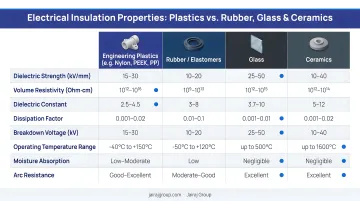
Ceramics and glass hold advantages in ultra-high voltage overhead transmission lines, where mechanical strength and long-term weather resistance matter most. For connectors, terminal blocks, enclosures, and wiring harness components, plastics win on every practical dimension. These are the applications that define modern electrical and electronics manufacturing.
Relevance for India's Electrical Sector
India's electric insulator market is projected to reach US$528 million by 2027, growing at a CAGR of 6.91%, driven by grid expansion, EV infrastructure rollout, and industrial automation. That growth creates direct demand for injection-moulded insulating components in Nylon, PC, ABS, and speciality grades.
Top Plastics for Electrical Insulation: A Comparative Breakdown
Each material below is evaluated on dielectric strength, continuous service temperature, and typical applications. Use this as a starting point — final selection requires datasheet validation against your specific operating conditions.
PTFE (Polytetrafluoroethylene)
PTFE is the benchmark for electrical insulation performance. Its dielectric loss is near-zero across a wide frequency range, it absorbs virtually no moisture, and it resists almost every chemical in industrial use. When a design cannot tolerate any compromise on insulation integrity, PTFE is the default starting point.
Beyond electrical properties, PTFE's non-stick surface resists contamination buildup, and its self-lubricating characteristics reduce mechanical wear in assemblies with moving parts.
| Property | PTFE Value |
|---|---|
| Dielectric Strength | 19–24 kV/mm |
| Continuous Service Temp. | Up to 260°C |
| Best Applications | Wire/cable insulation, high-frequency connectors, aerospace wiring, chemical plant equipment |
The trade-off is cost and processability. PTFE cannot be injection moulded by conventional means — it requires sintering or specialised compounding — which limits its use to applications where premium performance justifies the added manufacturing complexity.
Polycarbonate (PC)
PC offers a practical combination of flame retardance, optical clarity, and impact toughness that makes it the material of choice for electrical enclosures, circuit breaker housings, and switchgear panels. It handles mechanical shock well in applications where enclosures may be dropped, struck, or subjected to vibration.
Flame-retardant grades (UL94 V-0) are widely available from suppliers like Covestro (Makrolon) and SABIC (Lexan), and PC meets IEC and NEMA standards for electrical enclosures. Its UV resistance also makes it viable for outdoor electrical applications — junction boxes, distribution boards, and meter housings.
| Property | PC Value |
|---|---|
| Dielectric Strength | 15–17 kV/mm |
| Continuous Service Temp. | Up to 120–130°C |
| Best Applications | Electrical enclosures, junction boxes, switchgear panels, automotive relay housings |
Nylon (Polyamide — PA6 / PA66)
Nylon is the workhorse of electrical connector manufacturing. Its combination of high tensile strength, heat resistance, and fatigue durability under cyclic load makes it standard in terminal blocks, motor coil bobbins, cable ties, and automotive wiring harness components.
PA66 outperforms PA6 in continuous heat resistance and is the preferred grade for under-bonnet automotive applications. Moisture absorption is the key limitation — Nylon picks up humidity from the environment, which can degrade dielectric properties in consistently humid installations.
Glass-fibre reinforcement (PA66-GF) improves both dimensional stability and reduces moisture sensitivity, making it the standard grade for precision electrical components.
| Property | PA66 Value |
|---|---|
| Dielectric Strength | 15–20 kV/mm |
| Continuous Service Temp. | Up to 130°C (heat-stabilised grades to 180°C) |
| Best Applications | Electrical connectors, terminal blocks, motor bobbins, cable ties, wiring harness components |
Jairaj Group injection moulds PA66-GF for relay mounting brackets and terminal blocks across automotive and industrial electrical applications.
PVC (Polyvinyl Chloride)
PVC remains the most widely used material for wire and cable insulation globally, and the reason is straightforward: cost. It delivers acceptable dielectric performance, inherent flame retardance, and chemical resistance at a price point that makes it viable for almost any budget.
Flexible PVC grades are standard in household wiring, conduit liners, and low-voltage switchboard insulation. Limitations appear at elevated temperatures — most standard PVC wire insulation is rated to 70–90°C continuous service, with some speciality compounds reaching 105°C.
| Property | Flexible PVC Value |
|---|---|
| Dielectric Strength | 12–20 kV/mm |
| Continuous Service Temp. | 70–105°C (grade dependent) |
| Best Applications | Wire and cable sheathing, conduit liners, low-voltage switchboard insulation, household wiring |
A notable shift: PVC is being progressively displaced by LSZH (Low Smoke Zero Halogen) compounds in enclosed public spaces, EV battery environments, and railway carriages. When PVC burns, it releases hydrogen chloride gas — toxic in confined spaces. LSZH materials comply with IEC 60332 and EN 50267 standards where smoke toxicity matters.
ABS (Acrylonitrile Butadiene Styrene)
ABS is the cost-efficient choice for electrical enclosures, control panels, and protective housings where the operating environment is mild to moderate. It machines and injection moulds easily, holds tight tolerances, and costs less than PC or Nylon — making it a sensible choice when premium dielectric properties are not required.
Standard ABS grades are not inherently flame retardant and are best suited to low-to-moderate temperature environments. FR-ABS grades (UL94 V-0) are available for enclosed electrical applications, though the flame retardant additives can slightly reduce impact strength.
| Property | ABS Value |
|---|---|
| Dielectric Strength | 12–16 kV/mm |
| Continuous Service Temp. | 70–100°C |
| Best Applications | Consumer electronics housings, control panel enclosures, low-voltage electrical boxes, automotive interior components |
Key Properties That Define a Good Insulating Plastic
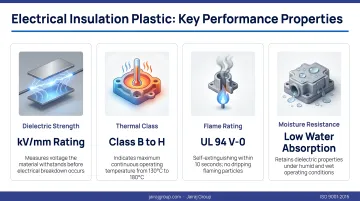
Dielectric strength gets cited most often in insulation material selection, yet it's routinely misapplied in isolation. It measures the maximum voltage (in kV/mm) a material can withstand before electrical breakdown — a higher value allows thinner insulation walls while maintaining safety margins, which matters in compact, weight-sensitive designs. Real-world performance depends on four additional properties:
- Thermal class / continuous service temperature — IEC thermal classes define the ceiling: Class B = 130°C, Class F = 155°C, Class H = 180°C. Running a material below its rated class accelerates insulation degradation
- UL94 flame retardance rating — V-0 self-extinguishes in ≤10 seconds with no dripping ignition; V-1 allows ≤30 seconds; HB is the lowest classification. V-0 is mandatory for enclosed electrical enclosures and EV battery environments
- Moisture absorption (% water uptake) — Water degrades dielectric performance. Nylon absorbs 2–3% moisture by weight; PTFE absorbs essentially zero. For humid environments, low-absorption materials or moisture-resistant grades are critical
- Volume resistivity — Measures how strongly a material resists current flow through its bulk (Ω·cm). High resistivity keeps current in the conductor, not the insulation. Failure here leads to leakage currents and insulation tracking
Thermoset vs. Thermoplastic — When It Matters
Thermosets (FR4, G10 glass-epoxy laminates, epoxy boards) cure into a rigid cross-linked structure that maintains dimensional stability at high temperatures. They don't soften under heat, which makes them ideal for PCB substrates and structural insulation in transformers. The limitation: they can't be reprocessed or injection moulded into complex geometries.
Thermoplastics (PC, Nylon, ABS, PTFE compounds) melt and flow — enabling injection moulding of complex shapes at scale. They're the right choice for connectors, bobbins, and housing components, provided the operating temperature stays within the material's rated ceiling.
How to Choose the Right Insulating Plastic for Your Application
Common Selection Mistakes
Three errors account for most field failures in insulating plastic components:
- Choosing on cost alone — Specifying ABS where PC or Nylon is required because it's cheaper per kilogram, then dealing with field failures at elevated temperatures
- Ignoring moisture effects — Using standard PA6 in high-humidity environments without accounting for dielectric property degradation under saturation
- Transferring specs across applications — Taking a material approved for one voltage class and using it in a higher-voltage environment without re-validation
A Practical Decision Framework
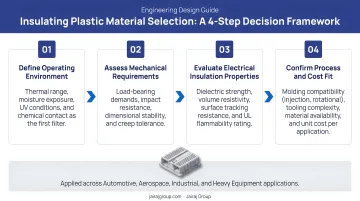
Follow these four steps when selecting an insulating plastic for a new component:
- Map your operating environment — Define maximum continuous voltage, peak temperature, chemical exposure (oils, coolants, solvents), UV/weather exposure, and mechanical load type (static vs. cyclic)
- Match to material thermal class and dielectric strength — Ensure the material's rated dielectric strength provides adequate margin at your operating voltage, and that its thermal class exceeds your maximum operating temperature
- Confirm flame rating compliance — Identify the standard your product must meet (UL 94, IEC 60695, IS standards for Indian markets) and verify the specific grade — not just the base polymer — carries the required rating
- Validate manufacturability — Confirm the selected material can be injection moulded or extruded to your required geometry and tolerances, and that tooling can be developed to support your production volume
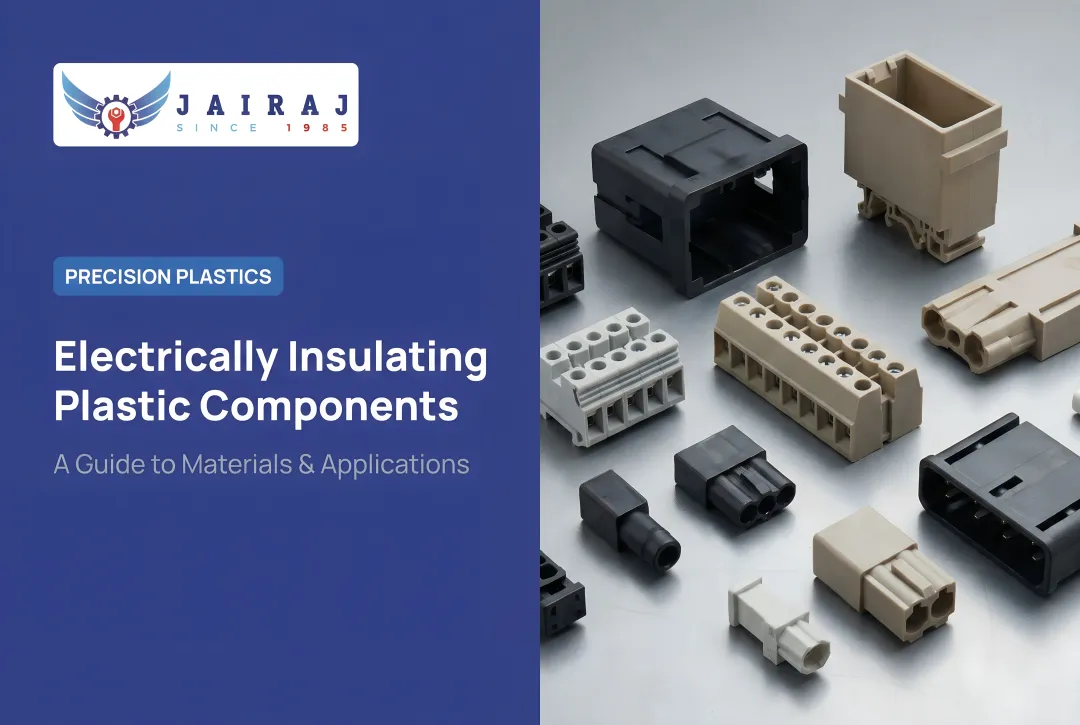
For Indian electrical and EV manufacturers, injection-moulded components in PA66-GF, PC, ABS, and PBT are the most commonly specified materials for connectors, terminal blocks, relay housings, and harness components.
Jairaj Group, with 42 years of precision injection moulding expertise, works with all of these materials across facilities in Manesar, Faridabad, Rudrapur, Aurangabad, and Sanand. In-house tool room capabilities and dedicated Research, Development & Value Engineering Centres support material selection, DFM analysis, and prototype validation — so engineers can confirm the right material choice before committing to production tooling.
Conclusion
No single plastic is the right answer for every electrical insulation application. PTFE leads on raw dielectric performance but is difficult to process and expensive. PC offers impact resistance and flame retardance in mouldable form. Nylon handles heat and mechanical stress across millions of cycles. PVC delivers cost-efficient performance for wire insulation. ABS suits low-cost housing applications where environmental demands are modest.
Material selection comes down to your specific voltage level, operating temperature, chemical exposure, and manufacturing process. The lowest cost per kilogram rarely produces the best outcome — the right match to your application does.
Engineers and procurement teams get better outcomes when material selection happens before tooling is committed. At that stage, Jairaj Group's in-house tool room capabilities and comprehensive testing can validate material choices, confirm regulatory compliance, and catch DFM issues that would otherwise surface as costly redesigns.
To discuss material selection for your electrical insulation components, or to request a custom manufacturing consultation, contact Jairaj Group at +91-9711-114-300 or email japl@jairajgroup.com.
Frequently Asked Questions
What plastic is the best electrical insulator?
PTFE leads in raw dielectric performance, with the widest operating temperature range and near-zero moisture absorption. The best choice for a given application depends on temperature rating, cost constraints, mechanical requirements, and whether the part needs to be injection-moulded.
What is dielectric strength and why does it matter for plastic selection?
Dielectric strength measures the maximum voltage (kV/mm) a material can withstand before electrical breakdown occurs. A higher value allows thinner insulation walls while maintaining safety margins — critical in compact, weight-sensitive designs like EV connectors or miniaturised electronics.
Which insulating plastic is best for high-temperature electrical applications?
PTFE handles up to 260°C continuous service, making it the top performer. PA66 and heat-stabilised PC grades are practical choices for 130–155°C environments. For extreme-temperature applications beyond standard engineering plastics, PEEK is the typical alternative.
Is PVC being replaced in electrical insulation?
PVC remains dominant for cost-sensitive wire and cable insulation. It is increasingly replaced by LSZH (Low Smoke Zero Halogen) compounds in enclosed public spaces, EV battery packs, and railway carriages — where burning PVC's toxic gas release poses unacceptable safety risks.
Can injection-moulded plastic components be used for electrical insulation?
Yes. Injection-moulded components in PC, Nylon (PA66-GF), ABS, PBT, and POM are standard for electrical connectors, terminal blocks, relay housings, and motor bobbins. The process enables high-volume production of complex geometries at tight dimensional tolerances.
What is the difference between UL94 V-0 and HB flame ratings?
UL94 V-0 means a material self-extinguishes within 10 seconds of flame removal with no flaming drips. HB is the lowest classification, permitting a slow horizontal burn with no self-extinguishing requirement. V-0 is mandatory for enclosed enclosures, EV components, and switchgear; HB applies only in open or low-risk environments.