For engineers and procurement teams, the challenge is not finding a material — it's finding the right material. Polycarbonate, Nylon, PTFE, Polypropylene, and phenolic composites each behave very differently under voltage, heat, and mechanical load.
This guide covers the essential insulating plastics, their defining properties, and how they map to real applications across automotive, EV, electrical, aerospace, and industrial sectors.
Key Takeaways
- Electrically insulating plastics are active engineering components — wrong material choices cause system failures, not just performance gaps
- Core properties to evaluate: dielectric strength, thermal stability, flame retardancy, mechanical rigidity, and moisture resistance
- Material selection must account for the full in-service environment: voltage, temperature, chemical exposure, and mechanical stress
- PC, Nylon (PA6/PA66), PP, PTFE, and phenolic composites (FR4/Bakelite) each cover a distinct performance range for most industrial insulation needs
- Grade-level selection matters: UL94 ratings, dielectric strength, and heat resistance vary significantly within the same material family
Why Electrical Insulation in Plastic Components Matters
In electrical and industrial systems, uninsulated or poorly insulated components create direct pathways for leakage current, short circuits, and arc flash events. The consequences range from equipment damage and production downtime to serious personnel injury.
Critically, insulation is a system-level requirement, not just a material property to check off a datasheet. A component may pass initial qualification but fail in service due to thermal cycling, chemical exposure, or humidity — conditions the datasheet never simulated.
Why Plastics Have Replaced Ceramics and Glass
Plastics offer several practical advantages in modern electrical assemblies:
- Lighter weight — significant in automotive, aerospace, and drone applications
- Design flexibility — complex geometries that ceramics cannot achieve cost-effectively
- Integrated function — insulation built directly into structural housings, reducing part count
- Easier high-volume manufacturing — injection molding enables precision at scale
The Demand Driver: EVs and Energy Infrastructure
The IEA reports over 17 million electric cars sold in 2024, representing more than 20% of global new car sales. Each EV requires battery cell separators, busbar covers, high-voltage connector housings, and junction box components — all with tightly defined insulation requirements. Solar junction boxes, smart grid infrastructure, and industrial motor drives are compounding that demand further.
Taken together, these growth vectors help explain why the global electrical insulation materials market stood at USD 10.6 billion in 2022 and is projected to reach USD 14.3 billion by 2027, growing at a 6.2% CAGR — making material selection and component engineering increasingly consequential decisions for OEMs and system integrators alike.
Key Properties That Define an Effective Insulating Plastic
Not all insulating plastics fail the same way. Each property below addresses a distinct failure mode.
Dielectric Strength
Measured in kV/mm, dielectric strength is the voltage a material can withstand per unit thickness before electrical breakdown. Higher values mean greater insulation reliability at elevated voltages.
Verified values vary significantly by grade and test thickness:
| Material | Dielectric Strength | Test Basis |
|---|---|---|
| PTFE (TECAFLON, 0.125 mm) | 80 kV/mm | ASTM D149 |
| FR4 (Isola 370HR) | 54 kV/mm | ASTM D149 |
| PP (TECAFINE natural) | 58 kV/mm | IEC 60243-1 |
| PA66-GF 30% (Zytel, dry) | 38 kV/mm | IEC 60243-1 |
| PC (LEXAN 940A, 3.2 mm) | 17 kV/mm | ASTM D149 |
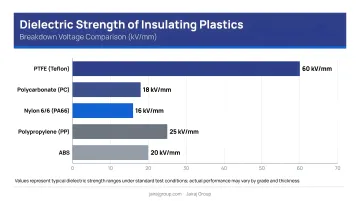
Always compare values at the same specimen thickness and test method — a PTFE value at 0.125 mm cannot be directly compared to a PC value at 3.2 mm.
Thermal Stability
Electrical systems generate heat, and insulating plastics must retain shape, stiffness, and dielectric performance under continuous operating temperatures — not just peak ratings. Thermoset composites (FR4, phenolic) generally outperform thermoplastics in sustained-heat environments.
Two common reference points: PTFE handles continuous service to 260°C; standard PP tops out around 100°C.
Flame Retardancy
UL94 ratings classify how quickly a material self-extinguishes:
- V-0 — extinguishes within 10 seconds, no flaming drips (highest performance)
- V-1 — extinguishes within 30 seconds, no flaming drips
- V-2 — extinguishes within 30 seconds, flaming drips allowed
Flame retardancy is grade-specific, not material-family-specific. PTFE and FR4 (Isola 370HR) are verified V-0. Specific PC grades like SABIC LEXAN FR achieve V-0; general PC does not automatically qualify. Natural PP has not been verified as V-0 in standard datasheet sources.
Mechanical Strength and Dimensional Stability
Insulating plastics in connectors, terminal blocks, and relay housings must hold tight tolerances under assembly loads, vibration, and thermal cycling. Dimensional drift over time can reduce electrical clearances to unsafe levels. This failure mode develops gradually and is often difficult to detect before it causes problems.
Chemical and Moisture Resistance
Moisture absorption degrades dielectric performance. The difference between materials is significant:
- PTFE: <0.01% water absorption at 23°C
- PC (LEXAN 940A): 0.15% at 24 hr
- PP: ~0.04% at 24 hr
- PA66 (30% GF, conditioned): up to 6% water absorption at saturation
For humid or wet environments, always specify using conditioned electrical properties, not dry-state values — particularly for Nylon components.
Top Plastics Used for Electrical Insulation: A Material-by-Material Breakdown
Material selection should be driven by the specific combination of thermal, electrical, and mechanical demands of your application — not cost alone. The five materials below cover the most common choices, from general-purpose engineering grades to high-specification thermosets.
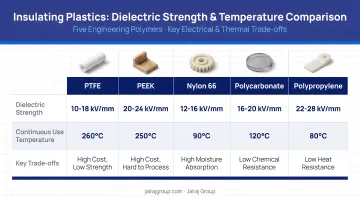
| Material | Dielectric Strength | Continuous Temp | Key Trade-off |
|---|---|---|---|
| Polycarbonate (PC) | ~15–20 kV/mm | ~130°C RTI | Susceptible to chemical attack |
| Nylon PA66 (GF) | ~38 kV/mm (dry) | ~140°C RTI | Absorbs moisture; performance drops |
| Polypropylene (PP) | ~25–30 kV/mm | ~100°C | Low heat ceiling |
| PTFE | ~60 kV/mm | 260°C | High cost; difficult to process |
| FR4 (Glass-Epoxy) | ~54 kV/mm | Tg ~180°C | Thermoset — cannot be remoulded |
Polycarbonate (PC)
PC offers high impact resistance, good dielectric strength, and flame-retardant grades that achieve UL94 V-0 (SABIC LEXAN FR series). It handles moderate continuous temperatures (RTI ~130°C per UL 746B) and maintains dimensional stability across a wide service range.
Common applications include electrical enclosures, relay housings, LED driver housings, transparent protective covers, and battery covers.
Jairaj Group manufactures relay mounting brackets and terminal blocks from PC — chosen for its dimensional stability and reliable insulation in panel and power distribution assemblies.
Nylon (Polyamide — PA6 / PA66)
Glass-filled Nylon grades deliver high tensile strength, wear resistance, and solid dielectric properties. DuPont Zytel 70G30HSL (30% GF, heat stabilised) achieves 38 kV/mm dry and an RTI of 140°C. The trade-off: PA66 can absorb up to 6% water at saturation, which depresses electrical performance in humid service.
Connectors, cable glands, terminal block bodies, DIN rail components, and sensor housings are the core use cases. For applications demanding tight tolerances under mechanical load — automotive underhood connectors and industrial control wiring in particular — glass-filled PA66 is the standard choice.
Polypropylene (PP)
PP's strengths are low moisture absorption (~0.04%) and excellent chemical resistance, making it reliable in wet or chemically aggressive environments. Its continuous service ceiling of around 100°C limits it in high-temperature zones.
Switch housings, battery component covers, capacitor film substrates, and solar component housings are typical applications. Borealis Borclean HC318BF — a high-crystallinity PP homopolymer — is specifically formulated for BOPP dielectric film in high-performance capacitors, a niche where electrical purity is critical.
PTFE (Polytetrafluoroethylene)
PTFE delivers the lowest dielectric constant of any common engineering plastic (2.1, stable from 50 Hz to 1 GHz), combined with continuous service to 260°C and near-zero moisture uptake. Its processing complexity and raw material cost — roughly 5–10× commodity thermoplastics — limit it to applications where failure carries serious consequences.
Typical applications include:
- High-frequency RF connectors
- Aerospace wiring insulation sleeves
- Semiconductor process components
- Parts exposed to aggressive acids or solvents
Phenolic Composites: Bakelite and FR4
These thermoset materials cannot be remelted once cured, giving them superior dimensional stability and heat resistance compared to most thermoplastics. FR4 (glass-epoxy laminate) achieves 54 kV/mm dielectric strength and a Tg of 180°C. Bakelite/phenolic grades serve in high-voltage switchgear and motor components where mechanical rigidity under heat is non-negotiable.
FR4 is used primarily for PCB substrates, switchgear insulation panels, and transformer boards. Phenolic grades cover motor commutators, circuit breaker components, and industrial switchgear where rigidity under sustained heat matters more than weight.
Industry Applications for Electrically Insulating Plastic Components
Automotive and Electric Vehicles
Automotive-grade insulating plastics face a demanding combination of thermal cycling, vibration, and chemical exposure from oils, coolants, and brake fluids. EV applications add high-voltage requirements to that list.
Key component categories include:
- Connector housings and wire harness insulation clips
- Battery cell separators and busbar covers
- High-voltage junction box components
- Relay mounting brackets and sensor housings
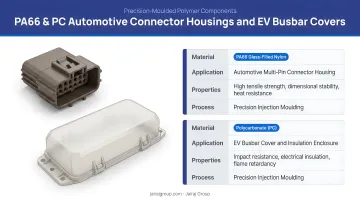
For electrical components in this sector, PA66-GF, PC, and PBT are the most commonly specified materials — driven by flame retardancy requirements, dimensional stability under thermal cycling, and chemical resistance. Jairaj Group supplies precision-moulded components to automotive OEMs including Endurance Technologies, Gabriel India Limited, and Tenneco Automotive, with expanding EV polymer capabilities as high-voltage component demand scales across India.
Electrical and Electronics Industry
Flame retardancy compliance and dimensional precision are non-negotiable here. Components in enclosed electrical assemblies — control panels, switchgear, power distribution boards — must pass UL94 requirements and hold tight tolerances to maintain safe electrical clearances.
Key components include:
- Circuit breaker housings
- Relay frames and relay holders
- PCB substrates and switchgear panels
- Terminal block bodies and power adapter casings
Relay mounting brackets, relay socket housings, and terminal blocks are among the components Jairaj Group produces for this sector — using PA66-GF, PC, ABS, PBT, and PP, with flame retardancy validation and electrical insulation testing built into the standard quality process.
Aerospace and Defense
Aerospace insulating components carry requirements that go beyond material properties: weight, temperature range, chemical compatibility with aviation fluids, and — critically — full material traceability and certification documentation.
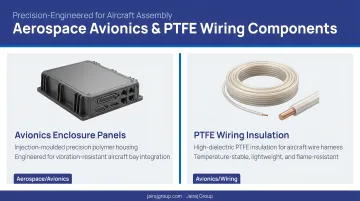
Common materials in this sector include PTFE for wiring insulation, glass-reinforced phenolics for structural insulation panels, and PEEK for ultra-high-temperature applications.
Key component categories include:
- Avionics enclosure panels and cockpit panels
- Overhead panels and structural insulation boards
- Wiring insulation and high-temperature connector housings
Jairaj Group produces these components using PC, ABS, PEEK, ULTEM, and fiberglass-reinforced composites — manufactured under ISO 9001:2015 and AS9100 standards with full traceability documentation.
Railway, Solar, and Emerging Industrial Applications
Jairaj Group's 2025 expansion into railways, solar, drones, and water pumps reflects the broader growth of insulating plastic demand in energy and transport infrastructure.
Railway applications include guide rings for braking systems, interior panels, and traction-related components. Materials must meet metro fire safety standards while offering UV and chemical resistance across the service life of rolling stock.
Solar components — junction box housings, cable clips, and protective covers — are engineered for outdoor UV exposure and long-term dielectric performance in photovoltaic environments.
Drones and water pumps demand lightweight insulating housings where compact geometry and component weight matter as much as electrical performance. PA66 and PEEK are common choices for motor controller enclosures and pump housing inserts in these applications.
Medical Devices
Medical-grade insulating plastics carry additional requirements beyond electrical performance: biocompatibility, sterilisation resistance, and full material traceability. PEEK, PC, and PMMA are the primary materials used in this space — selected for dimensional stability, chemical resistance, and compatibility with autoclave and chemical sterilisation processes. Jairaj Group manufactures precision medical components to these specifications with full material documentation.
How to Choose the Right Insulating Plastic for Your Application
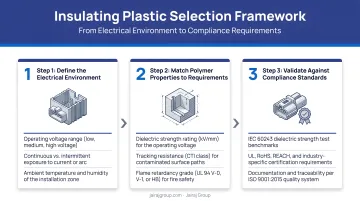
A 3-Step Decision Framework
Step 1: Define the electrical operating environment Identify the voltage level and frequency. A low-voltage control enclosure and a high-voltage EV junction box have fundamentally different dielectric strength requirements. Confirm whether the application involves DC or AC, as behaviour under each can differ.
Step 2: Identify thermal and mechanical constraints Determine the continuous operating temperature (not just peak), vibration or impact exposure levels, and required dimensional tolerances. This step typically narrows the field to a short list of candidate materials or grades.
Step 3: Confirm compliance requirements Before finalising material and grade selection, specify applicable standards:
- UL94 — flame retardancy class required (V-0, V-1, or V-2)
- IEC 60243-1 — dielectric strength test method
- RoHS Directive 2011/65/EU — restricted substance compliance for EEE supply chains
- ISO 9001 / IATF 16949 — manufacturing quality system (supplier qualification)
Thermoset vs. Thermoplastic
| Factor | Thermoplastics (PC, Nylon, PP) | Thermosets (FR4, Phenolic) |
|---|---|---|
| Processing | Injection mouldable, high volume | Laminated, machined — lower volume |
| Design flexibility | High — complex geometries possible | Lower — typically flat or simple forms |
| Dimensional stability at heat | Moderate — grade dependent | Excellent — no remelting |
| Best for | Enclosures, connectors, housings | PCB substrates, transformer boards, switchgear panels |
Working With the Right Manufacturer
Once you have a shortlisted material and grade, the next variable is whether your manufacturer can actually produce to spec — consistently, at volume, with documentation to back it.
Look for a supplier who can close the gap between material datasheet and production reality. Key capabilities to verify:
- DFM review — flags geometry issues before tooling is cut
- In-house tool room — faster iteration, tighter dimensional control
- Electrical and thermal testing — dielectric strength, flame retardancy (UL94), temperature cycling
- Compliance documentation — traceable test records for UL, RoHS, and customer-specific requirements
Jairaj Group has manufactured custom insulating components for automotive OEMs, electrical industry customers, and aerospace suppliers since 1985, with six production facilities across India and in-house testing covering electrical insulation, flame retardancy, and dimensional verification. For OEMs sourcing precision polymer components, their DFM and prototyping support can reduce first-article rejection rates before a single production tool is committed.
Frequently Asked Questions
What plastics are best for electrical insulation?
Polycarbonate, Nylon (PA6/PA66), Polypropylene, PTFE, and phenolic composites (FR4/Bakelite) cover most industrial needs. The best choice depends on voltage level, continuous operating temperature, moisture exposure, and flame retardancy requirements of the specific application.
What are the main types of electrical insulators?
The main categories are plastic/polymer insulators, ceramic insulators, glass-fibre/composite laminates, rubber insulators, and paper-based insulators. Plastic insulators dominate modern industrial and electronics applications due to design flexibility, weight advantages, and ease of high-volume manufacturing.
What is dielectric strength and why does it matter for plastic components?
Dielectric strength (kV/mm) is the maximum electric field a material can withstand before electrical breakdown occurs. Higher values mean better insulation reliability in high-voltage components — connectors, enclosures, motor parts — where failure leads to short circuits or arc flash events.
Can electrically insulating plastics be used in high-temperature environments?
PTFE handles continuous service to 260°C; high-grade PC is rated to approximately 130°C (RTI). For sustained high-temperature environments, thermoset composites like FR4 (Tg 180°C) and phenolic laminates are preferred. Always check the continuous-use temperature rating, not the short-term peak.
What certifications should electrically insulating plastic components meet?
UL94 for flame retardancy, IEC 60243-1 for dielectric strength testing, and ISO 9001:2015 for manufacturing quality systems are the baseline. Automotive components may also require IATF 16949; aerospace parts typically require AS9100 and full material traceability documentation.
How is injection moulding used to manufacture electrical insulating components?
Injection moulding forms insulating plastics into precise, complex geometries at high volumes. Key variables — material selection, mould design, process controls (cavity balancing, cooling uniformity, wall thickness consistency), and post-mould testing — all determine whether the finished part achieves the required dielectric and dimensional performance.