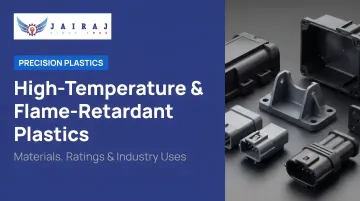
Across automotive, aerospace, electrical, and defense sectors, engineering teams increasingly depend on a narrow set of high-performance polymers — PEEK, PTFE, PPS, and PEI — that deliver where commodity plastics fall short. According to MarketsandMarkets, the EV plastics market alone is projected to grow from USD 3.7 billion in 2022 to USD 12.6 billion by 2027, driven largely by demand for flame-retardant and thermally stable polymer components.
This article covers the key material types, how UL 94 flame ratings work, and how to choose the right plastic for your specific application.
Key Takeaways
- High-temperature plastics maintain structural integrity at continuous service temperatures above 150°C; flame-retardant plastics resist ignition or self-extinguish under fire conditions
- These properties are frequently required together in safety-critical components across automotive, aerospace, EV, electrical, and defense sectors
- UL 94 is the primary flammability standard: ratings range from HB (least stringent) to 5VA (most stringent), thickness- and formulation-specific
- Key materials: PEEK (up to 260°C), PTFE (up to 260°C), PPS (up to 240°C), PEI/Ultem (RTI 170°C) — performance and cost vary significantly between them
- Material selection must be driven by operating temperature, required UL 94 rating, mechanical loads, and chemical exposure
What Are High-Temperature & Flame-Retardant Plastics?
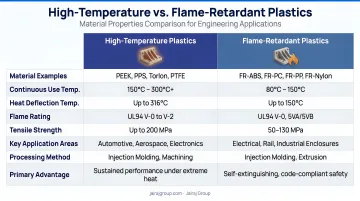
High-temperature plastics are engineering polymers that retain mechanical strength, dimensional stability, and chemical resistance at continuous service temperatures typically exceeding 150°C. This distinguishes them from commodity plastics like ABS or polypropylene, which soften, creep, or degrade well below that threshold.
Flame-retardant plastics are engineered to slow ignition, suppress flame spread, and self-extinguish after the ignition source is removed. This can happen in two ways:
- Inherent flame retardancy — built into the polymer's molecular structure (PPS, PTFE, PEEK, PEI all exhibit this)
- Additive flame retardancy — achieved through compounding with brominated compounds, phosphorus-based additives, metal hydroxides, or nitrogen-based systems
These two properties must be evaluated independently. A material can be thermally stable at 220°C yet still fail a UL 94 flame test without additive treatment. A flame-retardant additive system, on the other hand, won't compensate for a polymer that loses structural integrity under thermal load. PEEK and PPS are the standout exceptions — both deliver high thermal performance and inherent flame retardancy without additives.
UL 94 Flame Ratings: Understanding the Classification System
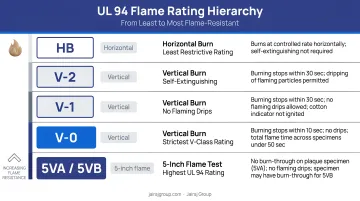
UL 94, formally titled the "Standard for Tests for Flammability of Plastic Materials for Parts in Devices and Appliances," is the primary international flammability standard for plastics used in devices and appliances. It evaluates how a material responds to a small open flame — measuring self-extinguishing behavior, ignition time, and whether flaming drips ignite a cotton indicator beneath the specimen.
The Rating Hierarchy
| UL 94 Rating | Test Orientation | Self-Extinguish Requirement | Flaming Drips | Burn-Through |
|---|---|---|---|---|
| HB | Horizontal | Slow burn rate only | Permitted | N/A |
| V-2 | Vertical | Within 30 seconds | Permitted | N/A |
| V-1 | Vertical | Within 30 seconds | Not permitted | N/A |
| V-0 | Vertical | Within 10 seconds | Not permitted | N/A |
| 5VB | Vertical (5x flame) | Within 60 seconds | Not permitted | Permitted |
| 5VA | Vertical (5x flame) | Within 60 seconds | Not permitted | Not permitted |
Thickness Dependency — A Critical Detail
UL 94 ratings are not universal — they are specific to the tested thickness and formulation. A resin that passes V-0 at 1.5mm may fail at 0.8mm. For example, SABIC ULTEM 1000 achieves V-0 at 0.75mm or greater, but only V-2 at 0.4mm.
Always request the manufacturer's UL Yellow Card — the third-party certification document that confirms a specific material grade, at a specific wall thickness, in a specific colour, has passed its rated classification. Even minor formulation changes — colorant additions, secondary additives — can invalidate a certified rating.
Flame-Retardant vs. Flame-Resistant
These terms are not interchangeable in regulatory contexts:
- Flame-retardant — slows ignition and self-extinguishes; UL 94 applies
- Flame-resistant — resists ignition entirely; tested under separate standards such as ASTM D6413 (textiles) or ISO 15025 (protective clothing and flexible materials)
This distinction matters when matching materials to regulatory frameworks in aerospace, defense, or construction. In those sectors, application-level standards like FAA 14 CFR 25.853 govern material qualification independently of UL 94.
The Shift Away from Halogenated Additives
Those regulatory frameworks extend beyond application standards — they also shape which flame-retardant chemistries are permissible in the first place. Regulatory pressure on brominated flame retardants (BFRs) is growing across multiple jurisdictions:
- EU RoHS restricts PBBs and PBDEs in electrical and electronic equipment
- The EPA's TSCA rules prohibit decaBDE for most uses
- ECHA's 2023 PFAS restriction proposal has significant implications for fluoropolymer supply chains
Industry preference is shifting toward halogen-free alternatives — phosphorus-based, metal hydroxide, and nitrogen-based systems — that deliver comparable UL 94 V-0 performance with lower combustion toxicity and better recyclability.
Key Types of High-Temperature & Flame-Retardant Plastics
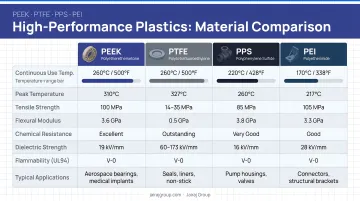
No single material dominates every application. Each polymer offers a specific combination of thermal ceiling, fire safety, mechanical strength, chemical resistance, and cost. The selection must match the specific demands of the component. The four materials below — PEEK, PTFE, PPS, and PEI — cover the performance range most engineers encounter in demanding thermal and fire-safety environments.
PEEK (Polyether Ether Ketone)
PEEK is a semi-crystalline, high-performance thermoplastic with one of the highest continuous service temperatures available — up to 260°C continuously — and a melting point exceeding 343°C. It achieves UL 94 V-0 without flame-retardant additives and delivers outstanding mechanical strength, fatigue resistance, and chemical resistance across a broad range of solvents and fuels.
Key applications: Aerospace structural components, surgical instruments, bearings, sensor housings, and metal-replacement parts in demanding mechanical environments.
Strengths:
- Highest tensile and flexural strength among high-performance thermoplastics
- Compatible with injection moulding, extrusion, and CNC machining
- Inherently V-0 rated without additives
Limitations:
- High material cost — best reserved for applications where extreme performance is non-negotiable
- Susceptible to UV degradation and concentrated strong acids
Jairaj Group produces injection-moulded PEEK components for automotive, medical, and electrical applications — including sensor housings and precision parts where dimensional accuracy under sustained heat is a hard requirement.
PTFE (Polytetrafluoroethylene)
PTFE is a chemically inert fluoropolymer with a service range of -180°C to +260°C. It is inherently non-combustible, carrying an oxygen index above 95 and a UL 94 V-0 rating, with no flame-retardant additives required. Its defining characteristics are near-universal chemical inertness, extremely low friction, and outstanding dielectric performance.
Key applications: Chemical processing linings, medical tubing, seals and gaskets, wire coatings, and electrical insulation.
Strengths:
- Widest usable temperature range of any material in this group
- Inert to virtually all industrial chemicals and solvents
- Excellent dielectric properties
Limitations:
- Poor mechanical strength at room temperature compared to PEEK or PPS
- Prone to creep under sustained compressive load
- Higher processing complexity — typically sintered rather than conventionally injection-moulded
Jairaj Group produces PTFE seals and precision components for industrial, automotive, and medical applications, using in-house CNC machining for custom profiles.
PPS (Polyphenylene Sulfide)
PPS is a semi-crystalline engineering thermoplastic that withstands continuous service up to 240°C and resists most solvents below 200°C. It inherently passes UL 94 V-0 — some grades achieve 5VA — without additive treatment, and offers exceptional dimensional stability and very low moisture absorption.
Key applications: Automotive under-hood connectors, fuel system components, heat shields, electrical insulation films, and chemical-resistant fluid-handling parts.
Strengths:
- Inherent V-0 flame rating across standard grades
- Excellent resistance to automotive fluids, fuels, and industrial solvents
- Strong dimensional stability under heat and load — well-suited for tight-tolerance precision parts
- Lower cost than PEEK or PTFE
Limitations:
- Brittle at low temperatures
- Lower impact strength than PEEK — not ideal for high-shock environments
PEI / Ultem (Polyetherimide)
PEI (commercially known as Ultem) is an amorphous thermoplastic with a glass transition temperature of 217°C and a continuous service temperature rated at 170°C. It is inherently flame-retardant, achieving UL 94 V-0 at 0.75mm or greater and 5VA at 3mm or greater. PEI holds the highest dielectric strength of any unfilled high-performance thermoplastic.
Key applications: Aircraft interior panels, avionics housings, circuit board components, food sterilization equipment, and medical device housings. SABIC ULTEM products are specifically cited as FAR 25.853 compliant for aerospace cabin interiors.
Strengths:
- Strong creep resistance and excellent electrical insulating properties
- Less expensive than PEEK while meeting V-0 requirements
- Thin-wall injection moulding friendly due to amorphous structure
Limitations:
- Lower mechanical performance and lower temperature ceiling than PEEK
- Susceptible to stress cracking with polar chlorinated solvents
Jairaj Group produces PEI/Ultem components for aerospace applications — including avionics enclosure panels and instrument housings — manufactured under ISO 9001:2015 quality systems.
How to Choose the Right High-Temperature or Flame-Retardant Plastic
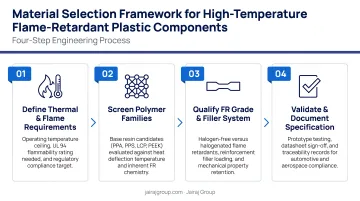
Both overspecifying and underspecifying carry real costs — in material expense, certification failure, and manufacturing complexity. The right material is found by systematically matching application requirements, not by defaulting to the most well-known option.
Selection Factors
1. Operating temperature
- Identify continuous service temperature and peak transient temperatures
- Confirm the chosen material's HDT and continuous use temperature rating exceed these values with adequate margin
- A 10–20°C buffer above the maximum expected temperature is a practical minimum margin
2. Required UL 94 rating
- Determine the minimum flame rating mandated by the end-use regulatory framework
- Verify the rating at the actual wall thickness of the part — not the material's maximum published thickness
- Cross-reference the UL Yellow Card for the exact grade, colour, and thickness combination
3. Mechanical and chemical environment
- Assess load-bearing requirements, fatigue cycles, and chemical exposure
- PEEK is the go-to for high-stress, high-temperature metal-replacement applications
- PPS handles precision fluid-handling and under-hood electrical components well
- PTFE is limited to non-structural chemical-contact and sealing roles — it offers excellent chemical resistance but cannot bear significant load
- PEI works for high-dielectric applications where mechanical demands are moderate and cost is a constraint
4. Processing method and part geometry
- Amorphous materials like PEI flow more easily in thin-walled injection molding, reducing processing risk
- Semi-crystalline materials like PEEK and PPS need tighter process control, but that discipline pays off in chemical resistance and long-term creep performance
- Part wall thickness directly affects the achievable UL 94 rating — always verify the material's rating is confirmed at the actual wall thickness, not a thicker test specimen
Applying this framework systematically reduces costly late-stage changes once tooling is committed. Jairaj Group's in-house R&D and Value Engineering Centres support customers through each of these steps — from material selection and DFM consultation to flow simulation and in-house testing — so the right decision is made before production begins.
Industry Applications: Where These Materials Are Used
Automotive and Electric Vehicles
PPS is widely specified for under-hood connectors, sensor housings, and fuel system components due to its inherent V-0 rating, resistance to automotive fluids, and dimensional stability at elevated temperatures. PEEK handles applications demanding higher thermal or mechanical limits.
In the EV sector, demand is escalating rapidly. IDTechEx projects a 13-fold increase in demand for fire-protection materials for EV batteries by 2033 versus 2022 levels. Flame-retardant grades rated V-0 or 5VA are increasingly specified for battery enclosures, charging connectors, and high-voltage system components — with UL's BEMS (Battery Enclosure Material Screening) service providing a dedicated evaluation framework under UL 2596.
Jairaj Group supplies EV-related polymer components including fan grills for EV chargers and charger handles, manufactured from PA66-GF, PC, and PBT grades meeting IEC and UL electrical safety standards.
Aerospace, Defense, and Electrical/Electronics
For aerospace cabin interiors, FAA 14 CFR 25.853 governs material flammability requirements — particularly for aircraft with 20 or more passengers, where ceiling panels, wall panels, and galley structures must meet Appendix F test criteria. PEI/Ultem and PEEK are the standard material choices for these applications.
In the electrical and electronics sector, connector housings, switch components, relay sockets, and terminal blocks are routinely specified in V-0 rated materials. Relay mounting brackets in PA66-GF, PC, PBT, and ABS — with flame-retardant properties and IEC/UL compliance — are among Jairaj Group's standard offerings here. The company also manufactures plastic panels for avionics enclosures using Ultem and PEEK under AS9100-certified manufacturing processes.
Industrial, Medical, and Emerging Sectors
PTFE remains the dominant choice in chemical processing equipment, medical-grade tubing, pump linings, and wire coatings — driven by its exceptional chemical inertness and thermal stability. The medical tubing market alone was valued at USD 12.9 billion in 2025, with projections reaching USD 25.5 billion by 2033.
Beyond established sectors, flame-retardant and high-temperature plastics are displacing metals across several growth industries. Jairaj Group's 2025 expansion reflects this shift, with components now supplied for:
- Railways — guide rings, seat shells, and braking system parts meeting metro fire-safety standards
- Drones — structural and enclosure components requiring low weight and thermal resistance
- Solar infrastructure — junction boxes and mounting components suited to outdoor thermal cycling
Frequently Asked Questions
What is the difference between heat-resistant and flame-retardant plastics?
Heat-resistant plastics maintain structural integrity at elevated temperatures, measured by metrics like HDT and continuous use temperature. Flame-retardant plastics are defined by fire behavior: slowing ignition or self-extinguishing when exposed to flame. Materials like PEEK and PPS offer both properties inherently; others achieve flame retardancy through additive treatment.
What does a UL 94 V-0 rating mean, and when is it typically required?
V-0 means a vertically oriented specimen self-extinguishes within 10 seconds with no flaming drips after two 10-second flame applications. It is typically required for electrical enclosures, EV battery components, consumer electronics housings, aerospace cabin parts, and any component where flaming drips could ignite secondary materials.
How does part thickness affect a plastic's UL 94 flame rating?
UL 94 ratings are thickness-dependent : a material may pass V-0 at 1.5mm but fail at 0.8mm. Engineers must confirm the UL Yellow Card covers the exact wall thickness of the final part, as applying a maximum published rating to a thinner actual wall is a common and costly compliance error.
Which high-temperature plastic is best suited for automotive under-hood applications?
PPS is the standard choice for under-hood connectors, sensor housings, and fuel system parts : it offers an inherent V-0 rating, resistance to automotive fluids, and strong dimensional stability under sustained heat. PEEK is the upgrade path when more extreme mechanical demands or higher temperature ceilings apply.
Are halogen-free flame retardants as effective as brominated options?
Halogen-free systems (phosphorus-based, metal hydroxide, and melamine-based) can achieve UL 94 V-0 in many polymer systems — phosphate-based options reach V-0 in PC/ABS at 8–15 wt% loading. They are increasingly preferred for lower combustion toxicity and better recyclability, though higher loading levels may reduce mechanical performance.
Can standard engineering plastics be made flame-retardant through additives?
Yes. ABS, PP, PA, and PBT can all be compounded with flame-retardant additives to meet UL 94 ratings. The key caveat: any formulation change, including colorant additions, requires re-testing and re-certification before the new compound can carry the original rating.