Introduction
The 2003 Daegu subway fire killed 192 people and injured 148 more. According to the IAFSS incident analysis, smoke filled underground levels within minutes, emergency lighting failed, and passengers could not manually open doors. The fire spread rapidly across train ceilings and seats covered with flammable materials — plastic among them.
That single incident captures what EN 45545 is about. Not bureaucratic box-ticking, but the real-world difference between materials that buy passengers evacuation time and materials that don't.
Plastic components now appear throughout rail vehicles: interior panels, seat shells, electrical housings, connector bodies, cable management systems. Each one is a fire behaviour variable. EN 45545 — specifically Part 2 — defines the mandatory performance thresholds for what those materials can and cannot do.
This article is a compliance guide for manufacturers who supply or plan to supply plastic components to railway applications. It covers the standard's structure, the hazard level and R-requirement system, fire performance criteria, material selection, and the most costly compliance mistakes.
Key Takeaways
- EN 45545-2 is the core part of the 7-part European fire safety standard that governs fire behaviour of materials and components, making it the primary compliance obligation for plastic suppliers
- Three Hazard Levels (HL1–HL3) apply based on the vehicle's operating context; HL3 is the most stringent
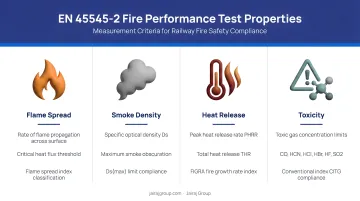
- Compliance is tested across four properties: flame spread, heat release rate, smoke density, and toxic gas emission
- 26 R-requirement sets (R1–R26) define which tests apply based on where and how a component is used
- Standard general-purpose thermoplastics typically fail EN 45545-2 at HL2/HL3 without modification
- Halogen-free FR grades have become the default material choice for compliant rail components
What EN 45545 Means for Plastic Component Manufacturers
Performance Qualification, Not Product Certification
EN 45545 does not certify a product — it qualifies material and component performance. This shapes where documentation responsibility sits in the supply chain.
The component manufacturer must:
- Test each material grade used in rail applications
- Generate test reports at the relevant R-requirement set and hazard level
- Document wall thickness ranges and production-representative geometries tested
- Provide this documentation to OEMs and system integrators
OEMs and system integrators then use supplier test reports to demonstrate full vehicle compliance to rail authorities. If your documentation has gaps, their vehicle qualification has gaps.
The 7-Part Structure
BSI's EN 45545 series covers:
| Part | Coverage |
|---|---|
| EN 45545-1 | General requirements |
| EN 45545-2 | Fire behaviour of materials and components |
| EN 45545-3 | Fire resistance of fire barriers |
| EN 45545-4 | Fire safety requirements for rolling stock design |
| EN 45545-5 | Fire safety for electrical equipment |
| EN 45545-6 | Fire control and management systems |
| EN 45545-7 | Flammable liquid and gas installations |
For plastic component manufacturers, Part 2 is the primary obligation. Parts 3, 4, and 5 become relevant depending on the subsystem your component sits within.
Who Must Comply — and Where
Part 2's reach now extends well beyond its European origins. Since 2016 it has been the baseline fire safety standard for rail materials across Europe — and procurement documents in India and Australia now explicitly reference it too:
- India (RDSO, June 2023): Passenger coach seat foam requires EN 45545-2 HL3/R21 compliance
- Australia (Transport for NSW, 2023): HVAC materials on light rail must comply with EN 45545
- Europe: Mandatory for all rail vehicle materials since 2016
If you supply to modern rail OEMs anywhere, EN 45545-2 compliance is increasingly a supplier qualification threshold.
One Tested Grade, Multiple Colours
Once a material grade is tested and classified at a defined wall thickness range, all colour variants within that range qualify without re-testing. This has real design freedom implications — specify the FR grade first, then manage colour through qualified pigment systems without triggering a new test cycle.
Understanding Hazard Levels and the R-Requirement System
Hazard Levels: HL1, HL2, HL3
Hazard Levels reflect evacuation difficulty, not just fire severity.
- HL1 — lowest risk; vehicles where passengers can evacuate quickly (such as trams and surface-running light rail)
- HL2 — intermediate risk; mainline intercity rail
- HL3 — highest risk; underground metro vehicles in tunnels, vehicles with sleeping areas, any scenario where evacuation is severely restricted
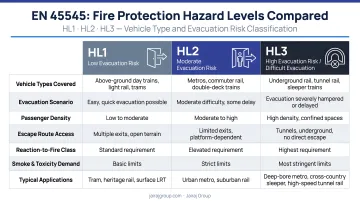
HL3 imposes the strictest material performance thresholds across all four fire behaviour properties. EN 45545-1 determines the correct hazard level based on vehicle operation and design category — your own assessment of the component's risk doesn't override this.
The R-Requirement System
Requirements are grouped into 26 sets (R1–R26), each corresponding to a category of component use within the vehicle. Selecting the wrong R-set is one of the most consequential errors in the qualification process — a material can pass testing and still be non-compliant if it was tested under the wrong category.
Key R-sets relevant to plastic manufacturers:
| R-set | Component category |
|---|---|
| R1 | Interior components — ceilings, sidewalls |
| R6 | Seat back shells, base shells |
| R21 | Flexible foam in seats and berths |
| R22, R23, R24 | Small electrical components — connectors, terminal blocks |
A Practical Example
To see how the R-set and hazard level interact, consider a plastic connector housing destined for a metro vehicle interior:
- Identify the R-set: Connector housings fall under R22 (small electrical components)
- Determine the hazard level: Metro underground operation = HL3
- Verify test parameters: The material must meet all indices specified for R22/HL3 — MARHE for heat release, Ds max for smoke density, CITG for toxicity
- Document the specifics: Wall thickness tested, geometry, and material grade designation must all be recorded
This is why material datasheets alone are insufficient for compliance. OEM qualification teams require documentation tied to a specific material grade, tested at the actual R-set and HL combination relevant to the application — not generic fire ratings.
Fire Performance Criteria Your Plastics Must Meet
The Four Properties
EU FP7 TRANSFEU research established that toxic combustion products can prevent passengers and crew from evacuating in time. EN 45545-2 tests for exactly the properties that determine whether that happens.
Flame spread and ignitability (ISO 5658-2) Quantifies how quickly fire propagates across a material surface. Slower spread gives passengers more time to reach exits.
Heat release rate (ISO 5660-1) Reports total heat energy released during combustion as MARHE (Maximum Average Rate of Heat Emission). High heat release accelerates fire growth and can overwhelm suppression systems before evacuation completes.
Smoke density (ISO 5659-2) Optical density is reported as Ds max. Dense smoke is a primary cause of disorientation during evacuation — the Daegu fire demonstrated this directly.
Toxic gas emission (ISO 5659-2 and related protocols) The failure data is consistent across material types:
- Neat epoxy reached Ds max above 792 during ISO 5659-2 testing
- Neat PC exceeded 792 after just 190 seconds
- PVC samples produced CITG values of 3.0–4.8
General-purpose polymers without flame-retardant modification routinely hit these levels, disqualifying them at HL2 and HL3.
Geometry Matters
Test specimens must reflect actual production geometry and wall thickness. Testing a flat 3mm plaque and then moulding a 1.5mm thin-wall component without re-testing is a well-documented non-compliance path. Warringtonfire's test guidance explicitly states that small differences in composition or thickness can materially shift test performance.
Selecting Compliant Flame-Retardant Plastics for Rail Applications
Material Families That Qualify
No single material suits every rail application — the right choice depends on the R-set and hazard level. That said, the following families have documented EN 45545-2 track records:
FR-grade engineering thermoplastics:
- FR PA66 and PA66/6 (e.g., BASF Ultramid C3U — HL3 for R22/R23/R24)
- PEI (e.g., SABIC ULTEM R16SG29 sheet — HL3 for R1 and R6 at 1–4mm; ULTEM 2300 resin — HL3 for R22/R23)
- FR PBT grades for electrical applications
Thermosets:
- SMC and BMC offer inherent flame performance, though neat epoxy can produce high smoke density — formulation matters even here
The Shift to Halogen-Free Systems
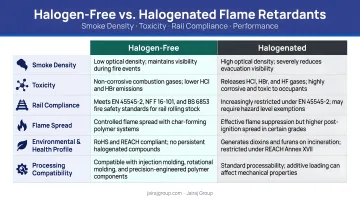
The 2023 Wiley study found that phosphorus-nitrogen (PIN) flame retardants — including ammonium polyphosphate, melamine cyanurate, and magnesium hydroxide — generally showed no significant increase in CITG or Ds max versus neat polymers. Bromine-based flame retardants, by contrast, were detrimental to both smoke and toxicity performance in most polymer matrices tested.
In PA6, magnesium hydroxide reduced smoke emissions to Ds max of 92 — well within EN 45545-2 limits for most HL3 applications. That performance advantage has business implications beyond the test lab. Rail OEMs increasingly specify halogen-free grades contractually, because halogenated combustion gases (HCl, HBr) cause corrosive secondary damage to vehicle electronics and infrastructure. It's a costly maintenance consequence even when no passenger is harmed.
Working with Pre-Qualified Material Families
For manufacturers entering rail supply chains, starting qualification with unknown base resins is expensive and slow. Jairaj Group's experience with engineering thermoplastics — PEEK, PEI, and PA66-GF across six manufacturing facilities — means component development can start from material families with established FR performance profiles. Their teams also support the test documentation and traceability records that OEM qualification processes require, reducing qualification lead time on both ends.
Common EN 45545 Compliance Mistakes Manufacturers Make
Mistake 1: Treating Qualification as a One-Time Test
EN 45545-2 compliance covers a defined material grade at specific tested thicknesses and geometries. Many manufacturers submit test samples without documenting the full range of wall thicknesses, colour variants, or production-representative geometries used across their actual output.
A test report that technically exists but doesn't cover production reality will trigger batch rejections at OEM audit. RDSO's specification requires re-testing after every 500 coach sets or whenever the tested formulation changes — that frequency reflects how seriously procurement bodies treat formulation traceability.
Mistake 2: Confusing UL 94 with EN 45545-2
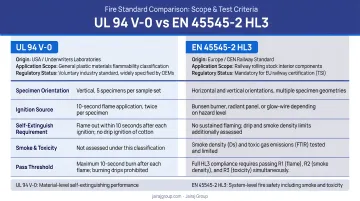
UL 94 V-0 is not equivalent to EN 45545-2 HL2 or HL3 compliance. As LATI's technical guidance notes, UL 94 measures vertical flame resistance only — EN 45545-2 additionally evaluates smoke density and toxicity across specific railway operating scenarios.
A material with a UL 94 V-0 rating may still produce smoke density or toxic gas concentrations that fail EN 45545-2 indices outright. Manufacturers who assume flammability ratings are interchangeable across standards discover this gap late in the qualification process, when the cost of correction is highest.
Mistake 3: Not Tracking Formulation Changes
EN 45545-2 compliance is material-grade specific down to the flame retardant package and filler type. When a resin supplier changes their formulation (even a minor additive adjustment), the compliance status of components made from that resin becomes uncertain.
Manufacturers without robust batch-level material traceability risk using non-compliant materials on previously qualified assemblies without realising it. The practical fix: treat any supplier-initiated formulation change as a trigger for compliance re-evaluation, not a routine procurement matter.
Key traceability controls that prevent this:
- Document the exact flame retardant package and filler type for every qualified grade
- Flag supplier change notifications (SCNs) for compliance review before production use
- Maintain batch records linking incoming resin lots to tested material specifications
Frequently Asked Questions
What is the EN 45545 standard?
EN 45545 is a European fire protection standard for railway vehicles, covering seven parts from general design requirements to electrical safety and fire management systems. Its primary objectives are minimising ignition risk, slowing flame spread, and limiting toxic smoke emissions across all rail vehicle types.
What is the EN 45545-2 standard?
EN 45545-2 governs the fire behaviour of materials and components within the standard. It specifies the applicable test methods (ISO 5658-2, ISO 5660-1, ISO 5659-2) and sets the performance limit values materials must meet for each R-requirement and hazard level combination.
What is the hazard level of EN 45545?
EN 45545 uses three hazard levels — HL1, HL2, and HL3 — determined by the vehicle's operating and design category. HL3 represents the highest fire risk scenario, typically underground metro vehicles in tunnels, and imposes the most stringent material performance thresholds across all four fire behaviour properties.
What is the best plastic material for fire protection in rail applications?
Material selection depends entirely on the component's R-requirement set and hazard level. Halogen-free FR-grade engineering thermoplastics (FR PA66, PEI) and appropriately formulated thermosets (SMC, BMC) are among the most widely qualified options for HL2 and HL3 applications.
Does EN 45545 compliance apply to manufacturers outside Europe?
Yes, increasingly. India's RDSO and Transport for NSW in Australia both reference EN 45545-2 in current procurement specifications. Any supplier targeting modern rail OEMs — regardless of geography — will encounter EN 45545-2 as a qualification requirement.
How do you get EN 45545 certification for a plastic component?
There is no single EN 45545 certificate. Compliance is demonstrated through accredited laboratory test reports confirming the material meets all relevant indices for its specific R-requirement set and hazard level. These reports form the supplier qualification package submitted to OEMs or system integrators.