The context makes this increasingly urgent. India's metro network has expanded from 248 km in 2014 to 1,013 km across 23 cities by May 2025, and 164 Vande Bharat train services are now operational across 274 districts. Each new trainset and corridor creates fresh demand for interior plastic components that meet global benchmarks.
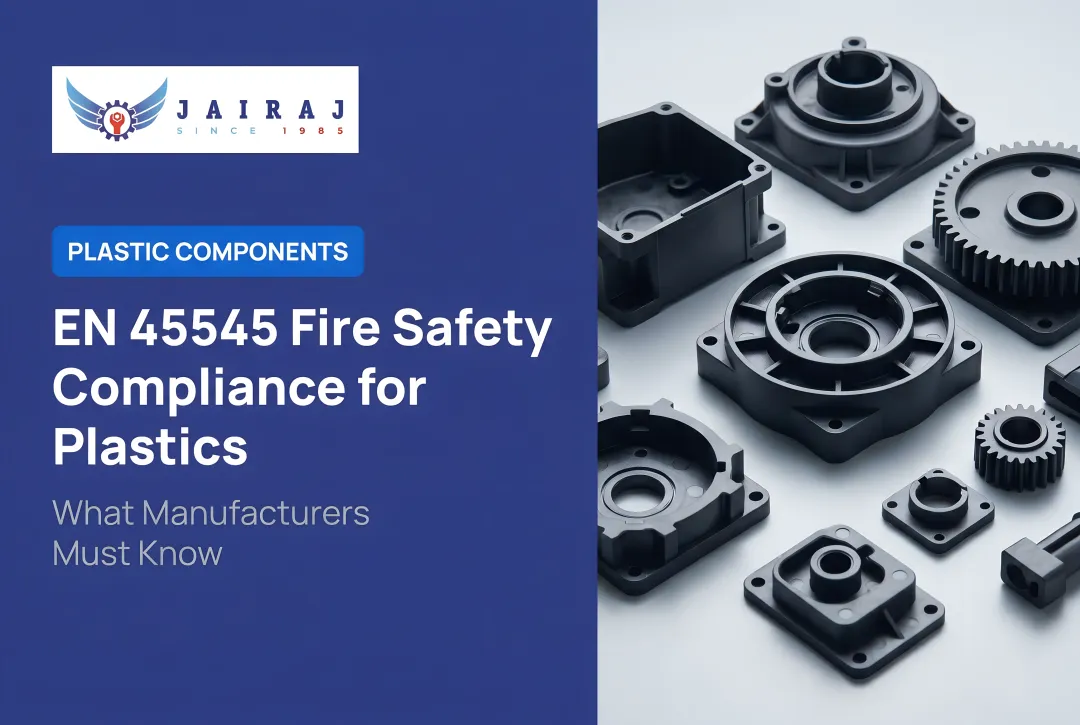
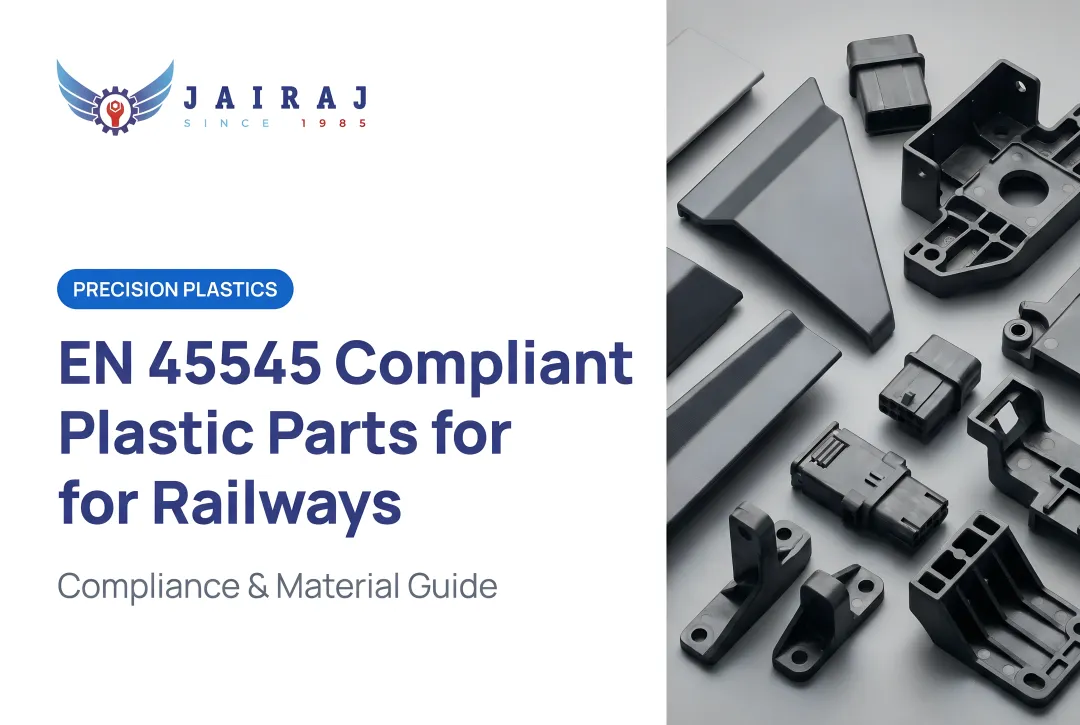
This guide covers where plastics are used in rail interiors, how to select the right materials, key design engineering principles, fire safety compliance (EN 45545-2 and RDSO specifications), manufacturing processes, and quality assurance requirements.
Key Takeaways
- Rail interiors use plastics for seat shells, wall panels, overhead racks, door trims, and light covers — chosen for weight savings and design flexibility
- Material selection must meet flame retardancy, impact resistance, dimensional stability, and chemical resistance requirements — standard commercial-grade plastics do not qualify
- EN 45545-2:2020+A1:2023 is the current international benchmark for rail interior fire safety; Indian Railways projects follow RDSO/RCF specifications such as MDTS-43373
- Design engineering must account for wall thickness uniformity, draft angles, rib geometry, and fillet radii to ensure durability across the component's service life
- Rail supply chain entry requires material test certificates, type approval records, and an ISO 9001:2015-compliant quality system
Where Plastic Components Are Used in Rail Interiors
Rail carriages use plastics and composites across multiple zones, each with distinct performance demands.
Primary Application Zones
The Vande Bharat V2 Maintenance Manual identifies the following interior plastic and composite applications in Indian rolling stock:
- Modular FRP side-wall and ceiling panels — lightweight, must maintain surface finish and dimensional stability under vibration
- Corrugated FRP roof panels — structural, requires high rigidity and weather resistance
- FRP modular toilet modules — enclosed space, demands chemical resistance and ease of cleaning
- Sound-absorbing floor plates with rubber noise-damping profiles — multi-material composite, combines structural and acoustic functions
- Continuous luggage racks — load-bearing, requires stiffness without excessive weight
- Sliding transit doors — precision-fit, requires dimensional consistency and impact resistance
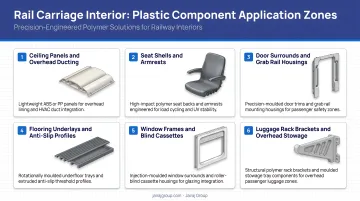
Beyond the Vande Bharat documentation, polymer suppliers including SABIC and Covestro identify additional common zones: window frames, passenger seat shells, light diffusers, tray tables, compartment partitions, and anti-graffiti sheet applications.
Each zone has a specific failure mode to guard against. Seat shells need impact resistance against passenger loads and vandalism. Light diffusers need high light transmittance and a clean surface finish. Panels must resist cleaning chemicals used in routine train maintenance.
The Shift from Metal and Fibreglass
Engineering plastics have largely displaced metal and traditional fibreglass in interior applications for two reasons: weight and geometry. SABIC states its LEXAN sheet series can offer up to 30% weight savings per part versus FRP, and Covestro notes that Makrolon polycarbonate weighs approximately half that of glass for lighting and window applications. Lighter carriages consume less energy, which now feeds directly into procurement decisions across Indian rail projects.
That shift is visible in current Indian tenders: Vande Bharat trains and modern metro projects specify interior components at automotive-grade surface quality. For domestic polymer component manufacturers capable of meeting both aesthetic and compliance requirements, this represents a concrete and growing opportunity.
Choosing the Right Materials for Rail Interior Plastic Components
Standard commercial-grade plastics cannot be used in rail interiors. Fire performance requirements alone disqualify most general-purpose grades. Material selection in this sector requires matching mechanical properties, flame retardancy, and surface quality to each application zone.
Engineering Thermoplastics for Rail Interiors
The most commonly specified base materials are:
- ABS (Acrylonitrile Butadiene Styrene) — good surface finish, easy to process, impact resistant; widely used for interior panels and seat components when specified in FR grade
- PC/ABS blends — combines polycarbonate's toughness with ABS processability; preferred for seat shells, partitions, and structural panels
- Glass-filled polypropylene (PP-GF) — high stiffness-to-weight ratio, cost-effective; used in structural brackets and load-bearing components
- Polyamide/Nylon (PA66, PA66-GF) — excellent wear and temperature resistance; used in mechanical fittings and load-bearing clips
- Polycarbonate (PC) — optical clarity, high impact strength; preferred for light diffusers and glazed panels
Flame-Retardant Grades: Non-Negotiable
Generic versions of these materials fail rail fire tests. FR-modified or halogen-free FR compounds are mandatory. Verified grades from major suppliers with confirmed EN 45545-2 ratings include:
| Grade | Polymer | Application | EN 45545-2 Status |
|---|---|---|---|
| LEXAN H6500 (SABIC) | PC/ABS | Sidewalls, tables, seating | R1/R6 HL2 at 3–4 mm; non-chlorinated, non-brominated |
| CYCOLOY C3650 (SABIC) | PC/ABS | Interior parts | R1 HL3 at 1.5–3 mm; halogen-free |
| LEXAN XHR6200 (SABIC) | PC copolymer | Ceilings, side walls, seating | R1 HL3 at 3 mm |
| ULTEM R16SG29 (SABIC) | PEI | Seat shells, interior components | R1/R6 HL3 at 1–4 mm |
| SIMORAIL HL3 (SIMONA) | Thermoplastic sheet | Armrests, seat backs, partitions | EN 45545 HL3 R1, 1–6 mm |
| Tepex dynalite 102fr-FG290 (LANXESS) | PA6 glass-fiber composite | Small housings | Halogen-free FR; EN 45545-2 compliant |
BASF's Ultramid PA and Ultradur PBT families extend this further. Both hold EN 45545 certifications across application groups R22, R24, R25, and R34 using halogen-free FR systems.
Mechanical and Environmental Performance
Beyond fire ratings, rail-grade materials must meet:
- Impact resistance — passenger loading, accidental impacts, and vandal resistance
- Creep resistance — sustained loads on luggage racks and seat structures without deformation
- Chemical resistance — train maintenance involves disinfectants and solvents; SABIC specifically cites cleaner and disinfectant resistance as a rail material criterion
- Dimensional stability — consistent geometry across the temperature swings typical in rail service
Composite and Advanced Materials
When mechanical performance criteria demand high stiffness at low weight, the material set shifts beyond standard thermoplastics. Sheet Moulding Compound (SMC) and continuous-fibre thermoplastic composites such as LANXESS Tepex are used for larger structural components. SMC compression moulding suits doors and architectural panels where surface finish and rigidity are both required.
These materials differ significantly from injection-moulded thermoplastics in processing — they require matched-die compression tooling and longer cure cycles, which affects tooling investment and lead time planning.
Halogen-free FR is no longer a differentiator — it is now a baseline supplier qualification. SABIC, BASF, and LANXESS all offer verified non-chlorinated, non-brominated FR systems, and procurement specifications for newer rail projects explicitly require it.
Design Engineering Principles for Rail Interior Plastic Components
Getting material selection right is only half the equation. Component geometry and design execution determine whether a rail-grade material actually performs as intended across years of service.
Wall Thickness and Uniformity
Non-uniform wall thickness leads to warping, sink marks, and internal stress concentrations, problems that are especially pronounced in rail environments where vibration cycling is continuous. The goal is consistent wall thickness throughout the component, with gradual transitions where thickness must change.
SABIC's EN 45545 compliance data provides a useful reference point: grades like CYCOLOY C3650 are tested and rated at 1.5–3 mm, and LEXAN H6500 at 3–4 mm. These fire-test thicknesses reflect the practical range for panel and seating applications and should guide initial design intent.
Draft Angles and Textured Surfaces
Insufficient draft causes ejection damage and surface drag during demoulding. For smooth surfaces, standard injection moulding draft minimums apply. For textured rail interior surfaces (a common aesthetic requirement for panels and seat components) draft must be increased to prevent texture smearing during ejection. The coarser the texture, the greater the required draft per side.
Rib and Boss Design
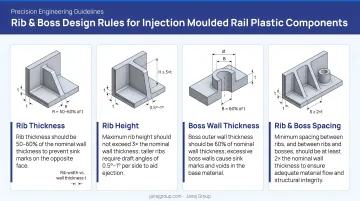
Rail components like seat shells and overhead racks must carry loads without being excessively thick. Ribs add structural rigidity without bulk, but poorly designed ribs cause sink marks on visible surfaces — unacceptable in passenger-facing interiors.
Key rib design rules:
- Rib thickness should be 50–60% of adjacent wall thickness to minimise sink marks
- Rib height should not exceed 3× the wall thickness
- Base fillets are essential to distribute stress
- Rib spacing should allow adequate cooling between features
Fillet Radii and Corner Design
Sharp internal corners are crack initiation points. In rail environments, vibration loads are sustained and repetitive — a small stress concentration at a sharp corner will eventually propagate into a fatigue crack. Correctly specified fillet radii are what maintain structural integrity across years of service in high-vibration environments.
The standard guidance:
- Internal radii: minimum equal to wall thickness
- External radii: minimum 1.5× wall thickness
Simulation Before Tooling
Mould-flow simulation (for filling, weld line placement, and warpage) and FEA (for structural load analysis) must be completed before tooling is committed. These tools identify problems that are expensive to fix post-tooling and inexpensive to address at the design stage.
Jairaj Group integrates flow analysis, cooling optimisation, and warpage prediction as part of its upstream development process through dedicated R&D and Value Engineering centres. This reduces design iterations and supports first-time-right quality, which is critical during rail procurement approval cycles.
Fire Safety, Compliance, and Regulatory Standards
Fire performance is the most consequential compliance dimension for rail interior plastics. Failure here results in component rejection regardless of mechanical or aesthetic performance.
EN 45545-2: The International Benchmark
The current standard is EN 45545-2:2020+A1:2023, which defines fire behaviour requirements for railway materials and components. It replaced earlier versions and is the version that current European and many international tenders specify.
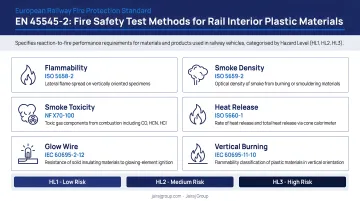
The standard uses three hazard levels:
- HL1 — lowest risk; surface trains in open environments with straightforward evacuation
- HL2 — medium risk; standard train operations
- HL3 — highest risk; underground or tunnel operations where evacuation is significantly more difficult
The applicable hazard level for a given project is determined by the train's design category and operating environment. A metro system running through tunnels will typically require HL2 or HL3 compliance for interior materials.
Key test methods within EN 45545-2 include:
- ISO 5660-1 — cone calorimeter (measures heat release rate and MARHE value)
- ISO 5659-2 — smoke opacity (Dsmax and VOF4 values)
- EN 45545-2 Annex C / EN 17084 — smoke toxicity (CIT values)
- ISO 5658-2 — lateral flame spread
- ISO 4589-2 — Limiting Oxygen Index (LOI)
RDSO and RCF Specifications for Indian Railways
Indian Railways compliance is governed by RDSO specifications and RCF (Rail Coach Factory) material and technical standards. Relevant specification documents for interior plastic and composite components include:
| Specification | Subject |
|---|---|
| MDTS-084 Rev 02 | FRP resin system for glass-fibre reinforced panels for LHB coaches |
| MDTS-214 Rev 13 | FRP modular toilet for LHB coaches |
| MDTS-43373 Rev 01 | FRP components complying with EN 45545-2 fire-retardant characteristics |
| MDTS-44376 Rev 01 | FRP modular toilet complying with EN 45545-2 |
| MDTS-44387 Rev 00 | Lightweight composite sound-insulating floor board with fire characteristics |
| MDTS-44388 Rev 00 | Lightweight composite partition frames and ceiling panels with fire characteristics |
Identify which MDTS documents apply to your specific components before submitting quotes. RCF also lists injection-moulded thermoset passenger amenities under MDTS-26381 and TPE components under MDTS-49264.
Smoke Toxicity: A Separate Compliance Dimension
Flammability ratings alone do not determine rail interior material acceptability. In enclosed rail environments, toxic smoke is frequently the primary evacuation hazard. EN 45545-2 includes smoke toxicity limits (CIT values) and optical smoke density limits (Dsmax) that are assessed separately from heat release rate.
The French standard NF F 16-101 is still referenced in some specifications alongside EN 45545-2. Review tender documents carefully — some Indian metro projects reference both frameworks, and complying with EN 45545-2 alone may not satisfy all specified tests.
Meeting these performance thresholds is only part of the compliance picture. Suppliers also need the documentation infrastructure to prove conformance at every stage of procurement.
Certification and Documentation Requirements
For rail supply chain entry, suppliers typically need:
- Material test certificates from accredited laboratories (TÜV SÜD and Tecnalia provide EN 45545-2 accredited testing)
- Type approval documentation for each component
- Lot-level certificates of conformance with full material traceability
- ISO 9001:2015 as a baseline QMS (some rail OEMs require ISO 22163:2023, the railway-sector QMS standard that builds on ISO 9001:2015)
Jairaj Group holds ISO 9001:2015 certification and maintains full material traceability from raw polymer batch through to finished component, meeting the documentation requirements rail procurement teams routinely audit.
Manufacturing Processes and Quality Assurance
Manufacturing Process Selection
Three primary processes cover most rail interior plastic components:
Injection moulding — suited to complex, medium-to-high-volume components including seat shells, brackets, trims, and hand grips. Offers precise dimensional control and excellent surface finish repeatability.
Thermoforming — used for large-area panels and ceiling linings. Lower tooling cost than injection moulding, making it practical for moderate production volumes where component geometry is relatively simple.
SMC/BMC compression moulding — used for structural composite panels requiring high rigidity and good surface finish. Suits door panels and architectural elements where strength-to-weight ratio is the primary driver.
In-house tooling capability is a meaningful differentiator in rail component manufacturing. Manufacturers that control their own tool rooms can iterate faster when engineering changes arise and protect proprietary mould designs. They also maintain tighter tolerances than those reliant on external toolmakers. Jairaj Group operates in-house tool rooms across its facilities, directly supporting faster development cycles for rail applications.
Secondary operations typically required include plastic welding for component assembly, insert moulding for metal fastener integration, and surface finishing for aesthetic compliance.
Quality Assurance and Testing
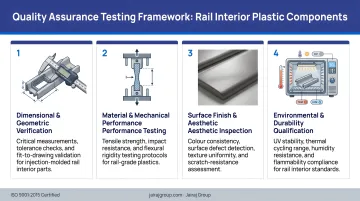
Rail interior plastic components must pass testing across four categories before deployment:
- Dimensional inspection — CMM or 3D scanning to verify tolerance compliance across all critical features
- Mechanical testing — impact resistance, tensile and flexural strength, and creep testing under sustained load
- Fire performance testing — cone calorimeter, smoke density, and LOI per EN 45545-2 or applicable RDSO requirements, conducted through accredited third-party laboratories
- Environmental testing — UV weathering, thermal cycling, and chemical resistance to cleaning agents
Material traceability is a procurement requirement, not a best practice. Rail supply chains require full documentation from raw polymer resin batch to finished component, with certificates of conformance for each material lot. Jairaj Group's quality system maintains batch-level traceability and produces comprehensive testing documentation for every component lot — giving rail OEM procurement teams the audit-ready records they need at the point of supplier qualification.
Frequently Asked Questions
How is plastic used in interior design for rail applications?
In rail interiors, plastics are used for seat shells, wall and ceiling panels, luggage racks, door trims, and light covers. They are chosen for their ability to be moulded into complex shapes, finished to high aesthetic standards, and engineered with flame-retardant additives to meet fire safety compliance requirements.
How are rail interior plastic components manufactured?
Three processes dominate rail interior manufacturing: injection moulding for complex small-to-medium components, thermoforming for large panels, and SMC/BMC compression moulding for structural composite parts. Process selection depends on production volume, component geometry, and performance requirements — no single process suits all applications.
What are the main components of engineering plastics used in rail interiors?
Rail-grade engineering plastics combine a base polymer (ABS, polypropylene, or polycarbonate) with a tailored additive package selected to meet fire and mechanical standards:
- Flame-retardant additives (phosphorus- or nitrogen-based in halogen-free systems)
- Thermal and UV stabilisers
- Glass fibre fillers for reinforcement
- Colorants
What compliance standards apply to rail interior plastic components in India?
Indian Railways projects are governed by RDSO and RCF specifications, with relevant MDTS documents varying by component type. Internationally referenced projects — including metro rail and high-speed rail — may also require EN 45545-2 compliance for fire safety. Suppliers should confirm applicable specifications with the railway OEM or procurement authority for each project.
What is EN 45545 and why does it matter for rail interiors?
EN 45545-2 is the European standard for fire protection of railway vehicles, defining three hazard levels (HL1–HL3) and test requirements for interior materials covering heat release, smoke density, and smoke toxicity. It is increasingly referenced in Indian rail tenders as the benchmark for interior material fire safety, particularly for metro and high-speed applications.
Which plastic materials are most suitable for high-traffic rail interior applications?
Flame-retardant grades of PC/ABS blends and polycarbonate copolymers are the most commonly specified materials for high-traffic rail interiors. Verified EN 45545-2 compliant grades include SABIC LEXAN H6500 (PC/ABS, HL2), CYCOLOY C3650 (PC/ABS, HL3), and SIMONA SIMORAIL HL3 sheet — each offering strong impact resistance, dimensional stability, and surface quality.