Introduction
A single non-compliant plastic part can halt an entire railway procurement programme. EN 45545 is a multi-part standard with hazard levels, R-requirements, and test thresholds that are easy to misread — and the consequences of getting it wrong are significant for procurement engineers and component suppliers alike.
This guide covers what railway engineers and buyers need to know:
- How EN 45545 is structured across its multiple parts
- What hazard levels and R-requirements mean in practice
- Which plastic materials and part types are most relevant
- What to verify when sourcing injection-moulded components
Key Takeaways
- EN 45545 is a 7-part European fire protection standard for railways; Part 2 (EN 45545-2:2020) governs material and component fire behaviour
- Hazard levels HL1–HL3 are determined by vehicle operation category and design type — not assigned arbitrarily
- Materials are classified by specific Rx HLy combinations (e.g., R22 HL3), not by the standard name alone
- PA66 GF, PBT FR, PC, and PEI are the primary polymer families tested and used for railway-compliant components
- Indian metro and rolling stock projects already reference EN 45545, making compliance relevant beyond Europe
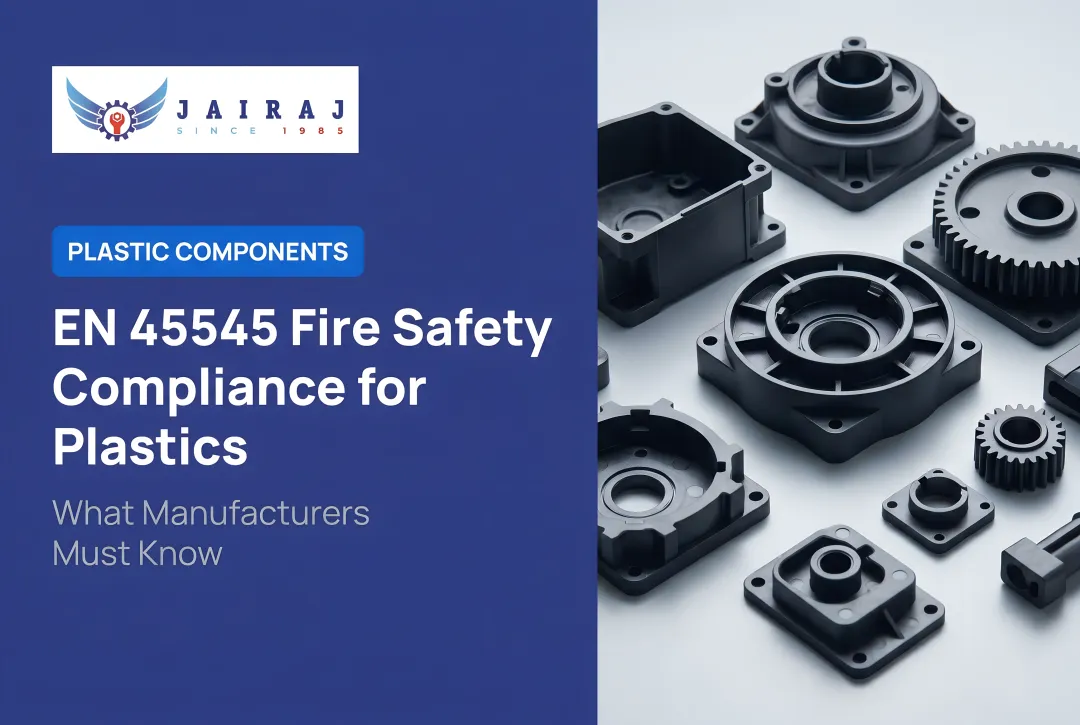
What Is EN 45545 and Why It Matters for Railway Plastic Components
EN 45545 is the European fire protection standard for railway vehicles. It replaced a patchwork of national standards — Germany's DIN 5510-2, France's NF F 16-101, and the UK's BS 6853 — becoming the sole applicable European rail fire safety regulation on 1 April 2016 under Directive (EU) 2016/797. For Indian rail procurement teams, this matters directly: DMRC and ICF programmes already reference EN 45545 as a compliance benchmark, making it a practical requirement, not just a European concern.
The standard is built around three fire safety objectives:
- Minimise ignition risk — reduce the likelihood of fire breaking out in the first place
- Limit flame spread — contain any fire that does start to prevent rapid escalation
- Control smoke and toxic gas emissions — ensure passengers can safely evacuate, particularly in tunnels or underground sections
Structure of the Standard
EN 45545 comprises 7 parts, each addressing a distinct aspect of fire safety:
| Part | Scope |
|---|---|
| Part 1 | General requirements |
| Part 2 | Fire behaviour of materials and components |
| Part 3 | Fire resistance requirements for fire barriers |
| Part 4 | Fire safety requirements for rolling stock design |
| Part 5 | Fire safety requirements for electrical equipment |
| Part 6 | Fire control and management systems |
| Part 7 | Flammable liquid and gas installations |
Part 2 (EN 45545-2:2020) is the critical reference for anyone selecting plastic materials or specifying plastic components. It defines the combustion performance requirements that materials must meet for each application and hazard level.
Why Plastics Need Special Attention
Unlike metals, polymers behave unpredictably under fire conditions. Depending on the base resin and additive system, a plastic part can have vastly different flammability, smoke density, and toxic gas output. Choosing the wrong grade — even within the same polymer family — can cause a component to fail compliance testing entirely and stall approvals.
That risk is amplified when Indian procurement specifications are involved. DMRC procurement documentation and ICF's Train 18 isolation transformer specification both explicitly reference EN 45545 compliance, confirming that Indian metro and rolling stock programmes treat this standard as a binding benchmark — not optional guidance.
Understanding EN 45545 Classification: Hazard Levels and R-Requirements
Hazard Levels (HL1, HL2, HL3)
Hazard levels are not assigned to vehicle types arbitrarily. They are derived from two inputs: operation category (OC) and design category, as defined in the ZVEI application guide for EN 45545.
| Operation Category | N (Standard) | A (Automatic) | D (Double-Deck) | S (Sleeping) |
|---|---|---|---|---|
| OC1 (surface) | HL1 | HL1 | HL1 | HL2 |
| OC2 (tunnels <5 km) | HL2 | HL2 | HL2 | HL2 |
| OC3 (tunnels >5 km) | HL2 | HL2 | HL2 | HL3 |
| OC4 (no side evacuation) | HL3 | HL3 | HL3 | HL3 |
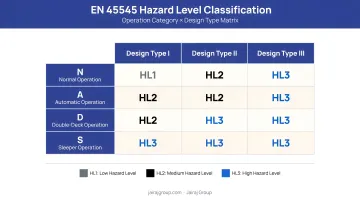
HL3 — the most stringent classification — applies to all OC4 vehicles and to OC3 sleeping/couchette trains. A metro system is not automatically HL3; the procuring authority or OEM must confirm whether the operational scenario falls into OC4 before that classification is applied.
This matters for material selection: HL3 requirements are significantly more demanding than HL1, and material grades that pass HL2 do not automatically qualify for HL3 use.
Once the hazard level is established, the next layer is the R-requirement — which defines what fire performance criteria apply to each specific component type and location.
R-Requirements (R1–R26): Application-Based Material Demands
EN 45545-2 Table 2 maps component types to R-requirements, specifying exactly which fire performance criteria apply to each application. Each material carries a specific Rx HLy classification — such as R22 HL3 — meaning it meets requirement set R22 at hazard level 3.
R-requirement mappings for common components include:
- R22 — Interior chokes, coils, reactors, transformer coils, spacers, air-guiding plates
- R23 — Exterior chokes and coils, including traction motor winding insulation
- R26 — Low-voltage circuit breakers, contactor relays, terminals, fuses
- R1/R17 — Interior and front trimmings (as cited in composite railway applications)
For components not listed in Table 2, EN 45545-2 Table 3 provides grouping rules for simpler products — including combustible mass thresholds such as 100 g for interiors and 400 g for exteriors, and proximity rules (20 mm horizontal, 200 mm vertical spacing).
Specifying engineers must identify the correct R-requirement for each component's location and function, then verify that the candidate material holds a valid classification report for that exact Rx HLy combination. Procurement documentation must cite the specific Rx HLy pairing — "EN 45545 compliant" alone does not meet the standard for procurement or approval purposes.
Key Fire Test Methods Under EN 45545-2
EN 45545-2 evaluates materials against several test parameters. The three primary methods:
- Smoke density — tested per EN ISO 5659-2, measuring the optical density of smoke to assess how severely a burning material would impair visibility during passenger evacuation
- Oxygen index — tested per EN ISO 4589-2, measuring the minimum oxygen concentration required to sustain combustion — higher values indicate better fire resistance
- Toxicity — tested under EN 45545-2 Annex C, covering toxic gas emissions that would affect evacuation safety
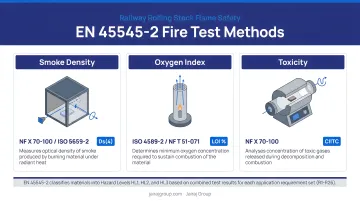
Heat release rate (ISO 5660-1) is also part of the EN 45545-2 test package for certain requirements.
Thickness Dependency
A material's EN 45545-2 classification is only valid for the wall thicknesses explicitly stated in the supplier's test report. A grade tested at 3 mm cannot be assumed to pass at 1.5 mm or 6 mm without separate testing documentation. For part design, this means wall thickness decisions must be locked in before approval, not revised afterward based on unverified assumptions.
UL 94 V-0 is frequently cited alongside EN 45545-2 in material datasheets, but the two are independent evaluations. Passing UL 94 V-0 does not satisfy EN 45545-2 requirements — the standards use different test methodologies, measure different fire behaviors, and carry separate acceptance criteria.
Note: If a supplier's datasheet only references UL 94 V-0, request EN 45545-2 test reports explicitly. The two certifications are not interchangeable.
Compliant Plastic Materials for Railway Applications
Commonly Used Polymer Families
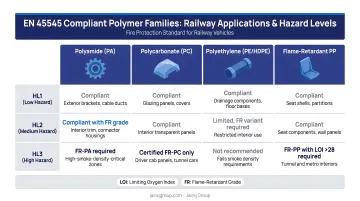
BASF has confirmed that its Ultramid (PA) and Ultradur (PBT) engineering plastics meet EN 45545 railway requirements. SABIC's LEXAN XHR6200 polycarbonate copolymer is cited for rail interior applications at the highest possible hazard level. Key polymer families used in EN 45545-compliant railway components include:
| Polymer | Typical Application | Notes |
|---|---|---|
| PA66 GF (glass-filled) | Electrical housings, connectors, structural brackets | Widely used; cost-effective HL2/HL3 classification achievable |
| PBT FR | Electrical component housings | Good dimensional stability under humidity |
| Polycarbonate (PC) | Interior panels, glazing, covers | Available in HL3-capable grades |
| PEI (Polyetherimide) | High-demand structural parts | High performance, higher cost |
| PPS | Electrical and under-hood components | Inherently good thermal stability |
| PEEK | Extreme-duty structural applications | Highest cost; used where HL3 + mechanical demands coincide |
The Role of Flame Retardant Systems
None of the polymer families above inherently meet EN 45545-2 thresholds — flame retardant (FR) additive systems are required in almost every rail application. The industry has shifted toward halogen-free alternatives: nitrogen/phosphorus intumescent systems and magnesium hydroxide are now preferred over traditional halogen-based retardants. This shift is driven by concerns about corrosive smoke gases in confined rail environments and tightening environmental regulations.
LANXESS has also confirmed halogen-free FR Tepex variants with a polyamide 6 matrix for rail-relevant structural applications.
Practical Considerations
- Colour variants of the same certified base compound typically skip re-testing — useful design freedom for OEMs managing interior aesthetics
- Glass fibre-reinforced PA66 and PBT dominate railway electrical and structural applications, balancing mechanical strength, humidity resistance, and HL2/HL3 ratings
- PEEK and PEI carry a significant cost premium; specify them only where HL3 classification and high structural loads must be met simultaneously
Common Railway Plastic Parts That Require EN 45545 Compliance
Interior Components (Highest Priority)
Interior components face the most stringent requirements because they are closest to passengers and directly affect evacuation safety:
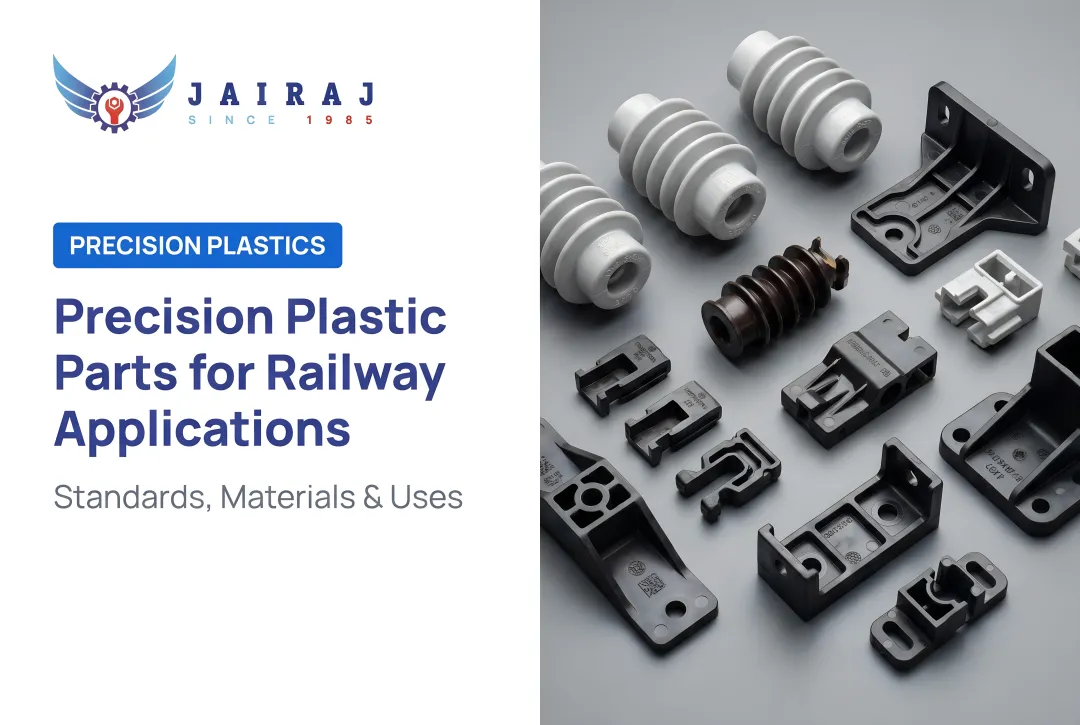
- Electrical/electronic housings — terminal blocks, connector bodies, wiring duct clips, circuit breaker housings, relay mounting brackets
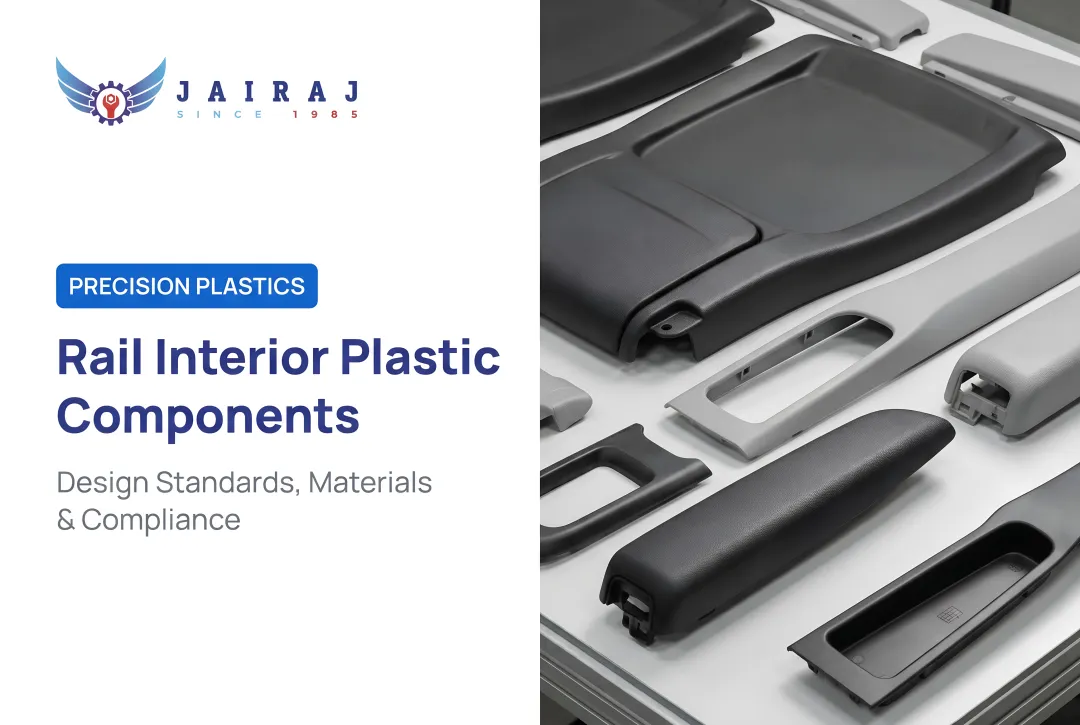
- Interior trim — seat shells, seat backs, armrests, partition clips, window trims, grab handles
- Metro-specific parts — interior panels, door components, lighting fixtures, air vent housings, flooring components
- Structural inserts and fasteners — precision brackets, guides, and retention clips
Exterior and Under-Floor Components
Interior parts carry the strictest compliance burden — but exterior and undercarriage components still fall within the EN 45545 framework. They typically qualify under less stringent R-requirements, such as R23 for exterior cable conduits versus R22 for interior equivalents. This distinction helps engineers prioritise material upgrades where safety exposure is highest in the bill of materials.
The Sourcing Oversight to Avoid
For custom-moulded parts — brackets, covers, clips, housings — it is the EN 45545-2 classification of the raw material compound that must be verified and documented, not just the final part geometry.
A well-designed part made from an uncertified or incorrectly specified compound will fail compliance review. Compound misclassification consistently ranks among the leading causes of approval delays in railway procurement programmes.
Sourcing EN 45545-Compliant Injection-Moulded Parts: What to Look for in a Manufacturing Partner
Documentation You Should Expect
A qualified supplier should provide, without exception:
- Material test reports citing the Rx HLy classification (e.g., R22 HL3) issued by an accredited laboratory
- Compound supplier datasheets confirming the tested wall thickness range
- Batch traceability records linking production material to the certified compound grade
- Evidence that no material substitutions occur between certified grade and production run
If a supplier cannot provide Rx HLy-formatted classification evidence for the specific compound used in your part, that is a red flag — regardless of what the product brochure claims.
Manufacturing Capability Requirements
Key capabilities that matter for EN 45545-compliant production:
- Processing expertise with halogen-free FR compounds, which often have narrower processing windows than standard grades
- In-house tool room capabilities for custom part geometries, enabling faster iteration when compliance-sensitive wall thicknesses need adjustment
- ISO 9001:2015 quality system with material traceability from incoming batch to finished part
- Dimensional and material properties testing to verify part conformance throughout production
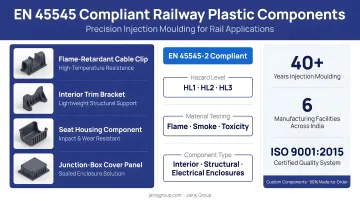
Jairaj Group (ISO 9001:2015 certified, operating since 1985 across six facilities in India) manufactures railway interior components — including seat shells, armrests, metro door components, window trims, and grab handles — using halogen-free FR compounds processed to EN 45545-2 requirements.
Their in-house tool room and R&D centres support design-for-manufacturability review when wall thickness adjustments affect compliance classification. For EN 45545-2 material certification enquiries, contact their technical team at japl@jairajgroup.com or +91-9711-114-300.
Frequently Asked Questions
Is EN 45545 mandatory for railway plastic components used in India?
EN 45545 is a European standard, but Indian metro and rolling stock projects are increasingly referencing it as a fire safety benchmark — DMRC procurement documents and ICF's Train 18 transformer specification both cite it explicitly. It is not yet universally mandated by Indian Railways, though OEM tender requirements and export-oriented rolling stock programmes frequently specify it.
What is the difference between HL1, HL2, and HL3 in EN 45545?
Hazard levels reflect fire risk severity based on operation category and evacuation feasibility. HL1 applies to surface-running vehicles where evacuation is straightforward; HL2 covers moderate-risk scenarios including shorter tunnels; HL3 is the most stringent classification, applying to vehicles in OC4 scenarios (no side evacuation possible) or OC3 sleeping trains.
Which plastic materials are most commonly used for EN 45545-compliant railway parts?
Glass fibre-reinforced PA66 with halogen-free FR additives is the most widely used choice for electrical components, offering a practical balance of cost, mechanical performance, and achievable HL2/HL3 classification. PBT FR, PC copolymers, PEI, PPS, and PEEK are used depending on structural and thermal requirements.
Can injection-moulded plastic parts meet EN 45545 requirements?
Injection-moulded parts fully meet EN 45545-2 requirements provided the correct certified compound grade is used, the part wall thickness falls within the tested range documented in the classification report, and processing controls are maintained to prevent material degradation during moulding.
What is the difference between EN 45545 and NFF 16-101?
NF F 16-101 is France's legacy national railway fire standard (1988); EN 45545 was designed to harmonise such national standards across Europe. Since the transition ended on 1 April 2016, EN 45545-2 is the primary requirement in France and most EU member states. Always verify the applicable standard with the procuring authority for your specific project, as AFNOR still lists NF F16-101 as current.
How long does EN 45545 material testing and certification take?
No accredited laboratory has published a standard turnaround time; the timeline depends on laboratory queue, test parameters required, and specimen preparation. For most procurement programmes, the practical approach is to work with compound suppliers who already hold valid EN 45545-2 classification reports, since commissioning new testing adds months and cost that is rarely justified for established polymer grades.