From PEEK replacing grey iron in automotive powertrains to thermoplastic composites taking over EV battery enclosures, materials science is moving fast. For OEMs, component suppliers, and design engineers, keeping pace with these developments isn't optional — it directly affects material selection decisions, supplier qualification, and competitive positioning in sectors like EVs, drones, and advanced industrial equipment.
This article covers four key trends reshaping specialty polymer innovation, the forces driving them, and what they mean for industrial manufacturing today.
Key Takeaways
- High-performance thermoplastics like PEEK and PPS are replacing metal across automotive, aerospace, and medical applications at measurable scale
- Fiber-reinforced composites are delivering 30–50% weight savings in structural components, with EV battery enclosures leading commercial adoption
- Sustainable and bio-based polymers are moving from R&D to production lines, driven by OEM sustainability mandates and global supply chain shifts
- Functional polymers — flame-retardant, thermally conductive, and LCP grades — are enabling thinner profiles, higher heat resistance, and lighter assemblies in EVs, electronics, and defense
Trend 1: High-Performance Engineering Thermoplastics Are Replacing Metal at Scale
The Performance Case
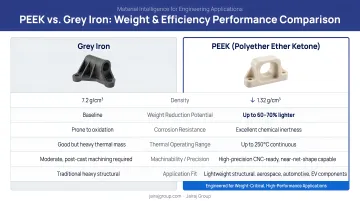
Engineering thermoplastics like PEEK, PPS (Polyphenylene Sulfide), Polysulfone (PSU), and PPSU have crossed a threshold. They now deliver mechanical strength, thermal stability above 200°C, and chemical resistance that matches or exceeds aluminium and steel across a growing range of applications.
The numbers are specific. Victrex reports that PEEK mass-balancer gears replacing grey iron components achieved up to 69% weight reduction, 78% lower rotational inertia, a 3 dB NVH improvement, and 9% lower operating torque — all in a single material switch. Victrex PEEK operates continuously at up to 260°C. Celanese's Fortron PPS handles continuous service up to 240°C.
Where Metal Replacement Is Happening
Adoption spans multiple sectors:
- Automotive: Fuel system components, transmission housings, sensor housings, and under-hood structural brackets where weight reduction directly impacts fuel efficiency
- Aerospace: Lightweight fluid handling components and avionics enclosures — corrosion resistance eliminates maintenance cycles that metal parts require
- Medical devices: Surgical instrument bodies and implantable device casings requiring biocompatibility, sterilization resistance, and dimensional precision
- Heavy equipment: Pump housings, bearing cages, and wear components in earth-moving machinery where chemical exposure rules out uncoated metals
Why Precision Injection Molding Enables This Shift
The manufacturing process makes the transition practical at production scale. Precision injection molding replicates complex geometries with tight tolerances in a single step, delivering multiple structural benefits at once:
- Consolidates multiple metal parts into one molded component
- Eliminates downstream fasteners, machining, and welding steps
- Reduces assembly labor and bill-of-materials complexity
- Maintains consistent tolerances across high-volume production runs
For OEMs converting existing metal assemblies, the tooling and process knowledge matters as much as the material choice. Manufacturers with in-house tool room capabilities and direct experience processing high-performance resins — like Jairaj Group, which works with PEEK, PA66-GF, PC, and PEI across automotive, aerospace, and medical programs — can compress development cycles by handling design, tooling, and production under one roof.
Market Momentum
The commercial pull is real. High-performance plastic compounds are forecast to grow from USD 9.59 billion in 2025 to USD 14.01 billion by 2030 at a 7.9% CAGR, covering PEEK, PPS, PEI, and PSU/PPSU/PESU grades. As processing volumes scale, the economics of metal replacement become cost-effective across more application types — not just aerospace and premium automotive, but broader industrial machinery, heavy equipment, and railways.
Trend 2: Fiber-Reinforced Polymer Composites Are Driving Lightweighting Across Industries
What Makes FRPs Different
Fiber-reinforced polymers embed high-strength fibers — carbon, glass, aramid, or basalt — into a polymer matrix to engineer components with exceptional strength-to-weight ratios. The result isn't just lighter parts. In specific loading conditions, FRP components outperform metals that are significantly heavier.
Component-level data from ACMA/IHS shows what this looks like in practice:
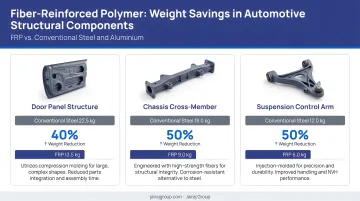
- A glass-fiber reinforced plastic front-seat backrest saves up to 30% versus standard metal options
- A hybrid cross-car beam using metals, composites, and glass fibers weighs 3.6 kg — up to 43% less than a full-metal beam exceeding 6 kg
- A GRP/GFRP MacPherson-integrated strut reduces weight by almost 50% versus conventional steel struts
EV Applications Are Leading Commercial Adoption
Those weight savings matter most where every kilogram directly affects range — which is why battery enclosures have become the fastest-moving commercial deployment zone for FRP composites. Kautex Textron is already in series production of thermoplastic composite battery enclosure parts for two EV models. SGL Carbon's glass-fiber reinforced plastic battery cases are replacing aluminum boxes in EV platforms.
The EV composites market reflects this momentum: valued at USD 2.3 billion in 2024 and forecast to reach USD 5.1 billion by 2029 at a 17.1% CAGR.
The Thermoplastic Composite Shift
Traditional fiber-reinforced composites used thermoset resins — strong, but difficult to recycle and slow to process. The shift toward thermoplastic matrices addresses both of those constraints directly:
- Thermoplastic composites are recyclable at end of life
- Faster processing cycles reduce manufacturing cost
- Short-fiber and long-fiber injection-moldable grades make FRP components accessible through standard molding equipment — no complex layup required
Jairaj Group processes both PA66-GF for automotive precision components and CFRP for aerospace applications, including UAV and drone structural parts, using injection molding rather than manual fabrication.
That processing flexibility also positions manufacturers to meet tightening regulatory targets. NHTSA's final CAFE rule increases passenger car fuel economy standards 2% per year for model years 2027–2031. Lightweighting through FRP composites is one of the few engineering levers that directly addresses these mandates without compromising structural performance.
Trend 3: Sustainable and Bio-Based Specialty Polymers Are Moving from Lab to Production
OEM sustainability mandates used to be aspirational language in annual reports. Now they have supplier deadlines attached.
Mercedes-Benz has set a goal to source only net carbon-neutral production materials by 2039. As of 2023, 84% of Mercedes-Benz Cars and Vans suppliers by annual purchasing volume had signed the Ambition Letter committing to supply net carbon-neutral products by that year. The EU's proposed vehicle circularity regulation adds a hard target: 25% recycled plastic content in new vehicles by 2030, with 25% of that sourced from closed-loop end-of-life vehicle treatment.
What's Commercially Available
Bio-based alternatives are scaling faster than most engineers expect:
- Bio-based epoxy resins: The market reached USD 938.96 million in 2024, projected to exceed USD 1.99 billion by 2035. Automotive is the largest application segment; aerospace is growing fastest
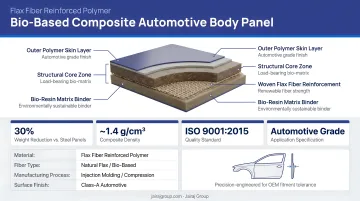
- Flax-fiber composites: Bcomp's flax-based bodywork has been used in Porsche Motorsport and BMW M4 GT4 applications, reporting up to 85% CO₂ reduction in initial energy expenditure versus comparable carbon-fiber parts
- Grafted polyolefins with recycled content: Maleic anhydride-grafted polymers enable recycled PET and polypropylene to meet functional performance thresholds in packaging and automotive interior applications
The Compliance Signal for Suppliers
The EU's Corporate Sustainability Reporting Directive (CSRD) required large companies to apply reporting rules for the 2024 financial year, with reports published in 2025. Automotive suppliers selling into European OEM supply chains now face direct pressure to document and reduce product carbon footprints — not just at the company level, but at the component level through frameworks like Catena-X's PCF Rulebook.
For Indian manufacturers like Jairaj Group — which produces precision injection-molded components across automotive, aerospace, and industrial verticals — this is a concrete commercial opening. OEMs building global supply chains now require suppliers who can document material origins, carbon footprints, and environmental compliance at the component level, not just the company level.
Trend 4: Smart and Functional Polymers Are Expanding Industrial Design Possibilities
Beyond Mechanical Performance
The next generation of specialty polymers isn't just stronger or lighter — it's functional. Materials now deliver electrical, thermal, and protective performance alongside structural properties, opening design space that metal and standard plastics can't occupy.
Key functional polymer categories in industrial use:
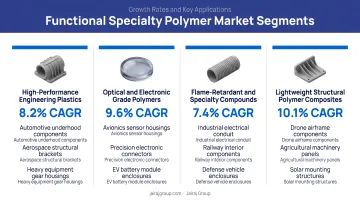
- Thermally conductive plastics: Valued at USD 156.10 million in 2023, growing at 12.6% CAGR through 2030 — essential for EV battery thermal management where pack temperatures must be precisely controlled
- Conductive and ESD-safe polymers: Market reached USD 5.08 billion in 2023, projected at USD 9.03 billion by 2030 (8.6% CAGR), driven by electronics miniaturization and EV control systems
- Flame-retardant wire and cable compounds: Growing from USD 15.26 billion (2025) to USD 22.22 billion by 2030 at 7.8% CAGR — tied directly to EV high-voltage wiring and railway electrification demand
- Liquid crystal polymers (LCPs): Specified for 5G antenna substrates, precision sensors, and electric motor insulation where low dielectric loss and thin-wall moldability are non-negotiable
Industrial Applications in Practice
Jairaj Group processes flame-retardant polymer grades — including PA66-GF, PC, ABS, and PBT — for relay mounting brackets and electrical components, each carrying certified electrical insulation and flame-retardant ratings.
For defense applications, the company manufactures sensor housings and precision enclosures using PEEK and impact-resistant polycarbonate, materials chosen for chemical resistance and dimensional stability in harsh environments.
BASF data shows thermoplastic casings can reduce component mass by up to 30% versus metal equivalents, with one application achieving 51% weight reduction using 35% glass-fiber reinforced Ultramid. When the performance requirement combines weight reduction with flame protection in an EV battery pack, functional specialty polymers are often the only viable answer.
What's Driving These Specialty Polymer Innovations
Three distinct pressures — electrification, supply chain restructuring, and faster development tools — are pushing specialty polymer demand higher across every industrial sector.
Electrification at Scale
Global electric car sales exceeded 17 million in 2024, up more than 25% year-on-year, with EVs representing over 20% of new car sales globally. Each EV platform creates demand for lightweight structural components, thermally stable battery enclosures, high-voltage wiring compounds, and ESD-safe control housings — all specialty polymer applications.
Supply Chain Localization
The US Inflation Reduction Act requires battery components in qualifying clean vehicles to be sourced domestically at 50% in 2023, rising to 100% by 2029. That policy alone has triggered over USD 45 billion in US private clean vehicle and battery supply-chain investment since enactment. Regional polymer component manufacturers with the right processing capabilities are positioned to capture share as global OEMs restructure sourcing.
Technology Enablers
Two capabilities are closing the gap between design and production:
Simulation-based material modeling has matured into a standard pre-production tool. BASF's Ultrasim CAE service — now 25+ years in operation — enables crash analysis, process simulation, and mechanical performance prediction before any tooling is cut. Jairaj Group's R&D centers apply the same logic, using flow analysis, cooling optimization, and warpage prediction as part of every process development workflow.
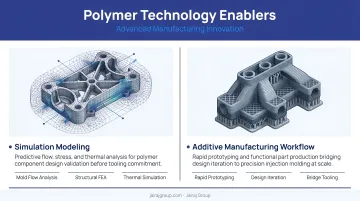
Additive manufacturing with PAEK materials is opening new doors in aerospace and high-volume production. Victrex made LMPAEK granules and powders commercially available in 2024. Because LMPAEK melts 40°C lower than standard PEEK, it enables AM processing at speeds above 100 mm/s — a meaningful jump for scalable manufacturing.
How These Innovations Are Reshaping Industrial Manufacturing
The operational change is already underway. Engineers now specify materials based on multi-functional criteria — mechanical plus thermal plus chemical plus electrical — rather than structural properties alone. That shift demands more from suppliers, and it's reshaping which manufacturers get specified for high-value programs.
Manufacturers who can process advanced specialty polymers across precision injection molding, blow molding, and rotational molding are gaining access to higher-value application segments. Jairaj Group's expansion into EV components, railway interiors, and drone structural parts, backed by six manufacturing facilities, in-house tooling, and ISO 9001:2015 certification, reflects this positioning directly.
Their 2025 entry into drone, railway, and electrical sectors draws directly on polymer processing capability built over four decades — making it a natural extension rather than a pivot.
That foundation matters because the next wave of applications will demand even tighter integration between material selection and process capability. Three developments are worth watching over the next 1–3 years:
- Thermoplastic composite injection molding at scale — Kautex Textron's battery enclosure production is a leading indicator; expect more OEMs to specify injection-moldable TPC for structural applications
- Polymer-based battery components for next-generation EVs — solid-state battery casings, thermal interface components, and structural pack elements will drive new specialty polymer qualifications
- Digitally integrated material selection — platforms connecting CAE simulation with manufacturing process planning will shorten the qualification cycle for specialty polymers from months to weeks
The qualification windows for these applications are opening now. Suppliers without established process capability and material expertise will find themselves outside those conversations before full-scale production begins.
Frequently Asked Questions
What are the different types of specialty polymers?
The main categories include high-performance thermoplastics (PEEK, PPS, Polysulfones), fiber-reinforced polymers (CFRP, GFRP), biodegradable and bio-based polymers, conductive and functional polymers, and liquid crystal polymers. Each category is engineered for specific performance requirements — thermal, mechanical, or chemical — that standard commodity plastics cannot deliver.
What are the industrial uses of polymers?
Specialty polymers are used across automotive, aerospace, medical devices, electronics, industrial machinery, and packaging. Fast-growing sectors — EV battery enclosures, drone airframes, and railway interiors — are now driving a second wave of adoption.
What makes specialty polymers different from standard commodity polymers?
Specialty polymers are engineered to deliver specific property combinations — heat resistance above 200°C, chemical inertness, and high mechanical strength — that commodity plastics cannot achieve. In demanding environments where standard materials would degrade or fail, specialty polymers hold up.
Which industries are driving the highest demand for specialty polymer innovations?
Automotive lightweighting, EV components, aerospace structural composites, medical devices, and electronics lead demand. Drone manufacturing and railway systems are gaining ground quickly as secondary growth sectors.
How are specialty polymers contributing to metal replacement in industrial applications?
Specialty polymers like PEEK, PPS, and fiber-reinforced composites match or exceed metals in strength-to-weight ratio, corrosion resistance, and thermal stability. Precision injection molding produces complex geometries in a single step — cutting out machining, welding, and secondary finishing while reducing overall component weight.