Introduction
Across automotive, aerospace, medical, and industrial sectors, specialty polymers are replacing metals, commodity plastics, and traditional composites — not incrementally, but at scale. Specialty polymers — engineered materials designed for specific mechanical, thermal, chemical, or functional performance requirements — are displacing metals, commodity plastics, and traditional composites across automotive, aerospace, medical, and industrial sectors.
The scale of this shift is significant. According to Grand View Research, the global specialty polymers market stood at USD 185.10 billion in 2024, projected to reach USD 362.31 billion by 2033 at a 7.8% CAGR. Asia-Pacific holds 42% of that revenue base, with India alone growing from USD 14.27 billion to a projected USD 30.07 billion (approximately ₹2.5 lakh crore) by 2033.
For Indian manufacturers, that growth trajectory carries direct consequences: OEMs are specifying materials that standard plastics cannot meet, regulatory requirements are tightening, and the gap between commodity and specialty polymer capability is becoming a supplier qualification differentiator.
This article covers five trends actively reshaping how parts are designed and made — and what manufacturers need to understand to stay ahead.
Key Takeaways
- The specialty polymer market is growing at 7.8% CAGR, reaching USD 362B by 2033 across automotive, aerospace, medical, and industrial sectors
- Five trends are reshaping manufacturing: high-performance thermoplastics, lightweighting composites, sustainable bio-based polymers, smart/functional materials, and AI-assisted design
- India's EPR framework, CAFE norms, and tightening global chemical standards are pushing manufacturers toward performance-optimized, sustainable polymer grades
- Manufacturers who can process and qualify specialty polymer grades quickly will be first to serve OEMs adopting next-generation material specifications
- Early adoption of specialty polymer capability is a baseline supplier qualification criterion, not just a competitive advantage
Trend 1: High-Performance Thermoplastics Replacing Traditional Materials
High-performance thermoplastics — PEEK, PPS, PEI, and polyimides — are no longer niche materials reserved for extreme applications. They are becoming standard specifications wherever thermal stability, chemical resistance, and mechanical strength matter.
What Makes These Materials Different
The temperature thresholds alone explain the adoption curve:
| Material | Continuous Use Temperature | Key Properties |
|---|---|---|
| PEEK | 260°C | Chemical resistance, biocompatibility, radiolucency |
| PPS (Ryton) | 200°C+ (short-term to 260°C) | Fluid resistance, dimensional stability |
| PEI (ULTEM) | Tg 217°C | Flame retardance, electrical insulation |
| Polyimide (Kapton) | -269°C to 400°C | Electrical insulation, thermal management |
Where Adoption Is Happening
Real-world use cases validate the trend:
- Medical: Invibio reports approximately 15 million PEEK-OPTIMA devices implanted globally, with a 20-year clinical history. PEEK's radiolucency made it the preferred alternative to metal in spinal implant design
- Aerospace: Victrex identifies PEEK composites in structural brackets, where strength-to-weight ratio and temperature stability are non-negotiable
- Automotive: Syensqo's Ryton PPS is specified for air-intake housings and water pumps — components that face road salts, aggressive fluids, and sustained heat
- EV/Electronics: DuPont's Kapton polyimide film handles fast-rising temperatures up to 400°C, making it integral to EV battery thermal and electrical protection
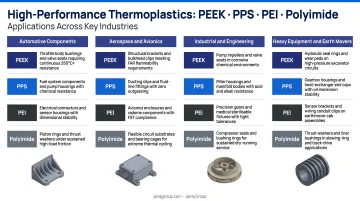
The high-temperature thermoplastics segment is projected to grow from USD 28.27 billion in 2026 to USD 41.47 billion by 2031 at 7.98% CAGR, according to Mordor Intelligence.
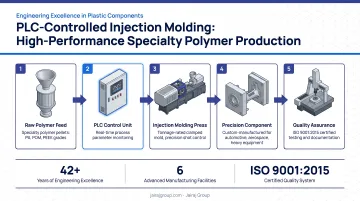
For manufacturers like Jairaj Group — which processes PEEK, PEI, PA66-GF, and reinforced composites for automotive, aerospace, and medical customers — these materials are already in production. PLC-controlled injection molding lines and in-house toolroom capabilities allow precise control over the melt temperatures, pressures, and cooling profiles these polymers demand.
Trend 2: Lightweighting with Reinforced Polymer Composites
Every gram removed from a vehicle, aircraft, or drone has measurable downstream value. The U.S. Department of Energy has established that a 10% reduction in vehicle weight improves fuel economy by 6–8%, and replacing steel and cast iron with lightweight materials can cut body and chassis weight by up to 50%.
Reinforced polymer composites — glass-fiber reinforced plastics (GFRP), carbon-fiber reinforced plastics (CFRP), and nano-filled polymer matrices — deliver the strength-to-weight ratios that make this possible across high-volume production.
Why the Market Is Accelerating
- The automotive lightweight materials market is projected at USD 101.5 billion globally by 2027 (6.5% CAGR, MarketsandMarkets)
- CFRP alone is growing from USD 19.27 billion in 2024 to USD 43.66 billion by 2033 at 9.2% CAGR
- The EU's 100% emission reduction target for new cars and vans from 2035 creates a hard regulatory deadline that makes lightweighting non-optional for automotive OEMs
- U.S. EPA emissions standards phasing in from model year 2027 through 2032 add North American pressure to the same trend
- U.S. EPA emissions standards phasing in from model year 2027 through 2032 add North American pressure to the same trend
- India's CAFE Phase 2 norms, fully in effect from 2022, push domestic OEMs toward the same lightweighting imperative — making this a local priority, not just a global one
The Drone Signal
Market data tells one story. A specific engineering outcome tells another. Solvay's thermoplastic carbon fiber composites helped Flybotix's ASIO inspection drone double flight time compared to traditional solutions. When flight endurance is the primary performance metric, material weight is the engineering variable that matters most.
For component manufacturers, the real challenge is translating composite material properties into repeatable, functional parts in production volumes. Precision injection molding and multi-cavity tooling are the processes that determine whether laboratory performance becomes consistent shop-floor output.
Jairaj Group applies this directly in drone manufacturing — producing drone arms using carbon fiber reinforced construction for maximum strength at ultra-low weight, with PA66 motor mounts selected specifically for vibration damping. These material choices map to the performance specifications drone OEMs actually put in their briefs.
Trend 3: Sustainable & Bio-Based Polymers Entering Industrial Supply Chains
Regulatory pressure is changing which materials manufacturers can specify — and tightening the window on those they've historically defaulted to.
The global bioplastics market is projected to grow from USD 18.41 billion in 2025 to USD 67.42 billion by 2033 at 17.6% CAGR, driven by a combination of consumer pressure, OEM sustainability commitments, and government mandates. Global bioplastics production capacity is set to more than double — from 2.47 million tonnes in 2024 to approximately 5.73 million tonnes — according to European Bioplastics' 2024 data.
What's Driving the Industrial Shift
Bio-based and recyclable polymers are moving from sustainability footnotes to active procurement criteria. Several converging pressures are behind that shift:
- India's CPCB Extended Producer Responsibility (EPR) framework requires producers, importers, and brand owners to register and demonstrate plastic waste management — with EU single-use plastic and chemical restrictions adding further pressure on global supply chains
- Automotive and consumer goods OEMs with public sustainability commitments are flowing those targets downstream through procurement requirements to Tier 1 and Tier 2 suppliers
- Manufacturers who can offer bio-based or recycled-content alternatives gain a measurable edge in supplier qualification, where sustainability criteria now sit alongside price and quality
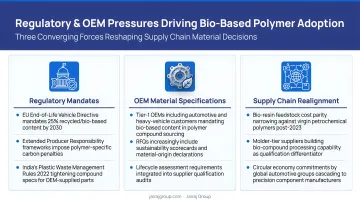
For non-critical housings, packaging, and components where mechanical demands allow, industrial manufacturers are beginning to qualify bio-based grades including PLA, PHA, and bio-PE.
Chemical recycling pathways — pyrolysis and depolymerisation — are opening routes to reclaim engineering-quality material from complex polymer waste streams. Industrial-scale capacity for engineering-grade polymers is still maturing, but the direction is clear.
Trend 4: Smart & Functional Polymers Enabling Intelligent Components
Smart polymers respond to environmental stimuli — temperature, pH, light, moisture — by changing their properties. Self-healing materials close micro-cracks autonomously. Shape-memory polymers return to a predefined geometry when triggered. Thermally responsive materials stiffen or soften under defined conditions.
Commercial adoption is already underway. The smart polymers market is estimated at USD 12.84 billion (2023), growing to USD 17.76 billion by 2030 at a 4.5% CAGR (Grand View Research) — with some analyst definitions placing the opportunity considerably higher.
Where Commercial Adoption Is Emerging
- Medical devices: Self-resorbing implants and responsive drug delivery systems are among the most advanced commercial applications, reducing the need for secondary surgical procedures
- Aerospace: Shape-memory polymers are being evaluated for deployable structures — components that can be compactly stored and then triggered to deploy under thermal or mechanical stimulus
- Industrial coatings and surfaces: Self-healing coatings that autonomously repair micro-damage extend component service life and reduce maintenance intervals
Longer-lasting components that require fewer maintenance interventions directly reduce total operating cost for the end user. In medical devices and electronics — where size constraints are tightening — responsive polymer behaviour addresses engineering requirements that passive materials simply cannot meet.
For component manufacturers, smart polymer adoption creates new processing and qualification challenges. Materials that change properties under stimulus require different validation protocols than static-property polymers. Qualifying these materials for OEM programs demands comprehensive in-house testing infrastructure and documented quality systems — capabilities that separate suppliers who can work with next-generation materials from those who cannot.
Trend 5: AI-Driven Material Simulation Accelerating Polymer Innovation
AI and machine learning are compressing the polymer development cycle in two distinct ways.
On the materials side, AI tools can:
- Screen polymer candidates rapidly against mechanical and chemical performance targets
- Predict material behaviour under real-world conditions before physical prototyping
- Optimise formulations iteratively, cutting trial-and-error cycles significantly
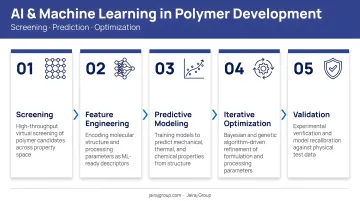
A peer-reviewed review published in PMC documents active progress in AI applications for polymer research, covering property prediction and formulation optimisation.
On the process side, simulation platforms optimise injection molding parameters — temperature profiles, pressure curves, cooling sequences, gate locations — reducing defect rates and improving part consistency across high-volume runs. This matters most for specialty polymers, where processing windows are narrower than commodity plastics and out-of-spec conditions are harder to recover from.
Jairaj Group's Research, Development & Value Engineering Centres already run process simulations — flow analysis, cooling optimisation, and warpage prediction — before tooling is committed. As AI-designed polymer formulations enter commercial supply chains faster than ever, pre-production simulation capability directly determines how quickly a new material can be qualified and scaled.
Manufacturers who can process, validate, and document new polymer grades for OEM approval without extended development cycles will be first to serve OEMs specifying next-generation formulations.
What's Driving These Specialty Polymer Trends
Four distinct forces are pushing manufacturers toward specialty polymers — and they're reinforcing each other.
Regulatory pressure is the clearest driver. The EU's 100% emission reduction mandate for new cars and vans from 2035, U.S. EPA standards phasing in from model year 2027, India's EPR plastic waste framework, and evolving chemical regulations collectively force manufacturers and their supply chains to transition toward polymers that meet stricter thermal, chemical, and end-of-life requirements.
OEM specification upgrades are raising the bar across industries. Automotive EV platforms, aerospace structures, medical devices, and drone systems all require parts commodity plastics cannot reliably deliver:
- Higher thermal ceilings and tighter dimensional tolerances
- Lower mass without sacrificing structural integrity
- Longer service life under sustained mechanical and chemical stress
Cost and efficiency logic supports adoption despite higher raw material costs. Specialty polymers extend component lifespan, reduce assembly complexity through part consolidation, and minimise maintenance-driven downtime — delivering long-term ROI that industrial buyers can model against total system cost, even when per-kilogram material costs are higher.
Technology enablers are lowering processing barriers. PLC-controlled injection moulding equipment, advanced toolroom capabilities, and AI-assisted simulation are making specialty polymer processing more accessible, consistent, and repeatable than even a decade ago.
How These Trends Are Impacting the Manufacturing Industry
Operational Impact
Material qualification cycles are becoming more rigorous. Processing high-performance thermoplastics requires tighter control over temperature profiles, residence time, and cooling sequences than commodity plastics — equipment and process parameters that were calibrated for PP or ABS need adjustment for PEEK or PPS.
Manufacturers with in-house testing capabilities, PLC-controlled machinery, and multi-material processing flexibility are better positioned to absorb new polymer grades without production disruptions. Jairaj Group's infrastructure — spanning injection molding, blow molding, rotational molding, and multi-cavity tooling across multiple facilities — provides the process breadth that specialty polymer adoption requires.
Business Impact
Specialty polymer capability is becoming a supplier differentiation factor. Automotive Tier 1s are qualifying suppliers not just on price but on material expertise, process consistency, and the ability to co-develop components for new platforms — EV, drone, railway, and advanced industrial.
Jairaj Group's experience spans automotive OEMs — Endurance Technologies, Gabriel India Limited, Tenneco Automotive — alongside active work in aerospace, drone, railway, and solar sectors. That cross-industry reach is exactly what OEM co-development programs now demand from suppliers.
For OEM customers, two services reduce early-stage risk:
- Material selection advisory — evaluating specialty polymer options before tooling commitments
- DFM (Design for Manufacturability) review — validating component designs against process and material constraints upfront
Workforce Impact
Polymer material knowledge is becoming a core competency on the shop floor and in engineering teams. The gap between knowing a material's datasheet properties and knowing how to process it consistently is where manufacturing quality is won or lost. Suppliers who bridge that gap internally — through cross-functional teams of material scientists, process engineers, and quality leads — are the ones OEMs increasingly prefer for new platform development.
Future Signals for Specialty Polymers in Manufacturing
The specialty polymer landscape will continue evolving rapidly. Manufacturers should monitor several signals over the next one to three years.
Early indicators to watch:
- Accelerating regulatory action on plastic waste in India and other Asian manufacturing hubs
- Growing OEM tender specifications that mandate bio-content or recyclability claims in supplier documentation
- EV and drone manufacturer requirements for polymer components that simultaneously meet structural and thermal management criteria
Technologies and developments to track:
- Commercial scale-up of chemical recycling (pyrolysis and depolymerisation) for engineering-grade polymers — this would meaningfully change the recyclability equation for high-performance materials
- Mainstream adoption of AI-designed polymer formulations entering industrial supply chains at commercial volumes
- Emergence of multifunctional polymers — conductive plus structural, or self-healing plus lightweight — that consolidate component functions and reduce part counts
Scenarios for 2026–2028:
India's specialty polymer market is projected to nearly double from USD 14.27 billion (2024) to USD 30.07 billion by 2033, according to industry market projections. High-temperature thermoplastics alone are on track to reach USD 41.47 billion by 2031.
Manufacturers who have already built specialty polymer processing capability, rigorous quality systems, and multi-sector application knowledge are best placed to meet rising procurement demand — as automotive electrification, drone commercialisation, and railway modernisation programmes ramp up at scale.
Conclusion
Specialty polymer trends — from high-performance thermoplastics and lightweight composites to sustainable materials and AI-assisted design — are changing what manufacturers can build, what OEMs will accept, and what end-users will demand.
The manufacturers capturing advantage are investing in material expertise, precision processing infrastructure, and quality systems that can validate new polymer grades without disrupting production timelines. The manufacturers being left behind are the ones waiting for customer pressure to arrive before building those capabilities.
In specialty polymers, early material adoption has become a baseline qualification criterion for serving automotive, aerospace, EV, and advanced industrial markets. OEM specifications in these sectors are already reflecting that shift — manufacturers who build polymer expertise ahead of mandates hold a tangible position advantage over those who respond after the fact. For a company like Jairaj Group, with four decades of polymer engineering across six facilities and direct supply relationships with OEMs like Endurance Technologies, Gabriel India, and Tenneco Automotive, that foundation is already in place. The question for the broader industry is whether others will build it in time.
Frequently Asked Questions
What are specialty polymers and materials?
Specialty polymers are engineered materials designed for specific performance requirements — including high thermal resistance, chemical inertness, or mechanical strength — that standard commodity plastics cannot reliably meet. They are widely used in automotive, aerospace, medical, and industrial manufacturing where performance margins are tight and material failure carries real consequences.
How big is the specialty polymer market?
The global specialty polymers market was valued at USD 185.10 billion in 2024 and is projected to reach USD 362.31 billion by 2033 at a 7.8% CAGR, according to Grand View Research. Asia-Pacific leads with a 42% revenue share, and India's portion is projected to grow from USD 14.27 billion to USD 30.07 billion over the same period.
What are the 4 types of polymers?
The four main polymer classifications are thermoplastics, thermosets, elastomers, and specialty/engineering polymers. Specialty polymers are engineered for exceptional performance in heat resistance, chemical inertness, or mechanical strength, and are at the center of most material innovation in advanced manufacturing.
How are specialty polymers used in automotive manufacturing?
Common applications include:
- Under-hood components using PPS and PEEK for thermal and chemical resistance
- EV battery thermal management using polyimide films
- Structural lightweighting with glass-filled nylons and CFRP
- Sensor housings requiring dimensional stability across temperature extremes
Together, these help automotive OEMs meet fuel efficiency, safety, and emissions targets.
What is driving innovation in specialty polymers?
Three converging pressures are reshaping the field. Vehicle electrification is creating new thermal and structural material requirements. Tightening environmental regulations are pushing bio-based and recyclable alternatives up the supply chain. And AI-accelerated R&D is compressing development timelines for tailored polymer formulations across industrial applications.
What are high-performance polymers and why do they matter for manufacturers?
High-performance polymers like PEEK, polyimides, and PPS offer mechanical, thermal, and chemical properties that commodity plastics cannot match. For manufacturers supplying OEM customers in automotive, aerospace, or medical sectors, the ability to process these materials precisely — with the right tooling, controlled parameters, and validated quality systems — is increasingly what separates capable suppliers from the rest.