According to Grand View Research, the high-performance plastics market reached USD 26,750 million in 2024, growing at a 9.32% CAGR through 2030 — driven by electrification, lightweighting demands, and the push into harsher operating environments. The materials enabling this growth are a small, specialised family: PEEK, PPS, PEI, and PTFE being the most widely deployed.
This article explains what HPPs are, the properties that define them, the four most important types, where they are used, and how to select the right one.
Key Takeaways
- HPPs maintain structural integrity under extreme heat, chemical exposure, and mechanical stress — conditions that destroy commodity and engineering plastics
- They sit above nylon and polycarbonate in the polymer hierarchy, commanding cost premiums justified by performance and longevity
- PEEK, PPS, PEI, and PTFE each address distinct performance profiles — no single material wins across all criteria
- Selection starts with defining operating conditions precisely, not defaulting to the most advanced option available
- Processing compatibility and total cost of ownership matter as much as the raw material spec
What Are High-Performance Polymers?
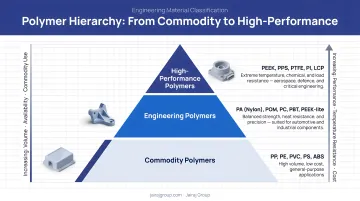
High-performance polymers are a class of thermoplastic materials engineered to sustain demanding performance thresholds that standard and engineering-grade plastics cannot maintain. Polymer materials fall into three broad tiers:
- Base — Commodity polymers (PE, PP, PVC): Low cost, widely used, limited thermal and mechanical capability
- Middle — Engineering polymers (nylon, polycarbonate, acetal): Better performance, used in structural and precision applications
- Top — High-performance polymers (PEEK, PPS, PEI, PTFE): Extreme thermal, chemical, and mechanical capability
Goodfellow's polymer pyramid framework places HPPs squarely at this top tier, intended for environments involving high temperatures, aggressive chemicals, and significant mechanical stress.
What Separates HPPs from Engineering Plastics
The qualifying benchmarks matter. According to SpecialChem, high-temperature thermoplastics — the technical classification most HPPs fall under — must demonstrate:
- Continuous operating temperatures above 150°C
- Heat deflection temperature (HDT) above 200°C at 1.8 MPa
These thresholds have direct consequences in the field. Nylon absorbs moisture and loses stiffness at elevated temperatures. Polycarbonate creeps under sustained load. HPPs are engineered precisely to avoid these failure modes, which is why they appear in seals, bearings, implants, and connectors where component failure is not acceptable.
That level of reliability comes at a cost. Producing HPPs requires specialised monomers, exacting synthesis conditions, and tightly controlled processing — manufacturing demands that don't exist for commodity or engineering plastics. This is why HPPs command prices approximately 10 times higher than general-purpose plastics, according to SpecialChem.
Key Properties That Set High-Performance Polymers Apart
Not all HPPs perform equally across every property. Understanding the five defining property categories — and where each material fits — is essential for selection.
The Five Core Properties
| Property | What It Means | Why It Matters |
|---|---|---|
| Thermal stability | Sustained performance at high continuous-use temperatures without deformation | Under-hood automotive, aerospace, and industrial heat exposure |
| Chemical resistance | Inertness to acids, solvents, fuels, and aggressive fluids | Fuel systems, chemical processing, laboratory equipment |
| Mechanical strength | High tensile strength, fatigue resistance, impact toughness | Structural components, load-bearing parts |
| Dimensional stability | Retention of tight tolerances under heat, moisture, and load | Precision connectors, seals, and mating components |
| Low friction / wear resistance | Reduced surface friction and wear rate | Gears, bearings, bushings in moving assemblies |
Where the Trade-offs Are
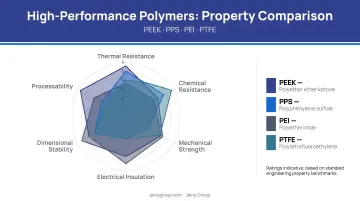
No single HPP excels across all five. Each material has a distinct weak point:
- PTFE is nearly chemically inert with the lowest friction of any polymer, but creeps under sustained compressive load — a real risk in seal applications
- PEEK covers the broadest temperature range and offers exceptional mechanical strength, but costs significantly more than PPS and requires specialised processing equipment
- PEI provides excellent electrical insulation and dimensional predictability during moulding, but has lower chemical resistance than PEEK or PPS
Matching the property profile to the application matters more than defaulting to the most advanced option available.
Types of High-Performance Polymers
HPPs are not a single material. They are a family of distinct polymers, each with a unique combination of properties and optimal use environments. Here are the four most widely used.
PEEK (Polyetheretherketone)
PEEK is the reference-point high-performance polymer, the material other HPPs are routinely measured against. Its repeating ether-ether-ketone molecular structure delivers both rigidity and broad-temperature property retention.
Key performance data (Victrex PEEK 450G):
- Electrical RTI: 260°C
- Mechanical RTI (without impact): 240°C
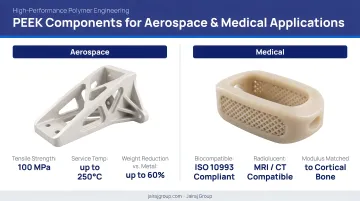
- Tensile strength (unfilled): 14,500 psi, rising to 47,900 psi with carbon fibre fill
- UL94 V-0 rating at 0.060 inch (unfilled)
- Biocompatible grades (e.g., PEEK-OPTIMA LTI) have supported FDA-cleared implant devices under ISO 10993
Best-fit applications:
- Aerospace structural brackets and under-fuselage components
- Automotive transmission and under-hood parts
- Oil and gas downhole seals and connectors
- Spinal implants and surgical device components
- Semiconductor wafer cassettes and CMP equipment
Key limitation: PEEK is among the most expensive HPPs. It requires specialised high-temperature injection moulding equipment. For applications where PPS would perform adequately, specifying PEEK adds unnecessary cost.
PPS (Polyphenylene Sulfide)
PPS offers a strong cost-to-performance balance, particularly for chemically aggressive environments and flame-critical applications. Its chemical inertness is inherent to the material — no additives required.
Key performance data (Syensqo Ryton PPS):
- Long-term continuous-use temperature: above 200°C
- Short-term resistance: up to 260°C
- UL thermal indices: up to 240°C
- Most Ryton grades achieve UL94 V-0 and many reach UL94 5VA without flame-retardant additives
- Virtually impervious to automotive fuels, transmission fluids, brake fluids, and engine coolants
Best-fit applications:
- Automotive fuel system housings, water pump bodies, under-hood connectors
- Electrical components requiring inherent flame retardancy
- Industrial pump bodies, valve housings, and filter components
- EV power electronics housings and stator bobbins (newer Ryton Supreme grades support thin-wall components down to 0.3 mm)
Key limitation: Neat (unfilled) PPS can be brittle. Most production-grade applications use 40% glass-fibre reinforced compounds like Ryton R-4, which improves toughness but adds cost and roughens surface finish.
PEI (Polyetherimide)
PEI is an amorphous HPP, and that structural characteristic is a deliberate selection advantage. Unlike semi-crystalline materials, amorphous polymers shrink more predictably during moulding, which directly benefits tight-tolerance parts.
Key performance data (SABIC ULTEM 1000):
- Glass transition temperature: 217°C
- RTI (electrical, mechanical): 170°C
- UL94 V-0 at 0.75 mm; 5VA at ≥3 mm
- Dielectric strength: 32.7 kV/mm (ASTM D149, 1.6 mm in air)
Best-fit applications:
- Aerospace interior components and seating structures meeting FAA flame requirements
- Surgical device housings, lab ware, and clinical diagnostics equipment
- Electronic connectors, insulators, and semiconductor manufacturing components
- Automotive under-hood sensors and electronics
Key limitation: PEI has lower chemical resistance than PEEK or PPS and is more susceptible to UV degradation. Outdoor applications without protective coatings are generally not suitable.
PTFE (Polytetrafluoroethylene)
PTFE occupies a distinct chemical category. Its carbon backbone is completely shielded by fluorine atoms, making it resistant to virtually every aggressive chemical at process temperatures — acids, bases, solvents, and fuels included. No common industrial substance adheres to or degrades it under normal operating conditions.
Key performance data:
- Useful mechanical temperature range: -268°C to 260°C continuously
- Near-total chemical inertness — acids, bases, solvents, fuels
- Lowest coefficient of friction of any solid polymer
- Excellent electrical insulation across a broad frequency range
Best-fit applications:
- Chemical processing seals, gaskets, and pipe linings
- Medical device components requiring biocompatibility and sterilisability
- High-frequency cable and connector insulation
- Bearing and wear surfaces in industrial equipment where external lubrication is not practical
Key limitation: PTFE cannot be processed by conventional injection moulding. Its extremely high melt viscosity means it must be processed by sintering preforms and then machining to final dimensions — which limits design complexity and increases per-part cost. PTFE also exhibits creep under sustained compressive load, which is a real design constraint for high-pressure sealing applications.
Where High-Performance Polymers Are Used
HPPs show up in sectors where failure isn't an option — from engine bays to surgical suites. The breakdown below covers the primary application areas, along with the specific polymers driving each one.
Automotive and EV
- Under-hood connectors, sensors, and housings (PPS, PEEK)
- Fuel system components, pump housings, coolant-circuit parts (PPS)
- EV power electronics housings, stator bobbins, chip carriers (PPS Supreme grades)
- Transmission components requiring wear resistance under heat (PEEK)
Aerospace and Defence
- Lightweight structural brackets and panels (PEEK, PEI, CFRP composites)
- Wire insulation and harness components
- Interior components meeting FAR 25.853 flame-smoke-toxicity requirements (PEI, PEEK)
- Avionics enclosure panels and cockpit instrument housings
Medical Devices
- Spinal fusion spacers and orthopaedic implants using biocompatible PEEK grades
- Sterilisable surgical instrument housings (PEI, PEEK)
- Drug delivery components and fluid-contact parts (PTFE, PEEK)
Electronics and Semiconductor
- Wafer cassettes and FOUP components in semiconductor fabs (PEEK)
- High-frequency connectors and PCB substrates (PTFE)
- Electronic component housings needing flame retardancy (PEI, PPS)
Industrial Equipment
- Chemical-resistant pump bodies and valve components (PPS, PTFE)
- High-temperature seals and gaskets (PTFE, PEEK)
- Wear parts — gears, bushings, bearings — in heavy machinery (PEEK, Acetal, UHMW-PE)
Each of these sectors demands tight tolerances and material-specific process control — HPPs leave little margin for error in manufacturing. Jairaj Group produces HPP components across these applications — including implant-grade PEEK parts and semiconductor-spec PTFE components — for automotive OEMs and aerospace customers across India. With six manufacturing facilities, ISO 9001:2015 certification, and in-house tool room capabilities, their PLC-controlled injection moulding lines are equipped for the elevated temperature control these materials require.
How to Choose the Right High-Performance Polymer
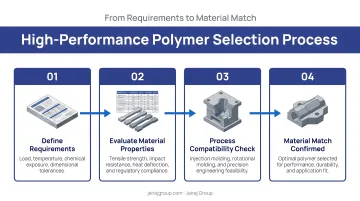
Material selection should start with operating conditions, not with the most familiar name on the shortlist.
Step 1: Define the Exact Operating Requirements
Before comparing materials, document:
- Maximum and minimum continuous-use temperatures
- Chemical exposures — type, concentration, duration, and whether contact is intermittent or sustained
- Mechanical loads — tensile, compressive, fatigue, and impact
- Whether electrical insulation, biocompatibility, or specific regulatory compliance is required
Step 2: Apply Regulatory Filters First
Compliance requirements narrow the shortlist quickly:
- Medical implants: Biocompatible PEEK grades (ISO 10993 evidence required for finished device clearance)
- Aerospace interiors: FAR 25.853 flame-smoke-toxicity requirements (PEI, PEEK)
- Electronics: UL94 V-0 ratings (PPS, PEI, and PEEK all qualify depending on grade and thickness)
Step 3: Match Processing Method to Material
Not all HPPs can be manufactured the same way:
| Material | Primary Processing Method | Notes |
|---|---|---|
| PEEK | Injection moulding | Requires high-temperature barrel and tooling; specialised equipment |
| PPS | Injection moulding | Glass-filled grades typically preferred; good flow in thin walls |
| PEI | Injection moulding | Amorphous structure makes it dimensionally predictable; good for complex geometries |
| PTFE | Sintering + machining | Cannot be injection moulded; limits geometric complexity |
Step 4: Avoid These Common Selection Mistakes
- Defaulting to PEEK when PPS would handle the temperature and chemical environment adequately — the cost difference is substantial
- Specifying unfilled PPS in impact-critical applications without accounting for its brittleness in neat form
- Ignoring PTFE's creep under sustained compressive load in high-pressure sealing applications
- Overlooking total cost of ownership — a more expensive HPP that lasts longer and needs less maintenance can be the lower-cost choice over a component's service life
Jairaj Group's engineering and value engineering teams work directly with customers on material selection — identifying the minimum performance specification needed and matching it to the most cost-effective HPP, rather than defaulting to an over-specified grade that adds unnecessary cost.
Frequently Asked Questions
What is a high-performance polymer?
High-performance polymers are a specialised class of thermoplastics engineered to maintain mechanical, thermal, and chemical properties under extreme conditions that standard or engineering-grade plastics cannot handle. They sit above commodity plastics like PE and engineering plastics like nylon, used in critical applications where material failure carries real consequences.
What is an example of a high-performance polymer?
PEEK (Polyetheretherketone) is the most widely recognised example, used in aerospace brackets, spinal implants, and automotive transmission components. PPS, PEI, and PTFE are other common examples, each suited to different performance demands and application environments.
How are high-performance polymers different from engineering plastics?
Engineering plastics like nylon and polycarbonate outperform commodity plastics but have meaningful limits — nylon absorbs moisture and loses stiffness, polycarbonate creeps under load. HPPs exceed these limits in continuous-use temperature (often above 200°C), chemical inertness, and dimensional stability under sustained mechanical stress.
What properties define a high-performance polymer?
Five properties define HPPs: high thermal stability, chemical resistance, mechanical strength (tensile and fatigue), dimensional stability under load and temperature, and — in select types like PTFE and PEEK — low friction and wear resistance for moving components.
Are high-performance polymers more expensive than standard plastics?
Yes. High-temperature thermoplastics can cost approximately 10 times more than general-purpose plastics, reflecting more complex monomers, specialised synthesis, and demanding processing requirements. The premium is justified by longer component life, reduced maintenance intervals, and reliable performance in conditions that would destroy cheaper alternatives.
Can high-performance polymers replace metals in industrial applications?
In many applications, yes. PEEK and PPS can replace metals in bearings, bushings, seals, and housings — offering comparable functional strength at lower weight, inherent corrosion immunity, and more design flexibility. Where very high structural loads, impact conditions, or thermal conductivity requirements exceed HPP limits, metals remain the appropriate choice.