The challenge is that high-performance polymers (HPPs) aren't interchangeable. PEEK behaves differently from PPS under thermal cycling. PAI outperforms both under sustained compressive load. Picking the right one requires matching a material's actual property profile — not just its headline tensile strength — to the specific demands of the application.
This guide breaks down the top HPP materials for pressure-critical environments, the six selection factors that matter most, and how to avoid the mismatches that lead to premature failure.
Key Takeaways
- HPPs maintain strength, dimensional stability, and chemical resistance under extreme conditions (continuous service temperature above 150°C)
- Key materials: PEEK, PTFE, PPS, PEI (Ultem), and PAI (Torlon) — each suited to different failure modes and operating environments
- Six selection factors: pressure/mechanical load, thermal range, chemical compatibility, creep resistance, regulatory compliance, and processability
- HPPs offer significant weight savings versus metals, with Victrex citing up to 80% weight reduction in selected metal-replacement scenarios
- Manufacturing partner capability is a direct selection variable — processing precision at production scale determines real-world outcomes
What Are High-Performance Polymers?
HPPs sit at the top of the plastics hierarchy. Below them are engineering plastics (nylon, polycarbonate), and below those, commodity plastics (PE, PP). What separates HPPs is performance under conditions that cause standard plastics to soften, deform, or chemically degrade.
Ensinger classifies high-performance/high-temperature plastics as materials maintaining a continuous service temperature above 150°C — defined as the temperature at which a material retains at least 50% of its initial properties after 20,000 hours of exposure (per IEC 216). That's the baseline threshold, not a marketing label.
The global high-performance plastics market reached USD 26.75 billion in 2024, with a projected CAGR of 9.32% through 2030 — driven by aerospace lightweighting, EV thermal management, and stricter industrial safety requirements.
Core Properties That Define an HPP
Five properties must hold simultaneously — where standard plastics typically fail on at least two:
- Thermal stability — no significant property loss at operating temperature
- Mechanical strength — adequate tensile, compressive, and flexural load resistance
- Chemical resistance — no swelling, cracking, or chain scission from process fluids
- Dimensional stability — tight tolerances maintained across temperature cycles
- Creep resistance — no slow deformation under sustained stress below yield strength
For pressure-critical applications specifically, compressive strength and creep resistance are the decisive properties — and both must be evaluated at operating temperature, not just at room temperature.
Key HPP Materials for Pressure-Critical Applications
| Material | Tensile Strength | Max Continuous Service Temp | Best For |
|---|---|---|---|
| PEEK (unfilled) | 98 MPa (450G) | 260°C | Balanced strength, heat, chemical resistance |
| PTFE | 13–55 MPa | 260°C | Chemical inertness, low friction sealing |
| PPS | Moderate | 200–240°C | Cost-sensitive thermal/flame applications |
| PEI (Ultem 1000) | ~105 MPa | 217°C (Tg) | Electrical, sterilisation, flame resistance |
| PAI (Torlon 4203) | 152 MPa | 275°C | Highest load/wear performance |
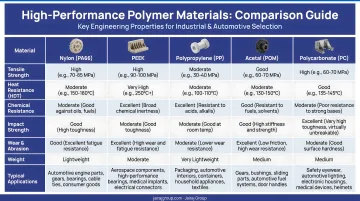
PEEK is the most widely used HPP for demanding environments. Its semi-crystalline structure gives unfilled grades like VICTREX 450G a tensile strength of 98 MPa at 23°C, with a continuous use temperature of 260°C — well above its glass transition temperature of 143°C.
Carbon-fibre reinforced grades (VICTREX 450CA30) reach 235–265 MPa depending on the specific property measured. PEEK resists acids, hydrocarbons, and steam, though it degrades under strong oxidising acids and halogenated organics at elevated temperatures.
PTFE is the material of choice where chemical inertness matters most. Teflon fluoropolymers maintain resistance from -200°C to 260°C across virtually all chemical environments. The trade-off: tensile strength ranging from 13–55 MPa makes it unsuitable for load-bearing structural parts without design validation. PTFE is processed via compression moulding and ram extrusion — not conventional injection moulding , which limits design geometry options.
PPS delivers strong thermal performance (200–240°C UL temperature index) with inherent UL94 V-0 flame retardance — no additives required. Toray's TORELINA PPS offers low moisture absorption, good dimensional stability under heat and humidity, and solid resistance to hydrocarbons. It's cost-positioned below PEEK, making it the practical choice when temperatures and loads don't require PEEK's full performance envelope.
PEI (Ultem 1000) offers tensile strength around 105 MPa with a Tg of 217°C and dielectric strength of 33 kV/mm. Most grades meet UL94 V-0 at sections as thin as 0.75 mm.
The ULTEM HU1004 grade withstands steam autoclave sterilisation up to 134°C, gamma irradiation, and hydrogen peroxide vapour, making it the dominant choice for medical device applications. SABIC confirms ULTEM 1000 compliance with aerospace FAR 25.853 for cabin interior flammability.
PAI (Torlon 4203) records the highest tensile strength of any unfilled thermoplastic: 152 MPa by ASTM D638, with performance retention up to 275°C. Syensqo (formerly Solvay) positions Torlon as the strongest and stiffest thermoplastic across that temperature range.
The critical operational requirement: Torlon parts require post-cure after moulding, as the material continues chain extension and cross-linking when heated. This affects lead time, cost, and quality planning, and must be factored into procurement schedules.
Why Critical Industries Rely on HPPs
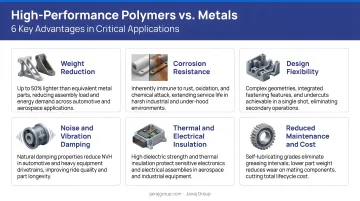
- Weight reduction versus metal alternatives — Victrex documents up to 80% weight savings in specific aerospace metal-replacement scenarios
- Extended part life under cyclic pressure and temperature without surface coating requirements
- Self-lubricating grades eliminate or reduce lubrication system complexity
- Biocompatibility (PEEK, PEI) enabling direct contact in medical implants and devices
- Inherent or additive-free flame and smoke resistance for aerospace and rail applications
- Corrosion immunity in aggressive fluid environments where metal would require protection
What to Consider When Selecting a Polymer for Critical Applications
Polymer selection for critical applications isn't a materials science exercise in isolation — it's a systems engineering decision. The wrong choice affects component life, maintenance intervals, safety compliance, and total cost of ownership. Datasheet values are a starting point, not a verdict.
The following six factors connect material data to real-world operating demands.
Pressure and Mechanical Load Profile
This is the primary filter. The load type determines which mechanical properties actually matter:
- Sustained hydraulic pressure → compressive yield strength and creep resistance
- Structural brackets under vibration → fatigue endurance limit
- Cyclic pressure cycling → time-to-failure under repeated load
Selecting by tensile strength alone leads to mismatches. A material with excellent tensile strength may still creep under constant compressive load, causing seal blow-by or bearing failure weeks after installation. Compressive yield strength and flexural modulus belong in the review alongside tensile strength — not as an afterthought.
Thermal Operating Range
Temperature affects HPP performance in two distinct ways that engineers sometimes conflate:
- Glass transition temperature (Tg) — the point at which amorphous regions soften; PEEK 450G has a Tg of 143°C
- Continuous service temperature (CST) — the practical upper limit for sustained use; PEEK 450G has a CST of 260°C
The gap between these two values exists because PEEK is semi-crystalline. Its crystalline regions maintain structural integrity above Tg, which is why room-temperature tensile data cannot be assumed to apply at operating temperature. Victrex 450CA30 data shows tensile stress at break dropping from its room-temperature value to approximately 160 MPa at 125°C and 50 MPa at 275°C. Request elevated-temperature property data at your specific operating conditions — room-temperature specs tell you very little about in-service behaviour.
Chemical and Fluid Compatibility
Chemical resistance is not binary — it varies with temperature, concentration, and exposure duration. PEEK resists most acids and hydrocarbons but degrades under strong oxidising acids and halogenated organics at high temperatures. PPS handles hydrocarbons well but shows reduced resistance to strong acids and alkalis at elevated temperatures.
Key metrics to evaluate:
- Dimensional change after fluid immersion
- Retention of tensile and flexural strength after exposure
- Surface integrity (no stress cracking or blistering)
Supplier-provided chemical resistance tables at the specific grade level are the right reference point — not generic polymer-family guides. A rating valid at 23°C can fail to hold at 120°C, and that gap is where components fail in service.
Creep Resistance and Dimensional Stability
Creep is the slow, time-dependent deformation of a material under constant stress below its yield strength. It's the failure mode that passes short-term testing and then causes problems months later — particularly in seals, bushings, and valve seats under sustained hydraulic load.
Semi-crystalline polymers (PEEK, PPS) outperform amorphous polymers in creep resistance because their crystalline structure resists molecular chain movement under load. Key reference points from suppliers:
- Celanese confirms Fortron PPS retains dimensional stability under sustained load at elevated temperatures
- Victrex documents PEEK creep testing per ISO 899 at 23°C over 1,000 hours
Critical design point: creep rate increases non-linearly with temperature. Room-temperature validation underestimates real-world deformation at 100°C or above — often by a wide margin.
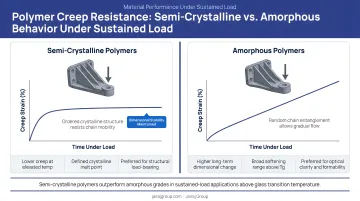
For sustained-load applications, request time-dependent creep data from your material supplier at the actual operating temperature and stress level — not just at standard test conditions.
Regulatory and Industry Standards Compliance
In regulated industries, a material that fails compliance disqualifies the component regardless of mechanical performance. Key standards affecting HPP selection:
- UL94 V-0 — flame retardance for electrical and aerospace applications; PEEK 450G, TORELINA PPS, and most ULTEM grades have supplier-verified V-0 ratings
- ISO 10993-1 — biological evaluation framework for medical devices; FDA guidance explicitly references this standard for 510(k), PMA, and other submissions
- 14 CFR 25.853 — FAA regulation governing aircraft compartment interior flammability; SABIC confirms ULTEM 1000 compliance
- RoHS — restriction of hazardous substances for electronic components; ULTEM 1000 listed as compliant
Critical point: Verify compliance at the specific grade and colour/additive package level. A flame rating or biocompatibility approval for one PEEK grade does not automatically carry over to another.
Manufacturing Processability and Design Complexity
The best-performing polymer on paper can become a production problem if it can't be reliably processed into the required geometry at volume. Processing constraints by material:
- PEEK — requires high-temperature tooling; achieves tight dimensional tolerances in precision moulding operations
- PTFE — processed via compression moulding and ram extrusion; complex geometries and thin walls are limited compared to injection moulded materials
- PAI (Torlon) — requires post-cure cycles after moulding; this adds lead time and process steps that must be planned into production schedules
- PPS — generally more processable than PEEK with good dimensional stability; suitable for high-volume automotive and industrial production
Dimensional repeatability across batches, achievable tolerances, and tool life are direct outputs of this factor. Confirm processability at the design stage — discovering these limits during qualification adds cost and delays that are difficult to recover from.
How Jairaj Group Can Help
Selecting the right HPP only delivers value when the material can be manufactured consistently, to tolerance, at production scale. The manufacturing partner is as critical a variable as the material itself.
Jairaj Group has been engineering polymer components since 1985, serving automotive, aerospace, medical, EV, railway, and industrial customers across six manufacturing facilities in India. The company works with PEEK, PTFE, PA66-GF, POM, TPU, and other high-performance polymer grades through injection moulding with PLC-controlled machinery and in-house tooling capability.
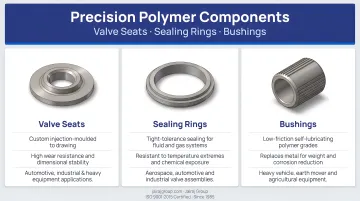
Their component portfolio for pressure-critical and mechanically demanding applications includes valve seats, piston rings, sealing rings, bushings, and oil scoops — all produced with tight tolerance control and material traceability under ISO 9001:2015 certification.
For automotive applications, the quality system also encompasses IATF 16949 compliance, with full PPAP and APQP documentation capability for Tier-1 OEM supply.
Jairaj's differentiators for HPP component sourcing:
- Supplier awards from Endurance Technologies, Gabriel India Limited, and Tenneco Automotive — including "A" rated supplier status and "Best Supplier For Fastest & First Time Right Developments"
- In-house R&D and Value Engineering centres covering material selection, DFM review, flow simulation, and rapid prototyping
- Active production capability for EV, drone, railway, and defence applications, including carbon-fibre reinforced polymer drone frames, sensor housings, and railway flanges
- Full quality documentation: dimensional verification, material traceability, load testing, wear resistance evaluation, and performance validation with certification
- AS9100-aligned quality processes and regulatory documentation capability for aerospace component supply
For material selection support or to discuss HPP component requirements, contact Jairaj's technical team at japl@jairajgroup.com or +91-9711-114-300.
Conclusion
High-performance polymer selection is a multi-variable decision. The right material is the one whose complete property profile — thermal limits, chemical resistance, mechanical load tolerance, and processing constraints — matches the actual demands of the application across its full service life.
Polymer selection also shouldn't be treated as a one-time specification decision. Operating conditions evolve — next-generation EV powertrains run hotter, aerospace emissions requirements are tightening, and industrial processes introduce new chemical exposures. Component materials should be periodically reviewed and re-qualified as those conditions change. The selection guide is a starting point; sustained performance requires ongoing engineering judgment.
Frequently Asked Questions
What plastic can withstand high pressure?
Several HPPs perform well under high pressure. PAI (Torlon 4203) offers the highest compressive and tensile strength among unfilled thermoplastics at 152 MPa, followed by PEEK and PEI (Ultem). The right choice also depends on whether the pressure environment involves elevated temperatures or aggressive chemical media, as those factors narrow the field significantly.
What are examples of high-performance polymers?
Key HPPs include PEEK, PTFE, PPS, PEI (Ultem), PAI (Torlon), PVDF, and Polyimide (Vespel). They are distinguished from standard engineering plastics by a continuous service temperature above 150°C, superior chemical resistance, and retained mechanical integrity under prolonged stress.
What is the difference between engineering plastics and high-performance polymers?
Engineering plastics (nylon, polycarbonate) offer improved properties over commodity plastics but are designed for moderate performance across a broad range of conditions. HPPs sit at the top of the polymer hierarchy, engineered for a narrower set of extreme conditions where temperature, pressure, or chemical resistance requirements exceed what engineering plastics can sustain.
Which high-performance polymer offers the best chemical resistance?
PTFE is the most chemically inert HPP, resistant to virtually all known chemicals across a service range of -200°C to 260°C. PEEK and PPS offer strong resistance to acids, bases, and hydrocarbons, making them the preferred alternatives where PTFE's lower mechanical strength is a design limitation.
How do high-performance polymers compare to metals in structural applications?
HPPs offer strength-to-weight ratios that can exceed conventional metals in specific configurations, with the added benefits of corrosion immunity and no need for surface coatings. Victrex documents up to 80% weight reduction in selected aerospace metal-replacement scenarios. For maximum absolute load capacity, metal or metal-HPP hybrid designs remain the better choice.
How do I ensure the HPP I select can be manufactured to the required tolerances?
Achievable tolerances depend on both the material properties and the manufacturer's process capability. Partnering with an ISO-certified manufacturer experienced in HPP injection moulding, with in-house tooling and documented quality systems, ensures consistent tolerances across production runs. Request capability data and first-article documentation before committing to production volumes.