Introduction
EV battery packs present a material selection problem unlike anything in conventional automotive engineering. They're heavy, thermally complex, electrically hazardous, and chemically aggressive — all at once. Every plastic component surrounding or within the pack must perform across multiple failure modes simultaneously, not just one.
Pick the wrong polymer for a busbar mount and you risk tracking failure at high voltage. Specify the wrong seal material and coolant absorption degrades mechanical performance within months. These aren't edge cases — they're the real cost of under-specified material decisions in battery programs.
This guide covers the specific plastics used inside EV battery systems, what each one actually does, and the selection factors that should drive engineering and procurement decisions. If you're specifying components for a battery enclosure or BMS housing, understanding the material rationale — not just the datasheet — is where reliable design begins.
Key Takeaways
- PP, PA/Nylon, PC/ABS, PBT, ABS, PE, EPDM, and PVDF are the core plastics used across EV battery systems
- Each material is chosen for a specific sub-function: structural enclosure, electrical insulation, chemical sealing, or ion separation
- UL 94 V-0 flame retardancy is the minimum threshold for plastics adjacent to high-voltage cell assemblies
- Five critical selection factors drive every decision: thermal performance, flame retardancy, CTI rating, chemical resistance, and weight-to-strength ratio
- The right approach is matching material to sub-component function, not searching for a single best-performing polymer
Why Plastics Are Critical to EV Battery Systems
Plastics occupy a unique position in vehicle design: according to the American Chemistry Council, plastics make up roughly 50% of vehicle volume but only about 10% of vehicle weight. That ratio is why material selection has such direct impact in EV programs — every gram saved in surrounding components translates to measurable range gains.
EV battery environments are fundamentally different from conventional automotive applications. The combination of factors these components must survive simultaneously includes:
- Continuous operating temperatures above 80°C in thermal management zones
- Direct exposure to lithium-salt organic electrolytes on the cell side
- Water-glycol or dielectric coolant contact on the thermal management side
- High-voltage electrical fields requiring active insulation performance
- Strict flammability containment requirements driven by thermal runaway risk
Commodity plastics don't meet these demands. Engineering-grade polymers with verified electrical, thermal, and chemical performance data are the entry point — not a premium option.
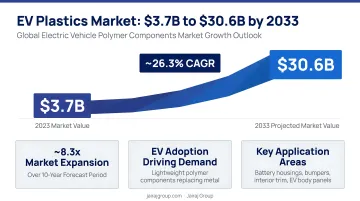
The market signal reflects that material complexity. Grand View Research projects the global electric vehicle plastics market will grow from USD 3.7 billion in 2025 to USD 30.6 billion by 2033 at a 30.5% CAGR — a trajectory driven not just by EV adoption volume, but by the per-vehicle material complexity of battery systems.
Key Plastics Used in EV Battery Systems
The plastics used in EV battery systems can be organised by primary function: structural enclosure, electrical insulation and connectivity, and sealing/separation/specialty applications. Understanding each group prevents the common error of over-specifying expensive materials where simpler grades would perform equally well.
Structural and Enclosure Plastics
Polypropylene (PP) is the dominant material for battery casings and outer trays. Its advantages in this role:
- Excellent acid and alkali chemical resistance
- Low density (~0.90 g/cm³ for unfilled grades)
- Cost-effective at large production volumes
- Compatible with injection molding and thermoforming for complex geometries
Glass-filled grades significantly extend PP's capabilities. SABIC's EV battery PP compounds are available at 15%, 30%, and 40% glass fiber loadings specifically for battery frames and housings — each step up in fill percentage improves stiffness and heat deflection temperature at the cost of added density.
Polycarbonate (PC) and PC/ABS blends are preferred for battery covers and module-level enclosures where higher impact resistance and thermal stability are required. Covestro's Bayblend FR series — specifically developed for prismatic battery pack packaging — achieves UL 94 V-0 at 1.5 mm wall thickness and ball indentation resistance of ≥125°C.
These flame-rated formulations are the standard for components adjacent to high-voltage cells.
ABS handles battery holders, structural brackets, and secondary housings where impact resistance and ease of precision molding matter more than extreme heat resistance. It absorbs vibration and road shock reliably — a straightforward requirement where cost and processability outweigh thermal performance.
Electrical Insulation and Connector Plastics
Polyamide/Nylon (PA 6 and PA 6/6) is the primary material for high-voltage connector housings, busbar mounts, and terminal blocks. Key performance attributes:
- High Comparative Tracking Index (CTI) — glass-filled PA66 grades target CTI 600 V (PLC 0)
- Dimensional stability through thermal cycling
- Resistance to oils and automotive fluids
- Available in 25–30% glass-reinforced grades where mechanical load combines with electrical duty
Polybutylene Terephthalate (PBT) covers connectors, wire harness components, and insulators requiring precise dimensional stability under long-term thermal stress. Envalior's EV-specific PBT compound achieves CTI 600 V and UL 94 V-0 at 0.8 mm — suited for BMS housing internals and connector bodies where tracking resistance under contaminated-surface conditions is critical.
Sealing, Separation, and Specialty Materials
Polyethylene (PE) — specifically microporous grades — is the standard separator material inside lithium-ion cells. It physically isolates the anode from the cathode while allowing lithium-ion flow. The thermal shutdown behaviour is a key safety feature: PE pores close around 130°C, halting ion flow and providing passive protection during overheating events.
Commercial separators often use a trilayer PE/PP/PE architecture, where the PP outer layers maintain mechanical integrity while PE provides the shutdown response.
EPDM (Ethylene Propylene Diene Monomer) handles gaskets, O-rings, and weatherproofing seals throughout the battery pack assembly. Its broad temperature flexibility, ozone resistance, and compatibility with cooling fluids make it the standard sealing material for pack perimeters and coolant interface joints.
PVDF (Polyvinylidene Fluoride) operates at a different scale — inside the cell itself, as an electrode binder and separator coating. Arkema and Solvay both supply PVDF specifically for lithium-ion battery cell manufacturing, with Solvay announcing a 35% PVDF capacity expansion in Europe in direct response to EV battery demand growth.
Critical Factors When Selecting Battery-Grade Plastics
Get the material selection wrong on a single sub-component and you're looking at redesign cycles, failed homologation, or worse — a thermal event. These five factors cover the decisions that separate a field-ready battery system from one that doesn't survive validation testing.
Thermal Performance
Every plastic in a battery system must be rated for its sub-component's continuous operating temperature — but the more critical design parameter is behaviour during thermal runaway, where localised temperatures can spike far beyond normal operating ranges.
Two thermal metrics are commonly confused:
| Metric | What It Measures | Design Relevance |
|---|---|---|
| Heat Deflection Temperature (HDT) | Short-term deflection under load at temperature | Processing and handling reference |
| Continuous Service Temperature | Long-term structural/functional integrity | Operational specification that matters |
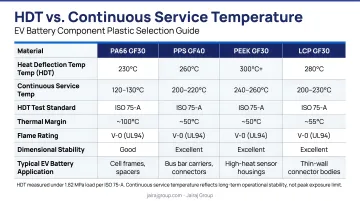
Specify continuous service temperature for battery applications, not HDT alone.
Flame Retardancy
UL 94 V-0 is the minimum benchmark for plastics used in or adjacent to high-voltage cell assemblies. V-0 requires:
- No specimen flaming for more than 10 seconds after each flame application
- Total flaming time across 5 specimens/10 applications must not exceed 50 seconds
- No flaming drips that ignite the cotton indicator below
OEMs increasingly specify halogen-free flame-retardant formulations for environmental compliance. Failing V-0 is a disqualifying defect in automotive homologation — full stop.
Electrical Insulation Properties
Two metrics govern electrical insulation selection for battery plastics:
- Dielectric strength — the voltage gradient a material can withstand before breakdown (typically 30–35 kV/mm for high-performance grades)
- Comparative Tracking Index (CTI) — resistance to surface tracking under contaminated conditions
CTI is especially critical for connector and busbar components, where moisture or electrolyte contamination can create conductive paths at high voltage. For 800V EV charging systems, suppliers like Envalior have begun testing beyond standard CTI limits, since conventional test methodologies were designed for lower-voltage applications.
CTI ≥600 V (PLC 0) is the target for high-voltage EV connector materials.
Chemical Resistance
Battery pack plastics face a dual chemical environment:
- Cell side: Lithium salt (LiPF6) dissolved in organic carbonate solvents — aggressive to many unfilled engineering plastics
- Thermal management side: Water-glycol coolant — creates hydrolysis and long-term absorption risk
PBT requires hydrolysis-resistant grades in coolant-exposed applications — standard PBT degrades under prolonged hot water/glycol exposure. PA6 similarly absorbs moisture from glycol-water mixtures, affecting dimensional stability and mechanical properties. Always qualify candidate materials against both environments before finalising the specification.
Weight-to-Strength Ratio and Processability
Glass-filled grades improve stiffness but also add density — so fill percentage must be optimised rather than maximised. A 40% glass-filled PP tray may outperform a 30% grade structurally while exceeding weight targets for the system.
Injection moldability affects economics directly: flow characteristics, cycle time, and tool complexity all drive unit cost. A material that requires a complex hot-runner tool or extended cycle times can erase the cost savings from reduced part count — so processability belongs in the material brief, not as an afterthought.
Matching Plastics to EV Battery Sub-Components
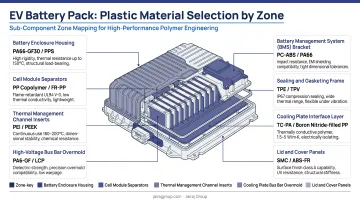
Even with the right materials shortlisted, applying them to the wrong sub-component is an avoidable and expensive mistake. The table below maps validated plastic choices to the five primary functional zones of an EV battery pack.
| Sub-Component | Primary Plastic(s) | Key Property Requirement |
|---|---|---|
| Outer enclosure / structural tray | PP (GF20–GF40), PC/ABS FR | Chemical resistance, UL 94 V-0, low density |
| Battery cover / module housing | Flame-rated PC/ABS | Impact resistance, ≥125°C thermal stability |
| Cell separator (inside cell) | Microporous PE (PE/PP multilayer) | Porosity, thermal shutdown at ~130°C |
| Cell holders / module spacers | PP, PS | Dimensional precision, thermal cycling tolerance |
| BMS housing / HV connectors | PA 6/6 GF, PBT | CTI ≥600 V, dimensional stability, fluid resistance |
| Pack seals / gaskets | EPDM | Coolant compatibility, temperature flexibility |
| Coolant manifolds / pump housings | PP GF, PA GF | Hydrolysis resistance, pressure integrity |
Cell Module Internals
Microporous PE handles separator duty inside each cell. For cell-to-cell spacers and module frames, PP or polystyrene (PS) are used — both offer sufficient stiffness for dimensional control during thermal expansion cycles. Injection molding tolerance capability matters directly here. Poorly dimensioned spacers concentrate mechanical stress on cell casings, which accelerates degradation over repeated thermal cycles.
BMS Housing and High-Voltage Connectors
PA 6/6 (glass-filled) and PBT are the default specifications in most EV OEM supplier standards for this zone. These components must meet all three requirements at once:
- Maintain electrical insulation under contamination (CTI)
- Hold dimensional tolerances through hundreds of thermal cycles
- Resist automotive fluid ingress (oils, glycol coolant)
Grade selection must be verified against all three requirements together. Optimising for one while neglecting the others is a common and costly specification error.
Thermal Management and Sealing Components
EPDM covers perimeter seals, O-rings, and pack gaskets where coolant exposure and temperature cycling are constant. For coolant manifolds and pump housings within the battery thermal management circuit, glass-filled polypropylene or nylon provides the pressure integrity and hydrolysis resistance needed for long-term fluid handling.
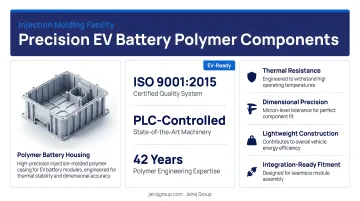
Jairaj Group manufactures polymer components for automotive thermal management applications, using PLC-controlled injection molding processes to maintain dimensional consistency in fluid-handling and sealing-interface parts.
How Jairaj Group Supports EV Battery Component Manufacturing
Jairaj Group is a precision polymer component manufacturer with over four decades of engineering expertise in injection molding and thermoforming. Since 2023, the company has specifically expanded into EV-focused polymer components for automotive customers, operating across multiple manufacturing facilities in India under ISO 9001:2015 certification.
The manufacturing capabilities relevant to EV battery plastic programs include:
- In-house tool room for rapid tooling development, including prototype tooling and process simulation (flow analysis, cooling optimisation, warpage prediction)
- PLC-controlled injection molding for tight-tolerance EV connectors, housings, and structural components
- Advanced polymer processing across engineering grades including PA66-GF, PC, PEEK, and TPU
- Design for Manufacturability (DFM) support through R&D and Value Engineering Centres
- Full documentation and testing aligned with automotive supplier quality standards
Jairaj supplies Endurance Technologies, Gabriel India Limited, and Tenneco Automotive — each of whom has recognised Jairaj with supplier awards for performance in demanding, specification-driven programs.
Material selection is the technical decision, but manufacturing precision determines whether that selection performs in the field. Specifying the right polymer and partnering with a manufacturer who can hold tolerances, qualify materials, and document compliance are equally important — both need to happen together, not one after the other.
EV battery plastic specifications should also be reviewed periodically. Cell chemistry, thermal management strategies, and regulatory standards continue to evolve, and material grades that met requirements in 2022 may not reflect what current OEM programmes specify.
Frequently Asked Questions
What kind of plastic is used in batteries?
No single plastic is used throughout a battery system — selection is component-specific. Polypropylene covers casings, Polyethylene handles cell separators, PA/Nylon and PBT are used for connectors and BMS housings, PC or PC/ABS covers module enclosures, and EPDM seals gaskets and pack perimeters.
What are EV battery casings made of?
Outer battery casings and structural trays are typically made from glass-filled Polypropylene (PP) or flame-rated PC/ABS blends, chosen for chemical resistance, light weight, and UL 94 V-0 compliance. Aluminium may be used for the outermost pack shell, but internal module housings remain predominantly polymeric.
Which plastic is used for EV battery cell separators?
Microporous Polyethylene (PE) is the commercial standard for lithium-ion cell separators, often in a trilayer PE/PP/PE architecture. PE isolates anode from cathode while allowing lithium-ion flow; its pores close around 130°C, providing a passive thermal shutdown function during overheating.
What flame retardancy standard applies to plastics in EV battery systems?
UL 94 V-0 is the benchmark for plastics used in or near EV battery cell assemblies. V-0 requires self-extinguishing within 10 seconds and no flaming drips — the minimum threshold for most automotive OEM battery component specifications. Halogen-free FR formulations are increasingly preferred by OEMs for environmental compliance.
How does plastic selection for EV batteries differ from conventional automotive applications?
EV battery environments introduce demands largely absent from combustion vehicle applications: high-voltage electrical fields, direct electrolyte and coolant exposure, and thermal runaway containment requirements. Battery-grade plastics must satisfy electrical insulation (CTI), flame retardancy, and chemical compatibility standards simultaneously, rather than optimising for a single property as in most conventional automotive contexts.