Introduction
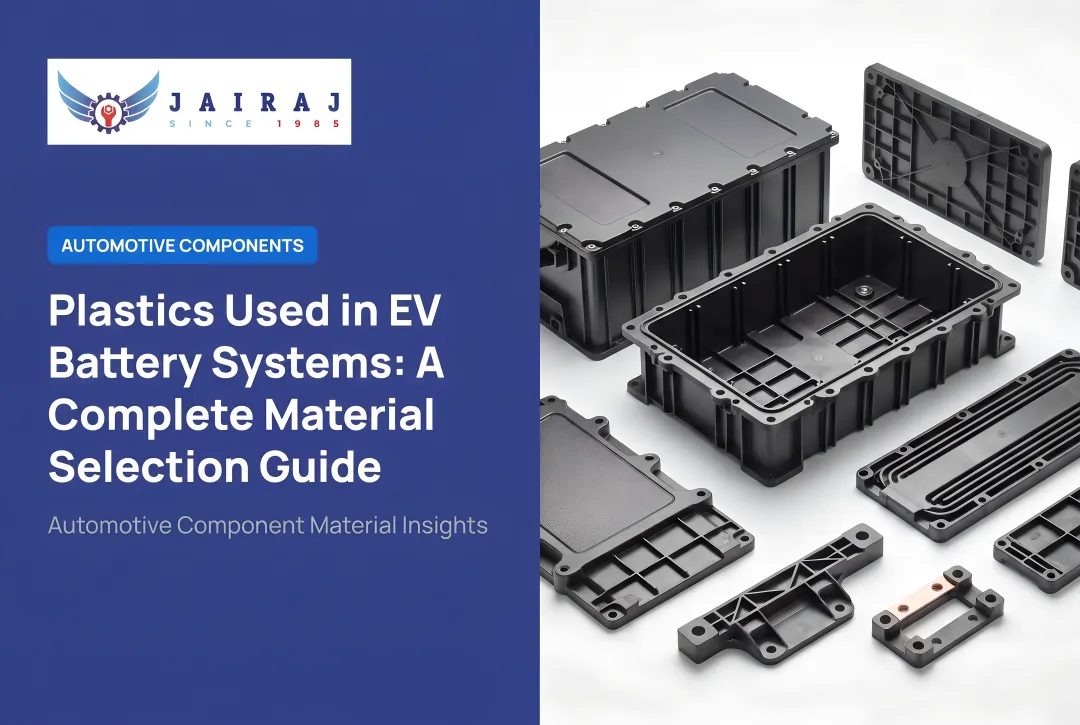
Designing plastic housings for EV power systems means satisfying requirements that actively conflict with each other. A battery pack enclosure base must meet all of the following — simultaneously:
- Insulate against high voltage
- Resist coolant and chemical exposure
- Survive road vibration and mechanical load
- Comply with UL 94 flame standards
- Weigh less than the aluminum it replaces
Get the material wrong and the consequences are real. The electric vehicle plastics market was valued at USD 3.7 billion in 2025 and is projected to reach USD 30.6 billion by 2033, reflecting the scale of decisions OEMs are making on polymer specification right now. A mid-production material redesign, triggered by a failed UL 94 certification or unexpected thermal deformation, burns time and tooling budget that most programs cannot absorb.
This article gives OEM engineers a direct, application-level comparison of the two most commonly specified housing materials: Glass-Fiber Reinforced Polyamide 66 (GF-PA66) and Polycarbonate/ABS (PC/ABS) blends. Each has a clear domain where it outperforms the other — and the comparison covers thermal performance, mechanical properties, flame ratings, processability, and cost trade-offs.
Key Takeaways
- GF-PA66 is the structural workhorse — specified for high-temperature zones, load-bearing enclosures, and coolant-exposed components
- PC/ABS blends win on impact toughness, surface finish, and processability — suited to covers, BMS housings, and control shells below 110°C
- Both materials can achieve UL 94 V-0 flame ratings; differences lie in base formulation, cost drivers, and processing requirements
- Most EV platforms use both — the specific application (battery pack base, inverter cover, or junction box) determines which belongs where
GF-PA66 vs PC/ABS: Quick Comparison
The table below summarises the key performance differences between GF-PA66 and PC/ABS for EV power system housing applications. Use it as a starting point for material selection before engaging your molder on grade-specific tradeoffs.
| Property | GF-PA66 (30% Glass) | PC/ABS (FR Grade) |
|---|---|---|
| Continuous Service Temp | 120–150°C (up to 180°C heat-stabilised) | 90–110°C |
| UL 94 Flame Rating | V-0 achievable at 0.4–1.5mm | V-0 achievable at 1.5–2.0mm |
| Tensile Modulus | ~9,500 MPa (dry) | ~2,400–3,200 MPa |
| Notched Impact Strength | ~11 kJ/m² (23°C, dry) | 35–45 kJ/m² (23°C) |
| Moisture Absorption | 1.5–1.9% at 50% RH | Low (<0.5%) |
| Chemical Resistance | Excellent vs. coolants, oils | Vulnerable to strong solvents |
| Processing | Higher melt temp; pre-drying required | Easier processing window |
| Cost Drivers | Glass loading, FR package, hydrolysis stabilisation | PC/ABS ratio, FR additive system |
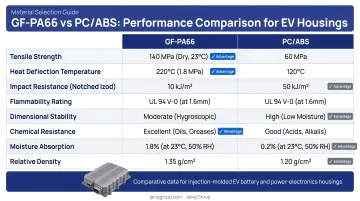
Data drawn from BASF Ultramid A3WG6 HRX datasheet and Covestro Bayblend FR3010 product page.
What Is GF-PA66 and Why Do EV Housings Use It?
Material Identity and Core Properties
GF-PA66 is a semi-crystalline engineering thermoplastic — polyamide 66 reinforced with 15–50% short or long glass fibers. The glass fiber transforms a moderately capable base resin into a structural material whose strength-to-weight ratio competes with light alloys.
For EV power system housings, the properties that matter most are:
- Continuous service temperature of 120–150°C, with heat-stabilised grades reaching 180°C — covering battery-adjacent and under-hood environments
- Tensile modulus up to 9,500 MPa (dry) per BASF datasheet data for PA66-GF30 — sufficient for load-bearing enclosure bases
- Resistance to automotive fluids, oils, and battery coolants — critical for components in thermal management systems
- Electrical insulation — a fundamental requirement for high-voltage junction boxes and motor controller frames
Moisture absorption sits between 1.5% and 1.9% at 50% relative humidity for PA66-GF30, which introduces dimensional variation if not controlled. Pre-drying before injection moulding is required to maintain dimensional stability and avoid surface defects.
Flame Retardancy and Safety Compliance
FR-grade GF-PA66 achieves UL 94 V-0 ratings at wall thicknesses as thin as 0.4mm — LANXESS Durethan AKV 25 F30 (25% glass-filled PA66) achieves V-0 at 0.75mm and 1.5mm. Halogen-free FR versions are increasingly specified by OEMs with sustainability and end-of-life recycling requirements.
At the system level, UNECE Regulation No. 100 Rev.3 governs fire resistance requirements for rechargeable energy storage systems in EVs. Material-level UL 94 ratings feed into, but do not automatically satisfy, these system-level approvals.
Glass Fiber Loading Options
Flame retardancy is one axis of selection. The other is structural performance — and that's determined largely by how much glass fiber is in the compound.
| Grade | Glass Content | Best Fit |
|---|---|---|
| 15GF | 15% | Balance of toughness and cost; connector housings |
| 30GF | 30% | Standard structural choice; motor controller frames |
| 50GF | 50% | Near-metal stiffness; load-bearing enclosure bases |
| Long-fiber PA66 | 30–40% LFT | Improved impact performance; crash-zone components |
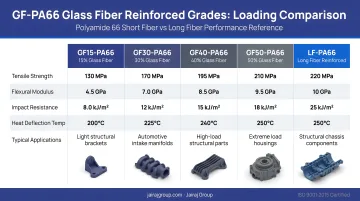
OEMs select fiber loading based on the stiffness and strength the specific sub-assembly demands — not a single "best" grade across a programme.
Where GF-PA66 Is Used in EV Power Systems
These fiber loading options map directly to how the material is deployed across EV power system sub-assemblies:
- Battery module end-plates and tray components
- Motor controller housings and DC-DC converter enclosures
- High-voltage junction box housings
- Cooling manifold brackets in direct contact with thermal management fluids
The LANXESS and Kautex Textron large-format all-plastic battery housing demonstrator put a number to what this means in practice: replacing the aluminium housing of a mid-size EV with a PA-class thermoplastic design cut cycle times and reduced processing costs compared to aluminium extrusion — a concrete reference point for OEMs evaluating metal-to-plastic conversion.
What Is PC/ABS and Where Does It Fit in EV Housing Design?
Material Identity and Core Properties
PC/ABS is an amorphous thermoplastic alloy — polycarbonate blended with ABS. The polycarbonate contributes heat resistance and flame performance; the ABS contributes processability, surface quality, and ductility. Originally developed for automotive interiors, it has since moved into power electronics housing as EV programmes demand better impact performance and tighter dimensional control from enclosure covers.
Key properties for EV housing applications:
- Notched impact strength of 35 kJ/m² at 23°C (Covestro Bayblend FR3010) — roughly three times that of GF-PA66 at equivalent conditions
- Continuous service temperature of 90–110°C — adequate for inverter covers and BMS enclosures, not for direct battery contact zones
- Low moisture absorption — dimensional stability in humid environments without pre-drying
- Superior surface finish — reduces or eliminates post-processing; supports in-mould decoration and EMI shielding coatings
For OEMs running high-volume injection moulding, PC/ABS's wider processing window and lower sensitivity to moisture means fewer rejects and more predictable cycle times in practice.
Limitations to Account for in Design
PC/ABS has real constraints that must be designed around:
- Thermal ceiling — continuous service above 110°C risks deformation in high-heat zones
- Solvent sensitivity — certain assembly fluids and cleaning agents can attack PC/ABS through environmental stress cracking; Covestro notes that unsuitable solvent combinations in paint systems can compromise the material
- Lower structural stiffness — sustained mechanical loads that a GF-PA66 housing handles without creep may cause long-term deflection in PC/ABS
These constraints don't eliminate PC/ABS from consideration — they shape which variant you specify and where.
PC/ABS Variants Worth Knowing
- Standard PC/ABS — general-purpose covers and control unit shells; typically 20–25 kJ/m² notched impact at room temperature
- High-heat PC/ABS — SABIC CYCOLOY CS9610 achieves Vicat B/50 of 124°C, extending the thermal envelope for more demanding applications
- FR PC/ABS — Covestro Bayblend FR3010 achieves UL 94 V-0 at 1.5mm; SABIC CS9610 achieves V-0 at 2.0mm with a non-chlorinated/non-brominated flame retardant system
- Glass-reinforced PC/ABS — adds stiffness where the standard blend falls short, at some cost to impact performance
Where PC/ABS Is Used in EV Power Systems
- Inverter and converter covers (secondary enclosure faces)
- On-board charger housings
- BMS enclosures and control unit covers
- Connector protection shells where snap-fit features and surface quality matter
Its widespread use in EV charging infrastructure and consumer electronics housings confirms the manufacturing scalability — supply chains and process knowledge are well-established.
PA66 vs PC/ABS: How OEMs Should Choose
No single material wins across an entire EV power system. The housing sub-assembly decides.
Choose GF-PA66 When:
- Operating temperature exceeds 110°C continuously
- The housing carries structural loads or must maintain tight dimensional tolerances under sustained stress
- Components contact coolants, thermal management fluids, or battery electrolyte environments
- Near-metal stiffness is required for enclosure bases replacing aluminium extrusions
- Long service life under mechanical and thermal cycling is the primary design driver
Process note: GF-PA66 requires pre-drying to control moisture before moulding, higher melt temperatures, and abrasion-resistant tooling steel — glass fiber wear on mould surfaces accelerates tool degradation without it.
Choose PC/ABS When:
- The housing is a cover, shell, or secondary enclosure face — not a primary structural component
- Operating temperature stays below 110°C
- Impact resistance is a priority, including crash-zone proximity for power electronics covers
- Surface quality, colour consistency, or in-mould features (snap-fits, living hinges) are design requirements
- Processing efficiency and cycle time predictability matter at high production volumes
Decision Summary
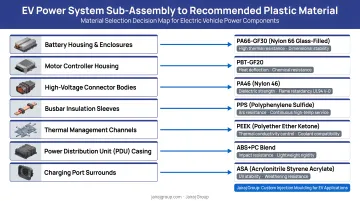
The table below maps common EV power system sub-assemblies to the recommended material based on the criteria above.
| Application | Recommended Material | Primary Reason |
|---|---|---|
| Battery pack base/tray | GF-PA66 (30–50% glass) | Structural load + coolant resistance |
| Motor controller frame | GF-PA66 (30GF) | Temperature + stiffness |
| HV junction box housing | GF-PA66 FR grade | Chemical resistance + V-0 compliance |
| Inverter cover | PC/ABS FR grade | Impact resistance + surface quality |
| BMS enclosure | PC/ABS FR grade | Precision mouldability + dimensional stability |
| On-board charger housing | PC/ABS or high-heat PC/ABS | Moderate thermal + EMI coating compatibility |
Jairaj Group has supported EV OEM material selection across this range of applications for over 40 years. With precision injection moulding across six facilities, the engineering team works from application requirements to grade recommendation — covering both formulation fit and process configuration.
Real-World Considerations for Indian EV OEMs
Manufacturing Process Compatibility
Both materials run on standard injection moulding equipment, but the process requirements differ:
GF-PA66 production requirements:
- Pre-drying to remove absorbed moisture before moulding
- Higher melt temperatures (270–290°C for PA66-GF30)
- Hardened or tool-steel tooling to manage abrasive wear from glass fibers
- Controlled shrinkage compensation in tool design (GF-PA66 shrinks anisotropically)
PC/ABS production requirements:
- Lower melt temperatures and wider processing window
- Less abrasive on tooling — longer tool life between maintenance cycles
- Faster cycle times at equivalent wall thickness for most cover geometries
For Indian OEM production lines running high volumes, the tooling investment difference is meaningful. GF-PA66 tooling typically requires higher-grade steels and more frequent maintenance checks — costs that factor into total-cost-of-ownership calculations alongside raw material price.
Metal-to-Plastic Conversion Opportunity
The LANXESS and Kautex Textron battery housing demonstrator showed that large-format PA-class plastic housings can replace steel or aluminium extrusions with reduced cycle time and measurable weight savings. India's EV market context makes this directly relevant: EV sales in India rose from 50,000 units in 2016 to 2.08 million in 2024 according to NITI Aayog, with India now accounting for roughly 9% of global EV stock.
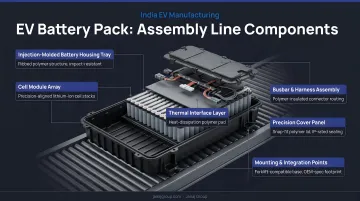
OEMs scaling at that pace face real pressure to cut battery pack weight and component cost at the same time — which is precisely what metal-to-plastic conversion in housing design delivers.
Certification and Supply Chain
That growth imperative makes supplier reliability a direct commercial concern. For Indian EV OEMs, sourcing FR-grade GF-PA66 or UL 94-compliant PC/ABS from an ISO 9001:2015-certified domestic supplier reduces two friction points: lead time and compliance documentation. A manufacturing partner that maintains material certifications, batch traceability, PPAP documentation, and testing records for each housing sub-assembly compresses the OEM's supplier qualification timeline.
Jairaj Group's quality management system — ISO 9001:2015 certified across its manufacturing network — includes dimensional verification, material properties validation, and full traceability documentation structured for automotive OEM supply requirements.
Conclusion
For most EV power system programmes, the answer is both materials — deployed where each is strongest. GF-PA66 belongs in high-temperature, load-bearing, and chemically exposed housings. PC/ABS belongs in impact-critical covers, precision shells, and control unit enclosures where processing efficiency and surface quality drive the decision.
The practical takeaway for OEM engineers: locking in material selection against application-specific temperature, load, and regulatory requirements at the design stage prevents the costliest programme failures:
- Mid-production redesigns triggered by thermal or structural underperformance
- Failed certifications due to incorrect flame or chemical resistance ratings
- Tooling rework when shrinkage or dimensional tolerances weren't validated upfront
An injection moulding partner with documented polymer engineering capability across both material families — such as Jairaj Group, which has supplied precision EV polymer components to automotive OEMs across India since 1985 — reduces that risk from the first design review rather than after a costly setback.
Frequently Asked Questions
What plastic material is most commonly used for EV battery pack housings?
Glass-fiber reinforced polyamide — typically GF-PA66 or GF-PA6 at 30–50% fiber loading — is the most widely specified material for structural battery pack enclosures. Its combination of thermal resistance, chemical compatibility with coolants, and load-bearing stiffness makes it the default choice for enclosure bases and tray components.
Can PC/ABS meet UL 94 V-0 flame retardancy requirements for EV applications?
Yes. Flame-retardant grades such as Covestro Bayblend FR3010 achieve UL 94 V-0 at 1.5mm, while SABIC CYCOLOY CS9610 achieves V-0 at 2.0mm with a non-halogenated FR system. The polycarbonate component's inherent char-forming behaviour gives PC/ABS a flame performance advantage over pure ABS formulations.
How does glass fiber reinforcement affect PA66 performance in EV power system housings?
Glass fiber increases tensile strength, flexural modulus, and creep resistance: BASF's PA66-GF30 reaches a tensile modulus of 9,500 MPa dry versus roughly 3,000 MPa for unfilled PA66. The trade-offs are reduced notched impact toughness and moisture sensitivity requiring pre-drying before moulding.
Can plastic housings fully replace metal enclosures in high-voltage EV applications?
Yes, in many applications. The LANXESS/Kautex Textron demonstrator confirmed that large-format GF-reinforced thermoplastic housings can replace extruded steel or aluminium. Design simulation, wall thickness optimisation, and material qualification testing are essential before production release.
What is the key difference between PA66 and PC/ABS for EV power electronics covers?
PA66-GF excels where structural load and continuous temperatures above 110°C define the requirement. PC/ABS is the better choice for covers and secondary enclosures where impact resistance, dimensional stability in humid conditions, and surface quality matter more than structural stiffness.
What certifications should OEMs verify when sourcing plastic housing components for EVs?
Verify UL 94 flame rating (V-0 at specified wall thickness), ISO 9001:2015 certification, and automotive-grade test documentation covering thermal ageing, dimensional stability, and chemical resistance. PPAP and FMEA documentation should also be available from the supplier for production part approval.