The plastic housing is the first line of defense for everything inside a charger: the power electronics, connectors, and control systems that make charging work. Get the material or design wrong, and you're looking at field failures, water ingress, UV degradation, or worse — a safety hazard that triggers costly recalls.
This guide covers the key material choices, design requirements, and manufacturing considerations for EV charger housings across Level 1, Level 2, and DC Fast Charger (DCFC) applications, for both indoor and outdoor installations.
Key Takeaways
- PC, ABS/PC-ABS, PBT, and PA6/PA66 are the primary plastics for EV charger housings — each suited to different components and environments
- Outdoor housings need to meet IP54 as a minimum, with public fast-charging stations often targeting IP55 or higher
- UL94 V-0 flame retardancy is required for internal components; specify by grade, not by assumption
- Injection molding dominates production — tight tolerances, complex geometry, and lower per-unit costs at volume make it the default choice
- For EV charger housings, plastics outperform metals on weight, corrosion resistance, electrical insulation, and design flexibility
Why Plastics Outperform Metals in EV Charger Housings
Metal enclosures have a long track record in electrical equipment. For EV charger housings — particularly outdoor, high-voltage installations — engineering plastics consistently outperform sheet metal across safety, weight, design, cost, and sustainability criteria.
Electrical Insulation and Safety
Unlike steel or aluminium enclosures, engineering plastics are inherently non-conductive. In DC fast charging environments where bus voltages can exceed 500V, this eliminates the risk of accidental electrical shorts through the housing and removes the need for additional insulating liners — reducing both BOM complexity and compliance risk.
Weight and Corrosion Resistance
According to Covestro, polycarbonate has roughly one-seventh the density of steel and half the weight of aluminium for EV wallbox applications. Beyond weight, plastics simply don't rust. Rain, humidity, salt spray, and cleaning chemicals that would corrode a steel enclosure over a few years have no effect on a properly specified PC or PBT housing — which matters greatly for chargers installed outdoors across India's varied climate zones.
Design Freedom and Part Integration
Injection-moulded plastic housings can combine multiple functional features into a single part:
- Cable routing channels and strain relief features
- Snap-fit and clip assembly interfaces
- Mounting bosses and insert pockets
- Display lens cutouts and light pipe guides
- Gasketed sealing grooves
Each of these would require secondary fabrication or additional components in a sheet metal enclosure. That part count reduction translates directly into lower assembly time and fewer potential failure points.
Cost Efficiency at Scale
Global public charger deployments have already surpassed 5 million units. At that scale, tooled injection moulds deliver a clear per-unit cost advantage: tooling capital is amortised across tens of thousands of shots, and unit costs drop sharply as volumes grow — something sheet metal fabrication cannot replicate.
Sustainability
Polycarbonate is available in grades incorporating post-industrial or post-consumer recycled content. Covestro's Makrolon RE was used in the EVBox Livo wallbox — the first wallbox built with sustainable PC — and SABIC supplies certified renewable LEXAN PC for Charge Amps' Dawn charging station. Recycled or renewable grades still require full UL94 and UV performance validation, but the option exists without sacrificing core material properties.
Taken together, these five factors make the case for engineering plastics not as a compromise over metal, but as the specification-driven choice for modern EV charger housings.
Best Plastic Materials for EV Charger Housings
Material selection for EV charger housings is driven by four variables: operating environment, thermal load (which scales directly with charging power), applicable flame and safety ratings, and cost constraints. Each of the four primary material families covers a distinct part of that design space — and understanding where each excels prevents costly specification errors.
Polycarbonate (PC)
PC is the top candidate for outer enclosure bodies and transparent covers for user interface panels. Its key advantages in this application:
- Meets IK10 impact targets when correctly formulated — relevant for vandalism-prone public charger installations
- Enables integrated display lenses and light pipes without requiring separate glazing parts
- Continuous service temperatures of 116°C–150°C (MatWeb); Covestro rates EV wallbox grades across -30°C to +80°C
- UL94 V-0 and 5VA flame-retardant grades are commercially available from Covestro and SABIC
UV-stabilised PC grades should be specified for outdoor applications; standard PC without UV packages will chalk and yellow over a 10+ year service life.
ABS and PC/ABS Blends
ABS offers good impact strength, easy processability, and paintability at lower cost than PC. Its limitations — inferior UV and heat resistance (maximum service temperature 50°C–109°C per MatWeb) — make it unsuitable on its own for outdoor charger housings.
PC/ABS blends are the practical middle ground. They combine PC's toughness with ABS's better flow characteristics, with maximum service temperatures of 60°C–132°C depending on grade. PC/ABS blends are widely used for the main body shells of indoor and semi-sheltered Level 2 chargers where full outdoor weatherability isn't required. Grade-specific UL flame ratings and UV performance should always be confirmed on the manufacturer's yellow card.
PBT (Polybutylene Terephthalate)
PBT is better understood as an electrical engineering plastic than a cosmetic housing material. It excels in:
- Connector housings and cable strain relief components
- Internal mounting brackets and electrical enclosures
- Parts requiring exposure to oils, greases, or cleaning fluids
BASF's Ultradur B 4500 delivers UL94 V-0 at 0.75 mm thickness and an RTI Electrical rating of 130°C — both directly relevant for components operating near live conductors. PBT also maintains dimensional stability in humid environments better than many alternatives, which matters in outdoor charger internals.
Specialty Polyamides (PA6 / PA66)
Glass-fibre reinforced polyamides offer high stiffness and strength-to-weight ratios that make them attractive for structural brackets, cover components, and thermally demanding parts. BASF's Ultramid PA has been used in LAPP's Mobility Dock portable EV charging system, specified for its mechanical strength, UV resistance, chemical resistance, and halogen-free flame retardancy.
Grade selection within the polyamide family follows a clear split:
- PA66-GF (30–50% glass fibre): the traditional default for under-hood automotive applications; selected where dimensional stability under sustained mechanical load is the primary requirement
- PA6-GF: increasingly specified for EV charging components, where peak operating temperatures are lower than internal combustion engine environments and the grade's improved flow aids complex part geometries
Material Selection Summary
| Material | Impact Resistance | Heat Resistance | UV Stability | Flame Retardancy | Fluid Resistance | Relative Cost |
|---|---|---|---|---|---|---|
| PC | Excellent | High | Good (with additives) | V-0 / 5VA available | Moderate | High |
| ABS / PC-ABS | Good | Moderate | Fair (ABS) / Good (blend) | V-0 available | Fair | Medium |
| PBT | Moderate | Moderate–High | Fair | V-0 at 0.75 mm | Excellent | Medium |
| PA6 / PA66 GF | Good–High | High | Good (stabilised) | HF grades available | Good | Medium–High |
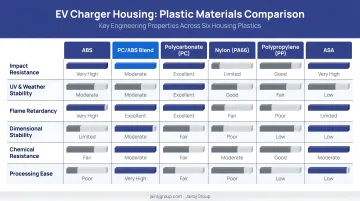
Cost ratings reflect global market pricing. Relative positioning may vary for India-sourced or locally compounded grades.
Key Design Considerations for EV Charger Housings
Weatherproofing and IP/NEMA Ratings
Real-world public charger specifications give the clearest picture of what outdoor installations actually require: the ABB Terra 54 DC fast charger is rated IP54 with IK10 cabinet protection; the Schneider EVlink Pro AC achieves IP55 with IK10. These are not theoretical minimums — they're what leading OEMs actually ship.
Achieving these ratings requires more than selecting a waterproof material. Housing geometry must be engineered to perform:
- Gasketed seams with consistent compression across the full perimeter
- Downward-facing cable entries to prevent water tracking into the enclosure
- Drainage channels at the base to prevent pooling
- Labyrinth baffles at any ventilation openings
IP ratings must be validated through ingress protection testing — not assumed based on the material datasheet. That same discipline around verification extends directly into how you manage heat.
Thermal Management
DC fast chargers generate substantial internal heat. The design challenge is achieving sealed weatherproofing without creating a thermal trap. Design strategies include:
- Thermally conductive plastic compounds — SABIC's LNP KONDUIT compounds provide 1–18 W/mK thermal conductivity, 10–50 times more conductive than unfilled thermoplastics, for targeted heat dissipation paths
- Vented housings with baffles — strategically placed vents with labyrinth geometry that blocks water ingress while allowing heat to escape
- Wall thickness optimisation — thinner walls reduce thermal resistance; uniform wall sections prevent localised heat build-up
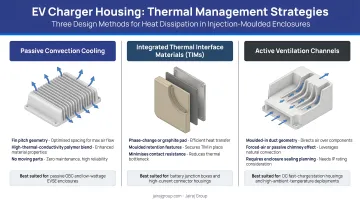
Outdoor charger housings must also perform across wide ambient ranges: the ABB Terra 54 operates from -35°C to +55°C; the Schneider EVlink Pro AC from -30°C to +50°C. Material selection and wall design both need to account for this full cycle. Once thermal behaviour is confirmed, the next variable to lock down is fire safety.
Flame Retardancy Requirements
Any plastic in proximity to live electrical components must be specified to a UL94 flame retardancy rating — and that rating must be verified on the material supplier's UL yellow card, not assumed from the grade family.
- UL94 V-0 — required for internal components directly adjacent to electrical conductors
- UL94 V-2 or better — minimum for outer housing parts
Flame-retardant grades of PC, ABS, and PBT are commercially available from major suppliers. FR performance must be specified at the grade level — standard, unmodified grades of the same base polymer may not meet V-0 or even V-2.
Structural Integrity and Dimensional Stability
Charger housings face mechanical threats — vandalism, accidental impacts, and the cumulative stress of thermal cycling over a 10+ year product life. Design requirements include:
- Wall thickness of 2.5–4 mm for structural housing walls, with uniform sections to prevent sink marks and warpage during moulding
- UV-stabilised grades for all externally visible surfaces
- IK10 impact resistance (matching ABB and Schneider public charger benchmarks) engineered into the part geometry, not just claimed on the datasheet
Assembly and Integration Design
Modern charger housing design increasingly moves away from metal fasteners toward:
- Snap-fit and clip assemblies for faster build and easier field serviceability
- Insert moulding at structural mounting points, using threaded metal inserts for load-bearing connections
- Dual-shot moulding for integrated sealing elements or soft-touch grip areas without adding separate parts
Common integration requirements also include RFID reader cutouts, display apertures, and cable management channels — features that moulded plastic delivers with greater geometric freedom and lower tooling complexity than fabricated sheet metal.
How Injection Moulding Shapes EV Charger Housing Production
Injection moulding is the dominant process for EV charger housings because it combines repeatability, geometric complexity, and economic efficiency in a way no alternative process matches at meaningful production volumes.
Why Injection Moulding Wins
- Tight tolerances are maintained across thousands to millions of shots through PLC-controlled machine parameters
- Complex features — undercuts, ribs, sealing grooves, boss features — can be integrated in a single shot
- Per-unit costs fall sharply as volume increases, making it the right choice once production exceeds a few thousand parts per year
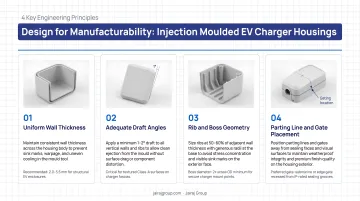
Design for Manufacturability Principles
Getting DFM right at the design stage avoids expensive mould modifications later. Key requirements for charger housing tools:
- Uniform wall thickness — prevents differential shrinkage, warpage, and sink marks
- Draft angles of 1–3° on all vertical surfaces to enable clean part ejection
- Gate positioning away from visible surfaces and structural stress points
- Mould flow simulation to predict fill patterns, weld line locations, and optimise cooling before cutting steel
Jairaj Group's Manufacturing Fit
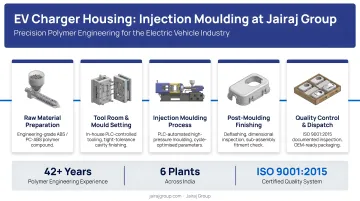
Jairaj Group's injection moulding capabilities align with the technical demands of EV charger housing production. Facilities are positioned near India's major EV manufacturing clusters — Manesar/Gurugram for NCR-based OEMs, Sanand for the Gujarat automotive corridor, and Aurangabad for Pune-region customers.
Relevant capabilities include:
- Materials processed: PC, PC/ABS, PA66-GF, PBT, and ABS — the core families for charger housing applications
- Tooling: In-house tool room covering DFM analysis, mould flow simulation, and prototype tooling
- Advanced processes: Insert moulding and two-shot moulding, both applicable to charger housing assembly features
- EV components in production: EV charger handles and plastic fan grills for EV chargers
Quality documentation under ISO 9001:2015 covers material traceability, dimensional inspection, and process validation records — outputs that support OEM compliance submissions directly.
Compliance, Certifications, and Testing Standards
Key International Standards
| Standard | Scope |
|---|---|
| IEC 61851 | General requirements for EV conductive charging systems |
| IEC 60529 | IP ingress protection rating definitions and test methods |
| UL 2594 | Electric Vehicle Supply Equipment (EVSE) — North American market, Edition 3, Dec 2022 |
| UL94 | Material flammability classification |
| UL 746C | Outdoor suitability of plastics — requires 720h carbon-arc or 1,000h xenon-arc UV exposure plus water immersion; the f1 rating confirms both requirements met |
These international standards set the baseline. For projects targeting the Indian market, a separate — and still-developing — compliance framework applies.
India Market Compliance
India's EV charging standards continue to evolve. Key reference points:
- AIS-138 Part 1 (ARAI, June 2018) — Electric Vehicle Conductive AC Charging System
- Ministry of Power guidelines (revised January 2022) — cover tariff structures and public charging infrastructure requirements
- BIS certification — active for EV charging standards; housing material suppliers must be able to provide material certifications and test data to support OEM submissions
Practical Testing Requirements
Assembled charger housings and their constituent plastics must pass:
- IP ingress protection testing per IEC 60529 protocol
- UV ageing tests — minimum 1,000 hours xenon-arc exposure for outdoor f1 rating
- Thermal cycling across the full operating range (-35°C to +55°C for public charger environments)
- Impact/IK rating tests — IK08 or IK10 for vandalism-prone public installations
- UL94 flammability tests — validated by grade on the supplier's UL yellow card
Each of these tests requires documented material data — traceability back to the original resin grade, UL yellow card confirmation, and third-party test reports. Gaps in this documentation are the most common cause of delays during compliance submissions, so confirming your moulding partner's documentation process before tooling begins is worth the early conversation.
Frequently Asked Questions
What are the three types of EV charging systems?
Level 1 uses a standard domestic socket for slow AC home charging. Level 2 delivers faster AC charging for homes, workplaces, and public stations, while Level 3 (DC Fast Charging) converts AC to high-voltage DC at the station for rapid public use. Each level has different power outputs, connector standards, and heat profiles that directly shape housing material and design requirements.
What plastic material is best for outdoor EV charger housings?
UV-stabilised polycarbonate or PC/ABS blends are generally preferred for outer enclosure bodies due to their impact resistance, dimensional stability, and weatherability. PBT and glass-fibre reinforced PA6 are better suited for connector housings and internal structural components where higher heat and chemical resistance matter more than optical or cosmetic properties.
What IP rating is required for outdoor EV charger enclosures?
IP54 (splash protection, dust-protected) is a common minimum for outdoor chargers, with public charging stations frequently targeting IP55 or IP65 depending on the installation environment. Real-world OEM benchmarks — ABB Terra 54 at IP54, Schneider EVlink Pro AC at IP55 — confirm that requirements vary by product and installation context, not a single universal standard.
Why is flame retardancy important for EV charger housing materials?
EV charger housings enclose live electrical components, so any internal fault must not propagate into a fire through the housing. Plastics must meet UL94 V-0 for internal components or V-2 minimum for outer shells — and flame retardancy must be verified at the specific grade level, not assumed from the base polymer family.
What does an EV charging station cost to set up?
Costs vary widely by charging level and installation context. India's PM E-DRIVE guidelines reference an upstream infrastructure benchmark of ₹6.04 lakh for stations up to 50 kW (based on August 2022 rates). Housing material choices — plastic grade, wall design, integration complexity — represent one lever for managing hardware cost per unit, particularly as deployments scale into high volumes.
Can recycled plastics be used in EV charger housing manufacturing?
Yes, particularly polycarbonate — Covestro's Makrolon RE and SABIC's certified renewable LEXAN PC are both in active use in commercial wallbox housings. Recycled or renewable-content grades must still be validated against the same UL94, UV resistance, and mechanical standards as virgin grades before deployment.