Introduction
Naval vessels — warships, patrol boats, and submarines — operate in one of the most punishing environments on earth. Saltwater corrosion, hydrostatic pressure, mechanical shock from wave impact and weapons discharge, and wide thermal swings don't occur in isolation; they happen simultaneously and around the clock.
That combination makes material selection and manufacturing precision mission-critical. A fitting that fails on a surface warship isn't just a maintenance problem — it's a mission risk.
Precision plastic components are increasingly replacing traditional metals across vessel systems. Not as a cost-cutting compromise, but as a deliberate engineering upgrade. The right engineered polymer, manufactured to tight tolerances, outperforms steel and aluminium on corrosion immunity, weight reduction, and through-life maintenance cost — with no painting, no galvanic degradation, and no rust.
This article covers why naval environments demand a different grade of plastic engineering, which components are prime candidates for polymer replacement, which materials are suited to each application, and what manufacturing and quality standards govern defence vessel supply chains.
Key Takeaways
- Precision plastics deliver corrosion immunity, weight savings, and long service life that metals can't match without costly treatment
- Naval applications span hull fittings, pipe systems, navigation housings, deck structures, and propulsion components
- UHMWPE, PEEK, PTFE, and flame-retardant Nylon are matched to specific naval stress profiles — no single polymer covers every application
- Injection moulding, rotational moulding, and precision machining each demand naval-grade dimensional accuracy
- ISO 9001:2015 sets the quality baseline; defence programmes add First Article Inspection, T&I Plans, and full material traceability
Why Defence Vessels Demand a Different Grade of Plastic Engineering
The Compound Stress Problem
Standard commercial plastics are designed for one or two stress modes. Naval vessels impose five simultaneously:
- Constant saltwater immersion and spray — driving electrochemical and galvanic attack
- Wide thermal variation — from tropical surface temperatures down to cold-water depths
- Mechanical shock — from wave impact, manoeuvring loads, and weapons discharge
- Vibration — continuous, broadband, transmitted through hull structures
- Chemical exposure — fuels, lubricants, hydraulic fluids, and bilge chemistry
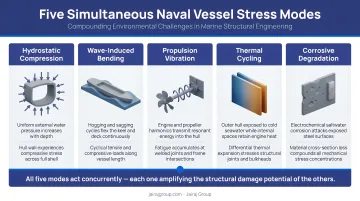
Commercial-grade polymers fail under this combination through plasticiser leaching, UV degradation, stress cracking, and microbiological fouling. Engineering-grade polymers are formulated to resist all of these failure modes together, not each in isolation.
The Weight Argument
Topside weight directly affects vessel stability. NAVSEA's U.S. Navy Salvor's Handbook states that metacentric height (GM = KM - KG) decreases when weight is added above the centre of gravity — and that topside weight additions can deteriorate afloat stability. The density difference is stark: polyethylene sits at 910–960 kg/m³ (57–60 lb/ft³), while aluminium alloy runs at ~2,770 kg/m³ (173 lb/ft³) and wrought iron at ~7,770 kg/m³ (485 lb/ft³).
Replacing topside aluminium and steel fittings with qualified polymer alternatives reduces the topside weight penalty, supporting vessel stability and payload margins — provided the polymer grade meets the applicable fire, smoke, and toxicity requirements for that location.
Weight savings, however, are only part of the case for engineering polymers. Corrosion is where maintenance costs compound steadily across a vessel's service life.
Corrosion as a Lifecycle Cost Driver
Across naval fleets, corrosion is one of the largest recurring cost drivers in vessel maintenance. A DoD corrosion cost analysis estimates $2.608 billion in annual corrosion costs for Navy ships and vessels, representing 23.2% of the FY2006 maintenance budget — a figure that illustrates the order of magnitude of the problem, even if specific current totals differ. Metal fittings in marine environments require protective coatings, cathodic protection systems, and scheduled replacement cycles. Precision polymer components eliminate galvanic corrosion entirely, removing one of the largest drivers of recurring maintenance expenditure.
Flammability Requirements
Naval compartments carry strict fire and smoke toxicity requirements. Relevant standards include MIL-STD-1623E for interior finish materials, MIL-STD-2031(SH) for submarine composites, and UK defence standards Def Stan 02-711 and Def Stan 02-713 covering smoke and toxicity indices. Halogen-free flame-retardant grades of engineering polymers allow plastics to meet these requirements without sacrificing mechanical performance.
Precision Plastic Components Used in Defence Vessels
Hull Fittings and Through-Hull Components
Through-hull fittings — transducer housings, depth sensor ports, and penetration fittings — must seal against water ingress under pressure, resist biofouling, and avoid galvanic interaction with dissimilar metals in the hull structure.
UHMWPE and glass-filled Nylon are typical material choices for these applications:
- UHMWPE: near-zero water absorption (below 0.01%), self-lubricating surface, suited to metallic hull interfaces
- Glass-filled Nylon: dimensional stability under load, supports pressure-rated geometries
Important caveat: Public naval approval evidence for polymer through-hull fittings is limited. Any specific installation requires validation against the vessel's class-approved drawings and technical authority.
Fluid Handling and Piping Systems
Naval fluid systems using precision plastic components include ballast and bilge pipework, freshwater distribution, fuel transfer lines, and fire suppression circuits. Key requirements across all service categories: pressure rating, chemical compatibility, and vibration-resistant joint design.
IMO Resolution A.753(18) sets the acceptance baseline for shipboard plastic piping. Compliance criteria include:
- Adequate fire endurance under sustained heat exposure
- Low flame spread index across pipe surfaces
- Low smoke generation and toxicity thresholds
- Hydrostatic testing at 1.5× design pressure for a minimum of five minutes
PP-R piping systems have received DNV type approval for marine applications. PVDF and CPVC are used in specific service categories, though their exact pressure-temperature limits require the relevant type approval certificate for the specific installation.
Navigation and Electronic Equipment Housings
Signal interference is a disqualifying failure mode in naval electronics housings. Sonar domes, radar housings, communication enclosures, and navigation panels all demand electromagnetic transparency alongside impact resistance and UV stability.
Polycarbonate is widely used for its dielectric properties and impact resistance. Glass-filled PEI (Ultem) suits applications requiring higher heat resistance alongside electromagnetic transparency. ABS is common for lower-stress interior panels. DTIC research on broadband thermoplastic radomes confirms polycarbonate's dielectric characteristics as suitable for this role.
Jairaj Group manufactures avionics enclosure panels and instrument housings in PC, ABS, PEEK, and PC/ABS blends, meeting specified EMI/RFI shielding attenuation values and UL94 V-0 flame retardancy — the same requirements that define qualification for naval electronic housing applications.
Deck and Interior Structural Components
Confined spaces in naval vessels impose strict fire-spread limits on every structural surface. Deck grating, hatch surrounds, cable routing channels, non-slip panels, and interior partitions must also carry structural loads and resist UV and ozone degradation over the vessel's service life.
Roto-moulded HDPE produces large, seamless structural panels without welds — a meaningful advantage where crack initiation at joint lines would be a failure risk. Injection-moulded glass-filled PP handles smaller structural brackets and conduit fittings with tight dimensional consistency.
Propulsion and Mechanical System Components
Shaft seal housings, bearing bushes, impeller wear rings, and cooling water inlet strainers operate in the vessel's most thermally and chemically aggressive zone — rotating assemblies exposed simultaneously to heat, fuel chemistry, and coolant media.
PTFE and PEEK are the materials of choice here:
- PTFE (Fluon grade): usable range −180 to +260°C, static friction coefficient 0.05, dynamic friction 0.11, water absorption <0.01%, chemically inert across nearly all marine fluid types
- PEEK (Victrex 450G): tensile strength 100 MPa, thermal index 260°C, water absorption 0.07%, excellent resistance to fuels, acids, and hydrocarbons
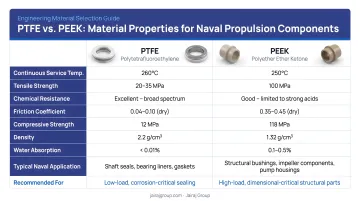
Tight dimensional tolerances are non-negotiable for interference fits in rotating assemblies — governed by ISO 20457:2018 for moulded plastic features, or drawing-specific requirements for machined components.
Engineering-Grade Polymers for Marine Defence Environments
No single polymer covers every naval application. Selection depends on a combination of mechanical load, temperature range, chemical exposure, flammability class, and UV resistance requirements.
| Polymer | Key Strength | Typical Naval Application |
|---|---|---|
| UHMWPE | Impact resistance, near-zero water absorption | Bearing pads, shaft liners, hull wear strips, bushings |
| HDPE | Structural, UV-durable, weld-free construction | Tanks, duct housings, large enclosures |
| PEEK | Metal-strength at 260°C continuous service | Engine room components, seal housings, wear rings |
| PTFE | Near-zero friction, broad chemical inertness | Shaft seals, valve seats, cable insulation |
| FR Nylon 6/66 | Halogen-free flame retardance, mechanical strength | Brackets, housings, structural panels |
| FR Polycarbonate | Flame retardance, impact resistance, dielectric | Electronic enclosures, panels, radomes |
UHMWPE (TIVAR 1000 grade) delivers Charpy notched impact of 100 kJ/m², water absorption below 0.01%, and continuous service to 80°C , making it a proven replacement for bronze and cast iron in fendering, bearing pads, and bushing applications.
For flame-critical compartments, material selection shifts toward certified FR grades. SABIC's LEXAN FR polycarbonate achieves UL 94 V-0 at 0.9 mm with a non-brominated, non-chlorinated flame retardant system. BASF's Ultramid FR polyamide compounds deliver low smoke density and reduced toxicity in fire conditions, both requirements under naval compartment compliance standards.
Jairaj Group manufactures components in PEEK, UHMWPE, PTFE, PA66-GF, and polycarbonate through precision injection moulding and rotational moulding. The company has supplied chemical-resistant and thermally stable components across automotive, aerospace, and defence programmes since 1985.
Manufacturing Processes That Deliver Naval-Grade Precision
Polymer selection is necessary but not sufficient. The manufacturing process determines whether the finished component achieves the dimensional accuracy, surface integrity, and structural consistency required for naval fitment.
Precision Injection Moulding
Injection moulding is the preferred process for small-to-medium components requiring tight tolerances and complex geometry: connectors, housings, fittings, and mechanical brackets. PLC-controlled machinery with real-time monitoring, cavity balancing, and calibrated cooling are essential for repeatable results in defence-grade production.
Jairaj Group operates an ISO 9001:2015-certified injection moulding facility with an in-house tool room for custom mould design and dimensional validation. This supports defence component development from initial tool design through production qualification, with direct experience in multi-cavity, insert, and two-shot moulding across PEEK, PA66-GF, PC, and PTFE.
Dimensional tolerances for moulded plastic parts are governed by ISO 20457:2018, which specifies achievable manufacturing tolerances for integral features and general moulded geometries.
Rotational and Blow Moulding
For larger vessel components, rotational moulding produces one-piece hollow structures without welds, with consistent wall thickness across complex shapes. Jairaj's roto-moulding capability processes PE, cross-linked PE, and LLDPE, with dual-wall and embedded-insert options for structural load-bearing parts. Components produced include:
- Tanks and equipment enclosures requiring seamless construction
- Duct sections with complex geometries
- Structural parts with embedded inserts for load-bearing applications
Beyond rotational moulding, two additional processes cover the remaining range of hollow and continuous-profile components. Blow moulding handles parts requiring precise wall-thickness accuracy — ducts, reservoir tanks, and ventilation sections. Extrusion covers continuous profiles including cable conduit, weather seals, and deck channel sections, where uniformity over length is the critical parameter.
Quality Assurance and Compliance in Naval Plastic Manufacturing
Documentation and Traceability
Defence vessel supply chains require documented traceability at every stage:
- Material certification — polymer batch and grade verification from resin supplier
- In-process dimensional inspection — against drawing tolerances per ISO 20457 or contract requirement
- Post-production testing — mechanical properties, chemical resistance, flammability performance
- Release documentation — certificate of conformance, test reports, and batch traceability records
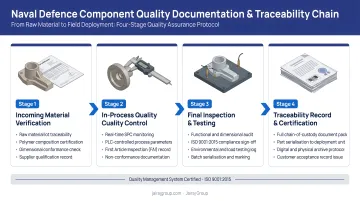
This documentation supports vessel classification society review and defence procurement audit. Jairaj Group maintains full material traceability from batch receipt through finished component dispatch under its ISO 9001:2015 quality system.
Testing Categories for Naval Components
| Test Type | Applicable Standard | Component Category |
|---|---|---|
| Hydrostatic pressure | IMO A.753(18): 1.5× design pressure, ≥5 minutes | Fluid system fittings and pipe joints |
| Salt spray / corrosion | ISO 9227:2022 | Topside and exterior components |
| UV weathering | EN ISO 4892-3 (UV-A 340 nm) | Deck and exterior structural panels |
| Vibration | MIL-STD-167-1A | Electronic housings and shipboard equipment |
| Shock | MIL-DTL-901E | Shock-rated shipboard installations |
| Flame / smoke | MIL-STD-1623E, MIL-STD-2031(SH) | Interior finish and structural materials |
Not every component requires every test. The applicable class rule, contract specification, or equipment standard determines the required test programme for each component.
Quality Framework Above ISO 9001:2015
ISO 9001:2015 is the baseline. Defence vessel programmes layer additional requirements:
- NAVSEA Standard Item 009-004 requires a Test and Inspection Plan (TIP) for each item
- SAE AS9102 defines First Article Inspection (FAI) documentation — covering dimensional verification, material certification, and functional testing at initial production
- NATO AQAP 2110 specifies quality assurance requirements for defence product suppliers
Jairaj Group brings PPAP documentation capability developed through automotive OEM programmes — including structured control plans, measurement system analysis, and process capability studies — alongside its ISO 9001:2015 quality system. This depth of documentation infrastructure supports the structured audit and traceability requirements that defence vessel programmes demand.
Frequently Asked Questions
What type of plastic is used for boats?
Marine vessels commonly use HDPE, UHMWPE, fibreglass-reinforced polyester, and Nylon across structural and fitting applications. Choice depends on water exposure, load-bearing requirements, and application type — defence grades must also meet flammability and toxicity compliance standards that recreational materials don't address.
Which type of plastic is the strongest?
In engineering applications, PEEK and UHMWPE are among the highest-performing: PEEK for high-temperature structural strength (100 MPa tensile, continuous service to 260°C) and UHMWPE for impact resistance (Charpy notched impact exceeding 100 kJ/m²). Carbon fibre-reinforced polymers can exceed the strength-to-weight ratio of many metals in composite form.
What makes plastic components suitable for saltwater environments in defence vessels?
Engineered polymers are inherently immune to galvanic and electrochemical corrosion, have near-zero water absorption depending on grade, and resist biofouling better than uncoated metal. They can be compounded with UV stabilisers and antifungal additives to extend service life under continuous saltwater exposure.
Can plastic components replace metal parts in defence vessel hulls?
Plastics are not used for primary structural hull plating. However, precision polymer components increasingly replace metal in fittings, internal pipe systems, bearing surfaces, and equipment housings — delivering measurable weight savings and corrosion elimination without compromising structural integrity.
How are precision plastic components tested before installation on defence vessels?
Components undergo dimensional inspection, pressure and leak testing, environmental conditioning (salt spray, UV exposure, thermal cycling), and flammability testing. All results are documented against the applicable naval specification or classification society requirement for that component type.
What certifications should a plastic components supplier hold for defence vessel programmes?
ISO 9001:2015 is the baseline requirement. Defence programmes additionally require material traceability records, First Article Inspection documentation per SAE AS9102, and compliance with Indian Navy or DRDO procurement standards. Export programmes may also require registration under NATO AQAP 2110.