The challenge is that "lightweight plastic" gets treated as a single idea when the reality is more specific. The strategic value of engineered polymers in defence shows up in fuel consumption data, soldier endurance research, lifecycle maintenance costs, and supply chain economics — not just density charts.
This article covers the measurable strategic advantages that lightweight engineered plastics deliver across defence applications, from ground vehicles and rotorcraft to dismounted soldier systems and UAV platforms, and what procurement teams leave on the table when these materials are overlooked.
Key Takeaways
- Engineered plastics are significantly lighter than steel and aluminium by density, directly reducing vehicle fuel consumption and carried equipment weight in the field
- High-performance grades — PEEK, Ultem, glass-filled nylons, polycarbonate — withstand heat, chemical exposure, and mechanical impact across defence operating environments
- Injection moulding consolidates multi-part assemblies into single components, cutting assembly time and reducing failure points
- Total cost of ownership drops over a system's service life through fewer replacements, less maintenance, and a lighter logistics burden
- India's ₹1.54 lakh crore defence production in FY 2024-25 is driving direct demand for qualified domestic engineered plastic suppliers
What Are Lightweight Engineered Plastics?
Engineered plastics are polymer compounds formulated with additives, fillers, or reinforcement agents (glass fibre, carbon fibre, mineral fills) to achieve mechanical, thermal, and chemical properties that match or exceed metals in targeted applications. Unlike commodity plastics chosen for cost and ease of forming, engineered grades are specified to a performance brief.
The distinction matters in defence contexts. A standard ABS housing and a glass-filled nylon structural bracket both get called "plastic," but they serve different performance envelopes. Engineered grades are specified, tested, and documented against defined operating conditions — that documentation discipline is what makes them suitable for mission-critical environments.
Where they appear in defence applications:
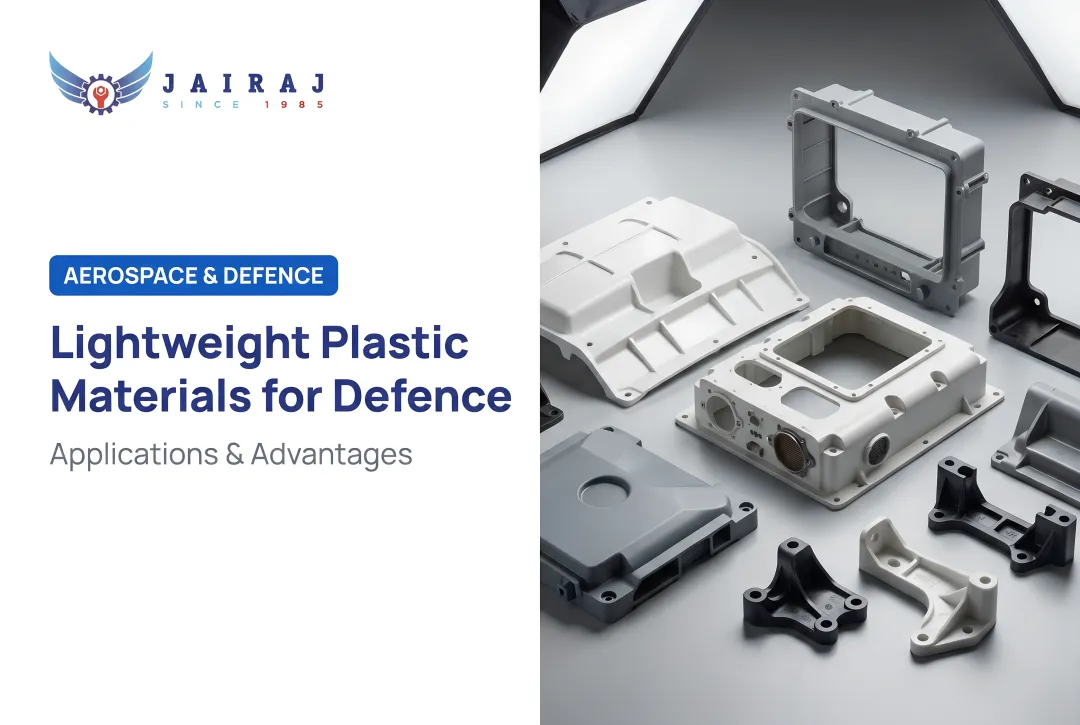
- Structural housings and protective enclosures
- Vehicle panels and access covers
- Cable connectors and avionics assemblies
- Weapon system components and weapon mounts
- Soldier-worn gear: helmets, radio housings, protective eyewear
- Drone frames, propeller guards, and motor mounts
- EOD suit components and sensor housings
These are load-bearing or environment-critical contributors, not decorative elements. Each item listed above carries load, protects electronics, or enables the system to function as designed.
Key Strategic Advantages of Lightweight Engineered Plastics in Defence
The advantages below are evaluated through operational and procurement lenses — weight, durability, cost, and design efficiency. Each maps to outcomes that defence planners and OEMs can measure.
Advantage 1: Significant Weight Reduction Without Sacrificing Structural Integrity
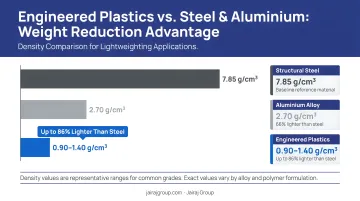
The density gap between engineered plastics and metals is substantial. Based on published material datasheets:
| Material | Density | vs. Steel (AISI 1018) | vs. Aluminium (6061-T6) |
|---|---|---|---|
| PEEK 450G | 1.30 g/cm³ | ~16.5% of steel mass | ~48.1% of aluminium mass |
| Polycarbonate | 1.20 g/cm³ | ~15.2% of steel mass | ~44.4% of aluminium mass |
| PA66-GF30 | 1.36 g/cm³ | ~17.3% of steel mass | ~50.4% of aluminium mass |
| Steel (AISI 1018) | 7.87 g/cm³ | Baseline | — |
| Aluminium (6061-T6) | 2.70 g/cm³ | — | Baseline |
Sources: Victrex PEEK 450G datasheet (March 2026); Covestro Makrolon 3103 via MatWeb; BASF Ultramid A3WG6 LT BK; MatWeb AISI 1018; ASM International via MatWeb for 6061-T6.
This density advantage is a starting point for structural design, not a direct substitution ratio — a polymer component replacing a steel one must be re-engineered to achieve equivalent load-bearing performance. But the weight reduction potential is real and substantial.
Operational impact on vehicles: A 2018 U.S. Army TARDEC modelling study found that a 15% lighter ground combat vehicle corresponded to fuel economy improvements of approximately 12% for the M1A2 Abrams and 14.3% for the M2A3 Bradley. Across a fleet, that difference compounds into significant logistics cost reduction and extended operational range per sortie.
Operational impact on dismounted soldiers: U.S. Army doctrine cited by Army University Press sets a fighting load threshold of no more than 30% of body weight and an approach march load of no more than 45%. Soldier-borne electronics, housings, brackets, and weapon accessories that can be specified in engineered polymers instead of metal directly reduce carried weight — without compromising protection or function.
KPIs affected: vehicle fuel consumption rate, payload-to-weight ratio, sortie range, soldier load weight, logistics cost per mission.
Advantage 2: Exceptional Durability Across Extreme Operating Conditions
Defence environments combine stressors that standard materials degrade under: heat, chemical exposure (fuels, hydraulic fluids, lubricants, decontamination agents), UV radiation, moisture, and mechanical vibration. The compound nature of this stress is what causes premature failure — and what engineered polymer grades are specifically formulated to resist.
Thermal performance by grade:
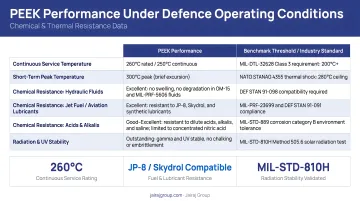
- PEEK 450G: Heat deflection temperature 152°C at 1.82 MPa; RTI/electrical rated at 260°C; melting point 343°C (Victrex, March 2026)
- PA66-GF30 (Ultramid A3WG6): HDT 240°C at 1.8 MPa (BASF)
- PPA (Amodel AS-1145 HS, 45% GF): Continuous service 165–185°C; HDT 279°C unannealed (Syensqo/Solvay via MatWeb)
- Ultem (PEI): Glass transition temperature 217°C; structural performance maintained up to 200°C; RTI up to 180°C (SABIC)
Chemical resistance in practice: Solvay's KetaSpire PEEK retained 98.9% tensile strength after 7 days in Jet Fuel A/A-1 and 100% tensile strength after 7 days in Skydrol LD-4 hydraulic fluid. Motor oil immersion testing at 165°C for 1,000 hours showed 97.3% tensile strength retention. Victrex independently rates PEEK as "A" (fully resistant) for aviation fuel and hydraulic oil across tested temperatures.
For components in engine bays, fuel system adjacency, and routine chemical decontamination, these properties are directly operational. A less specified material will show dimensional drift under sustained chemical and thermal load — and eventual failure in those conditions is not a maintenance event; it is a mission risk.
KPIs affected: component failure rate, maintenance cycle frequency, mean time between replacements, operational availability percentage, total lifecycle maintenance cost.
Advantage 3: Design Freedom, Part Consolidation, and Lower Total Cost of Ownership
Injection moulding allows geometries that are simply not achievable through metal machining or die casting within the same cost envelope — internal channels, variable wall thickness, integrated clips, colour-in-material finishes, and multi-function features produced in a single tool cycle.
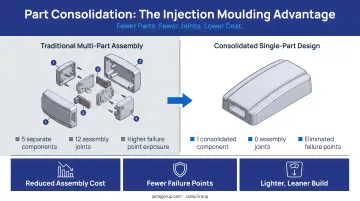
The direct consequence is part consolidation: what requires multiple machined metal parts with assembly operations can often be produced as a single moulded component.
- Fewer components = fewer assembly operations = lower production labour cost
- Fewer assembly joints = fewer potential failure points in zero-tolerance defence applications (NASA's Mechanical Design Reliability Handbook explicitly notes that joints are typically unreliable elements and recommends integrating mechanical functions where possible)
- Faster cycle times reduce per-unit cost at production volume
- Lighter assemblies reduce downstream logistics, handling, and transport costs through the supply chain
The TCO advantage builds further over a system's service life. Correct engineered polymer specification reduces the frequency of replacement cycles, cuts the logistics burden for spare parts, and reduces unplanned maintenance — all of which directly affect operational readiness and lifecycle programme cost.
Jairaj Group's precision injection moulding and in-house tool room capabilities are directly applicable here. With over 40 years of polymer engineering experience, ISO 9001:2015 certification, and active production of defence components — including PEEK equipment housings, polycarbonate avionics panels, glass-filled nylon structural parts, and Ultem-grade aerospace components — Jairaj delivers defence-specification polymer components with full documentation, material certificates, PPAP reports, and end-to-end traceability from an established domestic supply chain.
KPIs affected: per-unit production cost, number of assembly components per system, logistics cost per unit, defect rate at assembly.
What Happens When Engineered Plastics Are Overlooked in Defence Procurement
Ignoring engineered plastics where they are technically superior does not simply mean missing out on weight savings. The consequences are cumulative and operational:
- Heavier fleet platforms drain resources across the board. Vehicles built with excess weight consume more fuel, require more frequent mechanical maintenance, and lose tactical agility. A single incorrect material specification, replicated across hundreds of vehicles, produces measurable degradation in operational range and logistics cost over the platform's service life.
- Specifying the wrong plastic grade causes premature failure in the field. Commodity plastics used in place of engineered grades in high-stress environments lead to dimensional instability, chemical degradation, and component breakdown. In live operational contexts, reactive maintenance and unplanned downtime carry consequences that procurement decisions rarely account for.
- Procurement-stage pricing hides the true cost of metal. A metal component may appear cheaper upfront. Over a 15–20 year service life, more frequent replacement cycles, higher spares logistics burden, and greater maintenance labour typically reverse that calculation. For components that could have been specified in a durable engineered polymer grade, the cost gap widens with every service interval.
How to Get the Most Value from Engineered Plastics in Defence Applications
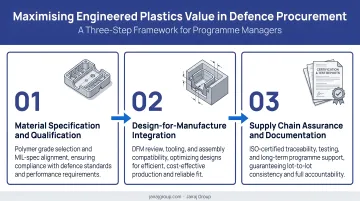
Realising the full advantage of engineered plastics requires getting three things right:
1. Application-specific material selection
Map the actual operating conditions before specifying a grade:
- Operating temperature range (minimum and maximum, not just nominal)
- Chemical exposure profile — the specific fuels, hydraulic fluids, and cleaning agents involved
- Mechanical load type and frequency
- Regulatory requirements: flame rating, RoHS compliance, military specification equivalents
Selecting PEEK for a low-load ambient housing wastes cost. Selecting standard ABS for an engine-adjacent component risks failure. The grade must match the actual performance envelope, not a generic "high-performance" label.
2. Partner with manufacturers who have documented quality systems and in-house capability
The gap between design intent and manufactured output is where defence programmes fail. Work with manufacturers who hold:
- ISO 9001:2015 certification (and AS9100 where applicable)
- In-house tooling capability (not outsourced)
- Full documentation: material certificates, dimensional reports, FMEA, control plans, and batch traceability
Jairaj Group is one such domestic manufacturer. With six facilities across India, ISO 9001:2015 certification, and active production of components for drone and defence vehicle applications, the group is structured to support defence-grade plastic component programmes under India's Make in India framework.
3. Design-in plastics from concept phase
The compounding advantages — weight, cost, durability — are fully realised when engineered plastics are specified at system design stage, not retrofitted as metal replacements after architecture is fixed. At system design stage, material choices affect structural geometry, fastening methods, and assembly sequencing — decisions that can't be undone cheaply once architecture is locked.
Conclusion
Lightweight engineered plastics give the defence sector something metal alternatives cannot: consistent performance across weight, durability, and design — without the maintenance burden. The density advantage is real. Chemical and thermal resistance is documented. Design flexibility enables part consolidation that cuts failure points and assembly cost in the same move.
That value scales. A correct material specification replicated across thousands of units drives real improvements in operational readiness, logistics cost, and mission capability. India's defence manufacturing expansion — targeting ₹3 lakh crore in production by 2029 — creates both the context and the demand for qualified domestic suppliers capable of delivering these components to defence-grade standards. Manufacturers like Jairaj Group, with four decades of precision polymer engineering across aerospace and industrial verticals, are positioned to meet that demand.
Engineered plastic adoption in defence procurement is a programme-level strategic decision — one with documented consequences for readiness, cost, and long-term capability.
Frequently Asked Questions
What are the main types of lightweight engineered plastics used in the defence sector?
The four primary categories are:
- High-performance resins (PEEK, Ultem) — extreme heat and chemical environments
- Glass-filled nylons — structural strength and dimensional stability
- Polycarbonates — impact resistance and optical clarity
- ABS/PC blends — housings and enclosures
Material selection depends on operating temperature, chemical exposure, and mechanical load. No single grade suits all defence environments.
What is military-grade plastic?
"Military-grade plastic" refers to engineered polymer compounds that meet defined performance standards — mechanical strength, temperature resistance, chemical resistance, and dimensional stability — as specified by military qualification standards such as MIL-P-46183 (covering PEEK moulding material). These materials are distinguished from commodity plastics by formulated, tested, and documented performance envelopes, not marketing claims.
What is the latest defence technology in India involving lightweight engineered plastics?
Atmanirbhar Bharat and Make in India are driving adoption of engineered plastics in drone components, armoured vehicle parts, and avionics enclosures — backed by DRDO's indigenous polymer materials programme. India's UAV market alone is projected to grow from USD 0.47 billion in 2025 to USD 1.39 billion by 2030 (24.4% CAGR), creating strong demand for qualified domestic polymer component suppliers.
Can engineered plastics replace metal in all defence applications?
Not entirely. Ballistic protection layers, extreme-load structural elements, and high-temperature propulsion components still require metal or composite-metal hybrids. That said, engineered plastics outperform metal across housings, panels, connectors, and sensor enclosures — categories that account for a substantial share of the total component count on most defence platforms.
How do engineered plastics perform in extreme temperature environments?
High-performance grades such as PEEK (RTI 260°C), PPA (continuous service 165–185°C), and Ultem (structural performance to 200°C) retain mechanical properties across wide temperature ranges. The key is matching the specific resin grade to the actual operating temperature profile — including both high-heat engine-adjacent conditions and cold-altitude environments — rather than selecting a generic "high-temp" designation.
What makes injection-moulded plastics particularly suitable for defence-grade components?
Injection moulding delivers high repeatability, tight dimensional tolerances, and the ability to consolidate complex multi-part assemblies into a single component — reducing joints and, with them, potential failure points. Full documentation and batch-level traceability across production runs supports defence procurement qualification requirements directly.