Key Takeaways
- Cold temperatures drive plastics toward their glass transition temperature (Tg), causing stiffening, brittleness, and crack-prone behavior
- UHMW-PE and PTFE maintain usable properties to −200°C and below; polycarbonate and glass-filled PA 6.6 are reliable to −40°C to −50°C
- Cold-weather suitability comes down to four properties: low-temperature impact strength, thermal expansion coefficient, moisture absorption, and thermal cycling resistance
- Datasheet ratings reflect lab conditions; real field performance is more demanding and requires component-level validation
What Cold-Temperature Performance Actually Means
Sub-zero service is not simply about surviving a cold soak. A plastic component rated to −40°C must maintain impact strength, dimensional stability, and seal integrity under load at that temperature — continuously, through repeated freeze-thaw cycles, and often alongside vibration, UV exposure, or chemical contact.
The governing concept is glass transition temperature (Tg): the temperature range at which an amorphous polymer shifts from a viscoelastic, energy-absorbing state to a rigid, glassy one. Below Tg, segmental chain motion is severely limited, meaning applied energy concentrates at stress risers rather than dissipating through deformation. Research published in PMC (2020) confirms that below Tg, chain diffusion is suppressed to the point where brittle fracture replaces plastic yielding.
Two important clarifications:
- Tg is a range, not a single point. Properties degrade progressively as temperature drops through this zone
- Semi-crystalline polymers behave differently. Materials like UHMW-PE and HDPE contain crystalline regions alongside amorphous segments, which provides partial protection against the sharp Tg-driven property drop seen in fully amorphous polymers like polycarbonate or ABS
Those lab-measured Tg values, however, assume ideal conditions. Real-world components routinely underperform datasheet ratings.
Why Field Performance Diverges from Lab Data
Theoretical Tg values assume dry, freshly moulded, unstressed material. Real components diverge from this in several ways:
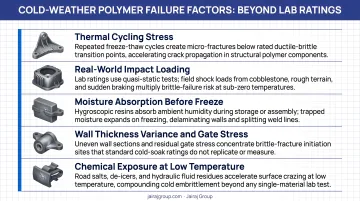
- Loading rate matters as much as temperature. ANTEC 2008 guidance from the Madison Group shows that high strain-rate loading — impact and mechanical shock — can trigger brittle fracture even above nominal Tg. A part that survives slow deflection at −30°C may shatter under sudden impact at the same temperature.
- Residual moulding stress concentrates at weld lines and gate areas, turning these into preferential crack initiation sites under cold-weather loading.
- Absorbed moisture initially acts as a plasticiser, lowering Tg. Once frozen inside hygroscopic materials, that same moisture expands internally and degrades mechanical properties from within.
- Thermal cycling progressively widens micro-cracks through differential expansion and contraction — creating failure sites even in materials that never approach their Tg.
- UV aging breaks polymer bonds over time, reducing cold-weather impact resistance in any outdoor component.
Temperature Thresholds by Material
Every plastic has two distinct cold limits: a continuous-use lower boundary (sustained load at rated temperature) and a short-term survival limit (brief exposure without load). Operating near the continuous-use boundary consumes safety margin rapidly — most acutely when mechanical and thermal stresses combine. The table below summarises nominal cold operating ranges across common engineering plastics.
Nominal Cold Operating Ranges
| Material | Approximate Cold Limit | Key Caveat |
|---|---|---|
| UHMW-PE | −200°C to −260°C (service range) | High CTE versus metals; grade-specific |
| PTFE | −268°C minimum service (air) | Grade and product status must be confirmed |
| Polycarbonate | −40°C minimum service (moulded) | Impact value drops sharply at −40°C by grade |
| Glass-filled PA 6.6 | −40°C to −50°C (selected grades) | Moisture conditioning mandatory for valid data |
| TPU | Flexible to −60°C (supplier-stated) | Exact limit requires grade datasheet confirmation |
| Standard HDPE | Relatively tough to approximately −50°C | Impact-sensitive under sudden loading below −30°C |
| Plasticised PVC | Brittleness temperature ≈ −31.7°C | One flexible grade per ASTM D746; highly dependent on plasticiser content and migration over time |
These ranges assume static load, dry conditions, no UV pre-exposure, and gradual temperature change — conditions that rarely hold in arctic or cold-industrial field environments.
Why Safety Margins Cannot Be Ignored
At temperatures approaching but not yet exceeding the published lower limit, cumulative effects accelerate degradation:
- Surface micro-cracking from thermal cycling widens progressively
- Creep resistance drops, reducing the load a component can sustain indefinitely
- Environmental stress cracking (ESC) risk rises sharply; NPL research (CMMT(A)288) links ESC — combining stress, chemical exposure, and temperature — to approximately 30% of engineering plastic failures
Specifying a material exactly at its published cold limit, with no margin, leaves no buffer for real-world variability in load, environment, or thermal cycling rate. Build in headroom.
Four Material Properties That Govern Cold-Weather Behaviour
Cold-weather suitability is a composite of interdependent properties. Specifying only minimum service temperature without reviewing the others is a common route to field failure. Each of the four properties below interacts with the others — weakness in any one can compromise a material that looks adequate on paper.
1. Low-Temperature Impact Strength
This is the most diagnostically useful property for cold-weather selection. Charpy or Izod impact tests should be conducted at the actual intended service temperature — not at room temperature.
The drop can be severe. SABIC Lexan 940A polycarbonate shows notched Izod impact falling from 7.00 J/cm at 23°C to 1.25 J/cm at −40°C (ASTM D256) — an 82% reduction. ABS grades show similarly wide variation at sub-zero temperatures.
By contrast, a glass-filled PA 6.6 grade (Ascend Vydyne R433H) records 18.0 kJ/m² at −40°C under 50% RH conditioning — demonstrating that impact-modified engineering grades can maintain respectable cold performance when correctly specified.
Impact-modified grades (rubber-toughened nylon, impact-modified ABS, toughened PC/PET blends) extend usable impact performance by incorporating rubber phases that lower the effective Tg of the polymer network without severely sacrificing stiffness.
2. Coefficient of Thermal Expansion (CTE) and Dimensional Stability
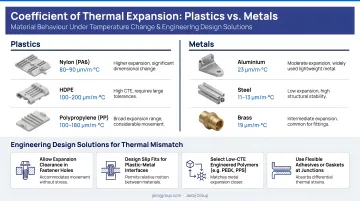
Plastics contract significantly more than metals during cooling. UHMW-PE has a CTE of approximately 180 × 10⁻⁶/K, while polycarbonate averages around 66–70 × 10⁻⁶/K. Compare these to aluminium 6061-T6 at 23.6 µm/m·°C and high-carbon steel averaging 12.5 µm/m·°C.
In plastic-metal hybrid assemblies, this mismatch generates tensile stress in the plastic as surrounding metal contracts less. Failure concentrates at welds, gate areas, or moulded-in inserts. Design solutions include:
- Clearance allowances sized for the full expected temperature range
- Compliant fastening systems that accommodate differential movement
- Representative thermal cycling in qualification testing
3. Moisture Absorption and Freeze-Thaw Interaction
Hygroscopic materials introduce a compounding cold-weather risk. PA 6.6 absorbs up to 8.5% moisture at saturation and 0.45% in 24 hours (ASTM D570, Ensinger TECAMID 66). That absorbed moisture plasticises the material at ambient temperatures — but at sub-zero temperatures, it can freeze within the polymer matrix and degrade mechanical properties.
Materials with near-zero moisture absorption are preferred in immersion or high-humidity cold environments:
- PTFE: ≤0.010% water absorption at 24 hours
- UHMW-PE: ≤0.01% water absorption
- HDPE: minimal moisture absorption (grade verification required)
For hygroscopic materials like PA 6.6, any cold-temperature impact testing must state moisture conditioning — dry-as-moulded values are not valid for conditioned field components.
4. Additive Packages and Rubber-Phase Tougheners
Arctic-grade formulations are distinguished from standard grades primarily by their additive packages. Common inclusions are:
- Cold-flow modifiers that maintain ductility at low temperatures
- Internal lubricants that reduce friction-induced stress during thermal cycling
- UV stabilisers that prevent surface embrittlement in outdoor cold exposures
Rubber-phase tougheners work differently. Small elastomeric particles distributed through the polymer matrix absorb impact energy and lower the effective ductile-brittle transition temperature — without the stiffness penalty of adding large amounts of flexible polymer. This mechanism explains why impact-modified nylon grades like BASF Ultramid A3Z and Ascend Vydyne 47 NT substantially outperform unfilled PA 6.6 grades in cold impact tests.
Which Plastics Perform Best in Sub-Zero Applications
Top Performers
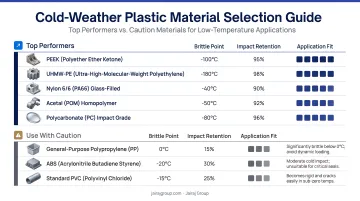
UHMW-PE covers the broadest temperature range of any common engineering plastic — service temperatures are documented to −260°C (Ensinger TECAFINE PE1000). High impact retention, excellent abrasion resistance, and near-zero moisture absorption make it the default choice for wear strips, plow blades, pipeline liners, and low-friction bearing surfaces. The main design constraint is its high CTE relative to metal mating components.
PTFE is non-embrittling at cryogenic temperatures, with minimum air service confirmed at −268°C (Chemours Teflon CFP6000). Its near-zero moisture absorption and chemical inertness make it the default choice for cryogenic seals, electrical insulation, and wire/cable coatings in extreme cold.
Polycarbonate maintains impact performance to −40°C, but only for appropriate grades. Suitable for safety glazing, instrument enclosures, and protective covers — provided grade selection is verified. Room-temperature PC toughness cannot be extrapolated to arctic conditions; the impact drop at −40°C is both real and significant.
Glass-filled PA 6.6 offers good structural stiffness at low temperatures for grades specifically conditioned and impact-tested at the target temperature. Used for structural brackets, gear wheels, and sensor housings. Moisture management during part life is non-negotiable.
TPU retains flexibility at low temperatures and is widely used for seals, gaskets, cable sheathing, and vibration damper bushes. Jairaj Group's TPU shock absorber components and vibration damper bushes are specified across the −40°C to 120°C range for automotive and heavy equipment applications. Grade datasheets must confirm the specific low-temperature flexibility limit.
Materials to Specify Cautiously
- Standard PVC: Brittleness temperature approximately −31.7°C for plasticised grades; embrittlement threshold rises as plasticiser migrates over service life
- Unmodified polypropylene: Poor cold impact performance; avoid in dynamic low-temperature applications
- Polystyrene: Brittle at room temperature; not suitable for sub-zero impact applications
Grade Selection Matters as Much as Resin Family
Pipe-grade HDPE outperforms standard HDPE in cold impact. Rubber-toughened PA 6.6 retains ductility where unfilled grades embrittle. Within polycarbonate, impact-rated grades differ substantially from general-purpose grades at −40°C.
Selecting the right grade requires verified datasheet performance at the target temperature, not room-temperature extrapolation. Jairaj Group's engineering teams apply 40+ years of material and process knowledge to grade selection and injection moulding of cold-rated components across automotive, aerospace, defence, and industrial programmes.
Design reinforces or undermines any material choice. At low temperatures, residual stress concentrations become primary failure sites — making the following critical:
- Uniform wall thickness across the moulded part
- Generous corner radii to distribute stress
- Carefully positioned gates to minimise weld lines
Jairaj's in-house tool room and DFM process simulations address these factors from the tooling stage, before the first shot is run.
Specifying, Testing, and Validating Cold-Weather Parts
A datasheet minimum service temperature is a screening value, not a component qualification. Cold-temperature performance must be both specified in engineering documentation and verified through testing under representative conditions.
Relevant test methods:
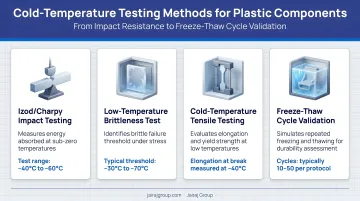
- ISO 180 / ASTM D256 — Izod impact strength at rated service temperature (not room temperature)
- ASTM D746 — Brittleness temperature by ball-drop impact; useful for embrittlement screening
- ASTM D570 — Water absorption; essential pre-conditioning step for hygroscopic materials before cold testing
- Freeze-thaw cycling protocols — Combined wet/dry preconditioning before impact or tensile validation where moisture exposure is credible
Common specification pitfalls:
- Applying room-temperature datasheet values to cold-service components
- Treating minimum service temperature as the lower operating boundary without adding a margin
- Testing flat, unnotched specimens rather than production parts that carry weld lines, residual stress, and non-uniform cross-sections
- Ignoring the combined effect of cold + vibration + chemical exposure, which accelerates failure modes not seen in isolated cold tests
Consistent process controls are what close the gap between validated test data and production-part performance. Jairaj Group's ISO 9001:2015-certified manufacturing system ties material certification, dimensional verification, and full traceability directly to each production run — so engineering teams receive documentation that supports qualification, not just shipment.
Frequently Asked Questions
What plastic is best for cold temperatures?
UHMW-PE and PTFE offer the widest cold service ranges, documented to −200°C and below. Polycarbonate and glass-filled PA 6.6 are strong structural choices to −40°C to −50°C. Final suitability depends on the specific grade, moisture state, loading mode, and additive package.
What materials can withstand extreme cold weather?
Engineering-grade polymers including UHMW-PE, PTFE, TPU, polycarbonate, and certain glass-filled nylon grades are formulated for arctic conditions. Standard PVC, unmodified polypropylene, and polystyrene are prone to cold embrittlement and should not be used in dynamic sub-zero applications.
Does HDPE get brittle when cold?
Standard HDPE remains relatively tough to approximately −50°C but loses impact strength at sub-zero temperatures, particularly under sudden loading. Pipe-grade and higher-density variants perform better. UHMW-PE is the preferred choice where low-temperature impact resistance is a primary requirement.
What is glass transition temperature and why does it matter for cold-weather plastics?
Glass transition temperature (Tg) is the range below which a polymer shifts from flexible to rigid and glassy, losing its ability to absorb impact energy. For cold-weather applications, select plastics whose Tg lies well below the minimum service temperature — and verify this with impact testing at actual operating conditions.
How does thermal cycling affect plastic performance in cold climates?
Repeated freeze-thaw cycles cause cumulative fatigue through differential expansion and contraction, progressively widening existing micro-cracks. Materials with low moisture absorption and stable CTE values — such as UHMW-PE and PTFE — resist thermal-cycling degradation better than hygroscopic or high-CTE alternatives.
Can standard injection-moulded plastic parts be used in sub-zero applications?
Yes, provided the correct cold-rated resin grade is specified, wall thickness and corner radii suit the application, and the moulding process is controlled to minimise residual stress. Generic commodity-grade parts that skip these considerations are likely to fail in sustained sub-zero service.