Introduction
For construction equipment OEMs and heavy vehicle manufacturers, equipment uptime, component weight, and maintenance costs all feed directly into project margins. Yet the material decisions behind these outcomes — specifically, which components use engineered plastics versus metal — rarely get the scrutiny they deserve.
Plastics have featured on construction equipment for decades. Komatsu documented resin shims and PET noise-absorbing materials on the PC200-7 excavator as far back as 2002. Volvo offers one-piece polycarbonate windows on its EW200E material handlers. These aren't experimental choices — they're production-validated engineering decisions.
What remains underestimated is the cumulative value: weight reductions that improve fuel efficiency, corrosion resistance that cuts maintenance cycles, and component lifespans that outlast the metal alternatives in specific applications. The compounding effect across a machine's operating life is significant — and measurable.
The sections below break down where plastics are actually used on construction equipment, what the numbers look like, and where poor material selection creates avoidable problems.
Key Takeaways
- Engineered plastics (HDPE, ABS, PP, Nylon) replace metal on covers, panels, fluid systems, and housings — cutting machine weight by 20–50% on individual components while lowering fuel costs across the equipment's service life
- Heavy-duty vehicles gain 1.7%–4% better fuel efficiency for every 10% of weight removed — a directly measurable return on material substitution
- Plastic components resist corrosion, chemicals, and UV exposure where metal degrades — protecting uptime in harsh environments
- Unplanned downtime rates of 20% to 30% are common in construction fleets; material durability directly reduces this exposure
- Across manufacturing, maintenance, and replacement cycles, precision-molded plastic typically delivers lower total lifecycle cost than equivalent metal parts
What Are Plastic Components in Construction Equipment?
Plastic components in this context are injection-molded or rotationally molded polymer parts that replace or supplement metal on construction machinery — spanning a much wider range of applications than a typical parts list might suggest.
Exterior and protective components:
- Cab panels, canopies, and main frame covers
- Mudguards, fenders, and side covers
- Engine hood covers and access guards
- Operator protection screens
Fluid and mechanical systems:
- Hydraulic fluid reservoirs and oil tanks
- Reservoir caps, fluid conduits, and ducting
- UHMW-PE dump body liners
- Spring guides and bushings
Functional and electrical components:
- Instrument panel housings and dashboard trims
- Pedal shrouds, dust covers, and body caps
- Cable protection systems and insulation panels
- Hose grommets and latch covers
These components appear across excavators, bulldozers, wheel loaders, dump trucks, and road-building equipment. They serve both exterior functions — covers, guards, and panels — and interior roles in fluid systems, electrical housings, and operator fittings.
The practical question isn't whether to use plastic, but where it earns its place: identifying which components benefit from lower weight, corrosion resistance, or design flexibility, and then specifying the right polymer for that application.
Key Advantages of Plastic Components for Construction Equipment
The advantages below are grounded in operational outcomes — fuel cost, uptime, maintenance frequency, and total lifecycle cost — not just material properties in a lab.
Weight Reduction and Fuel Efficiency
Replacing metal panels, covers, and housings with engineered plastics produces measurable weight savings at the component level. Research from EU/Ricardo-AEA confirms that plastic oil sumps are 30% to 50% lighter than aluminum equivalents, while glass-fiber reinforced plastic (GFRP) leaf springs for articulated trucks run 75% lighter than steel counterparts.
These per-component savings accumulate across a machine's total bodywork and enclosures. Two independent studies quantify the fuel efficiency impact for heavy-duty vehicles:
| Study | Vehicle Type | 10% Weight Reduction → Fuel Savings |
|---|---|---|
| EU/Ricardo-AEA (2015) | 27-tonne heavy truck | 3.5%–4% (≈0.05 L/100 km per 100 kg removed) |
| NHTSA/NAS | F-650 tow truck | 1.7%–3.6% depending on drive cycle |
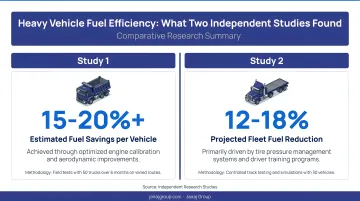
These figures translate directly to construction and earthmoving fleets — including the tippers, graders, and excavators common across Indian infrastructure projects — where fuel represents one of the largest operating costs per machine-hour.
KPIs directly affected:
- Fuel cost per operating hour
- Payload capacity per trip
- Transport cost between sites
- Total fleet operating cost across the year
For equipment OEMs, the effect is amplified in machines with large surface areas of sheet metal bodywork — cab structures, engine enclosures, and external panels — where conversion to lightweight polymer generates the most significant mass reduction per square metre.
Durability and Corrosion Resistance in Harsh Environments
Construction and earth-moving equipment operates in conditions that degrade metal reliably and fast: moisture, hydraulic fluids, soil chemistry, UV exposure, road brine, and mechanical impact.
Caterpillar explicitly identifies manure, fertilizer, and street brine as causes of premature rust damage on equipment interiors and exteriors. Volvo CE has documented how pitted cylinder rods from corrosion damage seals, leading to oil leaks and unplanned downtime. Both conditions are routine across construction, agricultural, and municipal equipment fleets.
Engineering-grade plastics (Nylon/PA, ABS, HDPE, UHMW-PE) do not rust. They resist chemical attack, maintain dimensional stability under UV exposure, and hold structural integrity across the temperature swings typical of outdoor equipment.
BASF's PA66-GF30 (Ultramid A3EG6), for example, carries a dry tensile modulus of 10,000 MPa and maintains Charpy impact resistance of 70 kJ/m² at -30°C — performance that holds up through the cold-weather operating conditions common in northern Indian construction seasons.
Plastic cab panels, fluid reservoir covers, and protective housings remain functional after years of outdoor exposure where equivalent metal components would require anti-corrosion coating, periodic inspection, and eventual replacement. UHMW-PE dump body liners — used by manufacturers like MCAM and Röchling — protect original truck beds from abrasion and impact while allowing viscous materials to release cleanly.
KPIs directly affected:
- Equipment uptime percentage
- Unplanned maintenance incidents per year
- Component replacement frequency
- Mean time between failures (MTBF)
Cost Efficiency Across the Component Lifecycle
The cost advantage of plastic components doesn't sit in material price alone. It spans the full component lifecycle:
| Cost Stage | Plastic Advantage |
|---|---|
| Manufacturing | Complex geometries via injection or roto molding — no expensive machining |
| Part count | Multiple features integrated into one molded part, reducing assembly steps |
| Freight | Lower component weight reduces logistics cost across supply chains |
| Maintenance | No rust treatment, fewer inspections, longer replacement intervals |
| Service life | Corrosion and chemical resistance extends usable component life |
BASF's metal-to-plastic conversion program identifies the primary drivers as cost reduction, weight reduction, part consolidation, and ease of assembly — all of which apply directly to OEM production at volume.
Precision injection molding and rotational molding allow functional features — mounting points, sealing surfaces, cable routing channels — to be built into a single component. Where a fabricated metal assembly might require five separate parts plus hardware, a molded plastic part achieves the same outcome in one.
For high-volume OEM production runs, this per-part saving compounds across thousands of units per model year. For equipment with high-wear exterior components (cab panels, mudguards, fenders), the reduction in replacement frequency and associated labor directly improves service economics.
What Happens When Plastic Component Selection Is Ignored or Done Poorly
Sticking with metal by default — or specifying low-grade plastic without engineering rigor — has predictable consequences:
- Overweight equipment drives up fuel consumption across the fleet — a direct, recurring cost that compounds at scale
- Metal in chemical or moisture-exposed positions corrodes unpredictably, causing unplanned downtime on job sites where equipment availability is directly tied to project schedule
- Under-specified plastic (wrong polymer grade, insufficient impact resistance) cracks or deforms under operating loads — creating safety risks and warranty claims for OEMs
- Higher maintenance frequency and accelerated part replacement cycles erode whatever cost advantage the material choice was supposed to deliver
- OEMs lose bids to competitors whose equipment is lighter, longer-lasting, and easier to service — a gap that widens each product cycle
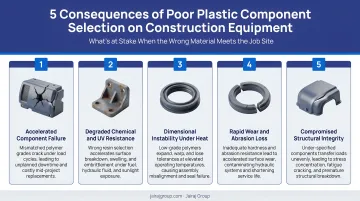
The damage often doesn't show up as a single failure. It shows up in maintenance logs — rising service intervals, shortened part life, and fleet availability numbers that quietly erode project margins over months.
How to Get the Most Value from Plastic Components in Construction Equipment
Value from plastic components comes from three consistent practices.
1. Select the right polymer for the specific application environment
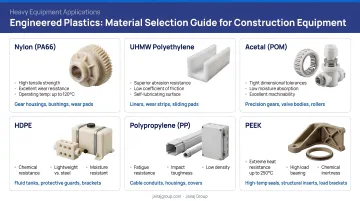
No single polymer performs best across all conditions. The right choice depends on the operating environment:
- ABS — structural panels, housings, cab interior fittings
- HDPE / Cross-linked PE — fluid-contact parts, impact-resistant covers, oil reservoirs
- Polypropylene (PP) — chemical-resistant components, ducting, covers
- Nylon / PA66-GF (glass-filled) — load-bearing parts, moving components, high-temperature applications
- UHMW-PE — dump body liners, conveyor surfaces, high-abrasion applications
- Polycarbonate — operator windows, transparent guards, UV-stable panels
2. Maintain engineering rigor in part design
Wall thickness, tolerances, integration of mounting and sealing features, and gate placement all affect whether a molded part performs as intended or fails early. Design-for-plastic is a different discipline from design-for-metal — and it matters.
3. Engage the component manufacturer early
The best outcomes come from collaboration at the design stage, not from substituting plastic for metal after drawings are finalized. Early engagement allows for material selection validation, process simulation (flow analysis, cooling optimization, warpage prediction), and prototype tooling before production commitment.
Jairaj Group is an example of that early-engagement model in practice. With 40 years manufacturing polymer components for heavy equipment OEMs and ISO 9001:2015 certification, Jairaj works alongside earth mover and heavy vehicle manufacturers from design through production — covering DFM analysis, material selection, process simulation, and full testing documentation. Their in-house tool room and Research, Development & Value Engineering Centers are structured specifically to operate before production tooling is committed.
Conclusion
The real value of plastic components in construction equipment compounds across three outcomes: reduced operating weight that cuts fuel cost, corrosion and chemical resistance that protects uptime, and lower total cost of ownership when material and process are engineered to application requirements.
The gains build over time. A well-specified polymer part resists environmental degradation that metal cannot, carries lower maintenance burden across service intervals, and reduces total fleet cost with each operating hour logged — not just in the first season.
Treat plastic components as an engineered specification decision. The gap between a well-engineered polymer part and an under-specified one shows up in service life, warranty claims, and fleet operating cost — and it shows up predictably, across fleets and applications.
Manufacturers like Jairaj Group, with four decades of polymer engineering experience across heavy equipment and industrial applications, approach each component specification as a functional problem — matching material properties, process method, and operating environment before a single part is produced.
Frequently Asked Questions
What are the plastic parts of construction equipment?
Common plastic components on construction equipment include cab panels, engine hood covers, hydraulic fluid reservoirs, operator protection screens, instrument panel housings, ducting, mudguards, fenders, dust covers, pedal shrouds, rebar chairs, and dump body liners. Both injection-molded and rotationally molded parts are used depending on component geometry and load requirements.
Which plastic materials are most commonly used in construction equipment?
Material selection depends on the application's load, chemical exposure, and environment. Common choices include:
- ABS — structural panels and housings
- HDPE / Cross-linked PE — fluid-contact and impact-resistant parts
- Polypropylene (PP) — chemical-resistant components and ducting
- Nylon/PA66-GF — moving or load-bearing parts
- UHMW-PE — high-abrasion liner applications
- Polycarbonate — operator windows and protective guards
How do plastic components reduce maintenance costs in heavy equipment?
Plastic components do not corrode, eliminating the need for anti-rust coatings and corrosion inspections. Many engineering plastics also resist chemical attack from hydraulic fluids and soil chemistry, reducing degradation-related replacement cycles — resulting in lower inspection frequency and fewer unplanned part replacements.
Can plastic components replace metal in load-bearing applications on construction equipment?
Engineering-grade plastics such as reinforced nylon (PA66-GF), UHMW-PE, and glass-filled polymers are used in select structural roles, but each application requires engineering analysis of the specific load profile. The clearest advantages come in non-primary-load applications — covers, panels, fluid systems, and housings — where weight savings and corrosion resistance matter most.
How does switching to plastic components affect fuel efficiency in construction machinery?
Based on heavy-duty vehicle research, a 10% reduction in vehicle weight reduces fuel consumption by approximately 1.7% to 4% depending on vehicle type and drive cycle. The effect is amplified in equipment with large metal enclosures — cab structures, engine covers, external panels — where conversion to engineered plastic generates the greatest mass reduction per component.
What should you look for when choosing a manufacturer for plastic components for construction equipment?
Prioritize manufacturers that can demonstrate:
- ISO 9001:2015 certification for quality systems
- Proven experience with engineering-grade polymers (ABS, HDPE, PA, UHMW-PE)
- In-house tooling capability for custom geometries
- Full testing and documentation support (dimensional, impact, chemical, environmental)
- A track record supplying OEMs in heavy equipment or adjacent industries