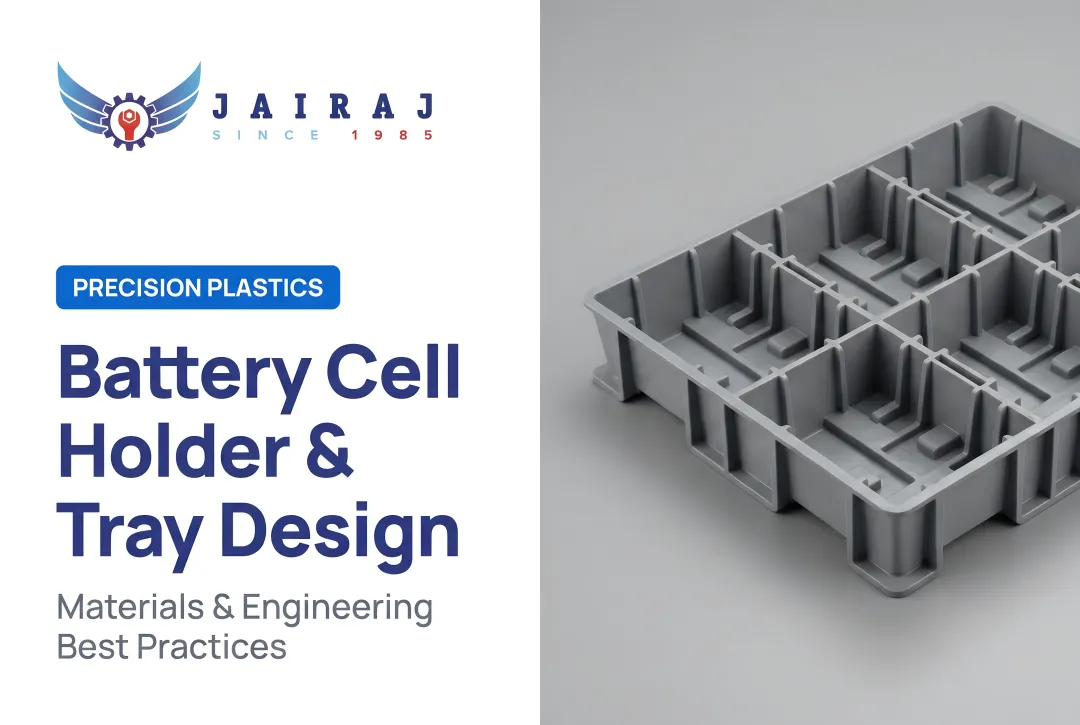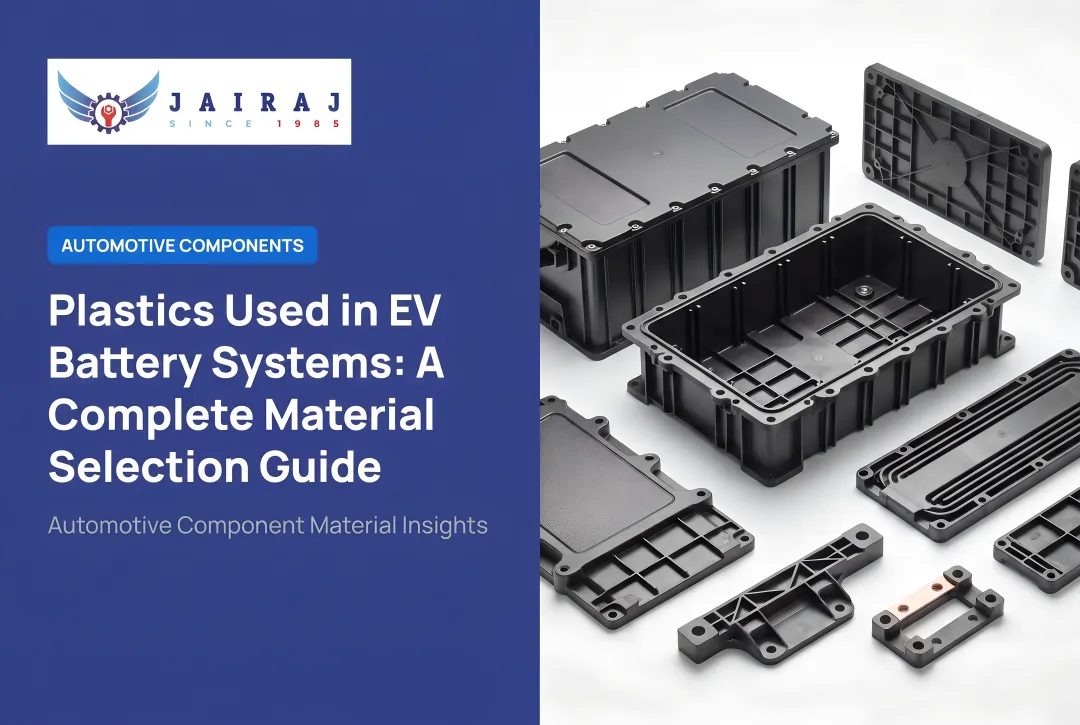

Cell holders and module tray plastics are routinely treated as commodity hardware — specified late, sourced cheaply, and reconsidered only after a quality problem surfaces. That's a costly mistake. These components determine how cells are positioned, electrically isolated, and thermally managed throughout the pack's operating life. Get them right and the rest of the assembly process becomes more predictable. Get them wrong and the problems compound quickly: alignment drift, insulation failures, rejection spikes at end-of-line testing.
This article covers what these components actually do, why precision engineering matters at the polymer and tooling level, and what the consequences look like when quality is compromised.
Key Takeaways
- Cell holders and module tray plastics are active structural, electrical, and thermal components in every battery pack
- Polymer selection (PA66-GF, PBT, PPS) determines heat resistance, dielectric performance, and flame retardancy
- Precision molding to tight tolerances prevents alignment drift, reduces defect rates, and protects busbar contact quality
- Poor-quality holders increase total cost through rework, field failures, and certification risk, often outweighing procurement savings
- Co-developing with a manufacturer that has in-house tooling and DFM capability prevents costly late-stage redesigns
What Are Cell Holder and Module Tray Plastic Components?
These two component types serve distinct but interdependent functions in a battery pack assembly.
Cell holders are precision-moulded plastic structures that cradle individual battery cells (cylindrical 18650/21700, prismatic, or pouch format) within a module. Their job is to maintain fixed cell positioning and consistent inter-cell spacing across years of thermal cycling, vibration, and mechanical load.
Module tray plastics are the larger structural frames that organise groups of cells (retained by individual holders) into complete modules. They interface with busbars, cooling plates, wiring harnesses, and BMS components, functioning as an integration scaffold rather than a simple container.
Neither component is passive. Both directly influence:
- How cells are electrically isolated from one another
- How heat transfers to or from the thermal management system
- How the module responds to the vibration profiles of automotive environments
- How quickly and consistently the module can be assembled at volume
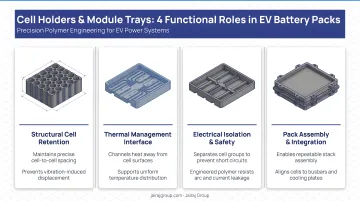
Each of those four factors has a direct material and geometric solution — which is why cell holder and module tray design decisions belong in the engineering conversation, not the procurement one.
Key Advantages of Precision-Engineered Cell Holders and Module Trays
The advantages below apply specifically to precision-manufactured components designed to specification — not off-the-shelf generic parts. Each maps directly to measurable outcomes in pack performance, assembly yield, and safety.
Accurate Cell Alignment and Structural Integrity Under Stress
Cell holders enforce consistent inter-cell spacing across the entire module. That spacing matters for two reasons: it prevents cell-to-cell contact that could cause short circuits, and it ensures uniform current distribution across busbars. When spacing drifts, current paths become uneven, localised heating increases, and pack capacity consistency degrades.
Precision injection moulding to tolerances typically in the range of ±0.05–0.1mm keeps cells locked in position through vibration, shock, and thermal expansion cycles. Research published in the International Journal of Energy Research confirms that geometrical manufacturing tolerances in cell positioning have measurable influence on battery pack performance — dimensional inconsistency is a documented source of pack-level degradation, not a theoretical concern.
The practical impact on production:
- Fewer rework cycles at module assembly
- Lower rejection rates at end-of-line electrical testing
- Reduced warranty claims tied to capacity inconsistency or premature cell degradation
This advantage becomes most critical at high cell counts. In large-format EV packs running 100+ cells per module, cumulative tolerance stack-up from individual holder inaccuracies compounds across the module length. High-vibration applications (two-wheelers, commercial EVs, off-road platforms) add additional mechanical stress that accelerates misalignment in poorly toleranced holders.
KPIs impacted: Assembly yield rate, end-of-line defect rate, pack capacity uniformity, warranty return rate
Electrical Isolation, Flame Retardancy, and Thermal Compatibility
The polymer choice for a cell holder is an engineering decision with direct safety consequences. High-performance grades used in EV battery applications (PA66 with glass fibre reinforcement, PBT, and PPS) provide the dielectric strength needed to isolate adjacent cells operating at high voltages.
These materials also meet UL94 V-0 flame retardancy ratings required for battery enclosures, meaning they resist ignition and self-extinguish rather than contributing to fire propagation.
Material selection also governs thermal compatibility. Holders and trays that interface with aluminium cooling plates or liquid cooling channels must maintain dimensional stability under sustained heat. Polymers that creep or warp under thermal load create gaps at cooling interfaces, reducing heat transfer efficiency and increasing cell operating temperatures over time.
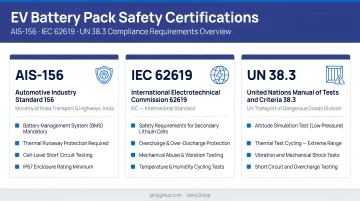
Electrical isolation failure within a cell holder creates a direct pathway to thermal runaway, one of the most severe failure modes in lithium-ion packs. There is also a regulatory dimension: EV battery packs sold in India must comply with AIS-156, and international markets require certifications including IEC 62619 and UN 38.3. Material-compliant plastic components are a prerequisite for passing these certifications.
Key situations where this advantage matters most:
- High-voltage packs (above 400V)
- Fast-charging applications where cells operate at elevated temperatures
- Markets with mandatory EV safety certification requirements
KPIs impacted: Pack safety certification pass rate, insulation resistance test results, thermal event frequency, field failure rate
Assembly Efficiency and Integration Compatibility
Well-designed module tray plastics do more than hold cells in place. They function as integration scaffolds : engineered to accept cell inserts, retain busbars, guide wiring harnesses, and interface with the module lid. Multiple assembly steps complete in a single fixture without repositioning the module.
Standardised tray geometry with snap-fit or interference-fit features reduces dependence on adhesives and mechanical fasteners. That reduction in consumables shortens cycle time per module and lowers the skill requirement for line operators. Research from Fraunhofer FFB on battery production ramp-up highlights that standardised component interfaces and process repeatability are among the primary levers for reducing per-unit manufacturing costs as production scales.
In practical terms:
- Fewer fasteners and adhesive steps = shorter cycle time per module
- Repeatable fit = lower operator skill dependency and fewer fit-up errors
- Single-fixture assembly = less handling, less damage risk
At production rates above 5,000 packs per month, even a 10–15 second reduction per module translates to meaningful throughput gains across a shift. The gains are greatest during scale-up from prototype to mass production, when process repeatability and auditability directly determine whether a line can hit target yield.
KPIs impacted: Modules assembled per shift, assembly labour cost per pack, adhesive and fastener usage, line changeover time
What Happens When Cell Holder Quality Is Compromised
The failure patterns from low-tolerance or incorrect-material holders follow a predictable sequence:
- Cell drift during operation causes busbar misalignment and increased contact resistance at the busbar-to-terminal interface
- Inadequate dielectric properties create leakage current paths between adjacent cells
- Polymer creep under thermal load leads to gradual structural loosening of the module over thousands of charge cycles
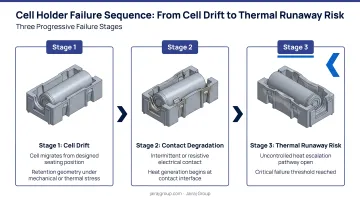
Each of these failure modes carries direct business consequences:
- Higher rejection rates at pack-level electrical and safety testing
- Increased risk of field failures and thermal events
- Costly rework from module disassembly — often exceeding the original component savings several times over
- Difficulty achieving or re-passing EV safety certifications when field data surfaces failures
Low-cost cell holders may appear attractive at procurement — until the first batch of end-of-line rejects, the first warranty return, or the first certification failure. At that point, a ₹5–10 saving per component can generate rework and liability costs that run into lakhs. The sourcing price gap rarely reflects the true exposure.
How to Get the Most Value from These Components
The highest return from these components comes from decisions made early — during design, before tooling is committed. Co-development between the pack engineer and the plastic component manufacturer at that stage costs little; catching the same problems after steel is cut costs significantly more.
Practical steps for maximising component value:
- Define temperature range, dielectric strength, flame retardancy rating, and dimensional tolerances before the RFQ stage — not just material names
- Confirm the supplier has in-house tooling capability; own tool rooms allow rapid geometry iteration without third-party delays when cell formats evolve or fit-up issues emerge
- Require dimensional audit reports, material traceability certificates, and dielectric and thermal test results as standard deliverables, not optional add-ons
- Maintain the same dimensional and material standards from first article approval through full production volume — process control continuity is not automatic
Jairaj Group works to this approach across its EV-grade plastic component programmes. DFM reviews cover flow analysis, warpage prediction, and rapid prototyping through 3D printing and prototype tooling — so geometry issues are resolved before production tooling is cut.
In-house tool room capabilities mean that when a cell format changes or an assembly interface needs adjustment, the tooling response is not gated on a third-party vendor's schedule.
The material portfolio for battery and electrical applications includes PA66-GF, PBT, PC, and PEEK — covering the dielectric strength, temperature resistance, and flame retardancy requirements these components demand.
All components are manufactured under ISO 9001:2015 standards, with testing covering dimensional verification, electrical insulation, flame retardancy, and temperature cycling as part of the standard quality output.
Conclusion
Cell holders and module tray plastic components are not interchangeable with generic structural parts. They define the dimensional accuracy, electrical isolation, and thermal behavior of a battery module — and their quality determines whether that module assembles consistently, passes certification, and holds up over its operating life.
Precision-engineered, properly specified plastic components deliver returns across the full pack lifecycle:
- Lower defect rates at assembly
- Fewer field failures and warranty claims
- Reduced certification risk
- Lower total warranty exposure
The margin available from cutting corners on these components is narrow. A single field failure, rework cycle, or failed certification run costs more than the savings ever will.
Frequently Asked Questions
What material are battery holders made of?
Consumer battery holders typically use polypropylene or standard nylon. EV and industrial applications require high-performance grades (PA66 with glass fibre, PBT, or PPS) chosen for their dielectric strength, temperature resistance, and flame retardancy compliance — UL94 V-0 or better.
What are the components of a battery pack?
A battery pack includes individual cells, cell holders, module trays, busbars, a Battery Management System (BMS), thermal management elements (cooling plates or channels), and an outer enclosure. Cell holders and module trays handle structural positioning, electrical isolation, and integration between these elements.
What is the difference between a cell holder and a module tray?
A cell holder positions and isolates individual cells within a module. A module tray is the larger structural frame that organises a group of cells (retained by individual holders) into a complete module assembly that interfaces with busbars, cooling systems, and BMS components.
Why does dimensional tolerance matter in cell holder manufacturing?
Tight tolerances ensure every cell sits in the same position across the module. When tolerances are loose, cells drift, busbar contact resistance varies, and capacity uniformity degrades. In modules with 100+ cells, small per-holder errors accumulate into significant pack-level performance variation.
Can cell holders be customised for different battery cell formats?
Yes. Cell holders are custom-designed for specific formats: 18650, 21700, prismatic, and pouch. Standard off-the-shelf holders rarely fit correctly, which is why in-house toolroom capability is critical for developing and iterating tooling efficiently as cell formats evolve.
How do plastic cell holders contribute to battery pack safety?
Plastic cell holders provide electrical isolation between adjacent cells, prevent physical contact that could cause short circuits, and — when manufactured from flame-retardant polymers — act as a passive barrier that slows thermal event propagation within the module.