The pattern is consistent: procurement teams treat TPMS sub-components as commodity buys, approve the lowest-cost sources without full automotive qualification, and only discover the gaps at vehicle homologation or — worse — in the field.
This guide covers what procurement and supply chain teams need to know: the anatomy of a direct TPMS system for sourcing purposes, the quality standards that separate reliable suppliers from risky ones, a supplier evaluation framework, and the specific pitfalls that derail TPMS component supply most often.
Key Takeaways
- Direct TPMS holds ~62–63% of global market share and drives the majority of OEM component procurement complexity
- TPMS sub-components — sensor ICs, valve stems, RF modules, polymer housings, and mounting hardware — each carry independent failure risk
- IATF 16949 with full Core Tools (PPAP, FMEA, SPC) is the real standard — ISO 9001:2015 is the floor, not the target
- Polymer sensor housings are routinely under-specified in TPMS BoMs — and account for a disproportionate share of field failures
- Single-source qualification for any critical TPMS sub-component is an avoidable supply risk — always maintain a vetted backup
What Is TPMS and Why It Demands OEM Sourcing Discipline
System Types and Why Direct TPMS Dominates
TPMS is an electronic system that continuously monitors real-time tire air pressure and alerts the driver when pressure drops to an unsafe level. Two architectures exist:
- Direct TPMS — a hardware pressure sensor mounted in each wheel transmits pressure data via RF to a central receiver
- Indirect TPMS — software interprets wheel-speed signals from existing ABS sensors to infer pressure loss, without dedicated wheel hardware
Most OEM mandates are technology-neutral in specification, but the market has moved decisively toward direct TPMS. According to Grand View Research, direct TPMS held 61.7% of global market segment revenue in 2023, with the overall TPMS market valued at USD 8.24 billion. Mordor Intelligence puts direct TPMS at 63.11% of 2025 sales, with the market forecast to reach USD 15.04 billion by 2031 at an 8.02% CAGR.
For OEM procurement teams, direct TPMS is the working case — and it drives a multi-component hardware sourcing requirement with real supplier management complexity.
Regulatory Mandates by Market
| Market | Regulation | Scope |
|---|---|---|
| United States | FMVSS No. 138 (TREAD Act) | ≤10,000 lb GVWR light vehicles; 100% compliance from September 1, 2007 |
| European Union | Regulation (EC) No. 661/2009 | M1 passenger vehicles; new type approvals blocked from Nov. 2012, sale prohibited from Nov. 2014 |
| China | GB 26149-2017 | Mandatory passenger car performance standard; effective January 2018 |
| South Korea | Vehicle Safety Standards Article 12-2 | Passenger cars and vehicles ≤3.5t |
| India | AIS-154 | M1 ≤3,500 kg and N1 vehicles when equipped — not a universal mandate |
The US and EU requirements are mature and non-negotiable. China and South Korea have verified mandatory standards. India is an if-equipped type approval standard, not a universal fitment requirement — an important distinction for global program planning.
Why Procurement Teams Must Own This
Direct TPMS sourcing carries consequences that extend well beyond the engineering team:
- Fixed schedules: Regulatory deadlines are immovable — component delays ripple directly into production launch dates
- Recall exposure: Component-level failures can trigger vehicle-wide recalls, with cost and reputational consequences that procurement decisions directly influence
- Certification dependency: Each sub-component affects system-level certification and vehicle homologation (type approval), meaning a single supplier's quality gap can block an entire program
Procurement and supply chain teams need to understand these requirements before sourcing begins — not after a supplier is locked in.
Key TPMS Sub-Components OEMs Must Source
Pressure Sensor ICs and Electronics
The pressure sensor IC is the performance baseline for the entire assembly. Current automotive-grade sensors — such as NXP's NTM88Hxx5S — integrate an MCU, pressure sensor, and dual-axis accelerometer in a single package, covering a compensated pressure range of 90 to 930 kPa across an operating temperature of −40°C to +125°C, with RF carriers at 315 MHz or 434 MHz.
When specifying sensor ICs, OEM sourcing teams must require:
- AEC-Q100 qualification (automotive-grade electronics reliability standard)
- Documented pressure accuracy and drift specifications
- Per-market RF certification (FCC for US, ETSI/CE for EU, regional approvals for APAC)
- Datasheet confirmation of the sensing principle (piezoresistive vs. capacitive) — generic "TPMS spec" claims are insufficient
Valve Stem Assemblies
Two valve stem types are used in direct TPMS: rubber snap-in and metal clamp-in. Both mount the sensor to the wheel and serve as the pressure interface.
Key sourcing specifications:
- Rubber snap-in stems: TPMS-grade rubber compound with dimensional precision for consistent seal engagement
- Metal clamp-in stems: Aluminium or brass, requiring nickel-plated valve cores to prevent galvanic corrosion at the dissimilar-metal interface — a documented failure mode that can destroy the sensor entirely
Corrosion resistance and dimensional precision are not optional on these parts. Specify them explicitly.
RF Transmitter Modules and ECU Connectors
RF transmitter modules relay pressure data to the vehicle's central control unit. Two sourcing considerations apply here that are frequently conflated:
- Environmental sealing: Connector housings and seal materials must withstand under-wheel conditions — water, mud, brake dust, and continuous thermal cycling
- Regional RF compliance: A sensor IC that passes pressure validation still requires market-specific radio certification before it can be fitted to vehicles sold in that region — these are separate qualification gates
Polymer Sensor Enclosures and Housings
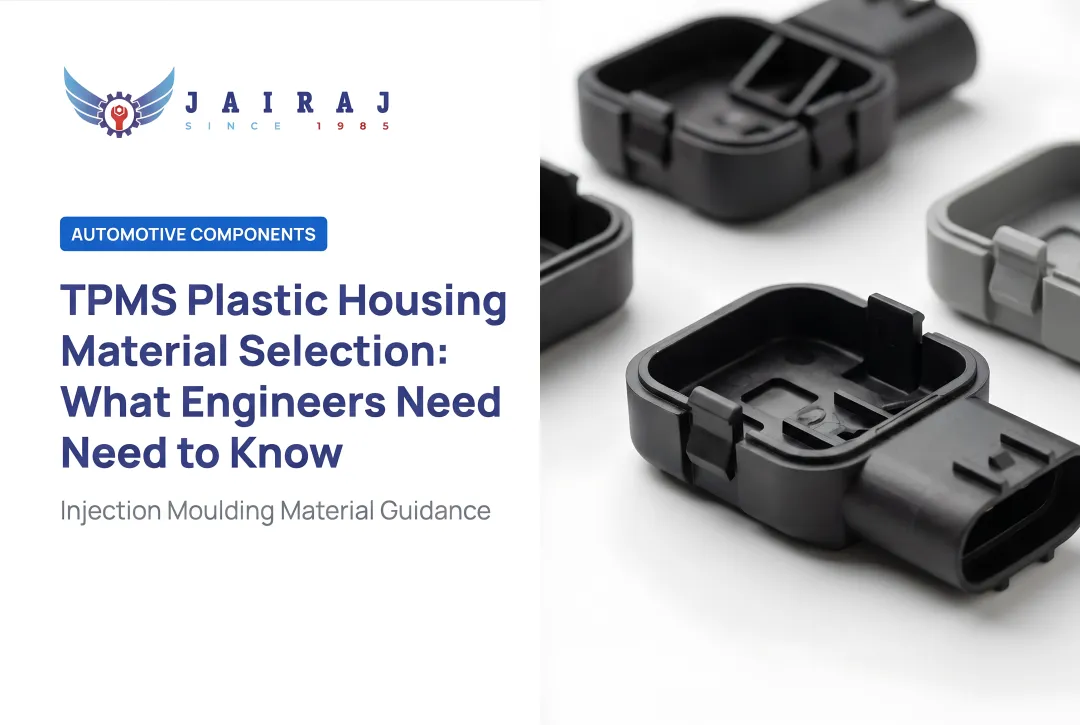
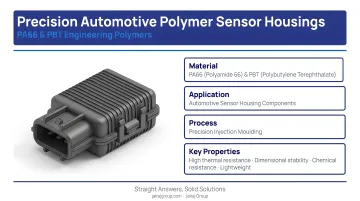
The sensor module housing is a precision injection-molded component — typically PA66, PBT, or glass-filled nylon — that protects sensitive electronics against vibration, thermal cycling, and chemical exposure while maintaining tight dimensional tolerances for sealed fit.
This is the most underweighted decision in most TPMS BoMs. The housing is not a commodity plastic part: it must maintain dimensional stability and seal integrity across the same −40°C to +125°C range the sensor IC operates in, while resisting brake fluid, road salts, and continuous vibration.
Sourcing from a specialist precision polymer manufacturer matters here. Jairaj Group, for example, produces precision automotive polymer components using PA66-GF, PBT, PC, and POM under ISO 9001:2015 quality systems, with in-house tool room capabilities and PLC-controlled production lines — the combination of material expertise and process control that sealed sensor housings demand.
Mounting Brackets, Clips, and Secondary Structural Components
Sensor mounting brackets, snap-fit clips, and wire harness retention parts appear simple — and that perception is the problem. Because they are high-volume, low-unit-cost parts, they are frequently sourced from non-automotive-grade molders to reduce spend. Failures in these components cause sensor displacement and false pressure readings, making that cost saving a liability.
The requirements are non-negotiable:
- Automotive-grade polymer (PP, PA6, PA66, or ABS as specified)
- Consistent wall thickness and dimensional accuracy across high-volume production runs
- Vibration-resistant retention force validated against the mounting interface
Quality Standards Every TPMS Component Supplier Must Hold
The Qualification Hierarchy
| Standard | What It Covers | OEM Sourcing Implication |
|---|---|---|
| ISO 9001:2015 | Documented processes, traceability, corrective action | Minimum baseline — not a differentiator |
| IATF 16949:2016 | Automotive-specific QMS: APQP, FMEA, MSA, SPC | Effective gate for direct TPMS component suppliers |
| AIAG Core Tools | PPAP, FMEA, MSA, SPC, APQP/Control Plan | Required evidence alongside IATF certification |
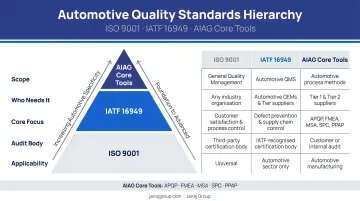
ISO 9001:2015 establishes the documentation baseline. IATF 16949 builds on it with automotive-production-specific requirements: process FMEA, measurement system analysis, and statistical process control. Major global OEMs — including Ford, whose 2024 Customer-Specific Requirements mandate IATF 16949 third-party registration for Q1 status — require ongoing Ppk >1.33 for critical characteristics. Indian OEM programs from Tata Motors and Maruti Suzuki enforce comparable CSR frameworks.
Jairaj Group holds ISO 9001:2015 certification across its automotive manufacturing operations and maintains full PPAP documentation capability — including dimensional reports, material certificates, FMEA reports, control plans, and process capability studies. This documentation structure aligns with what IATF-registered OEM supply chains require at the component level.
Environmental and Performance Testing
OEMs should require test reports, not just certificates. The evidence package for any TPMS component supplier should include:
- Temperature cycling: −40°C to +125°C, per ISO 16750-4:2023 (climatic loads for road vehicle electronics)
- Vibration and shock testing: To automotive profiles per OEM DVP&R or ISO 16750 series
- Ingress protection: Applicable IP rating for sealed housings — confirm OEM-specific requirements, as no single universal benchmark applies
- Salt-spray corrosion testing: For metal valve stems, connectors, and polymer components with metal inserts
Material Compliance Documentation
For polymer housings and brackets, "plastic part" is not a sufficient material description. OEMs must require:
- Polymer grade and filler content (e.g., PA66-GF30, not just "glass-filled nylon")
- RoHS and REACH compliance declarations by destination market
- IMDS submissions — the International Material Data System is used by virtually all global OEMs for material data collection and archiving
- Documentation of any mold-release agents, as residues can affect adhesion and seal integrity
Incorrect polymer specification is a documented root cause of sensor housing cracking and seal degradation during service.
PPAP Requirements
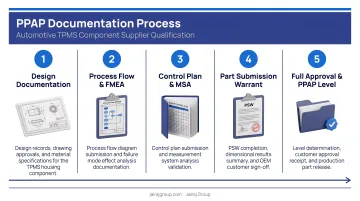
PPAP documentation is a sourcing gate — require it before series production approval, not after:
- Dimensional reports against the engineering drawing
- Material certifications for all specified polymers and metals
- Process capability studies (Ppk targets per OEM customer-specific requirements)
- First-article inspection sign-off
- Control plan and FMEA cross-reference
How to Evaluate and Vet a TPMS Component Supplier
Manufacturing Capability Assessment
Key questions when auditing a prospective TPMS component supplier:
- Do they have a dedicated in-house tool room? Suppliers without tool room capability depend on external toolmakers for mold maintenance — adding lead time and creating tolerance drift risk
- Are production lines PLC-controlled with documented process parameters? Ask specifically how process drift is detected and what the corrective action trigger is
- What multi-cavity tooling experience do they have? High-volume TPMS secondary components typically require multi-cavity molds with consistent cavity-to-cavity dimensional performance
Automotive OEM Track Record
Request reference customers and audit results before qualification. Third-party validation from existing OEM customers is more reliable than self-reported quality claims.
Look for awards that map to specific performance dimensions, not just generic commendations. Jairaj Group's recognition history demonstrates this distinction: an "A-rated Supplier" appreciation award from Gabriel India Limited reflects delivery, quality, and responsiveness; a "Best Supplier Award for Fastest & First Time Right Developments" from Endurance Technologies reflects development speed; and "Strategic Business Partner" recognition from Tenneco Automotive reflects collaborative depth. Each award speaks to a different capability — which is what meaningful track record evidence actually looks like.
Supply Chain Resilience
Single-facility suppliers create single-point failure risk for production-critical TPMS sub-components. Evaluate:
- Number and geographic distribution of production sites
- Whether multiple facilities can produce the same components (not just theoretically, but with qualified tooling in place)
- Raw material sourcing practices and safety stock policies
- Production interruption notification commitments — Ford's CSR requires 24-hour notification of any interruption affecting specified capacity
Jairaj Group's six production facilities across Manesar, Faridabad (two sites), Rudrapur, Aurangabad (two plants), and Sanand provide the multi-location capacity model that supply continuity planning requires.
Total Cost of Ownership Framework
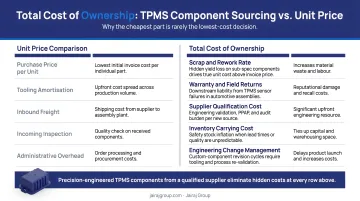
Unit price is one input. The actual TCO comparison should include:
- Tooling investment and amortisation terms
- Qualification timeline — a cheaper supplier that takes six months longer to qualify can miss a production launch entirely
- Scrap and rework rates, assessed from process capability data rather than quoted estimates
- Warranty claim exposure — field failures in sealed sensor components cost orders of magnitude more than any unit-price saving
- Supplier change cost — mid-production source switches require re-qualification, production holds, and potential homologation re-submission
Common Sourcing Pitfalls That Derail TPMS Component Supply
Polymer housings treated as commodity buys. Incorrect polymer grades, poor mold maintenance, and inconsistent wall thickness cause seal failures and sensor displacement. Specify material and process requirements explicitly — not just part geometry.
Single-source dependency with no qualified backup. Qualifying only one approved source for any TPMS sub-component creates a shutdown risk the moment that supplier faces a facility disruption, raw material shortage, or quality hold. Qualify at least one alternate source during normal production — not after a problem occurs.
Treating compliance as a launch-stage retrofit. A global TPMS program requires more than one sensor variant, and the regulatory differences run deeper than frequency bands. Key variables that differ by market include:
- RF frequency approvals (315 MHz for North America, ~434 MHz for most other markets)
- IMDS submission requirements and restricted substance lists
- Sensor reporting thresholds by region
Confirm that component suppliers can support multi-region compliance documentation from the design stage — not as a last-minute correction at launch.
Frequently Asked Questions
What is TPMS in automotive?
TPMS (Tire Pressure Monitoring System) is an electronic system fitted in vehicles to continuously monitor air pressure in each tire and alert the driver when pressure drops to an unsafe level. It helps prevent accidents, poor fuel economy, and premature tire wear caused by under-inflation.
What are the components of a TPMS system?
A direct TPMS system includes a pressure sensor and microcontroller in each wheel, an RF transmitter, a valve stem assembly, a central ECU or receiver module, and the driver warning display. Each sensor module sits inside a precision-molded polymer enclosure designed to survive harsh wheel-end conditions.
Do you need OEM TPMS?
TPMS is legally mandated for new passenger vehicles in the US, EU, China, and South Korea, so OEM fitment is a compliance requirement in those markets. India currently operates under an if-equipped type approval standard rather than a universal mandate — OEMs sourcing for the Indian market should verify applicable AIS regulations before finalizing program scope.
What quality standards should TPMS component suppliers meet?
ISO 9001:2015 is the minimum baseline. IATF 16949:2016 is the effective standard for automotive-grade suppliers, and OEMs should additionally require PPAP documentation, environmental test reports (temperature cycling, vibration, ingress protection), and full material traceability for all polymer and metal components.
What is the difference between direct and indirect TPMS for OEM sourcing?
Direct TPMS requires physical hardware sensors in each wheel, creating a multi-component sourcing requirement covering pressure sensor ICs, polymer housings, valve stems, and RF modules. Indirect TPMS uses existing ABS wheel-speed sensors and software, meaning fewer physical components to procure but greater dependency on software validation and calibration.
How do plastic and polymer components affect TPMS performance?
Polymer sensor housings must maintain dimensional integrity and seal performance across −40°C to +125°C temperature cycling, continuous vibration, and chemical exposure. Incorrect material grades or poor mold quality lead to housing cracks, seal failures, and sensor loss — so selecting a qualified precision polymer manufacturer is a primary sourcing decision, not an afterthought.