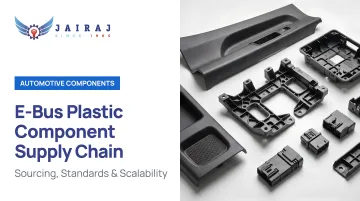
Plastic components sit at the heart of that challenge. They appear across nearly every major system in an e-bus: battery housings, electrical enclosures, HVAC ducting, interior trim, and exterior protection. Yet many procurement teams still source these parts from fragmented multi-vendor networks, creating quality inconsistency, lead time exposure, and scalability risk precisely when fleet contracts demand the opposite.
This article breaks down what plastic components make up a modern e-bus, how the supply chain is structured, what compliance requirements apply, and what it actually takes to scale supply for large municipal fleet orders.
Key Takeaways
- E-buses require plastic components across six systems: battery enclosures, body and trim, electrical housings, HVAC, exterior protection, and safety structures
- Engineering-grade polymers — not commodity plastics — are required for high-stress, high-heat, and electrically sensitive applications
- Three-tier supply chains are the norm; multi-capability Tier-2 suppliers cut vendor complexity and qualification risk
- Non-negotiable compliance includes ISO 9001:2015, IATF 16949, AIS-052/AIS-153/AIS-038, and UL94 flame ratings
- Fleet-scale supply requires in-house tooling, multi-facility capacity, and demand planning tied to tender timelines
What Plastic Components Make Up an Electric Bus?
Switching to an electric powertrain introduces thermal, electrical, and structural demands that conventional bus components were never designed to handle. Understanding where plastic appears — and why material selection matters for each application — is the starting point for any serious e-bus supply chain conversation.
Battery Enclosures and Thermal Management Housings
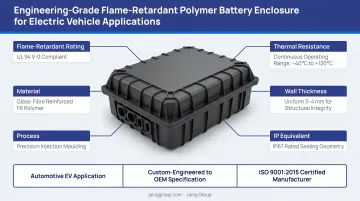
Battery enclosures are among the most demanding plastic applications on the vehicle. These components sit adjacent to high-voltage packs operating under continuous thermal load, requiring materials with flame retardancy, heat deflection performance, and dimensional stability under cycling temperatures.
CESL tender specifications require battery packs to maintain cell temperatures between 5°C and 45°C with IP67 protection — which means enclosure materials must also resist coolant fluid exposure over long service lives. Polymer benchmarks from EV applications point to 30% glass-fibre reinforced flame-retardant PP, PPA for high-voltage connector housings, and PPS grades with CTI ratings up to 600V for power electronics components.
Structural Body Panels and Interior Trim
Interior-facing components — seat surrounds, overhead consoles, door liners, pillar trims, dashboard panels — must balance dimensional stability, surface quality, and UV resistance. Common material choices include ABS, PC/ABS blends, and glass-filled PP. CESL tender requirements mandate that all bus body building materials used inside the bus meet fire retardancy standards per IS:15061:2002.
Jairaj Group manufactures this category across multiple vehicle platforms, producing dashboard panels in ABS/PC blend, door trims in lightweight PP, and console side panels across ABS, PC/ABS, and PP grades — all under IATF 16949 quality systems.
Electrical System Components
Connector housings, relay covers, busbar insulators, and cable management channels require high dielectric performance and precise dimensional control. BASF's PPA-based HV connector material achieves UL94 V-0 at 0.25mm wall thickness and a heat distortion temperature of 265°C — benchmarks that illustrate the performance tier required near EV powertrains.
Wiring insulation in CESL-tendered e-buses must comply with IS:2465-1984 using copper conductors meeting IS/ISO:6722:2006, which sets a precedent for how electrical system compliance cascades down to component level.
HVAC and Cooling System Components
E-bus HVAC components — fan shrouds, duct sections, coolant reservoir tanks, valve bodies — face thermal cycling, coolant chemical exposure, and pressure fluctuation over a 10+ year service life.
PM E-DRIVE's Phased Manufacturing Programme includes domestic assembly requirements for HVAC/VAC systems covering blowers, electric compressors, chiller units, and control panels — making this an active localisation priority. Jairaj Group produces HVAC ducting and coolant reservoirs using ABS, PP, PC, and TPU, with components validated for temperature resistance from -40°C to 120°C and chemical resistance to automotive fluids.
Exterior and Safety-Related Components
Front and rear bumpers, wheel arch liners, and mirror housings are increasingly replacing metal equivalents across commercial vehicles — driven by weight reduction and corrosion resistance requirements. Jairaj Group manufactures these components with OEM-compliant surface finishes across the following applications:
- Front bumpers — PP, ABS, and impact-resistant polymer grades
- Wheel arch liners — UV-stabilised PP and HDPE
- Mirror housings — ABS/PC blends for dimensional stability and impact resistance
Why Plastics Are the Preferred Material for E-Bus Design
Plastics earn their place in e-bus design by solving three engineering problems that electric powertrains create: weight accumulation, high-voltage safety, and manufacturing complexity at fleet scale.
Weight and Range
Every kilogram added to a battery-electric vehicle has a compounding effect on range. CESL tender specifications cap energy consumption at 1.1 kWh/km and require a minimum certified range of 250km — making weight management a hard design constraint. Replacing metal brackets, covers, and housings with engineering-grade plastics across dozens of components creates cumulative weight reductions that directly affect range performance.
Electrical and Thermal Insulation
Engineering polymers are inherently non-conductive, which makes them safer than metals in high-voltage environments. PPS and PPA grades used in EV connector and housing applications deliver:
- Tracking resistance up to 600V CTI — exceeding what metals can achieve without added insulation
- Long-term thermal stability above 175°C — suitable for sustained high-voltage operating environments
BASF's testing on PPA connector materials confirms another advantage: when polymers handle the housing and insulation role, electro-corrosion of metal contacts drops significantly. Addressing this at the design stage costs far less than correcting it after field deployment.
Manufacturing Efficiency at Fleet Volumes
Injection moulding allows complex geometries, integrated fastening features, and multi-function part consolidation in a single tool cycle. For components ordered in the thousands across a municipal fleet programme, this matters. A single injection-moulded connector housing can replace multiple fabricated metal parts, reducing assembly time and part count simultaneously.
How the E-Bus Plastic Component Supply Chain Is Structured
The Three-Tier Model
Understanding where procurement decisions are made is essential for supplier positioning:
- Tier-0 (OEMs): Tata Motors EV, Olectra, JBM Auto — responsible for type approval, tender compliance, and fleet delivery. Tata Motors won a 921 e-bus order from BMTC and reported orders for over 3,600 electric buses within a single month in 2022
- Tier-1 (Sub-assembly integrators): Battery pack assemblers, HVAC system suppliers, power electronics integrators — they specify component requirements and qualify Tier-2 suppliers
- Tier-2 (Component manufacturers): Precision plastic part manufacturers who supply individual housings, panels, covers, and structural elements to Tier-1 customers
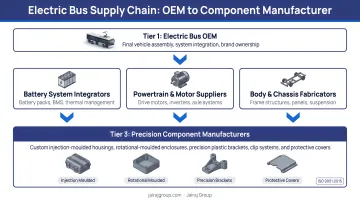
Jairaj Group operates at this Tier-2 level, supplying precision plastic components to Tier-1 customers including Endurance Technologies, Gabriel India Limited, and Tenneco Automotive across automotive and heavy vehicle programmes.
Resin Selection and the Risk of Substitution
Engineering-grade resins — nylon (PA66-GF), polycarbonate, ABS, PEEK, glass-filled PP — are selected through a matching process that maps each component's thermal, mechanical, and chemical environment to specific polymer grades. The substitution risk from unqualified suppliers is real: a visually identical part moulded from a lower-grade resin can fail flame, dielectric, or dimensional requirements with no visible sign during incoming inspection.
Suppliers with documented resin approval processes and material traceability — from resin lot to finished part — directly close this gap.
Process Selection Logic
Not all e-bus plastic components use the same manufacturing process:
| Component Type | Preferred Process |
|---|---|
| Connector housings, relay covers | Injection moulding |
| Coolant reservoirs, fluid tanks | Blow moulding |
| Large body panels, canopies | Rotational moulding |
| Duct sections, interior liners | Injection or extrusion moulding |
Suppliers operating multiple processes in-house reduce the OEM's vendor count and simplify qualification across a full component portfolio. Jairaj Group operates injection moulding, blow moulding, rotational moulding, and extrusion across its facility network.
Batch-Spike Demand and Lead Time Risk
Municipal e-bus tenders generate batch procurement spikes, not steady-state demand. CESL's 2024 tender required prototype approval within 4 weeks of Letter of Award, with delivery milestones of 30%, 60%, and 100% of buses within 6, 10, and 14 weeks after contract execution.
For plastic component suppliers, this leaves two options:
- Carry strategic buffer stock on long-lead parts (capital cost)
- Accept extended lead time risk that can delay the entire programme
Blanket order frameworks with rolling call-off structures absorb this volatility far more effectively than spot-procurement-dependent approaches.
Domestic Sourcing and Make in India
PLI Auto requires a minimum 50% domestic value addition, and PM E-DRIVE's PMP specifies domestic assembly requirements for HVAC and traction battery systems. This creates a direct incentive to shift away from import-dependent, single-source supply. Multi-facility domestic manufacturers reduce both regulatory risk and supply disruption exposure for critical plastic components.
Quality Standards and Compliance in E-Bus Component Sourcing
ISO 9001:2015 — The Baseline
ISO 9001:2015 is the minimum qualification threshold for any plastic supplier entering the e-bus supply chain. In practice, this means documented process control at every manufacturing stage, resin lot traceability from incoming material through to finished part, and a structured corrective action system for non-conformances.
Jairaj Group holds ISO 9001:2015 certification across its manufacturing operations, with quality systems covering dimensional verification, material properties testing, and full traceability documentation for automotive OEM customers.
IATF 16949 — The Automotive Grade Requirement
Most Tier-1 automotive customers require IATF 16949 certification, which builds on ISO 9001 with automotive-specific requirements for:
- PPAP (Production Part Approval Process): Validates that the supplier's manufacturing process can consistently produce parts meeting engineering specifications before volume production begins
- FMEA and Control Plans: Documents failure modes and in-process controls for each component
- First Article Inspection (FAI): Provides dimensional and material evidence on the first production parts
Suppliers pursuing IATF 16949 qualification need robust process documentation infrastructure — PPAP packages, FMEA reports, and control plans — ready before OEM qualification audits begin. Jairaj Group's ISO 9001:2015-certified quality systems provide the process control foundation that supports these documentation requirements.
India-Specific Compliance: AIS Standards
CESL tender requirements set the compliance stack for Indian e-bus programmes:
- AIS-052 + AIS-153: Bus body design and construction approval
- AIS-038 Rev-02: Battery-operated vehicle construction and functional safety
- AIS-049: Electric propulsion standards
- IS:15061:2002: Fire retardancy for interior bus body materials
- CMVR: Central Motor Vehicles Rules type approval
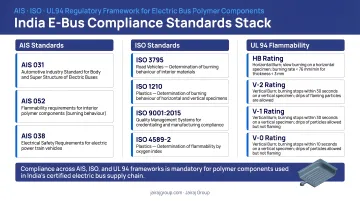
Suppliers targeting e-bus programmes need to understand which AIS standards apply to their specific component category and ensure their material and process documentation supports OEM type approval submissions.
UL94 Flame Retardancy — Non-Negotiable Near Battery Systems
UL94 classifies plastic materials by their resistance to burning and flame spread — the benchmark used across automotive and electrical applications globally:
- V-0: Individual burning time ≤ 10 seconds, total ≤ 50 seconds for 10 flame applications, no flaming drips
- V-1: Individual burning time ≤ 30 seconds, no flaming drips
- V-2: Same burn times as V-1, but flaming drips permitted
For battery-adjacent components and electrical housings in e-bus applications, UL94 V-0 is the required minimum. Components that don't meet this rating are not compliant with Indian tender specifications referencing IS:15061:2002 and related fire safety requirements.
Meeting these compliance thresholds is table stakes — the harder challenge is finding suppliers who can document conformance consistently across production volumes, not just on qualification samples.
Scaling Plastic Component Supply for Growing E-Bus Fleets
In-House Tooling: The Critical Differentiator
High-quality injection moulds represent significant capital investment. Suppliers that outsource tooling to third parties add lead time, cost, and communication risk into every engineering change cycle. When an OEM requests a design revision mid-programme, an in-house tool room can respond in days; a supplier managing tooling at an external vendor may need weeks.
Jairaj Group operates in-house tool rooms across its manufacturing facilities, with capabilities covering multi-cavity moulds, insert moulding tools, and two-shot moulding tooling. This enables faster response to engineering changes and volume ramp-ups without adding intermediaries.
That tooling agility matters most when procurement is unpredictable — which it always is in tender-driven e-bus programmes.
Demand Planning for Tender-Driven Procurement
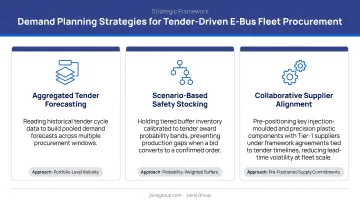
E-bus fleet programmes don't follow predictable monthly call-off patterns. The following strategies work in this environment:
- Strategic stocking on long-lead components: Identify parts with 8+ week mould cycle or resin procurement lead times and maintain buffer inventory ahead of expected tender awards
- Blanket order agreements: Establish annual volume commitments with rolling quarterly call-offs, allowing production scheduling to begin before formal purchase orders are issued
- Tender timeline alignment: Map production planning to CESL and state tender award calendars rather than reacting after contracts are signed
Jairaj Group's Multi-Facility Model for E-Bus Scale
The geographic distribution of manufacturing capacity matters for fleet-scale programmes. Single-facility suppliers create geographic concentration risk: a logistics disruption, labour stoppage, or capacity constraint at one plant can halt supply to an OEM with zero alternative.
Jairaj Group's manufacturing network spans facilities in Faridabad (Haryana), Rudrapur (Uttarakhand), Aurangabad (Maharashtra), Sanand (Gujarat), and IMT Manesar (Gurugram), covering northern, western, and central India.
For e-bus OEMs and Tier-1 partners managing large municipal fleet orders, this multi-plant model means production can run in parallel across regions — reducing geographic concentration risk and supporting localisation requirements under PLI and PM E-DRIVE frameworks.
The group expanded into EV-focused polymer components in 2023, drawing on four decades of automotive OEM supply experience. Its quality infrastructure includes ISO 9001:2015 certification, PPAP documentation capability, and in-house testing across dimensional, thermal, chemical resistance, and flame retardancy parameters.
Frequently Asked Questions
What are the components of an electric bus?
An electric bus comprises an electric drivetrain, traction battery pack, motor controller, onboard charger, power electronics, HVAC system, and passenger interior structure. Plastic components appear across nearly all of these systems — from battery housings and connector covers to interior trim and HVAC ducting.
What is the supply chain of electric vehicles?
The EV supply chain operates in three tiers: OEMs at the top, Tier-1 suppliers providing battery packs and HVAC modules, and Tier-2/3 component manufacturers supplying precision parts — with raw material and resin suppliers beneath them. For e-buses, demand aggregators like CESL coordinate large batch procurement across this chain.
What materials are used for electric bus body panels?
Common materials include glass-fibre reinforced plastic (GFRP), ABS, PC/ABS blends, and structural foam composites. Selection is based on strength-to-weight ratio, UV stability, impact resistance, and compliance with Indian fire retardancy standards under IS:15061:2002.
What quality certifications should e-bus plastic component suppliers have?
The minimum baseline is ISO 9001:2015. Automotive-grade supply requires IATF 16949 certification. At part level, UL94 V-0 flame retardancy is required for battery-adjacent components, and AIS-052/AIS-153/AIS-038 compliance is necessary for Indian market type approval.
How do e-bus plastic component requirements differ from conventional buses?
Key differences include stricter UL94 V-0 flame retardancy near battery systems, dielectric performance requirements for HV electrical housings, and IP67 sealing for battery enclosures. Engineering-grade polymers — PPA, PPS, glass-filled PA66 — are required throughout, replacing the commodity-grade materials typical in conventional bus components.
How can plastic component suppliers scale for large municipal e-bus fleet orders?
Effective scaling requires in-house tooling capacity for fast engineering change response, multi-facility manufacturing to distribute geographic risk, and strategic buffer stocking on long-lead components. Blanket order agreements allow production planning to begin ahead of formal call-offs, aligned to tender award timelines.