The consequences show up in predictable ways: bloated BOM costs that erode margins, substitution bids rejected because the process to validate an alternative is undefined, and lost contracts to competitors using equivalent-performing but lower-cost materials. None of this is inevitable.
Plastic material costs become expensive primarily because of how specifications are written at the design stage, how rarely those specifications are revisited, and how few manufacturers have a structured process for evaluating alternatives. This article walks through how those costs accumulate, what actually drives them, and how to reduce them through a deliberate substitution approach.
Key Takeaways
- Material over-specification, single-source supplier dependency, and absent substitution processes drive most avoidable resin costs
- Many parts continue using higher-grade or legacy materials long after functional requirements have been re-evaluated
- Effective substitution starts with a requirement-first review, not a price-first swap
- Three strategic levers drive savings: better upfront material decisions, tighter substitution management, and structural sourcing changes
- Successful programs align design, procurement, and manufacturing to cut costs without compromising part performance
How Material Costs Build Up in Plastic Manufacturing
Material-related costs rarely appear as a single identifiable problem. They accumulate gradually: through repeated use of over-specified grades, legacy approvals that no one questions, and small per-unit inefficiencies that compound across high-volume production runs.
What makes this especially difficult to catch is that these costs are usually invisible until something triggers scrutiny: a margin review, a supplier price increase, or a competitor quoting equivalent parts at a noticeably lower price. In routine operations, the cost just sits there, baked into every unit produced.
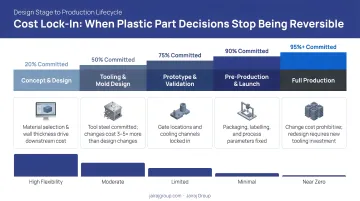
The root of the problem is almost always early in the product lifecycle. Research from the Design Society found that **70% to 80% of product cost is typically committed by the end of conceptual design**. For plastic components, this means the material grade selected during design — and then approved for qualification — tends to lock in a cost structure that persists for years.
The problem compounds in regulated industries. In regulated automotive programs, material qualification can take 5 to 7 months, with full development to fleet introduction spanning 3 to 5 years. Material decisions can be frozen after just a few days near final decision points. Once an approval is locked, re-opening it requires time, documentation, and cross-functional effort — so most teams simply don't.
That qualification inertia has a direct downstream consequence. The result: specifications written for a prototype or a worst-case operating scenario get carried into production unchanged, even when the actual production environment is less demanding than originally assumed.
Key Cost Drivers for Plastic Material Substitution
Understanding where cost originates is a prerequisite to reducing it. Five drivers account for the majority of avoidable material cost in plastic manufacturing.
Over-Specification
The most common driver. A polymer grade is selected for its heat resistance, impact strength, or UV stability — properties that exceed what the part's actual operating conditions demand. That performance premium gets built into every unit produced, for the life of the programme.
Parts using PEEK or PA66-GF in applications where POM or standard nylon would meet verified requirements are a straightforward example. The grade wasn't wrong at specification; it just was never re-evaluated as production requirements became clearer.
Single-Source Supplier Concentration
When one resin supplier holds the qualification for a material, manufacturers lose negotiating leverage entirely. Any price increase passes straight through. Automotive OEMs recognise this — the CAR Group's material qualification research notes that OEMs generally avoid single-source materials precisely because supply chain failure can halt production.
Re-qualifying an alternative supplier requires effort, so few teams do it proactively. Sustained price exposure is the predictable outcome — one that dual-source approval directly addresses.
Precedent-Driven Grade Selection
Engineers often default to previously approved materials because qualification risk feels higher than the cost of staying with the existing grade. This isn't irrational — real time pressure and approval friction make caution rational. The consequence is that specifications accumulate inertia, regardless of whether the original performance rationale still holds.
Processing and Approval Costs
Two additional drivers consistently catch substitution projects off-guard:
- Tooling and processing compatibility: A material that appears cheaper per kilogram can produce a higher total part cost if it requires mould modifications or extended cycle times. Unit price comparisons often look favourable; total economics frequently don't.
- Regulatory and OEM approval burden: In automotive, aerospace, and medical segments, the substitution cost is rarely the new material itself. PPAP submissions, customer notification requirements, and updated qualification records all consume engineering time before the first part ships.
Cost-Reduction Strategies for Plastic Material Substitution
Effective substitution strategy isn't one-size-fits-all. Savings come from three distinct levers: improving the decisions made before or at specification, improving how the substitution process itself is managed, and addressing the structural sourcing context around material decisions.
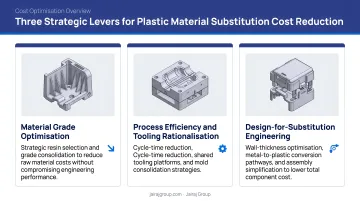
Strategies That Change Decisions
These approaches target the highest-value opportunity — shifting what specifications say and how grades get approved.
Re-evaluate specifications against current performance requirements. Audit existing parts by mapping each approved grade's properties against the actual mechanical, thermal, and chemical demands of its operating environment. Where margins are excessive, open a substitution evaluation. A part specified for a prototype environment that's been in production for five years under different conditions is a straightforward starting point.
Use a requirement-first material selection process. Define minimum functional requirements first, then identify the lowest-cost polymer grade that satisfies them. Useful tools include:
- Material property databases and polymer selection software
- ASTM D4000's classification system for specifying plastics by family, group, class, and grade
These structure the selection process objectively rather than leaving it to precedent.
Write specifications in terms of performance properties, not named grades. Where tolerances allow, this preserves the option to substitute later without triggering a full re-approval cycle. A specification that requires a minimum flexural modulus rather than a named grade stays open to multiple qualified candidates.
Engage polymer component manufacturers early. Suppliers who combine polymer engineering know-how with in-house toolroom capabilities can validate material candidates faster and flag processing compatibility issues before they become costly. Jairaj Group, operating across automotive, industrial, and aerospace applications since 1985, supports this through dedicated R&D and Value Engineering Centres focused on material research, selection, and validation across diverse polymer grades.
Strategies That Change How Substitution Is Managed
Poor substitution management is its own cost driver. Undefined processes stall evaluations or produce quality escapes that cost more than the original savings would have generated.
Establish a formal material change management protocol. Document the substitution workflow from candidate identification through prototype testing, qualification runs, and approval sign-off. Without a defined process, substitution attempts either stall or introduce risk.
Run structured process validation before switching. When changing grades, conduct parameter trials — injection pressure, melt temperature, cooling time — to determine whether tooling or cycle adjustments are needed. Capturing this data upfront prevents production disruptions after the switch. Manufacturers like Jairaj Group support this through in-house process simulation capabilities including flow analysis, cooling optimisation, and warpage prediction.
Track total cost of substitution, not just material unit price. A complete substitution evaluation accounts for:
- Retooling costs
- Qualification testing costs
- Supply chain transition costs
- Scrap generated during changeover
- Engineering time for documentation and approval
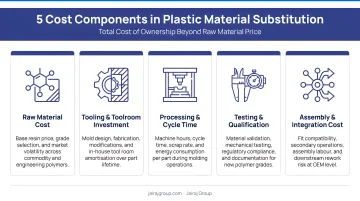
Only substitutions where net lifecycle savings exceed transition cost should be executed.
Strategies That Change the Sourcing Context
The structural environment around a material decision — supplier relationships, grade portfolios, approval timing — is often a larger cost driver than the material unit price itself.
Consolidate grades across parts and product families. Where multiple parts use slightly different grades of the same polymer family for similar functions, standardising on fewer grades increases purchase volume per grade, improves supplier leverage, and reduces inventory complexity. Done carefully, this delivers real unit cost reductions without functional compromise.
Qualify two or more resin suppliers for the same grade. Multi-sourcing introduces competitive tension and reduces supply disruption risk. It requires upfront qualification investment but pays back quickly at volume — and eliminates the single-source price exposure described above.
Align substitution proposals with OEM cost-down cycles. In automotive, scheduled value engineering rounds create a structured window for substitution proposals. Positioning a material substitution as a supplier-side value engineering contribution — rather than a unilateral change request — increases approval speed and customer buy-in.
Jairaj Group's work with customers including Endurance Technologies, Gabriel India Limited, and Tenneco Automotive demonstrates how well-timed, well-documented substitution proposals move faster and land more cleanly within these cycles.
Conclusion
Plastic material substitution generates lasting savings only when it begins with an honest assessment of where cost actually originates. Over-specification, legacy approval inertia, and structural sourcing constraints each drive cost in different ways — and each requires a different response. Treating this as a procurement exercise alone misses most of the opportunity.
The most durable substitution programmes combine systematic specification reviews, rigorous transition validation, and supplier partnerships with genuine polymer depth. The immediate objective is cost reduction. The longer-term objective is building material selection discipline — so that as parts age, programmes evolve, and specifications drift, avoidable costs don't quietly re-accumulate.
Frequently Asked Questions
What is material substitution in plastic manufacturing?
Material substitution in plastic manufacturing refers to the deliberate replacement of one plastic grade or material with another that meets the same functional requirements at lower cost, improved processability, or better lifecycle performance. The process covers specification re-evaluation, supplier qualification, and validation through prototype and production trials.
How do you ensure part performance is not compromised during material substitution?
Performance is protected by mapping the substitute material's properties against verified functional requirements. This means running controlled prototype trials and testing against the same criteria used for the original material. Substitution should only proceed when the new material meets or exceeds minimum required specifications — not just the price target.
Which material is cheaper than plastic?
Very few materials offer a lower cost-to-performance ratio than plastics for most industrial applications. Within the plastics family, commodity grades like PP, HDPE, and ABS are generally less expensive than engineering grades like nylon, polycarbonate, or PEEK. Substituting down the grade ladder — where specs allow — is one of the most effective cost reduction moves available.
What is an environmentally friendly alternative to plastic?
Bio-based polymers, recycled-content resins, and natural fibre composites have emerged as more sustainable alternatives, though adoption in precision industrial manufacturing remains limited. In precision industrial manufacturing, however, the most practical sustainable move is often switching to recycled-content grades of the same polymer family rather than to a fundamentally different material — given that bioplastics currently represent just 0.5% of global plastics production.
What is the alternative to plastic packaging?
Paper, glass, metal, and bio-based materials are commonly cited alternatives. From a manufacturing cost standpoint, these alternatives typically require significantly more material by weight to perform the same function, making them more expensive in most industrial and product packaging contexts — even before accounting for tooling, process changes, and supply chain adjustments.